At 8:30 a. m. on April 29, 2008, a hospital worker in Goldsboro, North Carolina, entered a dayroom carrying a breakfast tray and found a man sitting alone on a chair. The man, 50 years old, had been in that chair since 10 p.
m. the previous evening. The worker patted his shoulder twice. The man did not respond.
The worker turned and left, taking the tray with him. State security cameras recorded the next 13 hours. Investigators later reviewed the footage frame by frame. Over the course of that time, the tape shows staff in the ward watching television, playing cards, talking on their phones, and at one point dancing.
The man in the chair was not offered food. No one took him to the bathroom. At 8:59 p. m.
, he was finally moved to his bedroom. Six minutes later, the emergency team was called. He had remained in the chair for 22 hours and 34 minutes across four full shifts. By the end of that night, he was dead.
His name was Stephen Howard Sabock, and the place was Cherry Hospital, the state psychiatric hospital in Goldsboro. His death cost the hospital its federal certification. It is the only case in this record where events were captured on camera. For everything else, there were only documents, and the documents are the story.
This is the story of a 17-year-old boy registered in 1925 under number 8229, a name that stayed on the hospital rolls for 76 years. He was never tried. He was never diagnosed as insane by a doctor who could speak to him, because his only disability was deafness. It is the story of a surgery performed on him in 1932 in the name of a science this state believed in until 1974.
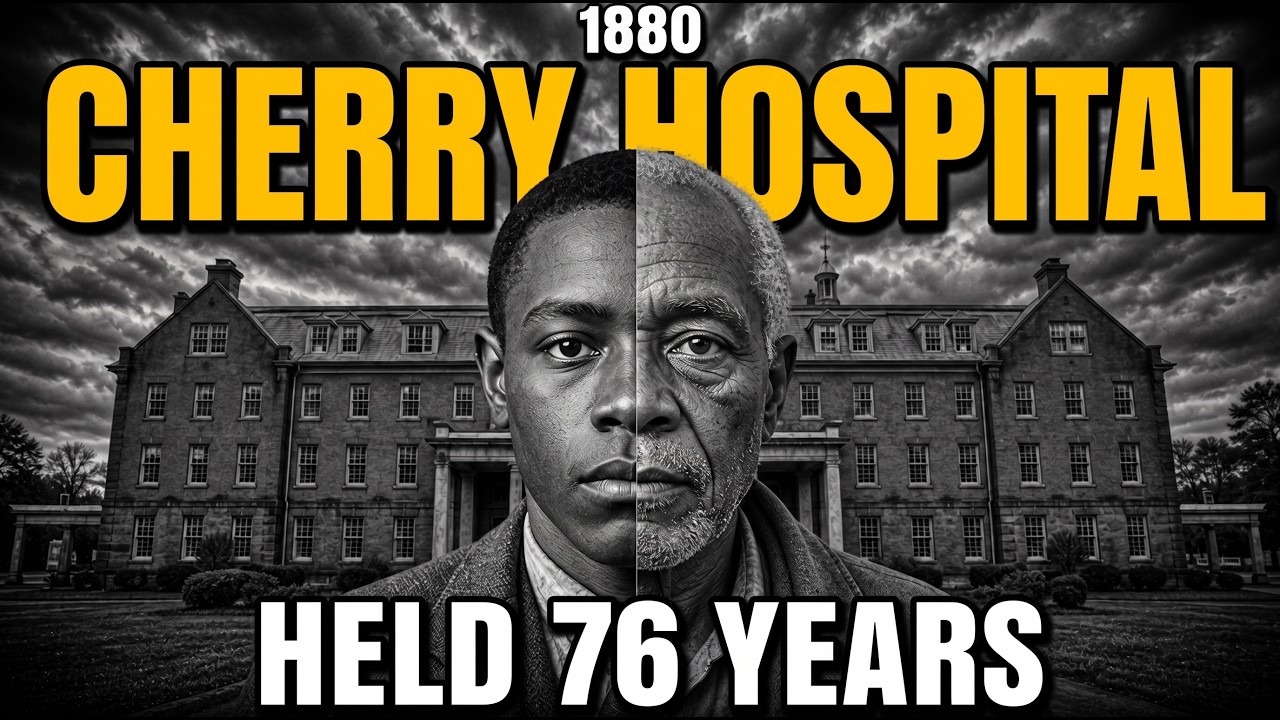
It is the story of a farm where patients picked cotton for the hospital that owned them, and of two cemeteries holding the remains of more than 3,800 people, most of the graves unmarked. The state built Cherry Hospital in 1880 as a promise that Black citizens with mental illness deserved a hospital, not a jail cell. Before 1880, a Black person in North Carolina suffering from mental illness had three options: remain at home if the family could manage, be placed in a county poorhouse that was not a hospital, or be jailed, which was the fate of many mentally ill people in the 19th century. The state’s first mental asylum, which Dorothea Dix had pushed the legislature to build in Raleigh, was reserved for white patients.
That was the rule. In 1877, the North Carolina General Assembly appointed a commission to find a site for a new institution to serve the state’s Black mentally ill. Twelve years after the end of slavery, a Southern legislature voted to spend public money on a hospital for Black people. On April 11, 1878, the state purchased 171 acres two miles west of Goldsboro in Wayne County.
The first year’s appropriation was $16,000. On August 1, 1880, the first patient was admitted to what the state called in its letters the “Asylum for the Colored Insane. ” The promise was treatment. A person with mental distress would be moved from jail or the poorhouse and given a bed, a doctor, food, a farm to work, and a chance to recover.
In the first six months, the asylum reported that about a third of its patients had recovered and gone home. The building held 76 beds. By Christmas 1880, more than 100 people lived there. The very first number in the hospital’s history was already too large.
In November 1883, the superintendent, a physician named J. D. Roberts, published a paper in the North Carolina Medical Journal titled “Insanity in the Colored Race. ” Census numbers were in front of him.
In 1860, the federal census recorded 766 Black people classified as insane nationwide. By 1880, the number had reached 6,157. For Roberts, this increase was a medical fact needing a medical explanation, and the explanation he gave was freedom. He listed civilization, education, religious excitement, intemperance, and poverty as causes.
He wrote that insanity among the lower classes came from poverty, ignorance, and prejudice. Roberts was not a movie villain. He was a working physician running an overcrowded, under-resourced asylum. But the logic mattered.
The state built this hospital because the number of Black people classified as insane had multiplied eightfold in 20 years. The doctor in charge believed the number was rising because slavery had ended. So the asylum was built on two ideas at once: Black patients deserved care, and emancipation made them sick, requiring more and more beds. In the early decades, the asylum looked like what it claimed to be: a main building on a rise, wings on either side, fields all around.
The farm was the heart of treatment. In the 1880s, almost every American asylum believed outdoor work was medicine. The 1884 superintendent’s report lists what patients produced: 80 barrels of corn, 6,000 pounds of fodder, 50 bushels of peas, 3,000 pounds of oats, and 37 hogs for slaughter, estimated at about 4,000 pounds. The hospital fed itself, and the patients did the feeding.
In that same year, the asylum bought a battery. In the 1880s, doctors believed electricity had healing power, and applying a mild current to the body was treatment, not punishment. The word “electricity” will return later in the story with a very different meaning. The hospital was formally incorporated on March 5, 1881, as the Eastern North Carolina Asylum for the Insane.
Over the years it changed names repeatedly: Eastern Hospital, State Hospital at Goldsboro, and finally, in 1959, Cherry Hospital, after a governor. Each name change was a rephrasing of the same meaning in more polite words. For 85 years, this campus was the only place in North Carolina where a Black person with mental illness could be sent, from all 100 counties, to one hospital two miles west of Goldsboro. For a family in the mountains 300 miles away, there was one door, and behind it the beds were full from the first Christmas.
The daily routine was a bell, a count, a meal, the fields, another meal, a ward, another count, then darkness. Those able to work worked. Those who were not were confined. Historians at East Carolina University who reviewed the early records describe chronic overcrowding, chronic understaffing, and frequent escapes.
The fields were open, the fences low, and a man could sometimes set down his hoe, head toward the road, and keep walking. The hospital added a separate building for tuberculosis patients because the disease moved from bed to bed in the crowded ward. In 1924, it opened a third building, this one for people the state called the criminally insane, surrounded by barbed wire. A year after it opened, a deaf boy from the coast would be locked inside it.
In its first 100 years, the hospital admitted 91,045 patients. The number is honest about scale. The hospital counted every one of them. The record does not tell you whether anyone ever looked for any of them.
Junius Wilson was born on October 8, 1908, in Castle Hayne, a small farming town north of Wilmington on the North Carolina coast. His father, Sidney, worked in timber. His mother, Mary, was a homemaker. He had an older sister, Asenia, born in 1905, and a younger sister, Carrie, born in 1911, with an infant between them who died.
He was born deaf into a Black farming family in 1910. That meant a child who could not attend the local school, could not hear the sermon, and did not know what the world was saying about him. In January 1916, when he was seven, his family did what a loving family could do. They sent him to Raleigh, to the North Carolina School for the Deaf and Blind and Colored.
Here the story turns in a direction most people have never heard. The school did not teach American Sign Language, and its principal was not fluent in it. So the Black deaf children of North Carolina invented their own language in the dormitories and yards. Historians call it “Raleigh signs.
” It was a real language, with its own rules and jokes, and almost no one outside that community understood a single word of it. Junius stayed at the school for about a decade. In 1924, when he was 15 or 16, he was dismissed after an incident involving the Negro State Fair. Records suggest he remained at the fair against his will, and that was enough.
He returned home to Castle Hayne, to a family that did not speak his language, in a town that never learned it. In 1925, a neighbor named Arthur Smith Jr. accused Junius of attempting to rape his wife, Lizzie Sidbury. Junius was arrested in Castle Hayne while gathering sticks.
He was 17. He was held in the new Hanover County jail for several months. He was never tried. Instead, in November 1925, a court in Wilmington held what was legally called an insanity hearing.
A white jury listened. There was no lawyer for the boy. There was no one in the room who knew sign language. The judge’s order read: “That the mental condition of the defendant renders him dangerous to himself and to others.
”
The criminal charge against him was later dropped. Hospital staff would discover this in 1970, 45 years later. No one told the hospital in 1925. No one ever brought Junius Wilson before a jury to ask what happened.
The record does not show why New Hanover County chose an insanity hearing instead of a trial. A trial would have required evidence, a defense, and an appealable verdict. An insanity hearing required none of that. A teenager had been moved from a county jail to a state institution more than 80 miles away, based on a neighbor’s testimony, without anyone having to prove the accusation.
The procedure did not require proof of a crime. It did not require a medical examination. It required an accusation, a room full of men who could not talk to him, and a judge with a form. A deaf boy gesturing in a language they had never seen looked like a mad boy.
On November 21, 1925, he was admitted to the State Hospital for the Negro Insane in Goldsboro. He was 17. The diagnosis recorded at admission was “constitutional psychopathic inferiority,” a term meaning roughly that the person was born defective and could not be cured. He was given his number.
He was patient number 8229. He was placed in the criminally insane building with the barbed wire, opened the year before. From that day on, in every record the hospital kept, that number was the most reliable thing about him. It never changed.
He never got sick. He never asked to go home. The hospital needed a strong 17-year-old who could not hear. They sent him to the fields.
By the 1920s, the farm that produced 80 barrels of corn in 1884 had grown into a huge operation. The hospital ran part of it as a “farm colony,” a set of housing on about a thousand acres where able-bodied patients who were not considered dangerous lived and worked. After the surgery to be described shortly, Junius was moved there, where he spent more than 30 years without pay. Picking cotton was among the tasks the hospital assigned its patients, along with feeding hogs, harvesting fodder, and hauling water.
The book that reconstructed his life, written by historians Susan Burch and Hannah Joyner, is based on his medical file in the hospital records. For most of those decades, the file is silent, with a number at the top. He existed. He worked.
He was counted. For some patients, working in the fields was the only part of the day with meaning. They could master it. For a deaf man who could not follow conversation, using a hoe and an axe and doing work he understood may have been a mercy.
In 1932, the hospital hired its first occupational therapist, which sounds like progress until you read what the therapy was: farm work, laundry, kitchen work, garden work. The therapy was the labor, and the labor was the therapy, and the hospital got the crop. By 1960, the hospital owned 2,300 cultivated acres. Fruit trees and an apple orchard, vegetables, sugar cane, plus hogs, chickens, turkeys, and cattle.
Every acre was worked by people who could not leave. The patient able to work was worth keeping. Releasing a strong, quiet, obedient farmhand meant hiring someone to replace him. No one had to make that decision openly.
The record made it year after year by simply not being opened. During the 1930s and 1940s, most of the old wooden buildings were replaced. The administration building and the large brick hospital, Woodard, were built in 1939. The campus became like a small town: a laundry, a kitchen, a power plant, a chapel by the early 1950s, and farm workers’ housing in the middle of the fields.
The state was proud of it. By the standards of Southern state hospitals, it had reason to be. It was organized. It was productive.
It was a model on paper. And on paper, Junius Wilson was one of its best workers. His father, Sidney, and his sister Carrie came to visit him on June 5, 1947. It was the last family visit recorded in the file.
They tried to get him released, and the attempt failed. The record gives no reason. He was 38 and had been confined for 22 years. His mother, Mary, later moved to New York City with Carrie and died there in May 1969 without seeing her son again.
After that 1947 visit, according to the file, no one from Castle Hayne ever came back to Goldsboro for him. Now it is necessary to go back nine years, to 1932, because there is something in the file. On January 20, 1932, the hospital superintendent, Dr. W.
C. Linville, castrated Junius Wilson. Junius was 23 and had been in the hospital for six years. He had never been convicted of anything and never would be.
The recorded justification described him as belonging to a family of intellectual disability. It called him insane, mentally defective, a sexual pervert, feeble-minded, a sexual degenerate, syphilitic, deaf, and mute. None of these descriptions came from any conversation with him. There was no conversation.
In 1929, three years before the surgery, North Carolina passed its first law allowing sterilization of people in state institutions whom the state called feeble-minded. The courts struck down the law in 1933, and 49 people were sterilized under it. The state’s response was to pass a better law. In July 1933, it created the North Carolina Eugenics Board, five officials in Raleigh who reviewed petitions and approved operations.
The board operated for 41 years, until 1974. Nearly 7,500 people were sterilized in North Carolina under its oversight. The program peaked in the 1950s, and over the decades it moved increasingly toward poor Black women who had never been in any institution. Cherry Hospital appears in that board’s records as one of the places where the operations happened.
Eugenics was a widespread belief among educated people in the first half of the 20th century: human weakness was hereditary, and the state could improve the population by preventing the weak from reproducing. It was taught in universities and endorsed by the U. S. Supreme Court in 1927.
The file does not make clear whether Junius’s operation was done under the 1929 law or merely under the superintendent’s authority. What the file does make clear is the logic. A deaf man gesturing in a language no one had bothered to learn was described as a hereditary danger, and a surgeon acted on the paperwork. The last item on that list is the most striking: “deaf” and “mute.
” In 1932, the only thing true on the page was placed last. North Carolina took a long time to acknowledge all this openly. In 2002, the Winston-Salem Journal published a series called “Against Their Will,” putting the names and numbers of sterilization victims on the front page. The next year, the General Assembly finally repealed the laws that allowed it.
In 2013, the state passed a law to compensate living victims, and the first checks went out in 2014 to people sterilized as teenagers in the 1950s and 1960s, now elderly. According to one account, Junius Wilson’s case was among the models the state used in determining what compensation was owed. He had died twelve years earlier. Meanwhile, the hospital that performed the procedure was in deep financial crisis.
By the 1950s, the Goldsboro campus had about 3,000 residents, peaking at roughly 3,500 in a campus opened with 76 beds. One hospital history states that until 1956, patients considered unruly were isolated in steel cages six feet by nine feet. This comes from secondary sources, so it is probable rather than proven. What is documented is the rest of the era’s therapeutic toolkit: hydrotherapy, long baths and wet packs meant to calm an agitated patient; and electroconvulsive therapy, a current through the brain to induce a seizure, given in those years without anesthesia or muscle relaxants, used in the crowded wards to maintain order as much as to treat.
Then, in 1955, the tranquilizers arrived. A ward that had been hard to control with 3,000 patients became chemically controllable. At that moment, the hospital stopped needing the cages. And at that moment, it also stopped asking why 3,000 people were there.
Then the law changed. Congress passed the Civil Rights Act in 1964. In 1965, Cherry Hospital was desegregated along with the other North Carolina state hospitals. From that year, the hospital served all residents of 33 eastern counties regardless of race, and Raleigh and other hospitals began admitting Black patients.
After 85 years of the state building one hospital per race, the wall fell on paper. Junius Wilson was 56 that year, and his name had been on the hospital rolls for 40 of them. Desegregation changed the admission criteria, but it changed little for those already inside. In 1970, a treatment team at Cherry Hospital reviewed Junius Wilson’s records and discovered that the criminal charge that had sent him there in 1925 had been dropped.
There was no case against him, and there had not been for a long time. The record does not specify how long. The team tried to reach his family but failed. Then the new mental health laws of that time, requiring court-ordered commitment, produced a small, terrible document.
Instead of releasing him, the hospital changed his status to involuntary commitment. A man held for 45 years on a charge that no longer existed was now formally a patient who could not leave. He was 61. He was deaf.
He had no family answering letters, no language any staff member understood, no address to go to, and a manner of gesturing that the file had described for four decades as a symptom of illness. Where was a 61-year-old Black deaf man in eastern North Carolina in 1970 supposed to go? The hospital asked itself the question and answered it the way it had answered every question since 1880: keep him, count him, then move on. But he was not just a number in that ward, and the file shows it almost accidentally.
The farm colony was closed as a work system by the late 1960s, and Junius was moved to the main campus. He found paid work. He carried water for the workers. He dug fishing worms out of the ground and sold them to staff and anyone with a rod.
In the 1970s and 1980s, he worked at the hospital car wash for $2. 50 an hour. By 1983, he had saved $7,000. He bought a watch and wall clocks.
He bought a television and a comfortable chair for his room. He bought a bicycle, then a second, then a third. He rode them around the grounds, and on special occasions into town. He fed stray dogs.
He fished. The staff knew him and liked him, and they did not understand what he said. In 1981, someone finally understood him. An evaluator named Rachel Wright, fluent in American Sign Language, sat with him.
It was the first real conversation Junius Wilson had had with anyone in authority since November 1925, 56 years earlier. Even then, the conversation was partial, because his language was Raleigh signs, not standard ASL, and half a century in a place where no one used sign language had made his private language truly private. But she realized, and she wrote it down, that this was not a man with psychotic illness. This was a man who was deaf.
The file now contained three documented facts. The charge had been dropped. There was no psychiatric diagnosis justifying his confinement. And he was deaf.
The file kept these three facts for another ten years. In the summer of 1986, he suffered a stroke that weakened his right side, his dominant hand, the hand he used for signing. He was 77. The hospital cared for him during that period, and he recovered enough to walk and remained in the hospital.
In December 1989, Cherry Hospital hired a social worker named Linda Taylor. Part of her job was to review cases of long-term patients and ask a question the hospital was not used to asking: should this person still be here? Junius Wilson was 81. He had been a patient for 64 years.
He was the oldest name in the ward, and, as far as anyone knew, the longest-serving patient in the institution’s history. She read his record, and she did what the record itself demanded. She asked for a guardian. On March 12, 1991, the court appointed John Wasson, assistant director of the New Hanover County Department of Social Services.
Wasson had never met him. He got the file and did what any careful person does with a file. He read it all the way through. What he found, in the words he used to reporters two years later, was that there was no diagnosis of mental illness in the file at all.
He found an insanity hearing from 1925 with no lawyer and no interpreter. He found a criminal charge that had been dropped. He found a surgery from 1932 and the note describing it as therapeutic. He found 66 years of a man’s life.
And he found that the only thing actually proven about Junius Wilson was that he was deaf. In April 1991, Wasson brought in a specialist named Denise Parks, fluent in sign language, for a proper evaluation. Her findings matched Rachel Wright’s from a decade earlier. Then Wasson went to the state demanding an explanation, and his language was not kind.
The state’s mental health director, Terry Stallings, later said it was not just shameful but embarrassing. He said Junius of the gaps, perhaps. The record suggests the gaps were 66 years long and numbered. On October 26, 1992, North Carolina reached a settlement with its patient.
It agreed to train him in sign language, provide interpreters, counseling, and proper medical care. But it refused to let him leave. The hospital director, Fidel Montgomery, joked: “We weren’t just going to throw him out on the street. ” It was true.
The state had taken in a 17-year-old speaking a language, and produced an 84-year-old man who spoke a language no one outside those walls understood, who had never rented a room, crossed a street alone, or bought a meal in a town that did not know him. There was no world to send him to. In June 1993, the story reached the newspapers, then the wire services, then NPR. For several months, Junius Wilson was famous.
Headlines said he was 95 or 96, which was wrong. The hospital’s own admission record says he was 84; the press inherited a wrong birth date along with everything else. Reporters came to Goldsboro and described him: 5 feet 6 inches, stocky, gray hair, wearing work clothes and a baseball cap, with remarkable alertness. Asked through an interpreter about his family, he shrugged, and he signed two documents, one about a place far away and one about a time long ago.
Wasson proposed that instead of leaving him on the street or in a locked ward, the state should provide him a house on the hospital grounds. On February 14, 1994, Junius Wilson moved into a three-bedroom brick ranch house on the hospital grounds at the corner of West Ash Street and Old Smithfield Road, the road running from the hospital toward Goldsboro. The state spent $49,000 renovating it, adding a wheelchair ramp and furnishing it. He was 85.
He had been a patient for 68 years, and now, on the same grounds, he was something else: a man with a front door. His friend James McNeil, another deaf patient, was to share that door. McNeil died in August 1994, six months after the move. A man named Everett Parker, who knew the old Raleigh signs, came regularly to visit and talk with him in the language he had learned as a child.
Staff took him to breakfast at Hardee’s and lunch at the K&W cafeteria. He did puzzles. He watched television. He went shopping.
The lawsuit was filed in November 1994, seeking $150 million from the state for assault and battery and false imprisonment. In January 1997, a judge ruled that the statute of limitations had not expired and set aside the 1992 agreement. In November 1997, the case, Junius Wilson v. State of North Carolina, was settled.
The state paid $226,000. After attorneys took $111,000, Junius received about $114,000. He was 89. That amount was on top of what the state was already spending, about a quarter of a million dollars a year, according to one report, to care for him in his ranch house.
For 72 years, he had been a number in a record. In his last seven years, he was the most expensive patient in Goldsboro. Somewhere between those two numbers lies the entire moral history of this hospital. He died on March 17, 2001, at Wayne Memorial Hospital in Goldsboro of heart and lung failure.
He was 92. On March 23, his funeral was held in the Cherry Hospital chapel, built in the 1950s when Junius was on the farm, and more than one hundred people attended. He was buried in Wayne Memorial Park in town, in the front row beside his friend James McNeil. He was not buried on the hospital grounds.
After his death, his biographer Susan Burch searched for his belongings, and in a shed on the hospital grounds found his last bicycle, a yellow Schwinn with two wire baskets. It is now displayed at the Smithsonian Institution in Washington. In 1994, the year he moved into his house, Dorothea Dix Hospital in Raleigh opened a unit for deaf patients, staffed by people fluent in sign language, so that any other deaf person committed by the state could be spoken to. In 2007, Burch and Joyner published a book reclaiming his biography, titled “Unspeakable.
”
Seven years after Junius Wilson was buried, a camera in a Cherry Hospital ward recorded what the institution had become. Stephen Howard Sabock, 50, was from Roanoke Rapids, near the Virginia border. He had bipolar disorder, and in late April 2008 he was admitted to Cherry Hospital for treatment. He stayed three days.
By then, Cherry Hospital was no longer an isolated asylum or a farm, but a state psychiatric hospital serving 38 counties, certified and inspected, heavily funded by Medicare and Medicaid. The building had cameras in the dayrooms. On the evening of April 28, he fell and hit his head on the floor. A nurse looked at him and said she could not determine whether he was injured.
At 10 p. m. that night, he was sitting in a chair during the day. You know what the camera recorded next because this is where the story began.
At 7 a. m. , a nurse changed his shirt. At 1 p.
m. , an aide came with a breakfast tray, patted his shoulder twice, and left. At 7:37, staff tried to wake him, but he refused to eat or drink. Over the afternoon and evening, four shifts of health care technicians came and went.
Footage later reviewed by state investigators working for the federal government showed them watching television, playing cards, and talking on their phones. One technician stretched a monitor while appearing to dance and hug or kiss a colleague sitting at a card table during the day. At some point during those days, Stephen Sabock choked on his medication while a nurse stood nearby without helping. At 1:59 on the night of April 29, he was moved to his bedroom.
At 5:09, an ambulance was called. At 5:21, paramedics arrived. At 5:27, they carried him out on a stretcher. He died that night.
The state medical examiner ruled he died of a pre-existing heart condition. Investigators reported the rest: he ate nothing the day he died, and very little in the three days before. No nursing staff assessed his nutritional state. No dietitian was called.
His doctor was not told he was not eating. Written doctor’s orders in his file were not followed. A hospital internal review found that some of what was written in his record was false. On the same day he fell, April 28, another camera in another ward recorded a patient biting a doctor, a staff member responding by punching him, and two technicians were arrested and charged with assault on a disabled person.
What happened next was the only part of the story where consequences were swift. One employee resigned, and 15 staff members faced disciplinary action and were removed from patient care. The ward was closed, and in September 2008, the federal Centers for Medicare and Medicaid Services withdrew the hospital’s certification, meaning North Carolina suddenly became responsible for paying up to $10 million a year for care Washington would no longer fund. The hospital’s accreditation was restored the following year, according to later accounts, after the director left and consultants were brought in to retrain staff.
Sabock’s family sued the nurses and administrators. The two cemeteries lie behind the old laundry building. One is a yard behind another building called McFarland. Together they are the hospital cemeteries.
Burial records go back to at least 1913, and the hospital’s own count indicates more than 3,800 people buried on the grounds since then. Volunteers transcribing cemetery records have found 3,813 names. About 700 of these graves are marked, with a small brass cross standing upright in rows. The remaining roughly 3,000 graves have no marker of any kind.
Descriptions of the crosses vary: some say they bear a name and date, others say the rows carry only the patient’s hospital number. Most of Cherry Hospital’s dead received no marker at all. In 2002, a team from East Carolina University came to find out what was actually there. Led by archaeologist Charles Ewen, with two graduate students and about twenty undergraduates, they surveyed the two fields.
In the upper field they found 57 burial pits; in the lower field, 51. The graves that could be measured were shallow, 60 to 120 centimeters deep. Most important in their report was the ratio. Unmarked graves vastly outnumbered marked ones.
On June 3, 2004, the hospital dedicated a memorial in the cemetery. It was erected 124 years after the first patient entered the gate, and three years after the funeral of a patient this hospital will never be allowed to forget. Junius Wilson is not buried in those fields. Neither is James McNeil.
They lie in the town cemetery, each with a name. The farm was the first thing to go. In 1974, the state took the hospital’s land, all those thousands of acres patients had worked for 90 years, and handed it to the Department of Agriculture. Today it is the Cherry Research Farm, where the state and N.
C. State University study sustainable agriculture. There is no historical marker among the cotton. 1974 was also, not coincidentally, the year the North Carolina Eugenics Board was finally dissolved.
What replaced the old system was the long decline that every state hospital in America went through. Deinstitutionalization is the proper term. Since the 1960s, medications improved, courts became stricter about confining patients, and states discovered that a 3,000-bed hospital was one they could no longer afford. Goldsboro’s population, steady at around 3,000 between 1950 and 1965, fell steadily.
By the early 2000s, Cherry Hospital treated a few hundred patients from 33 counties in a campus built for ten times that number. Old wards were emptied, buildings closed and left. The hospital ran a museum in one of the old houses, free to enter, where visitors could see restraints and records of the place where they stood. Then in 2008 came the camera and the chair, and the hospital lost its federal certification, and the state decided the answer was a new building.
On October 1, 2010, ground was broken for a replacement hospital next door. It was supposed to open in 2013, but opened on August 30, 2016, three years late, at a cost of $138 million. A single building of 410,000 square feet, designed by Perkins and Will, with about 300 beds, private and semi-private rooms, bathroom doors angled to prevent self-harm, nursing stations behind glass, heavy furniture difficult to lift, and tree-planted courtyards. By September 29, 2016, all patients had been moved into the new building.
Its address is 141 West Ash Street. It is the same road where Junius Wilson lived his last seven years, at the corner of West Ash and Old Smithfield, on the same hospital grounds. The state built its new hospital on the road he traveled. Governor Pat McCrory, speaking at the opening, said something that may have been more honest than he intended: “We’re not even close to what we need.
” He was talking about the state’s mental health system. Two months after the building opened, in October 2016, Hurricane Matthew flooded the old campus. The museum was damaged and closed on January 13, 2017. The only place on the site built for remembering was the first thing the water carried away.
91,000 people entered through one gate over a century. Now there is a new building for 300. The old campus stands closed, under guard, slowly returning to farmland. According to a 2024 report, many wards in the new building remain empty.
Not for lack of demand, but for lack of staff, something the hospital’s first superintendent would have recognized in 1883. There is a record in the state archives bearing the number 8229. There is a field behind the laundry with 3,000 people and a few hundred crosses. There is a timestamp on surveillance footage.
Cherry Hospital was always good at knowing exactly how many residents it had. It never built a way of knowing who they were. The breakfast tray. At 8:13 a.
m. , April 29, 2008, an aide pats a man’s shoulder twice, then leaves with his food. At first, this looks like indifference. But it may be something older.
It is a hospital repeating in a single gesture what it has done for 128 years. It touched the patient. It confirmed he was there. It made a note or did not, and then moved on to the next.
When a state builds a hospital for people it has decided are less worthy of being listened to, and then never learns their language, what is the real purpose of that hospital? The honest answer, the one Junius Wilson gave without saying a word, is that a hospital is only a hospital when someone inside wants to know who you are. Otherwise, it is just a building that counts its occupants. Cherry Hospital took 66 years to ask one man why he was there.
The answer was: nothing. He had done nothing. He was deaf. He spent his last seven years in a brick house on the same grounds, with a ramp, a television, a friend who knew the old signs, and a bicycle.
In a shed on the old hospital grounds after his death, they found his last of three bicycles, a yellow Schwinn with two wire baskets, lying where he had left it.