For decades, the Lima State Hospital in Allen County, Ohio, held a singular place in American institutional history. Described by some as the finest building of its kind anywhere on Earth, the massive facility opened in July 1915 with 575,000 square feet of space, barred windows, seven towers, and 70,000 cubic yards of poured concrete. Ohio built it to move the mentally ill out of its prisons. A federal judge would later determine that it was, in fact, a prison itself.
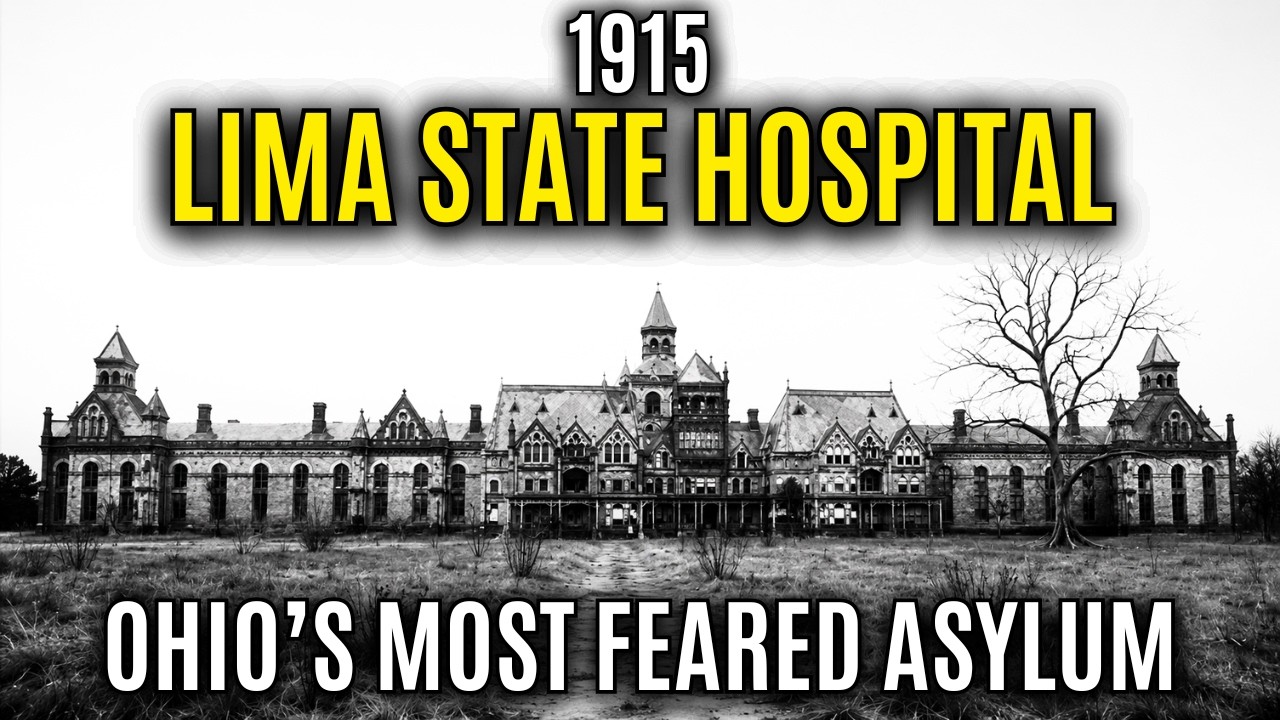
The story begins in 1904, with a bidding war. Ohio had been housing the mentally ill in institutions for 70 years, and the results were mixed at best. Before 1835, the state had no designated place for them at all. Those who could not be cared for at home were held in county jails or inside the Ohio Reformatory.
That year, the legislature authorized the Ohio Lunatic Asylum in Columbus, a facility built in part by convict labor—the first sign of a pattern that would repeat itself: the state would solve a prison problem by constructing a building, using prisoners to build it. On the evening of November 18, 1868, that asylum burned down. Six patients died, and more than 300 survivors were scattered across other institutions in the state. Ohio rebuilt, then kept building.
By the turn of the century, every state hospital it owned was full. What is striking is what the record does not contain: no reform literature, no inspector reports, no famous condemnation of conditions. Instead, what exists is a real estate deal. In April 1904, the Lima Republican Gazette printed a rumor: the state was scouting northwest Ohio for a new hospital for the insane, and Lima was on the list, as was Defiance.
The newspaper was candid about what was at stake. It was not about care; it was about commerce. The paper wrote that securing the institution would mean a great deal to the city’s business interests. By September, the city had organized.
On September 14, 1904, residents of north, south, east, and west Lima crowded into the Allen County Courthouse for a mass meeting. Then the citizens of Lima did something worth remembering for the rest of this story: they reached into their own pockets and pledged $500,000 of local money to build an asylum for the criminally insane. They won. On December 23, 1904, the State Hospital Commission chose Lima over Greenville, Marietta, and Sidney.
The local paper called it a Christmas gift. $500,000 raised by a city to give to the criminally insane. Then nothing happened for four years. Bids were not opened until August 12, 1908.
The site covered more than 628 acres north of town off North West Street. When the contractors finally laid out the plot, the Lima Times-Democrat wrote that the plan on the ground showed a building of immense proportions. It was not exaggerating. Fourteen buildings were arranged in a rectangular form around a central courtyard.
There were 70,000 cubic yards of concrete, 12,800 tons of steel, 6 million face bricks, 1,846 windows containing more than 48,000 separate panes of glass, 35 acres of plasterwork, 9 acres of flooring, and 122,890 feet of electrical wiring. No one knows who designed it; the architect’s name survives in no accessible record. Likewise, the stated treatment philosophy is lost. Every asylum of that era had one—fresh air, sunlight, moral treatment, honest labor.
Lima’s was never written down, or if it was, it has disappeared. In 1904, the state had projected a cost of $1. 5 million, including Lima’s contribution. Sources differ on the actual figure.
Newspapers in 1915 reported $2. 5 million; later calculations put the state’s investment at $2. 1 million over seven years of construction; the Lima News simply says it exceeded $2 million. All three figures exceed the estimate.
Part of the money went to a dining room floor built to make no sound at all, at a cost of $8,000. The hospital opened in July 1915, built to accommodate 1,000, 1,400, or 1,500 patients depending on the account. It received one patient. His name was Giovanni Seno, an Italian immigrant tried for murder in Marysville.
For several days that July, twenty state employees cared for a single man inside the largest poured-concrete building in Ohio. The Mansfield News Journal treated it as a joke, calling it “the most expensive house in the United States, with only one tenant. ” The joke ended on July 29, when 68 men arrived from the state hospital in Newburgh near Cleveland and entered behind the concrete. By December, the count was 619.
To understand what happened inside Lima, one must first recognize that it was a legal machine before it was a medical one. In 1939, state Senator Leo Asherman introduced Senate Bill 9, which expanded the conditions under which a prisoner could be referred for psychiatric examination and then committed indefinitely after a hearing. “Indefinitely” is institutional language meaning “until someone at Lima says otherwise. ” By the 1970s, the federal court counted nine separate legal pathways leading to that building: 30-day observation, 60-day observation, 15-day parole detention.
People found incompetent to stand trial, people acquitted by reason of insanity, transfers from prisons, transfers from ordinary civil hospitals for exhibiting dangerous tendencies. Under Asherman’s law, men convicted of no more than a misdemeanor could be held with no end date. The court recorded one phrase clearly: patients convicted of crimes and patients never convicted at all were placed in the same wards. The wards were classified as strict, dormitory, and open, in descending order of restraint, with separate wards for observation, women, behavior modification, and the chronically ill.
The old building had 24 wards and 1,000 rooms. A room in the old building measured 6 feet by 9. A newer unit, named for the senator, opened in 1952 with four wards and 276 rooms measuring 7 feet by 11. In 1960, the hospital created a security department as an independent arm of the institution.
By the time of the trial, it had 84 officers, and the court recorded the chief’s primary responsibility in seven words: “make sure no one escapes. ”
Once a year, a patient received a hearing to determine whether he or she would ever leave. It was called an “evaluation session. ” It lasted about 20 minutes.
The patient was asked whether he slept, ate, and was treated well; whether he was mentally ill; whether he needed help. Then he was asked to leave, and his case was discussed after he left the room. No lawyer was allowed at any stage. Mail was opened outside the patient’s presence.
Books and magazines could only be received directly from the publisher. Every letter between patients was read, and letters addressed to people the security chief described as “odd persons,” citing the Pope and the Queen of England as examples, were never sent at all. Every patient admitted to Lima was fingerprinted and photographed, including people transferred from ordinary civil hospitals who had never faced any charge. The fingerprints and criminal record photos were sent to the FBI and the Ohio Bureau of Criminal Investigation.
The bureau never asked for them. The institution built in 1919 was overcrowded by 1935. By 1960, it held 1,500 people. Mike Lackey, a columnist for the Lima News, later noted the ratio was roughly five patients per staff member.
When the first patient arrived, the total professional staff was six. By March 1971, the count reached 1,295. By August 31, 1973, it was 783; by November, 761; by 1980, just over 400. That decline was not driven by compassion but by litigation.
Documentation from the crowded decades is incomplete, and the record does not say where the additional numbers went. Look at the staff list the court compiled for a population of about 750: six staff physicians, three unlicensed medical assistants, eight psychologists, 14 nurses, 10 social workers, chaplains, and 271 aides. Any way you count it, Lima was run as a detention operation, and the numbers said so before anyone spoke the words. Of the patients, 44.
8% were Black. Plaintiffs later asked the court to order hiring that reflected that. The court refused, accepting that racial identity between staff and patients might aid treatment but deciding that adequate treatment could be provided without it. The mechanism of harm at Lima was not a chair, a table, or a machine.
By the time of the trial, about 73% of patients were receiving a psychiatric drug. The usual dose appears in the record twice daily: 100 milligrams of Thorazine, 10 milligrams of Stelazine, 2 milligrams of Artane. Others took Prolixin, Nardil, Mellaril, Haldol, Elavil, Trilafon, or Tofranil. The procedure worked like this: a staff member in a ward decides you are being troublesome.
He does not need a doctor in the room; he can recommend a certain dose or an increase. Often the recommendation is accepted by a physician who has never examined you and may not even be assigned to your case. If no doctor is available, the staff member sends a form to the pharmacy and receives the drug without a signature. Some orders are written for use as needed with no expiration date and no review date.
You are eligible to refuse. Nearly 85% of the people in that building were capable of making a rational decision about taking medication. Almost none were asked. Many did not know what they were given, why, or what it might do to them.
If drugs were not enough, there was a second layer classified by state executive order into three categories. Mechanical restraint included soft ties, thumbless gloves, restraint sheets, camisoles, padded leather belts and handcuffs, wristlets, and straitjackets. Medical restraint was defined as administering a narcotic, sedative, or antipsychotic to curb, control, or restrict behavior. The court could not tell you who made any of it, what it cost, or what color it was—no one wrote that down.
No one counted how many people were restrained. The order required a doctor to see a patient before signing. It required orders renewed every 24 hours. It required suicidal patients checked every 15 minutes, others every 30 minutes, and everyone released from restraints every two hours for movement and hygiene.
The court found the order was respected only by being violated. Physicians were not expected to examine a patient before signing a seclusion, restraint, or medication order, and one seclusion order could last 30 days. One patient spent two weeks in seclusion; the recorded justification was that he was agitated, annoying, destructive, and unclean. In seclusion, you bathed twice a week.
You were not regularly taken to the toilet, meaning, in the language of the specific case, patients often had to soil their beds. Some were isolated in their underwear; some were isolated naked. One correction before moving on: Lima has a notorious reputation, and lobotomies are often associated with it. Nothing in this record shows that lobotomies were performed at Lima State Hospital.
The documented mechanism was chemical. It never needed an operating room. The end of Lima was not caused by a riot, a fire, or a scandalous news investigation that embarrassed the legislature into action. There is no siege in this story, no body count.
It was a lawsuit filed on May 23, 1973, in the Northern District of Ohio, in the name of a patient named John A. Davis, brought by a Toledo lawyer who could not afford to file it. It succeeded. Then there are the people.
Giovanni Cateno entered first, in July 1915. Once the newspapers finished their jokes about America’s most expensive house, the record simply stops; his fate is unknown. Celilo Rose also arrived in 1915. In June 1896, in Richland County, she put arsenic in her family’s food and killed her father, mother, and brother because they prevented her from seeing a boy from the neighborhood.
She confessed. She was acquitted by reason of insanity. A newspaper of the time described her as speaking with a stutter and behaving at the level of children seven years younger. She went to the Toledo Asylum, then to Lima, and died there on March 14, 1934, one day after her 61st birthday.
No one claimed her body. That was Wolf Lavine, who came from Russia in 1904 at age fourteen, before his mother, brother, and sisters settled in a Cleveland tenement on Scovill Avenue. He sold newspapers and worked hard. In 1910, at twenty, he was arrested for picking a pocket and sentenced to one to five years in the Ohio State Reformatory at Mansfield.
On his admission papers, he listed his occupation as playwright. He never got out. The reformatory’s conduct record in his first year shows more than 300 days added to his sentence. By April 1912, he was recorded as suffering delusions of persecution and auditory hallucinations, sometimes with motor psychosis, so the state transferred him to Columbus State Hospital.
In 1915, he was moved again, to Lima, and diagnosed with “dementia praecox,” the old name for schizophrenia. In 1950, after 38 years inside, he was officially ruled unimprovable and transferred to Tiffin. When Tiffin closed in 1975, he was returned to Lima. He died there in 1982 at 92, having spent 72 years in the custody of the state of Ohio for picking a pocket.
A pauper’s fund paid for his burial. Then there is the man who tried. His name was Gerald B. Lackey, a Toledo attorney appointed to represent the patients.
The court wrote that it was no longer humanly possible for him to handle the case alone without sacrificing his entire professional practice. So the judge sent a letter to a local legal services group, “Lawyers for Basic Legal Equality,” who took the case with no promise of payment. They filed 135 pages of stipulated facts. They moved from filing to closing arguments in less than 16 months.
In September 1974, the court publicly praised the state’s cooperation. In January 1977, that same court issued a contempt ruling against the same officials for ignoring its order for two years. Follow the money and it gets worse. On September 3, 1973, 305 patients at Lima were working, not in treatment.
They worked 4 to 8 hours daily in labor the stipulations described as necessary for the proper administration of the hospital. They were paid between $10 and $15 a month. Do the math: at 8 hours a day, that is about six cents an hour, and it was the state of Ohio paying it. Others were paid nothing at all.
Patients cleaned the day halls for free. Patients were also asked by the guards to care for men in seclusion and restraint—bathing, feeding, changing, and wiping down their cells—without pay. The court was forced to issue an order in 1974 stating that patients could not be forced to administer drugs, take temperatures, insert catheters, or restrain and seclude one another. The order also prohibited polishing an already polished floor, polishing brass, and shining staff shoes.
Work assignments were distributed by the ward guards and an industrial committee whose staff physician never attended its meetings. Lima never sold anything. It had no factory, no product. What it produced was payroll, and the town that paid $500,000 to get it understood exactly what it bought.
When the buildings became the Lima Correctional Institution, the prison was among the top 15 employers in Allen County. That is why its closure in 2003 was a battle. The state closed the 88-year-old institution to save $25 million a year. 1,565 inmates were transferred to ten other prisons.
Early retirement was offered to between 800 and 900 workers. Five years later, the legislature asked what to do with the empty building, and a consultant assessed the costs: demolition, $8. 6 million; renovation, $184 million; a new prison of equal capacity, over $229 million. Today, on the same grounds, the state holds 1,645 men at a cost of about $62 each per day.
Perhaps you have heard one fact about Lima State Hospital, the single thing in this story that is unsupported. The claim is that Lima was the largest poured-concrete building in the world before the Pentagon. It appears in magazines, on preservation websites, and in the memories of people who worked there. No one provides a source.
The wording changes from “world” to “state” to “United States,” the behavior of unverified claims. The Lima News, closest to the site, softens it to “one of the largest poured-concrete buildings in the United States” according to some accounts only. Columbus State Hospital in Ohio claimed a version of the same title: the largest building under one roof until the Pentagon was built. Two Ohio institutions, one title.
The records do not support it. Whether it was the largest or not, nobody ever needed to lie about that. There is a second myth, and this one costs more. Celilo Rose is now a ghost story.
The Ohio Department of Natural Resources placed a marker at her family home, which sits inside a public park, and the marker itself says legend has it her spirit haunts the house. Tours are held at the house, including at Halloween. She is a seasonal attraction at a farm in Richland County, while the real Celilo Rose lies in an unclaimed grave beside Bible Road in Allen County, where no one visits at all. One more, because people constantly confuse the two: the castle in Mansfield, featured in the film “The Shawshank Redemption,” is the Ohio State Reformatory.
It is not Lima. Wolf Lavine was in both. Hollywood came to Lima once. In 1980, ABC aired a television film called “Attica,” directed by Marvin Chomsky and starring Charles Durning and Morgan Freeman.
97 minutes, five Emmy nominations, one win. It was filmed at Lima State Hospital while the hospital was still open and holding patients. A New York prison uprising was re-created inside a working Ohio mental institution, a set that came with its original inmates. One extra later recalled that actors talked with patients between takes.
Those are just memories posted online, not official documents, and should be treated as such. By that time, the end had already begun. In 1972, the Ohio Attorney General’s office completed a criminal investigation of the hospital that led to 31 indictments, most related to patient abuse incidents. What became of those 31 cases is not recorded in these records; no names were mentioned.
The institution’s response was to add a roving security patrol, visiting each ward once per day. Thirty-one indictments, one patrol. The lawsuit followed in 1973. The trial ran from August 26 to August 30, 1974.
On September 9, the court issued its preliminary order, appointed a special examiner, and required the order to be read to every employee and posted in every ward within five days. Two years later, nothing had happened. In January 1977, the state was found in contempt. In September 1978, the order on security, labor, mail, and fingerprinting was issued.
On September 16, 1980, the final opinion was announced. Patients at Lima had a constitutional right to refuse psychiatric drugs. No seclusion order could exceed 12 hours. Restraining a patient in crisis required a qualified professional at the bedside within 45 minutes.
The state was given until December 1 to submit a plan. In 1982, Ohio stopped arguing about whether Lima was a hospital and handed the buildings to the Department of Rehabilitation and Correction. The number who died inside over those 67 years has never been established. The cemetery held about 450 graves in 1971.
Today the public burial index lists 543 names. Sources differ on the count, and the state’s figure was never published. If you go there now, the address is 2338 North West Street, Lima, Ohio. The complex is now called the Allen Oakwood Correctional Institution, holding about 1,645 men with about 439 staff, 284 of them in security.
The Asherman unit opened in 1952 with 225 beds for sex offenders is now Oakwood. And Oakwood is where Ohio keeps the residential mental health unit for its entire prison system. Read that slowly: the building the state designated to move mentally ill people out of prisons is now where the prison system sends its mentally ill prisoners. The original hospital was reportedly still standing and empty as of 2015.
Its current condition is something we were unable to verify. There is no historical marker there. No record of the place. No tours.
No one sells tickets to visit it. Compare that to other places. The Ohio State Reformatory in Mansfield closed on December 31, 1990, after receiving more than 155,000 men. A film crew saved it from demolition.
Today it is a museum with three collections, guided tours, overnight ghost hunts, a haunted house season, and a music festival. The Athens Asylum for the Insane operated from 1874 until 1993. It was listed on the National Register of Historic Places in 1980. Now known as The Ridges, it is part of Ohio University, housing an art museum, classrooms, and walking trails, with monthly tours for $15 above graves holding 1,930 people.
The Matteawan State Hospital for the Criminally Insane in New York closed on January 1, 1977. Its buildings were absorbed into the Fishkill Correctional Facility, now a museum, campus, and prison. The city of Lima got the prison. The state built the facility to empty its prisons.
The state built the place and never recorded who designed it. The state built the place and a town paid half a million dollars for the privilege of hosting it. The state built the place and then needed a federal judge to clarify what the hospital was: hospital, warehouse, film set, prison, mental health unit inside a prison. The concrete still stands.
The fence is still there. The graves beside Bible Road are still there, and no one agrees on the number. Ohio has been moving the same kinds of people between the same kinds of walls since 1835. Its answer has always been to build a building.
What is the state building now? And what will it be called 80 years from now?