In September 1992, Audrey Hepburn traveled to Somalia with a UNICEF mission as the country was being torn apart by civil war, drought, displacement, and hunger. She was 63 and already suffering from abdominal pain, though the cause had not yet been discovered. She kept moving through relief centers, asking questions, listening to aid workers, and bending toward children. The famous face still opened doors—that was why she had come.
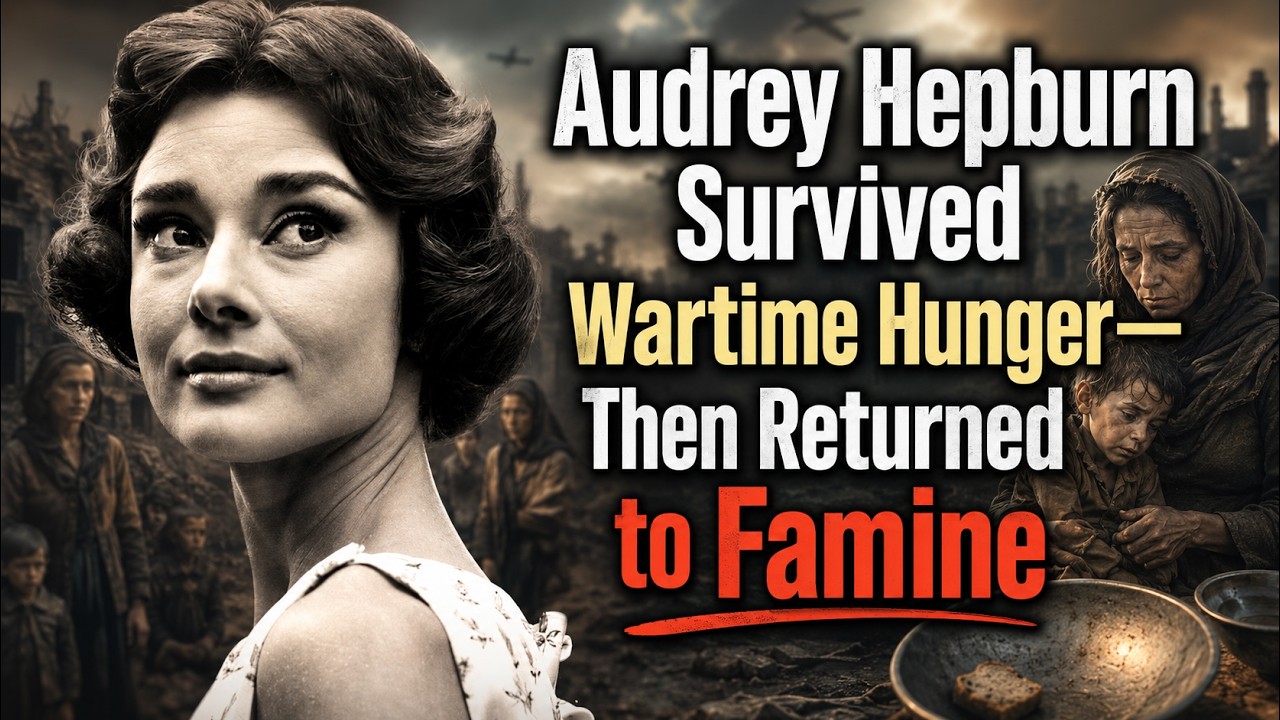
Hollywood had trained cameras to follow her, and now she was asking those cameras to turn toward people the world was learning not to see. Her son Shawn would later describe the shape of her life in one stark sentence: it began with war and ended with war. Between those wars stood the films, the clothes, the photographs, the marriages, the children, the disappointments, the discipline, and the extraordinary public affection. The distance from an occupied Dutch town to a famine zone in Somalia was not as great as it appeared.
In both places, a child depended on decisions made by adults who might fail, disappear, or arrive with food. Audrey Kathleen Hepburn-Ruston was born on May 4, 1929, in Brussels. Her father, Joseph Victor Anthony Ruston, was a British businessman. Her mother, Ella van Heemstra, came from a Dutch aristocratic family.
During the 1930s, both parents were drawn to fascist politics and supported the British Union of Fascists. For a child later remembered as a symbol of compassion, this fact can be uncomfortable to hold. Audrey did not choose her parents’ convictions, but those convictions belonged to the home from which she came. In 1935, when she was six, her father left the family.
She later described his departure as the most traumatic event of her life. The word carried weight coming from a woman who had survived military occupation and hunger. She learned early to adjust to new addresses, new schools, new accents, and the expectations of whichever adult held authority. What later appeared to audiences as instinctive social grace had practical roots.
After her parents separated, her mother brought her back to the Netherlands as Europe moved toward war. Ella believed a neutral country might be safer than England. On May 10, 1940, German forces invaded the Netherlands. Audrey was 11.
The place chosen as a refuge became occupied territory. Her English name could now attract attention, so she was called Edda van Heemstra, a Dutch identity that concealed her British-sounding name. It was more than a schoolroom adjustment—a child’s name had become something to protect. In May 1942, Audrey’s uncle by marriage, Otto van Limburg Stirum, was arrested.
On August 15, German forces executed him with other hostages in retaliation for resistance activity. Audrey was 13. His execution made the nature of the occupation intimate and irreversible. The girl who had already experienced the disappearance of a father now saw that an adult could be removed by the state and never return.
Stories about Audrey’s own resistance work grew in the decades after the war. Family accounts and later biographies described secret dance performances that raised money, messages carried, and small errands undertaken against the occupation. Some respected historical accounts repeat those stories. The Amsterdam City Archives, after examining the available record, has emphasized that direct resistance activity by Audrey herself cannot be firmly confirmed.
The disagreement should remain visible. She continued to dance during the occupation and helped in the hospital of Dr. Hendrik Visser ‘t Hooft, a physician connected to the resistance network around Arnhem and Velp. In September 1944, Allied forces attempted to seize bridges in the Netherlands during Operation Market Garden.
Arnhem became the center of a devastating battle. Velp filled with displaced people and wounded soldiers. Liberation did not come quickly enough to prevent the final winter’s suffering. Transport broke down, fuel disappeared, and food supplies collapsed.
Audrey later remembered eating tulip bulbs and trying to make bread from grass. She developed anemia and jaundice and spent periods in bed. When Allied troops reached the area in the spring of 1945, freedom arrived alongside exhaustion. Audrey was 16.
She later spoke with lasting gratitude about aid she associated with UNICEF, though the organization itself was created after the war in December 1946, and later memory appears to have compressed different institutions and dates. When food reached a hungry child from strangers beyond the border, it proved that someone had decided the child should live. First came recovery and the old dream of ballet. In 1948, Audrey and Ella moved to London, and Audrey won a place to study with Marie Rambert.
Audrey had musicality, intelligence, and presence, but she had lost years to the war, and her height and proportions made the path to becoming a leading classical ballerina uncertain. When the desired future closed, she redirected her training. She joined the chorus of the West End production “High Button Shoes,” then appeared in revues. Money remained tight.
She modeled, posed for advertisements, and took small film roles. In 1951, she went to the French Riviera for the production of “Monte Carlo Baby. ” Colette, the celebrated French writer, saw Audrey and recognized in her the young woman she wanted for the stage adaptation of “Gigi. ” When the production opened in New York in November 1951, critics saw a fresh presence whose lack of manner had become part of the performance.
Broadway placed her near the worldwide search for an actress to play Princess Anne in “Roman Holiday. ” Director William Wyler wanted discovery. Audrey’s screen test became a Hollywood legend because it revealed the quality film would repeatedly use. She performed the prepared scene, someone called “cut,” and believing the test was over, she relaxed, stretched, asked how she had done, and began to behave without performance.
Wyler had instructed the cameraman to keep filming. Paramount cast her opposite Gregory Peck. “Roman Holiday,” released in 1953, changed Audrey’s position almost overnight. She won the Academy Award for best actress.
Photographs of her appeared everywhere. The film ended with a final press conference where Princess Anne returns to duty, speaking in formal language while holding private knowledge. Audrey’s face carries the farewell without breaking the rules of the room—powerful feeling held inside immaculate control. Her next major film, “Sabrina,” placed that discipline inside a transformation story.
The production began the collaboration that would shape Audrey’s public image. She went to Paris and met Hubert de Givenchy, then a young designer. Edith Head was the film’s credited costume designer and received the Academy Award; Givenchy supplied the Paris wardrobe that Audrey chose. Audrey made choices—she simplified, removed, adjusted, and considered how the line would read on screen.
She married Mel Ferrer in September 1954. The union looked from outside like a merger of European refinement and theatrical intelligence. In private, it became a long, complex partnership shaped by affection, ambition, pregnancy loss, work, and differing needs. In July 1960, Audrey gave birth to a son, Sean.
She would later say that she could not pursue career and family at the same intensity. The center of gravity moved. “Breakfast at Tiffany’s” was adapted from Truman Capote’s novella, and Capote had imagined Marilyn Monroe as Holly Golightly. Audrey seemed an unlikely choice for a sexually independent New York woman.
The opening image became one of the most reproduced in film history—Holly steps from a taxi in a black Givenchy dress, pearls, gloves, and dark glasses, then eats breakfast while looking into Tiffany’s window. The scene is elegant, but it is also lonely. Over time, reproduction often removed the loneliness and kept the dress. The film also carries a serious stain: Mickey Rooney’s grotesque caricature of a Japanese neighbor is racist.
The sequence was offensive when made and has become impossible to excuse as harmless period comedy. Remembering Audrey’s contribution does not require protecting the film from judgment. In 1963, “Charade” placed Audrey opposite Cary Grant in a romantic thriller. The film was sophisticated entertainment built from danger, costume, and verbal timing.
“My Fair Lady” presented a different kind of transformation. When Warner Brothers chose Audrey for the film, resentment began before production, because the role of Eliza Doolittle had been created on Broadway by Julie Andrews. During post-production, most of her singing was replaced by the voice of Marni Nixon, a decision that created a fracture between the visible performer and the audible one. Audrey learned during production that much of her work would not be used and was upset.
She returned and completed the film. She was not nominated for an Academy Award even as the film won widely. Her marriage to Mel Ferrer led to divorce in 1968. In January 1969, she married Andrea Dotti, an Italian psychiatrist.
In February 1970, she gave birth to her second son, Luca. For several years, she largely withdrew from acting. The marriage to Dotti did not become the secure domestic answer she had hoped for; reports of his infidelities circulated, and the relationship grew painful. It ended in divorce in the early 1980s.
By then, Audrey had met Robert Wolders, a Dutch-born actor who had been the companion of Merle Oberon. With Wolders, she found a quieter partnership. They did not marry, but he became the steady companion of her final years. Audrey spent much of the year in Tolochenaz, a Swiss village near Lake Geneva, in a house known as La Paisible.
In 1988, Audrey Hepburn became a UNICEF Goodwill Ambassador. She approached the appointment as work, asking to travel and see programs directly. Her first major field mission took her to Ethiopia, where drought, civil conflict, and famine had placed children at extreme risk. She later traveled to Turkey, Venezuela, Ecuador, Bangladesh, Thailand, Vietnam, and Sudan, visiting camps for displaced people.
She testified before the United States Congress, helped launch UNICEF reports, and participated in the World Summit for Children. UNICEF’s executive director, James Grant, praised the consistency between her public and private conduct, saying, “She is what she seems to be. ”
In 1992, Somalia entered catastrophe. The state had collapsed under civil war, armed groups fought for territory and food routes, and drought deepened the emergency.
Audrey went with UNICEF in September. She spoke afterward of an apocalyptic landscape and of children beyond the point of ordinary hunger. By then she was experiencing abdominal pain. After returning, medical examinations in the United States revealed cancer in her abdomen.
She underwent surgery in November. She wanted to return to Switzerland. Friends helped arrange the journey, and she went home to La Paisible with Robert Wolders and close family around her. On January 20, 1993, Audrey Hepburn died at her home in Tolochenaz.
She was 63. Her funeral took place in the village church with family, friends, neighbors, film colleagues, and representatives of UNICEF gathered. After her death, the Academy presented the Jean Hersholt Humanitarian Award posthumously. Her image has been detached from context and reproduced on walls, mugs, cosmetics, and screens.
A character who stood outside a jewelry store because she could not afford the security it represented became an advertisement for uncomplicated luxury. The lonely morning was converted into decor. Nor was the simplification imposed entirely from outside—Audrey participated intelligently in the creation of her image. Her acting deserves rescue from the icon.
“Roman Holiday” remains more than a star-making vehicle because of the final press conference. “The Nun’s Story” endures because obedience fails to silence conscience. “Two for the Road” survives because a marriage is allowed to be affectionate, damaged, comic, and unfinished. “Wait Until Dark” works because vulnerability becomes strategy.
Her life was not a single repetition of abandonment. As an adult, she located her father in Ireland and reestablished contact, offering financial support. The reunion did not restore the childhood that had been lost, but it showed that she remained capable of reaching toward a person who had hurt her. Her elegance should also be understood without turning it into a diagnosis.
It was partly inheritance, partly training, partly fashion, partly intelligence, and partly work. Beauty first brought work. Work brought influence. Influence brought access.
Access could be redirected. At each stage, Audrey made decisions about what the previous stage might be used for. The humanitarian work depended on the glamour. UNICEF did not need Audrey to pretend she had never been a star.
It needed the rooms that opened because she had been one. The black dress and the relief mission belong to the same biography. In Somalia, near the end of her life, Audrey could not reverse war or famine. She could stand where the consequences were visible, listen, return, and speak.
She could ask people who still associated her with a princess in Rome to look at a child for whom no holiday was coming.