On the night of March 28, 1984, while snow fell over Owings Mills, Maryland, 15 moving trucks rolled into the parking lot of the Baltimore Colts’ training facility. The drivers had been summoned that evening without being told their destination. They loaded offices, film reels, helmets, trophies, and even the letters mounted on the walls. Then, one by one, each truck took a different route out of the state, because while a convoy can be stopped, 15 trucks heading in 15 separate directions cannot.
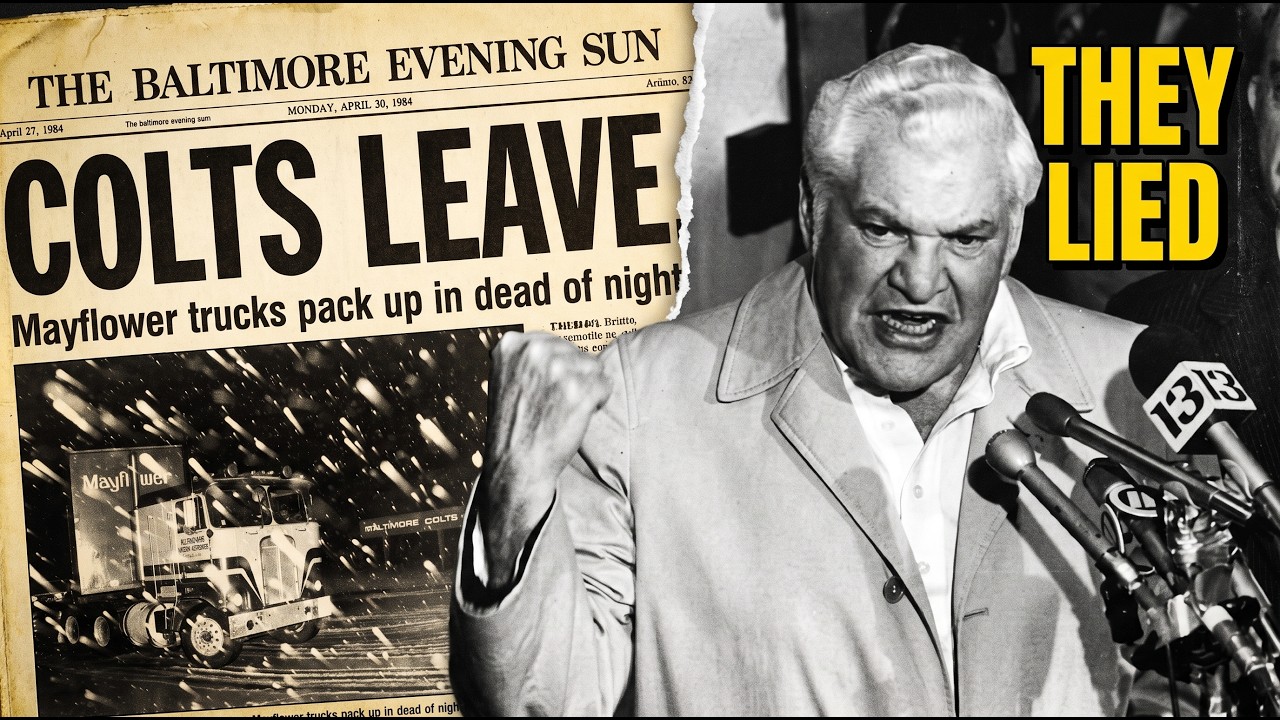
By dawn, the Baltimore Colts no longer existed. The famous story of the midnight move is well known. What is far less known is what was left behind that night, who went back for it, and why professional football exists in Baltimore today thanks to a marching band, a man who lent his delivery truck, and a wedding ring that never left a pawn shop. The Colts arrived in Baltimore in 1953, and within five years they became the best team in professional football.
In 1958, they defeated the New York Giants in the NFL Championship in sudden-death overtime on national television. It is still called “the greatest game ever played,” and it is credited with making pro football America’s biggest sport. They won the title again the following year and the Super Bowl in 1971, but the trophies were not the point. The players lived in row houses on ordinary streets next to the fans who paid to watch them.
In the off-season, they sold cars, worked construction, and stood shoulder-to-shoulder with the same men who cheered their names on Sundays. In the 1960s, the Colts sold out 51 consecutive home games. A football team in Baltimore was not just entertainment; it was belonging. In 1972, an Illinois air-conditioning millionaire named Robert Irsay bought the Los Angeles Rams and, on the same day, swapped that entire franchise with the owner of the Colts to acquire Baltimore’s team.
The relationship soured almost immediately. Irsay had a temper that became legendary for the wrong reasons. He ordered his head coach to bench the starting quarterback mid-game. He called plays himself and bragged about it to reporters.
Defensive back Bert Jones later said Irsay would not have known how many players were on the field, and all he did was embarrass coaches and players. When Irsay told him to run, Jones would pass. When Irsay told him to pass left, Jones ran right. By 1983, the franchise had declined so badly that when the Colts selected John Elway with the first pick in the draft, Elway refused to join, saying he would play baseball for the New York Yankees instead.
The Colts traded him to Denver. The most sought-after player in America preferred another sport over wearing that helmet. Throughout this period, Irsay shopped the team around. Phoenix, Memphis, Jacksonville, Indianapolis, and Baltimore were all mentioned in the press.
On January 20, 1984, he called a press conference at Baltimore-Washington International Airport to settle the matter. He had been scheduled to meet with Phoenix officials that day, but the meeting was leaked, so he cancelled it and flew to Baltimore instead. Standing next to Mayor William Donald Schaefer, he pointed his fingers in the air and shouted at reporters, “I have no intention of moving this goddamned team. ” He added, “I give you my word of honor.
I’m a good Catholic. I haven’t been to Arizona. Where the hell does all this come from? Who started this?
If you love the Colts, why haven’t you treated me right? ”
Sixty-eight days later, the trucks came. The common belief is that Irsay moved in the middle of the night because he was ashamed. In fact, he moved because he had run out of time.
It is also untrue that Baltimore refused to pay. They paid, or tried to. On March 8, the state of Maryland offered a $15 million loan at 8 percent interest, plus assumption of Irsay’s $2. 2 million debt on the Owings Mills complex.
Three days later, Maryland’s governor, Baltimore’s mayor, and the Baltimore County executive flew to Chicago together to sit before Irsay and ask him to stay. What they did not know was that the Colts’ coach, Irsay’s son, and the team’s lawyer had flown to Indianapolis five days earlier under assumed names to inspect the domed stadium. Baltimore was negotiating with a man who had already scouted the exit. Then, on March 27, the Maryland Senate voted 38–4 to give Baltimore the power of eminent domain over a professional sports franchise.
Eminent domain is the tool governments use to seize land for a highway. Maryland was preparing to use it to seize a football team. If the bill passed the House and was signed by the governor, the Colts would no longer belong to Robert Irsay. Colts attorney Mike Chernoff put it plainly: Maryland had not only challenged Irsay, they had put a gun to his head and asked him if he wanted to find out whether it was loaded.
The next morning, the Phoenix group withdrew its bid, citing Maryland’s action. Nobody wanted to buy a team the state was about to seize. That evening, Irsay called the mayor of Indianapolis and said yes. The mayor hung up, called his neighbor, who ran Mayflower Transit, and by 10 p.
m. the trucks were in the parking lot. Reporter Ken Murray got a call around 7 p. m.
from someone who had spotted a Mayflower truck heading toward the complex. He called head coach Frank Kush, who confirmed the move. Murray was the first journalist on the scene and described it in one word: surreal. The next morning in Indianapolis, the mayor stood before cameras and smiled, saying, “Ladies and gentlemen, I know that the Colts are on their way to Indianapolis.
”
Six hundred miles away, Baltimore learned the news on the radio while driving to work. No announcement, no farewell game, no chance to boo. A city of nearly 800,000 woke up on Thursday to learn that overnight, while they slept, their football team had been moved to Indiana. To this day, some people in Baltimore refuse to hire Mayflower for their moves.
But there is a part of the story the trucks never carried away. The Baltimore Colts marching band was founded on September 7, 1947. All its members were volunteers: postal workers, schoolteachers, factory workers, ordinary people who wore the uniform on Sundays. And here is the fact that reframes everything that followed: this was not the first time Baltimore had lost its football team.
In 1950, the original Colts had been dissolved and their players’ contracts sold back to the league. The team was gone. But the band kept working. In the early 1950s, they ran a fundraising drive with Martha Raye and Moe Amsterdam, asking Baltimore residents to reserve season tickets for a team that did not yet exist.
In 1953, Baltimore got its team back. Trombonist Bill Brubaker, who played in the band from 1947 to 1967, put it simply: the Colts had left twice, not once. Most people only remember the second time. So, on the night of March 28, 1984, the band had been through this before.
They received a warning before the trucks arrived and managed to get their instruments and equipment out of the building in time. But the uniforms were not there; they were at the dry cleaner. Band president John Ziemann, who had joined as a percussionist in 1962, called the dry cleaner owner and asked for the uniforms back. The owner told him the legal truth: the uniforms belonged to the football team, so he could not release them.
Then he told Ziemann that if he came and took the delivery truck, he would look the other way. Ziemann took the truck. The uniforms were in the back, with a handwritten sign beside them reading, “Go Colts Band. ” He took them first to his home, then to a mausoleum—a real family crypt belonging to a band member in a Baltimore cemetery.
Ziemann explained the logic: they needed a place to keep the uniforms for 60 days until they became unclaimed property. And what better place than with the dead? For 60 days, that was the entire plan: hide a marching band’s uniforms among the deceased until the law said no one had claimed them. But Ziemann and his wife Charlene were friends with Harriet Irsay, Robert Irsay’s wife.
Ziemann called her and told her what he had done. She told him to keep them. She said the uniforms belonged to Baltimore because the band members were there. Then she told him, “Keep marching.
”
The wife of the most hated man in that city, in the worst week in Baltimore sports history, quietly gave back the one thing her husband could not take. No press conferences. She simply told one man over the phone to keep going. And they did.
For 12 years, a marching band played without a football team, performing at parades, local events, and halftime shows for other teams. Three hours of rehearsal every Wednesday night in whatever space they could borrow. There is one detail from those years that shows exactly what it cost. One day, in the middle of it all, John Ziemann noticed his wife’s engagement ring sitting by the kitchen sink.
What he thought when he looked at it was, “New drumheads. ”
A few weeks later, Charlene came to him in tears. Ziemann recalled: “She came to me crying and said, ‘I think I have something to tell you. I think I lost my engagement ring.
‘ I said, ‘Wait, I have something to tell you. ‘” He has never said what happened next. In his words, “The rest stays between me and her. ”
He did not sell the ring.
He pawned it. When a journalist asked him about it 25 years later, the ring was still in hock. He still said he would get it back. The band’s persistence worked in a way no one could have planned.
One of the teams that began inviting the Colts band to play at halftime was the Cleveland Browns. The man who suggested it was Ernie Accorsi, the last general manager of the Baltimore Colts. Accorsi had been with the team since 1970, moving from public relations to running football operations entirely, selecting John Elway, and then watching the team be sold. He resigned in February 1984, weeks before the trucks arrived, and ended up in Cleveland as the Browns’ general manager.
When Accorsi told the Browns to bring in a marching band from a city that no longer had a football team, he was talking about his own band. Owner’s son David Modell thought the idea was absurd. “I looked at him like he was crazy,” he said. But they did it once.
The band played in Cleveland 10 times. The band had so much passion, they were so kind, and they came bearing gifts like little tobacco jars. It mattered deeply to them. Art Modell, the Browns’ owner, was watching.
Years later, he described what it did to him: “The idea lodged in the back of my head: if I ever had the chance to own a band, I would. ” When he came to Baltimore, that came true. In 1991, the Pro Football Hall of Fame invited the band to Canton for a tribute weekend. A band from a city without a team played in the museum of the sport itself.
They performed in the parade, before the game, and at halftime, and the crowd stood to salute them. It was the first standing ovation for a halftime band in Hall of Fame history. Then, in March 1987, the Maryland legislature was debating funding for a new stadium, which Baltimore would need if it wanted to get football back. The band went to Annapolis and performed on the front steps of the state house while legislators argued inside.
The funding passed. William Donald Schaefer, the man who had stood next to Robert Irsay at that airport and was now governor of Maryland, said the Colts band had made the difference and turned the vote for the new stadium complex. With the stadium nearing completion, the NFL looked at Baltimore again. In 1996, Art Modell moved the Cleveland Browns to Baltimore, where they became the Ravens.
Here is the part almost nobody knows: the band did not change. For two more years, the group that marched into that stadium was still the Baltimore Colts marching band, in the same old uniforms, playing the same team song written in 1947. A city with a new franchise was listening to the music of a team that had been taken away 12 years earlier, because no one had ever told them to stop. Their last performance as the Baltimore Colts band came in July 1998.
They became the Marching Ravens in August of that year and still play today, mostly volunteers, still rehearsing on Wednesday nights. They are the single thing in Baltimore football history that never left. But there is one man this story never felt good about: the most famous name in it. One of Robert Irsay’s first acts as owner was to send Johnny Unitas, the greatest quarterback in the history of the sport and a man whose name was synonymous with Baltimore, to San Diego, where he played four games and retired.
Unitas played 18 seasons, almost all of them in Baltimore. He won three league titles and three MVP awards. He threw a touchdown pass in 47 consecutive games, a record that stood for 52 years. In 1969, he was voted the greatest quarterback of all time.
He never left the city. He raised his family there, worked there, and died there. Baltimore was not just a stop; it was home. After March 1984, Unitas cut every tie to the franchise.
He did not go to their games. He did not appear at their events. And then there was the record book. Everything Johnny Unitas did on a football field officially belonged to the Indianapolis Colts.
The championships, the 47-game streak, all of it was credited to a team based in a city he never played in. So he asked the Pro Football Hall of Fame to fix it. He asked more than once, publicly, on national television. His request was simple: put “Baltimore Colts” on what he had done, or remove the display.
They never did. Lenny Moore supported him. Art Donovan supported him. Men who had been on that field with him in 1958.
It changed nothing. Johnny Unitas died on September 11, 2002, in Baltimore, at age 69. He was still asking. So this is how it stands.
Robert Irsay won. That is the honest ending. He got his trucks out before the law could catch him. The team he took is still in Indianapolis.
And the greatest quarterback in the history of the sport asked for one label on one display case and died without getting it. You can move a football team in one night. It is shockingly easy: 15 trucks and a phone call to a neighbor. What you cannot move is a group of volunteers who show up on Wednesday nights to rehearse for games that will not be played.
They did not do it because they thought it would work. They did it because stopping would have meant agreeing that it was over. And it worked anyway, not as a metaphor but as a fact. A pawned wedding ring, a crypt full of uniforms, and 12 years of Wednesday nights.
The trucks took the team, but they never took the band.