In the hills of Harpers Ferry, West Virginia, the Blackwood sisters ran what locals once called the finest boarding house in the county. But between 1892 and 1896, at least seven travelers who stayed at the Blackwood home were never seen again. Their belongings, however, kept turning up—a pocket watch here, a pair of spectacles there—always in the possession of one of the three sisters who ran the establishment. When questioned, the sisters said their guests had left early, often before dawn, leaving personal items behind as payment for debts owed.
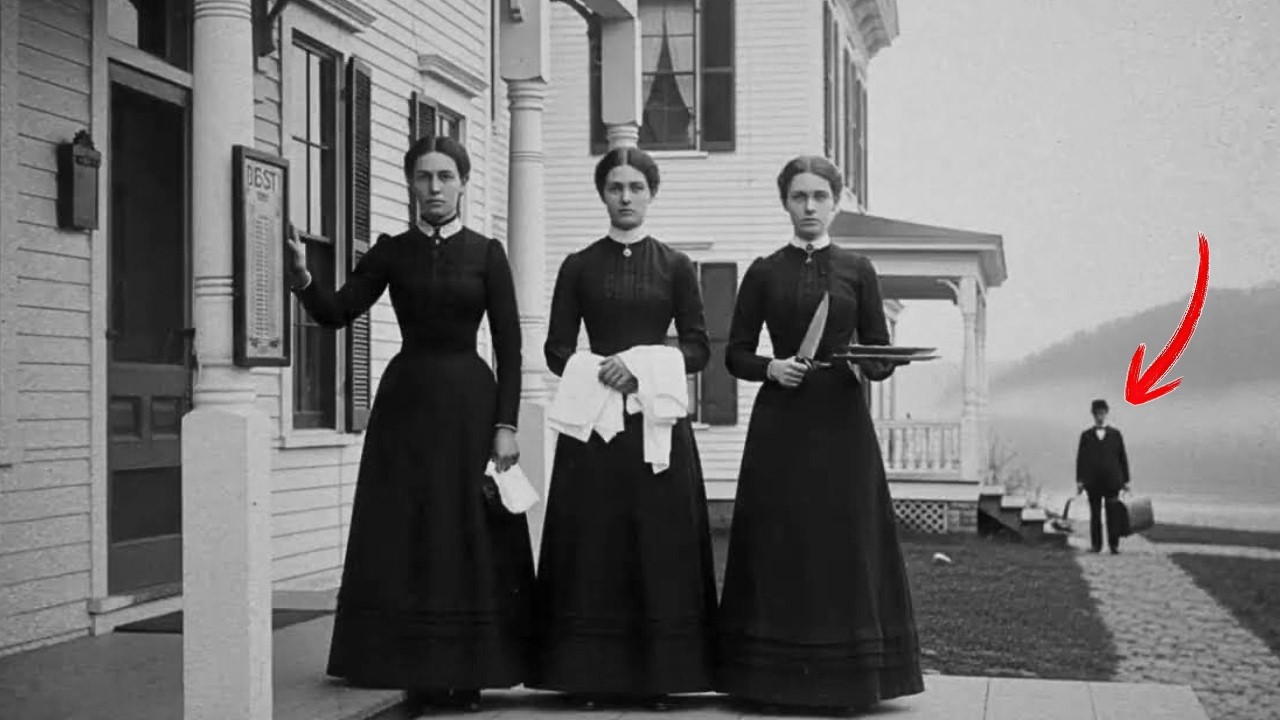
Local Sheriff Thomas Harlow, a cousin by marriage to the sisters, never pursued the matter. The Blackwood case remained buried in court archives until 1953, when Georgetown University professor James Whittaker uncovered a series of records while researching trade in the Shenandoah Valley after the Civil War. What he found led him down a path that ended with his own mysterious disappearance in 1968. The Blackwood family had deep roots in Jefferson County, dating back to the early 19th century.
Jeremiah Blackwood, a Baltimore merchant, purchased 20 acres overlooking the rivers in 1823. His son William, a Harvard graduate, inherited the family estate in 1852. William’s marriage to Elizabeth Hollister united two prominent local families. The couple had three daughters: Margaret, born 1854, Eleanor, born 1858, and Ruth, born 1863.
The Civil War changed everything for the Blackwoods. William, educated in northern schools with business interests in Baltimore and Philadelphia, chose to support the Union. He served as lieutenant colonel in the Second West Virginia Volunteer Infantry and was wounded at the Battle of Cedar Creek in October 1864. Letters to his wife reveal his internal struggle: “I cannot in good conscience support the dissolution of our great republic, though I know my position places you and our dear children in a difficult situation among our neighbors.
”
When William returned home, he found his family ostracized. Local sentiment leaned heavily Confederate, and Union supporters were often treated as traitors. The Blackwoods, once among the region’s most prominent families, found themselves socially shunned. A local minister wrote in his diary that several families rose and left the church when William entered for the first time since his return.
The ostracism continued for years. Business records show local merchants often charged the Blackwoods higher prices or refused them credit routinely extended to other families of the same class. The family retreated into increasing isolation. Elizabeth Blackwood, William’s wife, suffered the most acutely.
Medical records from Dr. Theodore Lambert describe her declining mental state: paranoia about neighbors watching the house, fears that enemies were trying to poison the family, and increasingly erratic behavior. By 1876, her condition had deteriorated to the point where home care was impossible. Elizabeth was committed to the Western State Hospital in Staunton, Virginia, in June 1876, diagnosed with severe depression with paranoid features.
She remained there until her death in 1883. The death certificate lists the cause as general failure of bodily functions from refusal to eat—her paranoia about food ultimately contributed to her death. The three daughters were left to face their fate almost alone. School records show they were exceptional students.
Margaret showed unusual talent in mathematics and accounting. Eleanor displayed skill in domestic arts, noted for her perfectionism. Ruth demonstrated competence in chemistry, writing an essay at age thirteen on “Modern Methods of Food Preservation and Their Chemical Foundations. ” Her science instructor noted “an unusually detailed understanding of organic decomposition for a student of her age” and “a somewhat disturbing focus on methods of preserving animal tissue.
”
The girls withdrew from formal education after their mother’s hospitalization. A series of private tutors came and went, none staying more than a few months. One tutor described the younger sister Ruth as asking “questions no child should think about. ” Another wrote that he could not “in good conscience continue” after observing the girls’ disturbing tendencies—Margaret’s precise household accounts, Eleanor’s obsessive arranging, and Ruth’s interest in dissecting small animals found on the property.
Colonel Blackwood’s health declined in the late 1880s. Dr. Lambert’s notes describe his belief that former Confederate soldiers were conspiring to burn down his house. He kept loaded firearms in every room.
In November 1890, he fired his pistol through a bedroom window claiming he saw intruders in the garden. There was no evidence anyone was there. The daughters remained notably calm throughout the incident. When the colonel died in February 1891, few attended the funeral.
Dr. Lambert wrote privately that he was “not entirely satisfied with the circumstances of the colonel’s death,” noting the body had already been prepared for burial by the daughters—unusual in itself—and their composure was remarkable for women who had just lost their only parent. The colonel’s death left the sisters in a precarious financial position. Bank records show their account contained only $237.
42 at his death, insufficient to support three unmarried women for more than a few months. Yet within a year, regular deposits began appearing, eventually growing into substantial sums that allowed the sisters not only to maintain their home but to make significant improvements to the property. Margaret, the eldest and most practical, proposed converting the family home into a boarding house. In a letter applying for a business license in March 1892, she wrote that their location near the railroad station and the quality of accommodations would attract respectable travelers.
The conversion was rapid and thorough. Local carpenter Joseph Winters was hired, and his invoice included an unusual line item: reinforcement of the basement ceiling beams and installation of a specialized drainage system. His assistant later recalled that the basement work was peculiar—a drain in the floor connected directly to the river, hooks on the ceiling beams capable of supporting heavy weight, and copper lining on the walls in one section. Winters’ assistant added a detail that caught the attention of researcher Whittaker.
“They brought in special equipment from Baltimore, a large iron table with channels running to the edges and a drain in the middle. The lady said it was for laundry, but no laundry table was ever built that way. ” He said it reminded him more of equipment he’d seen in a slaughterhouse. By May 1892, the Blackwood House was open for guests.
Advertisements in newspapers from Baltimore, Washington, Philadelphia, and Richmond described it as a fine establishment offering clean, comfortable rooms and home cooking of exceptional quality. One ad noted it was “very suitable for gentlemen traveling on business who appreciate fine cuisine and attentive service in a homelike atmosphere. ”
Business appeared to thrive immediately. Tax records show significant increases in the sisters’ income during the first year of operation.
But curiously, this financial success came despite low occupancy numbers recorded in the guest register. A private ledger kept by Margaret Blackwood, discovered much later, offers a possible explanation. An entry from September 1892 reads: “We have decided that official registration of all guests creates unnecessary documentation. Those selected for special hospitality will be recorded in this private register only.
This arrangement would reduce complications in case of any inquiries. ”
Local merchants soon noticed unusual purchasing patterns. A general store owner observed that the sisters bought more preserving salt than any family he’d ever seen, year-round, not just during slaughtering season. A hardware store recorded purchases of unusual quantities of locks, chains, and heavy-duty restraints of the type typically used for livestock.
When questioned, the sisters explained these items were needed to secure their basement storage room where they kept their valuable supplies and family heirlooms. The first documented disappearance linked to the Blackwood House occurred in February 1893. Howard Phillips, a lumber merchant from Baltimore, arrived on February 14 for what was supposed to be a three-night stay while negotiating timber rights. According to the guest register, he left on February 17 after paying his bill in full.
But his family reported him missing when he failed to return to Baltimore. Sheriff Harlow, the cousin by marriage, responded that Phillips had left Harpers Ferry on the morning train, according to the boarding house owners, and no further information was available. A note found in Margaret Blackwood’s private ledger for February 17 reads: “Mr. P settled his account in full.
Personal effects of suitable quality. Ruth particularly pleased with the watch chain. Eleanor claimed the leather bag for household purposes. ” A more disturbing entry follows on February 18: “Ruth’s special preparations were highly successful.
Dinner guests particularly commented on the tenderness of the roast. Eleanor’s new preservation technique appears effective; no odor or discoloration discernible. We will continue to use this method for future special preparations. ”
Bank records show a deposit of $243.
75 on February 18—a far larger sum than a normal room rate for a three-night stay would have generated. This pattern of unaccounted financial gain following guest disappearances continued throughout the boarding house’s operation. A similar pattern emerged with the disappearance of Edward Cartwright in June 1893. The sheriff’s investigation consisted of a brief visit to the Blackwood House where he accepted his cousin’s explanation that Cartwright had mentioned plans to visit properties in the Shenandoah Valley.
No further inquiries were made. Margaret’s private ledger records for June 13 note: “Mr. C’s account settled. Gold pocket watch of superior quality.
Eleanor finds his walking stick useful for reaching high shelves. ” A later entry describes Ruth experimenting with a new marinade: “Dinner guests commented the meat was more delicious than previous meals. Targets who regularly consume alcohol require additional soaking time to remove bitter flavors. ”
Over the next three years, similar entries appeared in Margaret’s ledger, always coinciding with guests later reported missing.
The pattern was consistent: a businessman traveling alone, carrying money, with no local connections. They would arrive, stay two or three nights, then apparently leave early in the morning when there were no witnesses. Neighbors later recalled the sisters as quiet, polite women who kept their home immaculately clean. One neighbor, Franklin Myers, told Whittaker he sometimes heard noises coming from their house at night—not like a party or guests talking, but like moving furniture or dragging heavy things.
He described hearing a mechanical sound like a pulley or winch working, always late at night. Myers added a detail he had kept to himself for years. “One night, it must have been summer of ’95, I was out late checking on my cattle during a thunderstorm. I saw lights in the basement windows of the Blackwood house.
Lightning flashed and I caught a glimpse of something through the window. It was the youngest sister, Ruth, working at some kind of table. She was wearing something like a butcher’s apron, stained all over with dark spots. There was something on the table in front of her, something large.
I tried to forget what I saw. ”
Sarah Jenkins, who worked briefly as a maid at the Blackwood House in 1894, later described the sisters’ strict division of labor. Margaret handled all financial matters and guest registration. Eleanor managed housekeeping and linens.
Ruth had complete control over the kitchen and dining room. This division allowed each sister control over her domain with minimal oversight from the others. Jenkins noted that Margaret had a way of evaluating gentlemen when they arrived, examining their clothes, their luggage, their hands. Some she welcomed warmly, others coldly.
Those she was warm to were always the ones who left early and were never seen again. Eleanor was meticulous about linens, occasionally finding stains she would take away personally, never allowing Jenkins near the laundry when certain items needed cleaning. But Jenkins’ most revealing observations concerned Ruth. “Miss Ruth was the strangest of them all.
She never allowed anyone into her kitchen while she was preparing meals. When guests praised her food, she would watch them eat with sharp looks, not exactly satisfaction, but closer to hunger. ” Jenkins left after only three months. She told the sisters she was needed at home, but admitted the truth was that the place gave her chills, especially the basement.
She described seeing shelves of jars that didn’t contain what one would expect—”not any fruit or vegetable I’d ever seen before. ”
As 1896 progressed, the disappearances accelerated. Between January and September of that year, four men vanished after staying at the Blackwood House. A July 1896 request to the Harpers Ferry pharmacy was particularly notable.
The receipt lists compounds with legitimate medicinal uses, but combinations that could produce strong sedative effects in certain quantities. The pharmacist’s assistant later recalled Ruth asking for precise amounts of each compound “to bring about deep relaxation without causing permanent harm. ” She asked about chemicals that preserve meat freshness during summer months and showed unusual interest in various salts and their effects on human tissue. The sisters’ activities might have continued unchecked had it not been for the arrival of a particular guest.
On September 18, 1896, the evening train from Baltimore carried a man who registered as Dr. Ephraim Samuels, identifying himself as a dentist relocating to establish a practice in nearby Martinsburg. He paid a full week’s lodging in advance. The sisters could not have known this man was not Dr.
Samuels. County records later revealed the real Dr. Samuels had died three months earlier in Baltimore. The man who arrived that September evening was James Pinkerton, a private investigator hired by the family of Howard Phillips, the businessman who disappeared in February 1893.
Pinkerton came to Harpers Ferry after months of investigation that led him to discover a pattern of disappearances associated with the boarding house. For three days, Pinkerton maintained his disguise, eating meals with the sisters and observing their daily routines. In his personal journal, he noted: “The eldest speaks little during meals but watches constantly. The middle sister maintains pleasant conversation while observing one’s reaction to food.
The youngest presents every dish herself, always waiting until guests take the first bite before withdrawing to the kitchen. The meals are exceptional, perhaps too much so. ”
On the second night, dinner featured roasted meat that Ruth described as local game. Pinkerton noted the texture was unusual, unlike venison or rabbit he’d encountered before.
Another guest ate two hearty portions with obvious enjoyment. Pinkerton claimed a headache and ate sparingly. The other guest became noticeably drowsy during dessert, and Eleanor helped him to his room. When Pinkerton asked about him at breakfast, he was told the man had left before dawn to catch the early train.
His final journal entry, dated September 21, 1896, reads: “I am now certain of my suspicions. I observed the basement windows from the garden. Unfamiliar equipment visible. Metal table with drainage system.
Large preservation vessels along the walls. Hooks in the ceiling with pulley system. I will execute the plan tonight. ”
That evening, Pinkerton pretended to be more drunk than usual, stumbling and having difficulty climbing the stairs to his room.
The sisters helped him to bed, with Margaret assuring him a good night’s sleep would fix everything. What happened next exists only in Pinkerton’s report, filed with Baltimore police and sealed until its discovery in 1962. According to his account, Pinkerton waited until nearly midnight, when he heard footsteps in the hallway. His door opened, and in the dim light, he saw Margaret and Eleanor entering with what he described as a large canvas cover, several ropes, and a collection of knives and other disturbing implements.
Pinkerton confronted the women—he had not actually consumed the drugged food or wine, having disposed of them cleverly. The confrontation that followed was not recorded in detail; the relevant pages were removed from his report before it was sealed. What is known is that Pinkerton left Harpers Ferry suddenly the next morning and returned to Baltimore, where he filed his report and then vanished entirely from historical records. One paragraph survived in Pinkerton’s report.
When asked directly about the fate of Mr. Phillips and others, the eldest sister showed no shame or denial. She stated calmly that waste was a sin, and that wealthy men traveling alone were rarely missed immediately. When he hinted that authorities would be interested in her philosophy, she noted that her family connections would prevent any serious investigation as they had before.
Pinkerton added a marginal note: “The youngest sister appeared in the doorway during the confrontation. She was carrying a large cleaver. She smiled in a most unsettling manner. ”
Three days after Pinkerton’s departure, the Jefferson County Advocate published a brief notice: “The Blackwood sisters have closed their boarding house indefinitely due to family matters requiring their attention elsewhere.
” The house sat empty for months before being sold. The real estate agent later recalled the house was “spotless, unnaturally so for a building that had been vacant for months. The basement had been entirely painted white. The garden had been completely dug up and the soil replaced.
” He added that the new owners found a ledger hidden inside a wall, containing lists of names with dates, amounts, and also weights and what appeared to be quality assessments. Terms like “excellent,” “choice,” and “standard” appeared beside names. He advised them to destroy the book, which they did. The sisters appeared to have vanished.
There was no record of their departure in local transportation books. Their large bank account was closed and funds transferred to an institution in Philadelphia under the name “Shepherd Sisters Investment Fund. ” One possible sighting came from a station porter in Baltimore who reported helping three elderly ladies traveling with an unusual amount of luggage in October 1896. He remembered them especially because the youngest had “an intense and strange look that made me uncomfortable,” and the middle one insisted on carrying some of the smaller crates herself, saying they contained breakable items.
One crate was damaged during loading, and the porter offered to repair it, but the eldest sister refused firmly, standing to block his view. He caught a glimpse of glass vessels inside, carefully wrapped in straw. The youngest whispered something to the eldest, and they both looked at him in a way that made him want to finish his duties and get away from them as quickly as possible. For nearly fifty years, the story of the Blackwood House faded from local memory.
The professor’s discovery in 1953 began to piece together the puzzle. Whittaker found unusual orders from a chemical supply company in Baltimore dated between 1892 and 1896—substances with no obvious household use but known for sedative properties when taken in small doses. Orders included quantities of chloral hydrate, various preservative compounds, chemicals used in leather tanning, and substances that could effectively mask the natural taste of food when added in small amounts. Whittaker’s research uncovered a journal kept by a local physician, Dr.
Maurice Fletcher. An entry from October 1896, shortly after the sisters’ departure, reads: “I examined the basement room at the request of the new owners. I found evidence of thorough cleaning, though some traces remain. The floor drain shows signs of frequent use.
The hooks in the ceiling do not correspond to usual food preparation methods. I advised the new owners to seal the room entirely. Some things are best left untouched. ”
A later entry from December 1896 is more revealing.
Fletcher wrote that he could not ignore the connection between guests who were never seen leaving and the exceptional meals the establishment was known for. “The drainage system, the hooks, the table with its channels and collection basin, all suggest activities that civilized minds refuse to contemplate. May God forgive me for even thinking such things. ”
Whittaker discovered a possible link to three women who established a small restaurant in Allentown, Pennsylvania, in 1897 under the name “Shepherd Sisters.
” The establishment operated for about two years before closing suddenly following the mysterious death of a customer who fell ill after dining there alone. A review of the restaurant echoed descriptions of the Blackwood House. “Gentlemen dining alone receive special attention and are often invited to try special dishes not on the regular menu. ”
The death that caused the restaurant’s closure occurred in March 1899.
A businessman was found dead in his hotel room the morning after dining at the Shepherd Sisters’ table. The coroner’s report listed the cause as an acute intestinal disorder of unknown origin, though a note in the medical examiner’s personal papers indicated poisoning could not be ruled out. By the time authorities sought to question the sisters about the meal, they had closed their restaurant and left Allentown. From Allentown, the trail led to similar establishments in multiple locations: a boarding house in Rochester, New York, 1900-1902; a small hotel in Cleveland, Ohio, 1903-1905; a restaurant in Chicago, 1906-1908.
At each location, the pattern was consistent: three women running an establishment known for exceptional meals followed by unexplained disappearances of male customers, then sudden closure and departure. The Chicago connection proved particularly fruitful. A former waiter at the “Sisters Table” restaurant described how the sisters preferred isolation, kept the kitchen completely off-limits to staff, and maintained a private dining room where special guests—always men dining alone—received personal service. Sometimes those gentlemen seemed unsteady when leaving, as if they’d had too much to drink, though he never saw alcohol being served.
The youngest sister, Carol, as they called her, often helped them into cabs, saying they needed assistance returning to their hotels. Some guests who left that way returned the next day confused, saying they had no memory of leaving the night before. Chicago police records for 1908 contained an investigation into the disappearance of William Carver, a cattle dealer from Kansas City, last seen entering the Sisters Table for dinner on April 17, 1908. The investigation was closed when the restaurant ceased operations and the owners left town before being questioned.
An investigator’s note mentioned discovering unusual modifications in the basement: “The basement contained a custom drainage system and evidence of regular hosing down. Presence of large hooks fixed in the ceiling beams. The floor had been recently covered with new concrete, but core samples taken from several areas showed traces of possible blood residue in the deeper layers. ” The investigator’s final comment read: “Similar pattern to the Rochester and Cleveland cases.
Same three women, same type of establishment, same target category of clientele. Evidence suggests a systematic, organized operation, not casual crimes of opportunity. ”
After Chicago, the trail became more difficult. Whittaker’s notes suggest possible connections to establishments in Detroit, 1909-1911, Buffalo, 1912-1914, and finally Pittsburgh, 1915-1917.
The Pittsburgh connection is particularly interesting because it represents the end of the trail. A small restaurant called “The Family Table” operated in the Oakland neighborhood from 1915 to 1917. In June 1917, the Pittsburgh Press reported the sudden death of Martha Wilson, the youngest sister, described as a cooking genius. The cause of death was listed as complications from influenza, though the Spanish flu pandemic had not yet reached Pittsburgh at that time.
A physician who treated Martha Wilson during her final illness wrote in his memoirs that her symptoms matched no known disease: progressive paralysis, cognitive decline, and eventually respiratory failure. Her sisters refused to allow her to be hospitalized and insisted she be treated only at home. The doctor suspected accidental self-poisoning, perhaps from materials used in their food preservation work. After Martha’s death, the restaurant closed permanently.
The two remaining sisters disappeared from public records entirely. Whittaker speculated that Martha Wilson was actually Ruth Blackwood, and her death marked the end of the sisters’ activities. If the pattern held, Ruth would have been about 54 years old in 1917—relatively young, but consistent with a life of stress and possible exposure to dangerous chemicals. What became of Margaret and Eleanor remains unknown.
Whittaker’s research suggests they may have retired to a small town in Vermont or New Hampshire, using wealth accumulated over decades to live out their remaining years in anonymous comfort. In March 1968, while examining records at the Chicago Historical Society, Whittaker disappeared. His research materials were found neatly arranged on a table with a partially written note reading only: “I think I am being followed… ” The sentence was never completed.
Chicago police conducted a brief investigation, concluding that Whittaker had likely suffered a medical emergency while working alone and wandered off in a state of confusion. His body was never found, and the case was classified as a disappearance rather than suspected homicide—this despite the fact that Whittaker’s hat, coat, and briefcase remained at his place of work, and weather records show below-freezing temperatures on the day he vanished. A strange footnote to Whittaker’s disappearance emerged in 1969 when a Historical Society employee reported finding an unusual item during reorganization of the storage area where Whittaker had been working. A small leather-bound notebook that didn’t belong to the collection contained a list of names and dates spanning 1893 to 1917 with notes about quality, tenderness, and flavor.
The notebook disappeared from the evidence locker at the Chicago Police Department three days after being turned in. The employee who found it retired early and moved to Arizona shortly afterward. Federal authorities confiscated Whittaker’s research within days of his disappearance. Most remains classified with access restricted until 2023.
What little has been released offers tantalizing but incomplete glimpses of a case spanning decades and possibly multiple jurisdictions. One researcher who gained limited access to Whittaker’s files published a carefully worded paper suggesting the Blackwood case represented a pattern of behavior that may have repeated across multiple locations across the eastern United States between 1870 and 1915—always owners of boarding establishments, always targeting financially comfortable travelers, always distinguished by unusual attention to the food experience presented to victims. More disturbing was her suggestion that the sisters may have had associates or apprentices who continued their practices long after the original perpetrators reached old age. This theory gained unexpected support in 1966 when a journalist investigating a series of disappearances in Minneapolis uncovered records of a small restaurant operating there from 1920 to 1922.
The establishment, called “Aunt Martha’s Kitchen,” was run by two elderly women and a much younger third woman who claimed to be their niece. That journalist’s work was never published. He suffered a debilitating stroke while conducting his research and died without completing his investigation. What actually happened at the Blackwood House remains a matter of speculation.
Physical evidence has long since disappeared. The sisters themselves, if they lived full lives, would have been dead before 1950. Any legal accounting is now impossible. What remains is fragments: records showing unusual purchases, a guest register with names matching missing person reports in distant cities, a physician’s cryptic journal entries, and unfinished research by a professor who disappeared while trying to connect these disparate elements.
Perhaps the most chilling artifact is a cookbook discovered during renovation of the Blackwood House in 1972. The handwritten volume was found sealed inside a wall cavity and contained recipes in Ruth Blackwood’s distinctive handwriting. Most were traditional dishes of the period, but several pages had been torn out. An inscription on the inside cover read: “The secret lies in preparation.
Patience imparts tenderness. What seems unpalatable can be made delicious with proper technique. ” The cookbook was among items confiscated by federal authorities. Its current whereabouts remain unknown, though rumors persist that it sits within a private collection at the FBI’s behavioral science unit.
One recipe that survived, copied by the contractor who discovered it before authorities arrived, is titled simply “Special Roast. ” It contains traditional cooking instructions but includes a note: “The subject must be properly prepared. Soak for at least 6 hours in the solution described on the missing page. The quality of the final result depends entirely on the care taken during preparation and the selection of suitable subjects.
Those who engage in excessive physical activity produce tough, fibrous results. Those who follow sedentary habits and rich diets produce the tenderest portions. ”
In the years since Whittaker’s disappearance, occasional attempts to reopen the Blackwood case have faced administrative obstacles or suspicious losses of key documents. The most recent attempt, begun by a true crime writer in 1966, ended when the author suffered a debilitating stroke before completing his research.
Local historians in Harpers Ferry now refer to the Blackwood sisters only in passing, usually in the context of businesses that operated in the town during the late 19th century. Tour guides sometimes mention the boarding house as being famous for its fine food but omit any reference to the disappearances or subsequent investigations. A park ranger admitted in a 2002 interview that certain aspects of the town’s history are deliberately omitted from official narratives. “We focus on John Brown’s raid, the Civil War, the natural beauty of the area.
The Blackwood case is something local historians know about, but it’s not something we focus on. Some stories are best left untold. ”
The current owners of the former Blackwood House, who purchased the property in 1998, said in a 2005 interview that nothing grows in certain patches of the garden, no matter what they plant or how they treat the soil, and there’s a corner of the basement that always feels colder than the rest of the house, even in summer. But they attributed this to poor insulation in an old building.
A strange detail emerged in 2009 when renovation work at an old restaurant building in Pittsburgh revealed a sealed wall cavity containing several glass preservation jars. The contents were too deteriorated to identify and were disposed of as biological waste. One jar contained a small metal object: a pocket watch engraved with the initials H. P.
on the cover. The building had previously housed “The Family Table,” the restaurant run by the Wilson sisters in 1917. No official connection was ever established to Howard Phillips, the first documented victim of the Blackwood sisters. The Historical Society curator who accepted the watch noted only that some artifacts raise more questions than they answer.
Perhaps the most fitting epitaph for the Blackwood case comes from a note found among Professor Whittaker’s belongings after his disappearance. Written on the back of a train ticket to Chicago, it consisted of a single sentence: “The most terrifying aspect of evil is not its brutality, but its mundanity. How easily it disguises itself as service, comfort, or a well-prepared table with a hot meal waiting for you. ”
In towns across the eastern United States between 1897 and 1915, local newspapers occasionally reported on establishments—restaurants, boarding houses, small hotels—where the proprietresses were known for exceptional cooking and attentive service.
These establishments operated briefly, usually less than three years, before closing without explanation. At each location, the pattern of disappearances continued. Traveling men were last seen enjoying a fine meal before vanishing entirely from the historical record.
The sisters who offered more than just dinner may have left Harpers Ferry in 1896, but the hunger that drove them may have found new kitchens, new tables, and new guests for many years after.