No coach in the history of the National Football League had ever been given a ten-year contract. Not Halas, not Lombardi, not any champion, not any legend. The first man to receive one had just posted a record of 13 wins and 38 losses. Read that again.
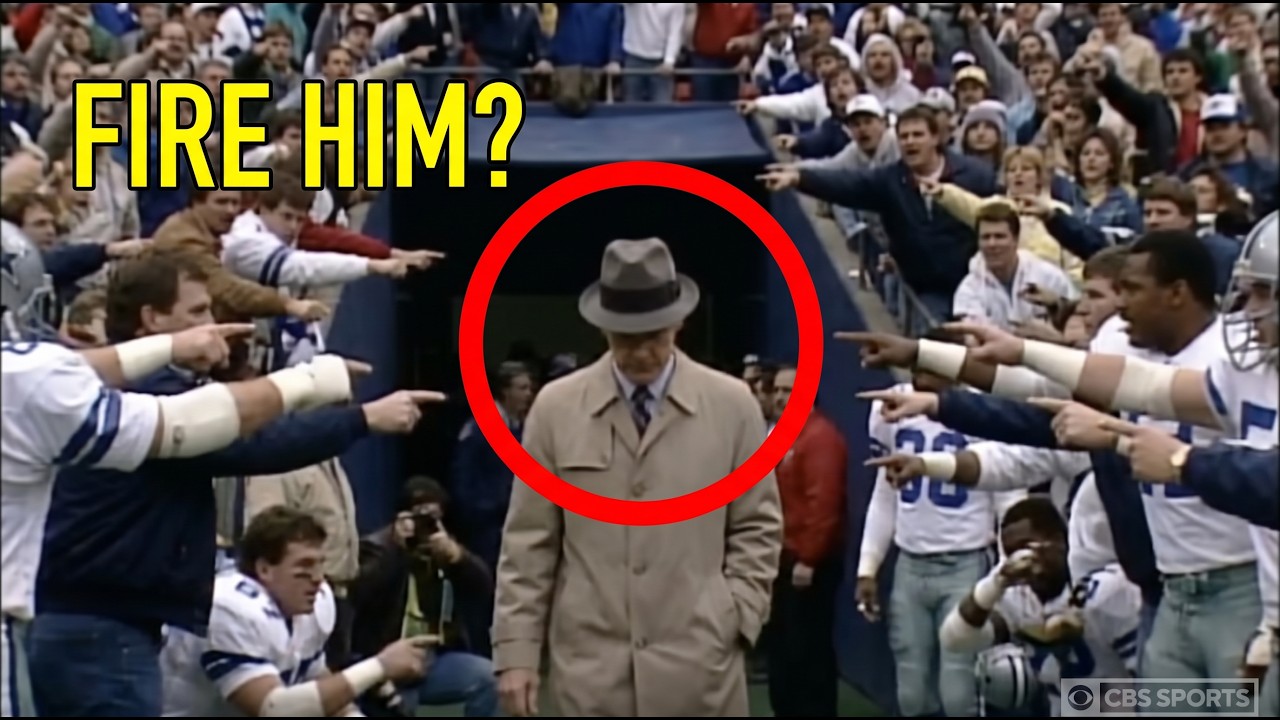
The longest contract in the history of American professional sports was not handed to a champion in his prime; it was given to the coach of the worst team in football at the very moment his own city was demanding his dismissal. This is the story of how one press conference built America’s Team, and why it happened. Tom Landry’s name is now synonymous with the Dallas Cowboys, with that trademark fedora, the stoic expression, and five Super Bowl appearances, two of them victories. What the highlight reels never mention is that none of it, not even one single Sunday, was ever supposed to happen.
In the winter of 1964, Tom Landry was on the verge of collapse, and everyone in Dallas knew it. Everyone except for one quiet oilman who was about to do the strangest thing any owner in the history of professional sports had ever done. Because the real story was never the contract itself; it was what the contract said about two men and what it had cost both of them to reach that point. To understand that press conference, you need to understand how bad things had become.
The Dallas Cowboys were founded in 1960 as an expansion team, assembled from castoffs of other franchises. In their first season, they did not win a single game. Zero wins, eleven losses, and one tie. A game that ended 31-31 against the New York Giants in New York was treated as the only good news of the entire year.
Owner Clint Murchison Jr. later joked about that game with genuine nostalgia, describing it as the day his team had finally not lost. Murchison was an understated Texas businessman with an engineering degree from the University of Montana. He bought a football team the way wealthy men buy ranches, then did something rare among owners: he stepped back and stayed out of the way.
The coach he hired was a 35-year-old Texan named Tom Landry. Here is something most fans never knew: Landry never even wanted to be a professional coach. He ran an insurance company in Dallas during the offseason. His plan was simple: coach for a few years, then return to business full-time.
Football was a detour for him, not a destiny. He was a quiet man of deep faith. A World War II bomber pilot who flew thirty combat missions before he was old enough to legally rent a car. He approached football the way he approached everything, with methodology, calm, and structure.
That structure was revolutionary. Landry created the 4-3 defense as an assistant coach with the Giants, the same defense that made Sam Huff a television star. In Dallas, he was building something no one had ever seen before: a scientific offense with shifting formations, a defense that read keys instead of chasing the ball. The problem was that none of it was working yet.
His players did not understand him, and some did not even believe in him. Behind his back, they called him “Old Stoneface. ” The losses kept piling up. In 1960, no wins.
In 1961, four wins. In 1962, five losses. In 1963, four wins and ten losses. Add it all together: 13 wins, 38 losses, and three ties across four full seasons.
The Cotton Bowl stood nearly empty on Sundays. Murchison was losing around $600,000 a year, a staggering sum in 1963, the kind of money that gave other owners nightmares. Sportswriters were circling. Sports Illustrated later described the critics of that era as howling like wolves.
In the newspapers, there was already frantic talk about who would replace Landry, including one name that dominated headlines: Bear Bryant, the biggest coaching legend in the South. Try to imagine Landry that winter. He was 39 years old. He had given everything to this team, and the entire city wanted him gone.
He was reading about his own firing in the morning paper over his coffee. His wife Alicia could see the strain even when the cameras could not, because his famous stoic expression was not coldness. It was armor. Landry believed that showing panic on the sideline would spread panic through his team.
So he showed nothing at all while everything around him burned. Through it all, he kept teaching a system no one believed in yet. He kept his faith, he kept his dignity, and he quietly prepared for dismissal like any other losing coach in the history of the game. That is what makes February 5, 1964, one of the strangest days in NFL history.
Clint Murchison called a press conference. Understand that this alone was news. Murchison did not hold press conferences. He was the most low-profile owner in football, a man who genuinely believed his job was to hire competent people and then leave them alone.
Reporters walked in expecting the obvious story, the one every losing team eventually writes: the coach has been fired, the search is underway, thank you for your years of service. Instead, Murchison announced that he had signed Tom Landry, the coach with 13 wins in four years, to a ten-year contract extension. On top of that, Landry already had 11 years remaining on his deal. It was the longest contract in the history of major American professional sports, given to a man with the worst record in football.
No one had ever heard of anything like it. Ten-year contracts did not exist. Not for champions, not for legends, not for anyone. The media was stunned.
People around the league openly wondered whether Murchison had lost his mind. This was more than a vote of confidence. This was an owner looking at four years of losing, empty stands, mounting debt, and a city screaming for change, and answering all of it with a single statement: this is my coach, and this debate is over. Gil Brandt, the legendary personnel director of the Dallas Cowboys, said years later that Murchison never hesitated in making the decision.
In Murchison’s view, Landry was the kind of man who could succeed at anything: banking, politics, whatever he chose. And if you found a man like that, you did not fire him just because the record had not caught up with him yet. You waited. Murchison supposedly treasured two things in life: his money and his patience.
In February of that year, he bet both of them together on Old Stoneface. Here is a detail that says everything about Clint Murchison: that press conference in February 1964, then his next one twenty years later when he sold the team. Two press conferences over a quarter-century of owning the Cowboys. One to save Tom Landry’s career, the other to say goodbye to him.
In between, silence and absolute confidence. In today’s world, where owners tweet their frustrations and fire coaches at midnight, that kind of restraint seems not merely rare but almost impossible. Now, what did that contract actually do? On paper, nothing changed.
The Cowboys had the same roster and the same growing pains. But something invisible changed everywhere else. Every player in the locker room now knew the system was not going to change, so they had two choices: learn it or leave. Every assistant coach knew the plan would be implemented.
And Tom Landry, the man who had quietly made peace with the idea of going back to selling insurance, suddenly had something almost no coach in NFL history has ever had: time. Real time. Time to build something the right way, brick by brick, without looking over his shoulder. He used every minute of it.
In 1965, the Cowboys scrambled to a 7-7 record, their first season out of the gutter. Then came 1966: ten wins, three losses, one tie, and an Eastern Conference championship game appearance. Tom Landry was named NFL Coach of the Year. The same writers who had been calling for his dismissal thirty months earlier were now calling him a genius.
But here is what no one expected, not even Murchison. The 1966 season was not the peak; it was the beginning. From that year forward, the Dallas Cowboys posted a winning record for twenty consecutive seasons. Read that number again.
Twenty. From 1966 through 1985. Across five presidential administrations, four economic recessions, retiring players, and entire eras of football changing, the Cowboys under Tom Landry never had a losing season. They appeared in 18 playoff games, won 13 division titles, and made five Super Bowls, winning two of them.
At some point, a television executive gave them a name that stuck: America’s Team. And the man in the hat, the man Dallas had wanted to fire, became the most famous coach on the face of the earth, standing on the sideline for 29 years. All of it growing out of one impossible decision announced to a room of stunned reporters in February 1964. Landry himself never boasted about it.
That was not his way. But those who knew him understood what that contract meant to him. Not the money, not the security, but the message behind it. In his darkest moment, when the whole world had given up on him, one man looked at him and said, in effect, “I see who you are, even if no one else does yet.
” For a man of Landry’s deep faith, that grace was more than a business matter. He spent the next two decades repaying it with work, the only currency he knew. The story has a bittersweet ending, familiar to Cowboys fans. Twenty-five years after Murchison’s press conference, a new owner bought the team and faced the same question: what do you do with Tom Landry?
Jerry Jones chose the opposite answer, firing the only coach the franchise had ever known in a move Dallas never fully forgave. Two owners, two decisions, but only one of them built America’s Team out of nothing but patience. Everyone loves a winner; that is obvious. But the truly rare thing, the thing that actually creates greatness, is believing in someone before there is any evidence.
Thirteen wins in four years was enough evidence for anyone to give up on Tom Landry. But Clint Murchison looked past the record and saw the man. Because of him, an entire generation of Americans grew up with the Dallas Cowboys on Sundays, never realizing that everything had been on the line in the winter of 1964.