The most enduring personal story to emerge from the Battle of Gettysburg centers on the death of Sergeant Amos Humiston of the 154th New York Infantry. He was killed during the first day of fighting on July 1, 1863, and his identity was lost in the chaos of the battle. When his body was found, he was clutching an ambrotype photograph of his three young children. A description of the image, which became known as “The Children of the Battlefield,” circulated throughout the North as authorities tried to identify the fallen soldier.
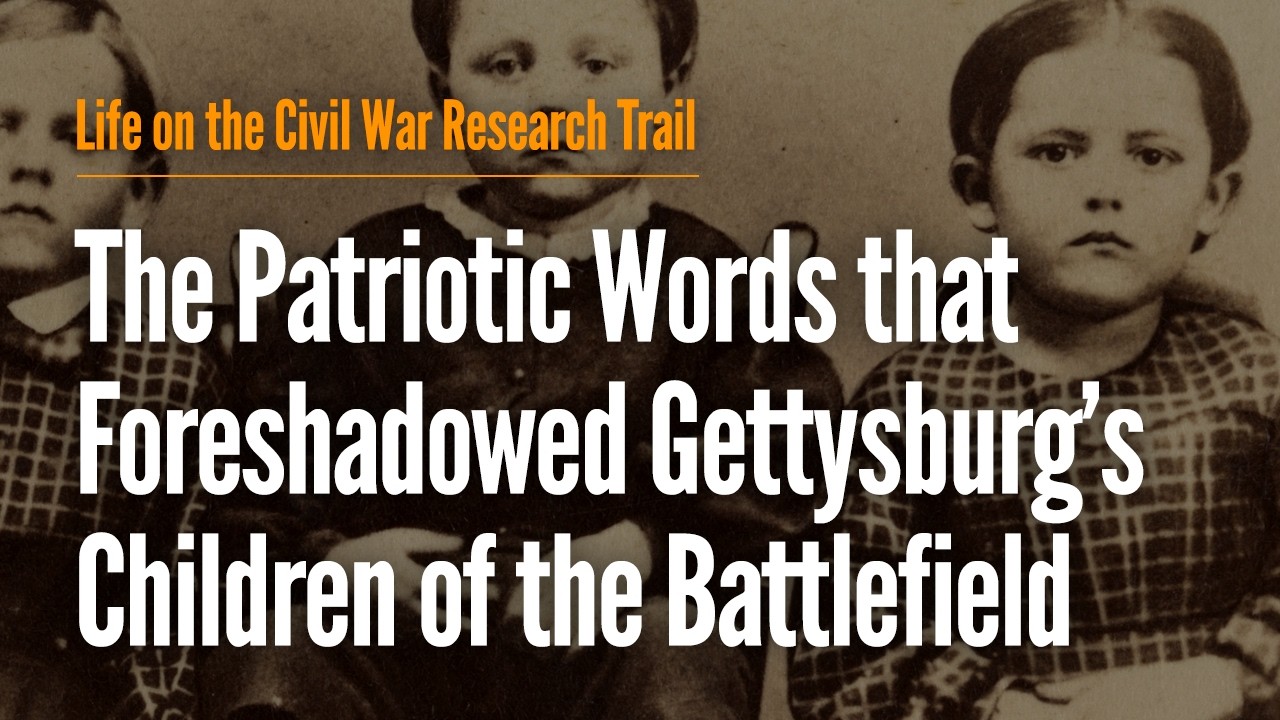
Eventually, Philinda Humiston, the soldier’s wife, responded to the inquiry and received a paper print of the photograph, known as a carte de visite, roughly the size of a modern trading card. She confirmed that the children in the image were her son and two daughters. In that moment, she learned she had become a widow and that her children had lost their father forever. While soldiers have been found dead with photographs on other battlefields, Humiston’s story remains the most famous account of military death and photography.
Other such narratives have been lost to time, as has a remarkable poem titled “The Carte de Visite. ” In patriotic and romantic verse, an anonymous poet told the story of a handsome young soldier who fell in the midst of battle, with his photograph lying upon his body. The poem appeared in two local newspapers, the Hartford Evening Press in Connecticut and the Daily Illinois State Journal, on the same day: August 29, 1862. That was roughly two months after the Seven Days Battles ended the Peninsula Campaign, two weeks before the Battle of Antietam, and nearly a year before Humiston met his fate at Gettysburg.
Two national publications, Harper’s New Monthly Magazine and William Lloyd Garrison’s The Liberator, printed the poem shortly afterward. Its appearance in such a diverse range of periodicals suggests it was mass-mailed to editors across the North in hopes of attracting attention. The poem opens with a soldier describing a terrible fight. He recalls that the colonel was among the first to fall, shot dead in the field by a rifle bullet.
“Never did a braver heart bleed,” he says. He then describes a scene fit for a painter: a soldier with a sunburned face, a fair young girl full of youth and beauty, and her old mother with wrinkled features and gray hair. The three sit on a porch where sunlight seeps through tangled jasmine leaves, spilling like golden wine and dotting the entrance with rings of flame. The soldier had stopped to rest on the road, for the weather was stifling with summer heat.
The road beneath his feet was like ashes, and he still had a long, weary distance ahead. He continues his account of the battle, explaining that the color-bearer was shot when the order to advance was given. Another soldier grabbed the flag, then he too fell dead in the same spot. The last one was a handsome youth, his curly hair clustered around his noble forehead.
The narrator imagines him now, with a crimson tinge on his charming face. When asked for the young man’s name, his regiment, and where he came from, the soldier replies that he does not know. He swears by God that he is telling the truth, and that he knows neither the boy’s name nor what part of the state he hailed from. But when they buried their dead that night, he took from the boy’s chest the photograph he now holds.
He holds it up to the light, saying it looks exactly like him. At the sight of it, a look of grief and astonishment crosses the mother’s face, and she grows even paler. Then a desperate, heartbreaking cry escapes her as she bends over her collapsed daughter. The poem is notable for having predicted Humiston’s death and the significance a photograph would play in his passing.
By 1864, possibly boosted by the real Humiston story, the poem’s popularity soared. That year it appeared in two collections of war poetry: “Pen Pictures of the War” and “Lyrics of Loyalty. ” In the latter, New York editor and journalist Frank Moore noted that the purpose of the collection was “to preserve some of the best specimens of lyric writing called forth by the present rebellion. ” As a result, “The Carte de Visite” appeared alongside works by literary giants such as Henry Wadsworth Longfellow, Ralph Waldo Emerson, John Greenleaf Whittier, and Harriet Beecher Stowe.
The poem’s success can be attributed as much to current events as to its artistic merit. The carte de visite, a recent French innovation, was immensely popular in America as grieving families struggled to come to terms with the growing casualty lists of the war. Its publication on the eve of the Second Battle of Bull Run and before the bloodshed at Antietam and Fredericksburg underscored how timely it was. The poem was not without critics.
In January 1864, a correspondent for the Springfield Daily Republican in Massachusetts wrote that the poem, usually called “The Carte de Visite,” had a pleasant rhythm and patriotic tone, woven from raw wartime material that was unfortunately cheaper than cotton, or else it would not have been used so much. The work was anonymous, or else the writer would have contacted the author, and it had now found a permanent place in a poetry collection. The critic also accused the unknown author of romanticizing the image of war. A weary soldier stops at a gate and tells a mother and daughter the story of a battle and how a young man was killed.
Of course, his hair clustered in curls around his noble forehead. But it is dangerous for such men to fight battles, for they are always the victims. The old soldier continues, saying he does not know the young man’s name, but he took the photograph from his chest. It resembles him as closely as a likeness can.
When the women see it, the girl faints and the mother leans down. The critic then asks pointed questions: did the young man carry his own photograph, and why? Is it romantic and moving for a young man to carry his own picture close to his chest? He appeals to the editor to resolve this doubt.
Despite the correspondent’s logical questions about the plot’s plausibility, readers did not seem to care. It was not the critic’s voice that drove the poem into obscurity, but the end of hostilities in 1865, which marked the beginning of a decline in public interest in all war poems. “The Carte de Visite” slowly faded into obscurity, though it continued to appear as late as 1922 in a Memorial Day poetry collection. By that time, however, the carte de visite itself had also disappeared, and the poem’s title had been changed to “The Photograph.
”