Elizabeth Taylor’s four children staged an intervention in late 1983, weeks before December, arriving at her home with written statements detailing what her addiction had done to each of them. She was 51, in constant pain from years of spinal surgeries, and had long relied on prescription medication and alcohol to a degree that her family believed was life-threatening. She thought they had come for a visit. She smiled, happy to see them together.
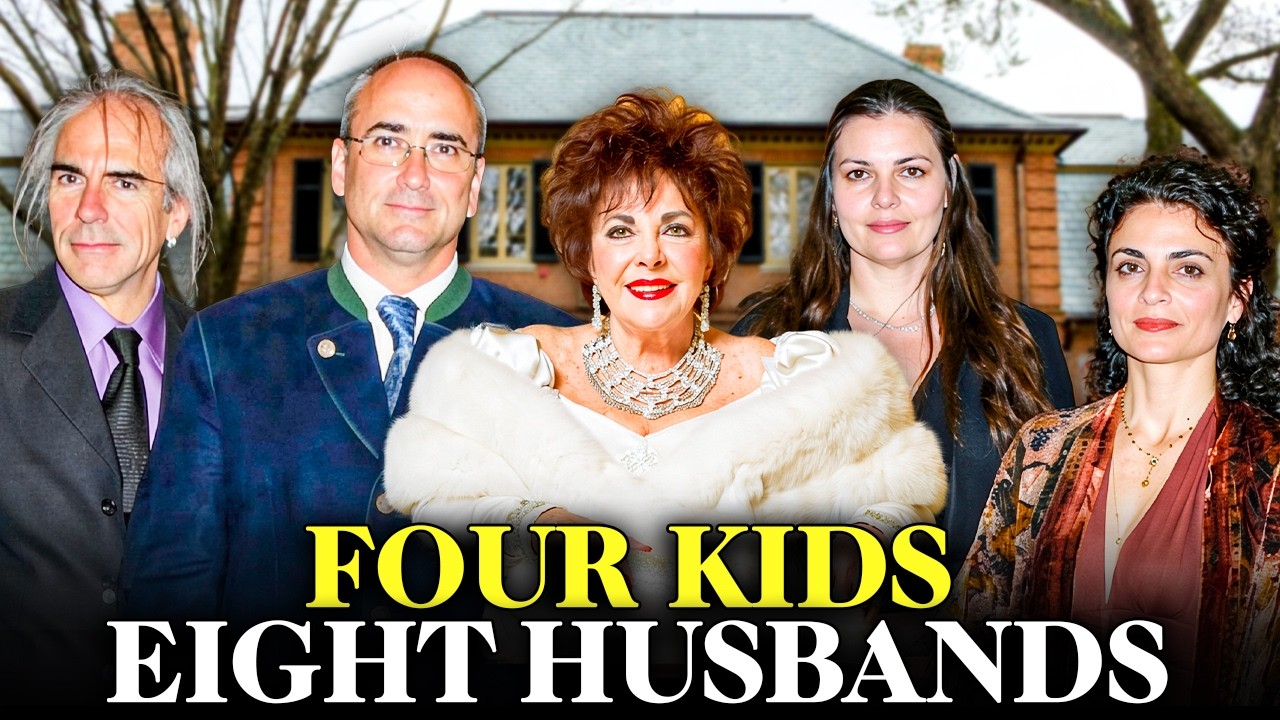
Then they sat down, took out their pages, and read aloud, one by one, in a room that had gone quiet. The scene broke through where years of doctors, publicists, and friends had not. During the confrontation, Elizabeth asked a question her children said they had never heard from her before: “I thought I was a good mother. How have I allowed myself to do this?
” She agreed to enter treatment and checked into the Betty Ford Center on December 5, 1983. The intervention saved her life. It did not repair the childhood that had already been consumed. To understand what her four children lived through, you have to understand how Elizabeth Taylor was made.
Born in London on February 27, 1932, she was placed under contract at MGM before she turned 11 and was a star by 12 through National Velvet. She was married at 18 to hotel heir Conrad Hilton Jr. in a ceremony that drew 3,000 spectators; the marriage lasted eight months. By the time she was old enough to understand what fame had cost her, she had already passed its consequences on to the next generation.
The children were Michael Wilding Jr. , born in 1953; Christopher Wilding, born in 1955; Liza Todd, born in 1957; and Maria Burton, adopted in the early 1960s. They were raised inside the most photographed private life in Hollywood history, standing just outside the frame, absorbing the adoration, chaos, relocations, addictions, and departures without the tools to process any of it. Michael arrived during Elizabeth’s marriage to British actor Michael Wilding, a quiet, gentle man 20 years her senior.
Christopher was born on her 23rd birthday. The marriage dissolved quietly within two years, and the boys were introduced to the pattern that would define their childhood: a new father figure, a new home, a new set of circumstances they could neither choose nor fully understand. Mike Todd was next. He matched Elizabeth’s intensity, bought her the jewelry that became the most famous private collection in the world, and gave the household direction and energy.
Liza was born on August 6, 1957. For a brief window, the family seemed genuinely happy. Then on March 22, 1958, Todd’s private plane crashed near Grants, New Mexico, killing everyone on board. Liza was seven months old.
She would know her father only through photographs and stories. His death confirmed a lesson the children would learn repeatedly: happiness in this household was vivid and temporary. Grief pulled Elizabeth into an affair with Eddie Fisher, her late husband’s best friend and the husband of Debbie Reynolds. The scandal was enormous and moralizing.
The marriage was emotionally hollow. But the Fisher years taught the children that their mother’s intimate life would always be public property, and that the household would rearrange itself around each new relationship without asking whether they consented or even understood. Maria entered the family carrying her own vulnerabilities, childhood hip problems that required multiple surgeries and sustained care. She needed a household organized around a child’s recovery.
She found instead a household organizing itself around the most famous love affair of the 20th century. In January 1962, Elizabeth Taylor met Richard Burton on the set of Cleopatra in Rome. The affair began around January 22, while both were married to other people. The Vatican condemned her as an “erotic vagrant.
” Paparazzi staked out every restaurant and hotel entrance. Newspapers covered it as though it were a geopolitical crisis. A photograph from that period captures the fracture: seven-year-old Christopher standing nearby while his mother touches up her eye makeup in full Egyptian queen costume, the machinery of the production about to reorganize his life completely. Christopher later provided the single detail that defines the family’s experience.
At boarding school, he found out what was happening in his own family by reading magazines. He heard taunts about his mother’s sex life from classmates who had read the same headlines and used them as weapons. Fame stopped being an abstraction and became something a child had to endure alone, in hallways and dormitories where no publicist or bodyguard could follow. The Burton marriage, for all the outside chaos, gave the children something they had never consistently had: a father figure who was present, intellectually engaged, and genuinely affectionate.
Burton read to them, talked to them like people, and was, by Christopher’s account, there for his main formative years. Christopher’s warmth in describing him, decades after Burton’s death, was unmistakable. That is what makes the coming destruction so devastating. Parts of the household were dazzling and affectionate.
And the marriage also gave the children a front-row seat to its annihilation. The couple married on March 15, 1964, and moved through a world of aristocrats, film producers, and yacht parties where the drinking was constant and the children were decorative rather than central. Life meant winters in Switzerland, shoots in Mexico, suites at the Dorchester, the yacht Kalizma cutting through the Mediterranean. The children had private tutors instead of school friends, household staff instead of neighbors, suitcases instead of roots.
The fights were not private. Screaming matches in hotel suites became part of the couple’s public brand, so well known that guests reportedly requested rooms near the Burton suite to eavesdrop. Whatever the exact truth of each anecdote, the collective record proves a precise measure of how completely the boundary between this family’s private suffering and the public’s appetite for spectacle had dissolved. Children were sleeping in adjacent rooms while strangers treated the couple’s marital violence as entertainment.
Christopher described the paparazzi not as occasional intrusion but as a fixed condition of daily existence. Photographers waited whenever the family left any building. He called the unrelenting attention “a huge drag,” a phrase whose deliberate flatness reveals more than dramatic language could. A child who describes the defining condition of his life as a drag has stopped expecting it to change.
The major structural events accumulated with grim regularity. Elizabeth and Burton divorced in 1974. They remarried in Botswana in October 1975, in a game park, and divorced again in 1976. For the children, that sequence formalized instability as family creed.
When your parents divorce, remarry, and divorce again within 20 months, the lesson is not about the persistence of love. The lesson is that nothing in this family is safe. After Burton, Elizabeth married Senator John Warner in December 1976. The marriage was quieter and conventionally respectable, but produced its own slow misery.
Elizabeth gained weight, drank heavily, and struggled visibly with the contraction from international superstar to Washington political wife. The marriage ended in 1982. By then she was 50, had been married seven times, and her use of alcohol and prescription medication had crossed from coping into genuine danger. Christopher addressed the medical reality without offering an excuse for the dependency.
His mother had real back problems, years of spinal issues and chronic pain that would have challenged anyone’s relationship with medication. But he also said something harder: she liked being high. The genuine physical suffering had merged with a genuine appetite for chemical escape, and no one, not Elizabeth, not her physicians, not her family, could separate them. The doctors failed systematically.
Elizabeth was so persuasive, so accustomed to having her desires met, that the physicians who treated her could not hold their professional ground. They prescribed what she asked for and renewed what she demanded. The entire apparatus around her, agents, publicists, assistants, friends, operated on the same principle. People who depended on Elizabeth Taylor for their livelihoods or proximity to fame were structurally incapable of telling her the truth.
The burden of honesty fell by default on the only people with no professional stake in her goodwill and no realistic option to walk away: her children. They were the last honest people in the room, and they were also the least powerful. By the autumn of 1983, they had decided understanding was no longer enough. They prepared written statements, specific and personal accounts of the damage her addiction had inflicted on each of them.
They rehearsed. They braced for her reaction. When she saw them arriving, her first reaction was pleasure. Then they took out their pages, and the temperature in the room changed completely.
Christopher described the atmosphere with a single phrase: “We were all petrified. ” Not angry, not self-righteous, but terrified, adults who genuinely believed she might die if they did not speak the truth to her face. One by one, they read their statements. Elizabeth listened.
By her own later account, she was stopped dead in her tracks. Then came the question that reframes the entire legend from the children’s side: “I thought I was a good mother. How have I allowed myself to do this? ” Elizabeth Taylor was not a villain.
She was a woman who had been performing since childhood, who had learned to conflate love with spectacle, who had numbed her pain with substances, and who had surrounded herself with people too dazzled or too dependent to tell her what she was doing. Her children finally broke through. At Betty Ford, she shared a room with another patient, was assigned chores, and followed an institutional schedule that did not bend for celebrity. The staff addressed her as a patient, not a guest of honor.
The experience of being handled with professional competence rather than awe was both humbling and freeing. She would later become one of the first major celebrities to discuss her addiction publicly. But the public courage followed the private reckoning. The children had done the difficult thing first.
Months later, on August 5, 1984, Richard Burton died of a cerebral hemorrhage in Geneva at 58. For the world, it was the death of a great actor. For Elizabeth, it was the loss of the one person whose hold on her heart had never loosened. Christopher stated it without hedging: her love for Burton never went away.
His death provided finality without resolution. And the children grieved him not merely as their mother’s great lost love, but as a man who had been materially present in their daily lives. In the mid-1980s, as the AIDS epidemic devastated communities and most of the entertainment industry kept its distance, Elizabeth became one of the first major celebrities to commit publicly to the fight. She co-founded the American Foundation for AIDS Research in 1985 and later established the Elizabeth Taylor AIDS Foundation.
She lobbied Congress, confronted presidents, and raised tens of millions of dollars at a time when many peers were terrified even of association with the cause. For the children, however, the activism carried a quiet irony. Elizabeth sober was still Elizabeth Taylor, enormous and public, committed to something larger than any household could contain. They once again stood just behind the bright light their mother cast across the world.
She married one final time, to construction worker Larry Fortensky, whom she had met at Betty Ford, in a ceremony at Michael Jackson’s ranch in October 1991. The marriage lasted until 1996. The children weathered it with the weary patience of people who had long since abandoned the expectation that her love life would stabilize. Her health declined visibly through the final decade.
Back problems worsened, followed by hip replacements, skin cancer, a benign brain tumor treated in 1997, and congestive heart failure that worsened through the 2000s, increasingly confining her to a wheelchair. The children navigated these years with the grim expertise of people who had been managing their mother’s medical crises since childhood. The four children solved the same equation in four different ways. How do you construct a self that can survive the gravitational pull of the most famous mother in the world?
Michael Wilding Jr. moved farthest from the original script. He tried acting and music first, then in 1991 left Los Angeles for Santa Fe, New Mexico, and built a life as a sculptor in bronze and steel. The move was a deliberate withdrawal to a landscape where the Taylor name carried less pressure and where his work was assessed by what his hands produced rather than by whose son he was.
He continued exhibiting into 2025. Christopher Wilding stayed closer to the industry but positioned himself behind the camera, working in film editing and sound, technical and invisible roles. He described himself as an introvert, a word whose poignancy becomes clear only when you consider the household that produced him. He became the family’s designated rememberer, able to describe what fame had cost them all without bitterness or self-pity.
By 2024, he was living in Sierra Madre, California, recently retired, and speaking about his mother with precision that honored both her gifts and her failures. Liza Todd built her adult life around things that could not betray her. Horses first, animals whose loyalty was not conditional on performance and whose daily needs imposed the routine her childhood never provided. Then sculpture, practiced with discipline after formal training in London and Los Angeles, establishing her as a working artist in her own right.
Later she turned increasingly to wildlife conservation, particularly elephants. She chose rootedness with the deliberateness of someone correcting a fundamental error. Maria Burton chose the most radical solution available to any of them: silence. She left the smallest public footprint of the four.
She appeared occasionally through family contexts and through her daughter’s involvement with the Elizabeth Taylor AIDS Foundation, but gave the world nearly nothing of her interior life. In a family where visibility was as involuntary and constant as breathing, her sustained withdrawal into privacy required a continuous act of will. It was not passivity. It was the most deliberate choice any of them made.
Elizabeth Taylor died on March 23, 2011, at Cedars-Sinai Medical Center in Los Angeles, at 79. The cause was congestive heart failure. She had been hospitalized for six weeks, and the children had rotated through the vigil. The official family statement confirmed she died surrounded by her children.
Michael issued the public words: she had lived with great passion, humor, and love. The words were also true. Her funeral at Forest Lawn Memorial Park began 15 minutes late. She had specified the delay in her plans.
She even wanted to be late for her own funeral. It was the last performance, both charming and exhausting. Christie’s auctioned her collection in 2011 for more than $156 million. The jewelry alone accounted for a staggering portion.
For the children, the auction represented something more complicated than a financial event. These were objects associated with specific marriages and specific rooms, and watching them dispersed across private collections was a final act of the pattern that had defined their lives: the private becoming public, the personal becoming property. More recent documentaries moved closer to the truth. Elizabeth Taylor: The Lost Tapes, directed by Nanette Burstein for HBO and released in 2024, used Taylor’s own audio recordings and family voices to reconstruct something more private and honest than the standard legend.
The BBC’s Elizabeth Taylor: Rebel Superstar, also from 2024, attempted a similar recovery. The most revealing inheritance was the one no auction could price. The Elizabeth Taylor AIDS Foundation continued its mission, with visible stewardship shifting from the children’s generation to the grandchildren. Quinty, Liza’s son, has served as co-trustee of Elizabeth’s estate since 2016 and as an officer of the foundation.
Naomi Wilding, Christopher’s daughter, appears publicly through the foundation’s work. Eliza Carson, Maria’s daughter, carries the family name into the next circle of engagement. The generation that endured the glare stepped back. The generation that inherited the legacy without living through the damage created it stepped forward.
The children are not publicly estranged, but they are not a visible unified public clan either. That restraint is itself a legacy. They learned through decades of hard evidence that public togetherness in this family was never as simple or as stable as it appeared in photographs. Michael Wilding Jr.
is now 73, living and working in the art world he constructed in New Mexico. Christopher Wilding is 71, retired in Sierra Madre, the family’s steadiest voice when a voice is called for. Liza Todd is 68, her life organized around sculpture, horses, and conservation. Maria Burton remains the hardest to locate in the present tense.
That is the story’s final proof. In a family defined by the impossibility of being unseen, she found a way to disappear from public view. Elizabeth Taylor gave her children devotion, damage, and an impossible surname. She gave them beauty, access, wealth, and a childhood no amount of money could make stable.
There is no tidy moral in that inheritance. There is only the image at the end: four children, old enough to have understood their mother completely, standing beside the bed where the legend finally went quiet.