It was just past two in the morning on November 4, 1274, when Mongol, Chinese, and Korean troops began landing on the northern coast of Tsushima, a forested island between Korea and Japan. The invasion force of roughly one thousand ships and tens of thousands of soldiers had crossed from the Korean port of Hopo to overwhelm the island’s small samurai garrison. The man responsible for Tsushima’s defense, So Sukekuni, had only about eighty mounted samurai to face an army that outnumbered his force by a hundred to one. Six years earlier, Kublai Khan, ruler of the largest continuous land empire in history, had sent letters demanding Japan’s submission and tribute.
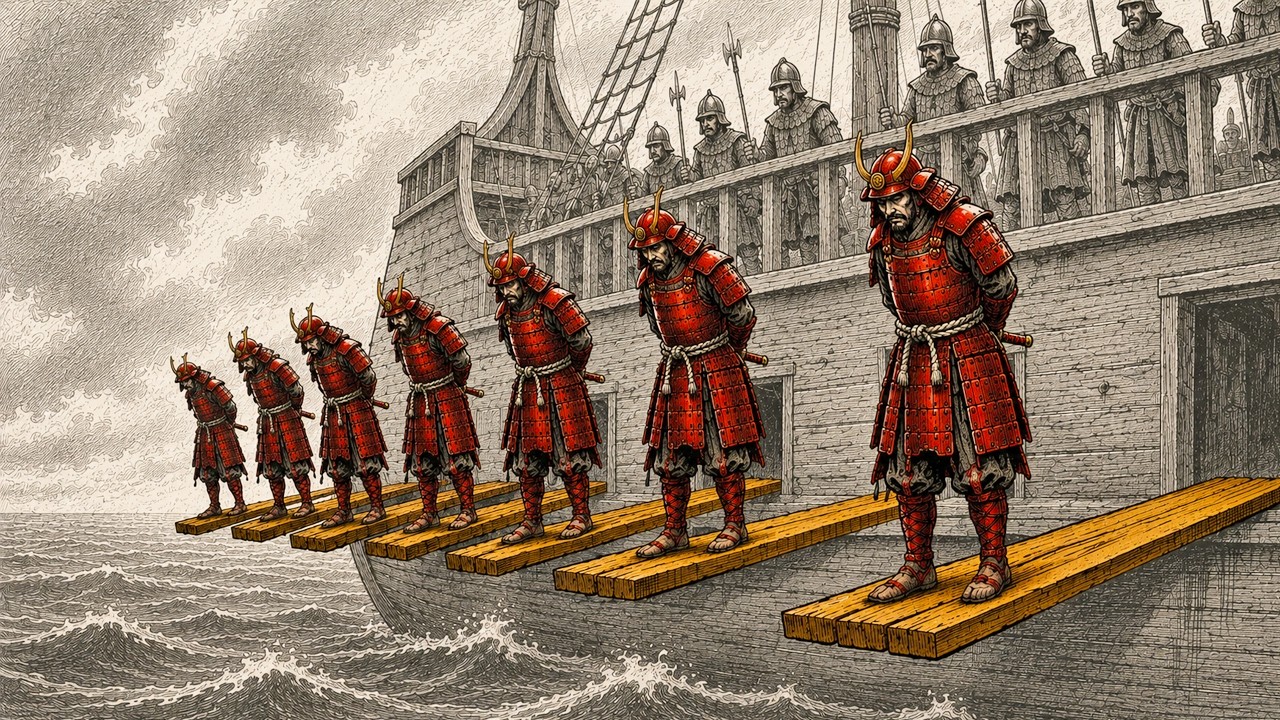
The Kamakura shogunate refused to answer any of the six letters sent between 1268 and 1273. From the Mongol court’s perspective, the silence was an insult and an invitation. Kublai ordered a fleet built, and Tsushima, located roughly halfway between Korea and Kyushu, became the obvious first target. The men aboard that fleet were mostly not Mongols.
Many were Korean sailors forced into service after the Mongol conquest of Goryeo, and others were Chinese conscripts taken from northern villages. They were attacking Japan on behalf of an empire that had already conquered them. Estimates place the total invasion force at twenty-two to thirty thousand men, with the portion that landed on Tsushima still numbering several thousand. So Sukekuni, steward of Tsushima and head of the So clan, was a professional frontier lord.
His mounted core consisted of around eighty samurai in lamellar armor, armed with tachi swords, yari spears, and the asymmetric yumi bow. They were trained to fight as individuals, to announce themselves, to challenge worthy opponents, and to duel. The Mongol forces fought a completely different war, one based on massed volleys, coordinated blocks, and disciplined formations directed by drums, horns, and flags. Around dawn, Sukekuni sent envoys toward the landing force to ask what the ships wanted and what terms were being offered.
This was the Japanese way: before combat, there is speech. The Mongols answered with arrows, cutting down some of the emissaries before they could complete a sentence. The message was clear: there would be no parley, no introduction, no etiquette. Sukekuni had real options.
He could have retreated into Tsushima’s forested ridges and tangled underbrush, where a small force could have bled a larger army from the trees. He could have sent riders south to Kyushu and evacuated civilians. Instead, he gathered his eighty men, mounted them, and ordered a frontal charge across an open beach into an enemy that vastly outnumbered them. No clever tactic, no hidden reserve, no fleet in the harbor.
Only eighty men and a beach. The samurai broke from the tree line about two hundred to four hundred meters from the enemy line. The first exchange was archery from the saddle, the traditional Japanese opening in which a samurai rode toward his target and loosed aimed arrows before closing for the sword duel. The Mongol line did not scatter.
At a single order, massed composite bows released volleys that turned the sky dark. The samurai in the front rank began falling before they ever reached sword range. Arrows found seams in armor, faces below helmets, and the necks of horses, which collapsed at full gallop and threw their riders into the wet sand. A later Japanese military writer summarized the tactical horror in one sentence: our warriors fought according to ancient custom, but the enemy fought in ranks and fired many arrows together.
The samurai were facing a system designed to erase individual action. Yet some, perhaps thirty or forty, made it through the arrow storm. Once they reached the Mongol infantry line with their tachi drawn, they proved to be the finest close-quarters horse and blade fighters of their time. For ten or twenty minutes, they carved through the enemy, cleaving light armor, severing spear shafts, and taking heads.
Each samurai was a small, fierce whirlwind, but there were only eighty whirlwinds against thousands. The Mongols did what they had trained to do. They folded around each charging samurai, enveloping them with spearmen and fresh archers. Each pocket of surrounded samurai became its own small massacre.
So Sukekuni was in one of those pockets somewhere; accounts differ on whether he died in the first clash or later led a final desperate sortie near nightfall, but all agree he did not leave Komoda Beach alive. It is at this point that one name emerges from the confusion. So Sukesada, likely a relative of Sukekuni, a cousin, nephew, or son by another line, was a samurai in his prime. According to the So clan’s own genealogical record, he cut down twenty-five enemy soldiers in individual combat before he fell.
A tachi with a full swing requires both hands and full body torque, and twenty-five effective strikes against moving, armored opponents means minutes of continuous killing, arms heavy as anvils, and a man who knew from the first blow that he was not going to survive. He was just going to be expensive. The chronicle does not say whether a spear, an arrow, or a mace finally dropped him, only that he fell. By late morning, or by nightfall if one follows the alternate chronicle, the Japanese defense of Tsushima had ceased to exist.
The beach was covered in bodies, Japanese and Mongol and Chinese and Korean, mixed together with dead horses, broken weapons, and scattered arrows. The Mongol commanders did not linger to perform funerary rites. The bodies of the eighty samurai were left where they lay, some later thrown into pits, some tumbled into the sea, most left for animals and weather. The Mongols were not finished.
Over the remainder of November 4 and into November 5, columns of troops moved through Tsushima’s coastal areas, going into fishing villages, farming hamlets, and Shinto shrines. They killed inhabitants who had not fled, took some prisoners as slaves or for ransom, and set fire to homes, boats, and storehouses of rice meant to feed the island through winter. They burned the shrine gates and the temples. No contemporary chronicle provides a body count for the civilian dead.
Later prayer inscriptions based on oral memory describe the horror plainly, praying for the souls devoured by foreign soldiers when they burned our island. The survivor story is barely recorded at all. Villagers who hid in the forested hills watched their homes burn and listened to sounds they hoped their children could not identify. When the smoke thinned, those who crept back down saw the ashes of their houses, the bodies of neighbors, the pulled-down torii gates, and the beach where eighty suits of armor lay scattered across the sand and into the shallows.
In one patch of sand, closer to the tree line, lay the bodies of two dozen enemy soldiers around a single Japanese sword. The Mongol side lost at minimum the twenty-five men Sukesada cut down, and likely dozens more in the general melee. Total invasion losses at Tsushima almost certainly ran into the low hundreds, a rounding error for a force of tens of thousands. The Yuan chroniclers described the Japanese as fierce but few, brave and capable, but tactically obsolete.
News of the invasion reached Kyushu within days, carried by coastal sailors from surviving villages or warriors who had been away during the landing. From there it climbed the samurai command hierarchy to Kamakura, where the Hojo regents, who had refused to answer Kublai Khan’s letters, now had to read what refusal had cost. The Azuma Kagami, the shogunate’s chronicle, records the shock, calling the invaders foreign bandits attacking western islands and killing local stewards. The cult of the heroic charge grew over centuries.
The number of 8,000 Mongols against 80 samurai that appears in every popular retelling is not from any Yuan document; it is a later Japanese rhetorical figure. The real Mongol force that landed was probably several thousand, still overwhelming, still unwinnable. The image of Mongol gunpowder bombs shredding samurai lines at Tsushima also has almost no direct evidence for 1274; significant gunpowder deployment came in the second invasion of 1281 at Hakata. What killed the samurai at Komoda was massed arrows, coordinated volleys, and discipline.
This distinction matters. Tsushima was not a story about magic weapons defeating brave men. It was a story about a small culture that fought as individuals meeting a large culture that fought as a system, and the system won. Sukekuni was not overwhelmed by exotic technology; he was overwhelmed by organization, by an army that had learned generations earlier to be brave together.
The survivors of Tsushima did not know that Kublai Khan would try again in 1281 with an even bigger fleet, and that the island would burn twice. The Samurai class took a lesson from the battle: old assumptions that combat was individual, that enemies would announce themselves, that honor governed war, had died on Komoda Beach. New coastal defenses were built, new tactics considered, and a stone wall nearly twenty kilometers long would eventually be constructed around Hakata Bay. For the So clan, the ruin of Tsushima became the foundation of centuries of authority.
The clan rebuilt and turned the island into the hinge between Korea and Japan, a place of diplomacy and trade. For four hundred years, they brokered relations between the Japanese archipelago and the Korean peninsula, negotiating treaties and running trading missions. The martyrdom of Sukekuni became a piece of clan identity, proof of the price of the seat they occupied. Over the generations, the story hardened into parable, a demonstration of what samurai were or were supposed to be.
Later writers polished it, later warriors invoked it, and by the modern era, when a video game brought Komoda Beach back into the world’s imagination, most of what people knew about it was fiction. The actual battle was not a tale of magical weapons, not a simple duel of honor. It was the story of eighty men who stood on a beach when the beach needed standing on, and one of them killed twenty-five enemies before he fell. Everything else is prayer.
The Mongol fleet, essentially untouched, moved on to Iki Island and then Hakata Bay, where the real Japanese army finally met them, and where a storm, the first kamikaze, the divine wind, shattered the fleet and drove the survivors back to Korea. At Tsushima, there had been no wind, only the arrows, the choice, and the fire.