In 1953, a small California beverage company accomplished something no major soda manufacturer had ever attempted: it put soft drinks in flat-top aluminum cans. Within fifteen years, more than half of all soda sold in the United States came in that format, and Coca-Cola, Pepsi, and every regional bottler eventually followed. The company that started it all was called Shasta. Three years after that breakthrough, Shasta was sold to a Chicago conglomerate best known for pantyhose and frozen cheesecake.
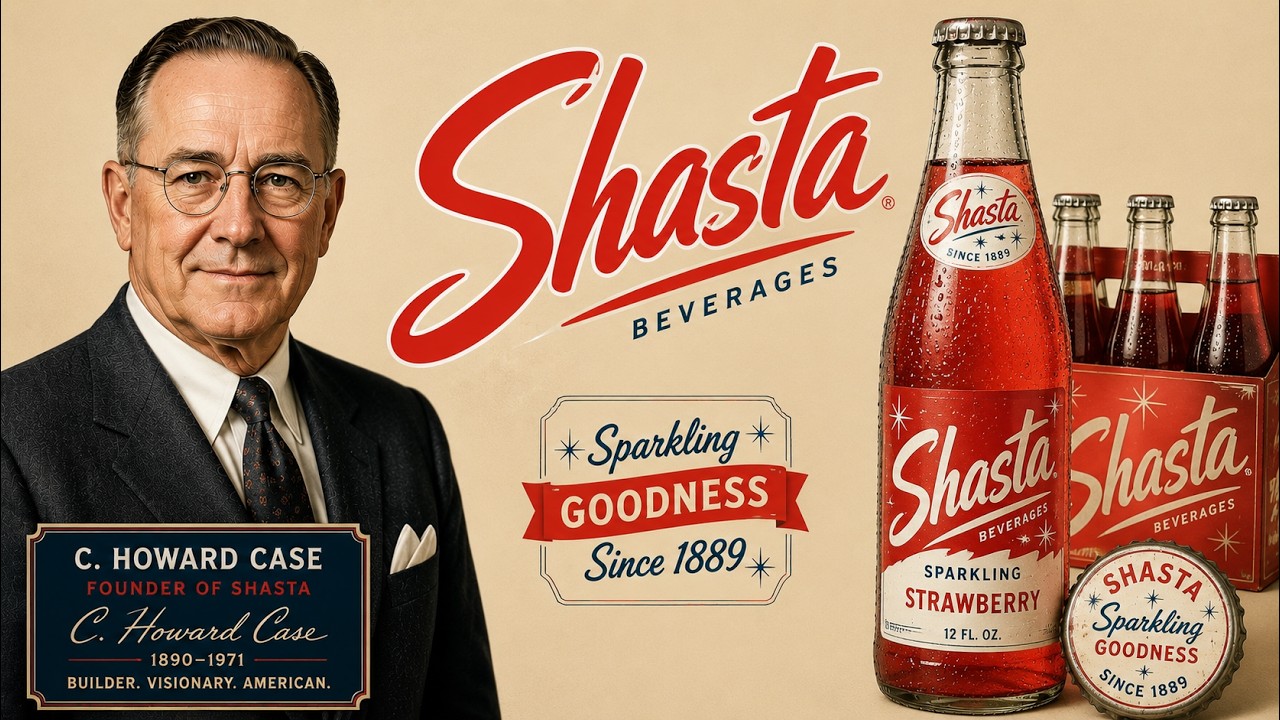
The sale was not the result of failure or bankruptcy. The owners simply stopped understanding what they had built. But the full story of Shasta is not really about the can. It is the story of a brand that reinvented the American soda industry three separate times and never received credit for any of it.
The company’s origins trace back to 1889, at the base of Mount Shasta in Siskiyou County, Northern California. The region was remote, and the railroad had only arrived a decade earlier. Beneath the dormant volcano, natural springs pushed mineral-rich, faintly carbonated water up through volcanic rock. In an era of contaminated urban water supplies, that spring was genuinely valuable.
In December 1889, a group of investors incorporated the Shasta Mineral Springs Company. Their plan was simple: bottle the water in glass siphon containers and ship it by rail to hotels, spas, and wealthy households along the West Coast. The logistics were not simple. Glass was heavy and fragile, and metal freight cars contaminated liquids.
The founders responded by lining the interiors of their railroad cars with glass, creating sealed, temperature-stable chambers. It was expensive, but it worked. By the turn of the century, Shasta mineral water was flowing into restaurants and hotels across the Pacific coast. In 1928, the company opened its third bottling facility and changed its name to the Shasta Water Company.
Then Prohibition reshaped its market. From 1920 to 1933, Americans turned to mixers and mineral water as alcohol was banned. When repeal arrived, alcohol returned, and the mixer market contracted almost overnight. Shasta needed a new reason for Americans to buy its products.
In 1931, during the deepest point of the Great Depression, Shasta introduced its pale ginger ale. Priced below Coca-Cola and bottled for home consumption, it was marketed not as a treat but as an everyday beverage a working family could afford. It sold steadily through the worst economic collapse in American history, appealing to exactly the kind of customer Shasta would chase for the next five decades: people who wanted something good but could not pay full price. The 1950s brought Shasta’s most consequential decade.
In 1953, the company made three decisions that rewrote the rules of the American soft drink industry. First, it committed fully to canned soda, using flat-top aluminum can technology developed primarily for beer. The can was lighter than glass, cheaper to ship, and required no return deposit. Soda in cans represented roughly one percent of American soft drink volume in 1950.
By the end of the 1960s, that number had crossed fifty percent. The second decision was diet soda. In 1953, no mainstream low-calorie soft drink existed. Shasta introduced its first low-calorie line the same year, using saccharine.
The taste was imperfect, but the category was real. Coca-Cola did not launch Tab until 1963. Pepsi followed with Diet Pepsi in 1964. Shasta had been selling low-calorie soda for a full decade before either competitor entered the space.
The third decision was distribution. In 1953, soda distribution ran through independent bottlers with exclusive territorial franchises. Shasta cut that chain entirely, establishing direct wholesale relationships with grocery store buyers. Without middleman markup, Shasta could price its products below the franchise system’s structural cost.
By the late 1950s, a 12-pack of Shasta in multiple flavors cost less than a 12-pack of Coca-Cola in a single flavor. The fourth pillar was flavor. While Coca-Cola guarded one formula and Pepsi guarded another, Shasta built an expanding library: root beer, orange, cherry cola, lemon lime, grape, strawberry, grapefruit, and later Tiki Punch, packaged in a vivid hot-pink can that became one of the most recognizable soda images of the 1970s. The philosophy was practical.
A family of four rarely agreed on a single flavor, and one case of Shasta could satisfy everyone. This built a loyalty rooted not in brand aspiration but in household utility. By 1960, Shasta had become the dominant value soda brand across the western United States without a celebrity spokesperson, national advertising campaign, or franchise bottler network. But the company had a problem.
Families bought Shasta because it made sense; they did not yet love it. In the American consumer market of the 1960s, the distance between those two positions was the difference between a brand that endures and a brand that gets sold. In the late 1960s, Shasta launched an aggressive television advertising campaign, humorous and high-energy, focused on one message: more flavors, lower cost, comes in a can. By the early 1970s, Shasta had embedded itself into a specific corner of American domestic life: the backyard, the kitchen table, the cooler at the Little League game.
In October 1972, Shasta aired what became its defining commercial on Saturday morning television. Animated children marched in a parade singing “Shasta, the pop that has to. ” The narrator was Tom Bosley, the actor who would soon become famous as Howard Cunningham on Happy Days. His closing line: “So many bubbles it’ll tickle your nose.
” It worked with remarkable precision. Millions of American children absorbed the message, and their parents, already predisposed to Shasta’s price point, found the decision easy. Tiki Punch arrived in this same window. The flavor was tropical and sweet, but the can mattered more: hot pink, visible from twenty feet.
In an era of predominantly red, white, and brown packaging, it announced itself with a confidence advertising copy could not manufacture. For an entire generation of children growing up in the suburban West, Tiki Punch was not a flavor. It was a season. In 1977, Shasta found a face for the brand.
Barry Williams, known to America as Greg Brady from The Brady Bunch, appeared in a Shasta Orange commercial dressed in medieval armor. The narration came from Casey Kasem, the voice of American Top 40. The commercial was absurdist and self-aware, and it worked because Shasta’s advertising genius was recognition, not sophistication. Every commercial confirmed the decision the consumer had already made.
By the late 1970s, Shasta had built something no balance sheet fully captured: a brand that three generations of the same American family could recognize simultaneously. The grandfather who bought ginger ale during the Depression. The mother who switched to diet Shasta in the early 1960s. The child who watched Tom Bosley on Saturday morning and demanded Tiki Punch at every birthday party.
That was the peak, and even at the peak, the forces gathering against Shasta were already in motion. In 1983, Shasta was expanding east, increasing advertising spend, and chasing national relevance. The campaign that emerged became the most culturally durable thing Shasta ever produced, and it was a jingle. Shasta’s ad agency hired a young musician named Al Jourgensen, then 24 and based in Chicago, to write and perform the commercial’s centerpiece song.
The lyrics were simple: “Don’t give me that so-so soda, the same old cola. I want a rock and roller. I want a pop. I want a Shasta.
”
The production was saturated with the sonic texture of 1983: synthesizers, driving rhythms, neon colors, geometric animation, and dancing penguins wearing sunglasses. The campaign ran in multiple versions through 1984 and locked Shasta into the consciousness of an entire generation of American children, the cohort later labeled Generation X. What those children did not know was that the man singing about wanting a Shasta would spend the following decade founding Ministry, one of the most influential industrial metal bands in American music history. The distance between “I want a pop” and Psalm 69 is one of the more improbable trajectories in American music.
But in 1983, none of that existed yet. There was only the jingle, the neon, and the penguins. The cultural penetration of that jingle became evident in 2002, when director M. Night Shyamalan inserted the original “I Want a Pop” television spot into a scene in his film Signs.
Not as a joke or parody, but as a genuine artifact of American domestic life. The audience recognized it instantly without explanation. By the mid-1980s, Shasta had achieved what its founders could not have imagined. Its can format had become the universal industry standard.
Its diet line had pioneered a category now dominated by Coca-Cola and Pepsi. Its advertising had reached three consecutive generations of American consumers. At its peak, Shasta was not competing with Coca-Cola for prestige; it was competing for the weekly grocery decision made by a parent with a budget, a cooler to fill, and children with opinions. In that contest, Shasta won more often than anyone outside the industry fully appreciated.
What happened next was not a single catastrophic failure. There was no contamination scandal, no regulatory collapse, no founder’s death that destabilized the company overnight. What happened to Shasta was slower and quieter. It was the story of a brand sold to people who did not understand what they had bought, and of an industry that learned everything Shasta taught and then used those lessons to bury it.
That story had begun 17 years earlier. In 1966, Consolidated Foods Corporation, a Chicago-based conglomerate, purchased Shasta. Consolidated Foods was a holding structure that had spent the post-war decades acquiring consumer goods companies. By 1966, it owned Electrolux vacuum cleaners, Hanes Hosiery, and Sara Lee Baked Goods.
The company would eventually rename itself Sara Lee Corporation in 1985. Shasta fit the portfolio as a cash-generating consumer product with established distribution and low capital requirements. It was not acquired because anyone at Consolidated Foods loved soda. It was acquired because the numbers worked.
The first thing the new owner did was rename the company Shasta Beverages. The second was to rationalize the operation, standardize production, and optimize margins. What it did not do was ask why Shasta had won. The answer, had anyone pursued it, was uncomfortable.
Shasta had won because it moved faster than its competitors. It saw the can before Coke, saw diet soda before Pepsi, saw direct grocery distribution before either. Its competitive advantage was institutional speed, the willingness of a smaller, hungrier company to take structural risks that larger competitors would not. Consolidated Foods was not a smaller, hungrier company.
Meanwhile, the competitors Shasta had outmaneuvered were arriving. Coca-Cola launched Tab in 1963, one decade after Shasta introduced low-calorie soda. Tab used cyclamates, which the FDA would ban in 1969 over a potential cancer link, forcing a reformulation. But Coca-Cola spent money on Tab that Shasta could not match, and the marketing apparatus turned it into a cultural phenomenon.
Diet Pepsi followed in 1964 with the same dynamic. The pattern was consistent and brutal: Shasta pioneered, the major players followed, and their marketing budgets rewrote the history of who had arrived first. By the early 1970s, the category Shasta had created was dominated by brands that had not existed when Shasta introduced the concept. The can format was now universal, so it was no longer an advantage.
The direct-to-grocer distribution model was now standard industry practice. Every structural advantage Shasta had built was gone, copied, absorbed, and scaled by competitors with far greater resources. What remained was price, and in the American consumer market, price alone is a foundation that does not hold. The second ownership transfer came in 1985.
Sara Lee, operating under that name by then, sold Shasta Beverages to National Beverage Corporation, a newly formed holding company headquartered in Fort Lauderdale, Florida. National Beverage had been assembled by a businessman named Nick Caporella, who had also acquired Faygo, a Detroit-based value soda brand. The logic was straightforward: Shasta and Faygo would together give National Beverage dominant coverage of the American value soda segment, Shasta in the west and Faygo in the east. It was a rational business decision, and it was the moment Shasta ceased to be a brand with a trajectory and became a brand with a position.
A fixed, defended, slowly shrinking position at the bottom of the grocery store soda aisle. The 1980s brought a structural shift no value soda brand was equipped to survive intact. The American beverage market fragmented. Snapple expanded nationally, pulling consumers toward premium non-carbonated alternatives.
Perrier and Evian established bottled water as aspirational. Gatorade, which had launched in 1965, reached mass market scale in the 1980s, capturing the active consumer demographic. The baby boomers who had grown up drinking Shasta from pink cans were now 35, with incomes their parents never had, and opinions about what their beverage choices said about them. A 12-pack of value soda said something they were no longer willing to broadcast.
Shasta did not lose those consumers to Coca-Cola. It lost them to a category that had not existed when Shasta was built: the premium non-soda beverage. The drink that cost more, signaled more, and satisfied something that cheap carbonated sugar water could no longer satisfy. Shelf space allocated to Shasta in California supermarkets, its home territory, contracted steadily through the late 1980s and into the 1990s.
Not dramatically, but consistently, one facing removed here, one SKU discontinued there. National Beverage responded with the playbook: new flavors, updated packaging, periodic advertising pushes. In 2003, Shasta launched Shasta Shorts, eight-ounce cans in candy-inspired flavors like cotton candy and bubblegum, targeted at children. The line ran until 2006 and was discontinued.
None of it reversed the trajectory. The demographic that remembered Shasta with affection was aging. The demographic that might have built a new relationship with the brand was not given a reason to. No single plant closed dramatically.
No founder died in a way that made the news. Shasta simply contracted year by year, shelf by shelf, until the brand that had invented the American soda can, pioneered the diet soft drink, and built the direct-to-grocer distribution model the entire industry now runs on occupied the bottom shelf, the last facing, the lowest price. Still there, just smaller than anyone remembered. Shasta still exists.
In 2026, Shasta Beverages operates as a subsidiary of National Beverage Corporation, headquartered in Plantation, Florida. Its products are distributed primarily through value retail channels like Dollar General, Walmart, and Food 4 Less. The flavor count remains extraordinary, more than thirty varieties, including Shasta Cola, Shasta Orange, Shasta Ginger Ale, Shasta Root Beer, Tiki Punch, Grapefruit Zazz, and Dr. Shasta.
No mainstream soda brand in America offers comparable variety at comparable price. That was true in 1965. It remains true today. But the brand’s continuation is not the story of a company that fought its way back.
It is the story of a company that never fully left, surviving in the space larger competitors chose not to contest, selling to the consumer premium brands stopped speaking to. National Beverage did not revive Shasta. It maintained Shasta, kept the lights on, kept the flavors flowing, kept the price where it had always been. The more vivid afterlife of Shasta exists in the secondary market for American consumer nostalgia.
Vintage Shasta cans from the 1950s through the 1970s are among the most actively traded items in the soda can collecting community. Flat-top cans from the early 1950s, the original format Shasta pioneered, command significant premiums among collectors. Tiki Punch cans from the early 1970s are among the most requested items in vintage soda can groups. Working Shasta neon signs from the 1960s and early 1970s sell for two hundred to six hundred dollars when they surface in good condition, and they move within days of listing.
There is also the practical reality of what Shasta still offers. A family with three children, each with a different preference, a grocery budget that does not accommodate premium pricing, and a summer afternoon to fill has had one solution since 1965: one case, multiple flavors, a price that does not require a decision. Shasta’s thirty-flavor lineup is not a marketing strategy. It is an answer to a domestic reality that has not changed in sixty years.
At the original site of the Shasta Mineral Springs Company, at the base of Mount Shasta in Siskiyou County, the natural springs still flow. The resort from 1889 is long gone. The glass-lined railroad cars are gone. The bottling operation is gone.
No one bottles the water commercially anymore. The springs remain. And then there is Al Jourgensen, the young musician who wrote “I Want a Pop” for Shasta in 1983. He went on to found Ministry, which spent the following three decades as one of the defining forces in American industrial metal.
He has never hidden the connection, acknowledging the jingle in interviews with the equanimity of someone who has made peace with a strange biographical fact. He needed the work. Shasta needed the song. What neither anticipated was that the jingle would outlast almost everything else either of them produced in that decade.
Viewed from sufficient distance, Shasta’s arc is the story of what American consumer culture does with innovation it cannot immediately monetize at scale. The can, the diet soda, the direct grocery channel: three structural changes to the American beverage industry, each pioneered by a company that lacked the resources to defend what it had created. Coca-Cola and Pepsi did not invent those things. They perfected them, scaled them, and spent enough money to ensure their names became synonymous with innovations they had not originated.
Shasta proved that Americans would buy soda in cans. Coca-Cola proved it to the entire world. Shasta proved that Americans wanted low-calorie soda. Diet Coke became the best-selling diet beverage in human history.
Shasta proved that direct-to-grocer distribution could work at regional scale. The entire modern beverage industry runs on a version of that model today. The company that proved all three of those things now sells thirty flavors of soda from the bottom shelf of a discount store. And somewhere in a Bakersfield, California store on a Tuesday afternoon, a parent reaches past the Coca-Cola and past the Pepsi and picks up a 12-pack of Shasta.
Root beer, orange, Tiki Punch, one of each. Because the kids can’t agree, and the budget is what it is, and this is the answer that has always worked. The can is cold. The choice is easy.
The pink one disappears first. It always does.