Born enslaved in North Carolina in 1851, conjoined twins Millie and Christine McCoy were sold three times before they turned two—at one point fetching $10,000, the equivalent of roughly $400,000 today. Their first owner, Alexander McKay, sold them when they were just ten months old because crowds kept trespassing on his farm to see them. Under a new owner, they were exhibited as the “Carolina Twins,” drawing daily crowds of around 5,000 at state fairs. While performing in New Orleans, a buyer offered $45,000 for the sisters—the equivalent of over $1.
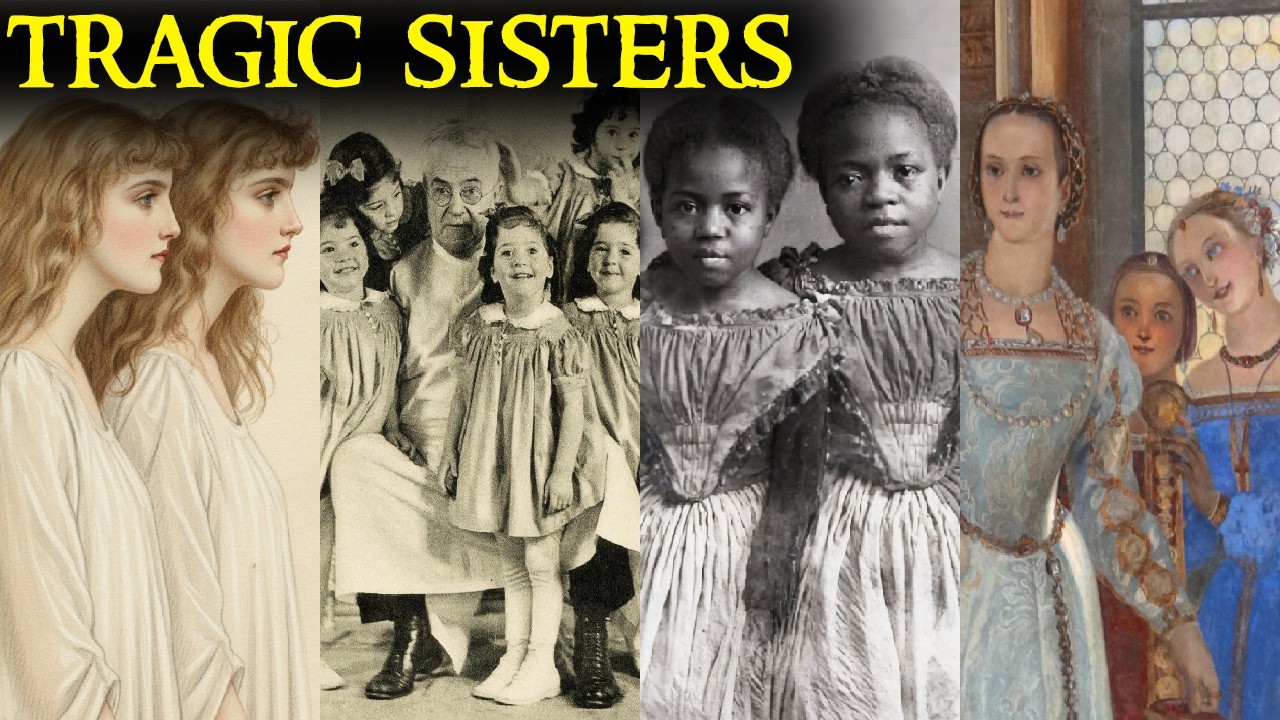
8 million today. It was a fraud: the buyer kidnapped them, and they vanished until resurfacing in a Philadelphia museum in 1854. Their legal owner hired a private investigator and tracked them down in England three years later. Their enslaved mother traveled to Liverpool to reunite with her daughters, who were then around five and a half years old.
But the reunion did not free them—they were immediately put back on display. When the Civil War ended, the sisters were finally emancipated. By then teenagers, they toured the new circuit of “freak shows,” performing duets and building a lucrative career. They eventually earned an estimated $25,000 a year—a massive sum in the 1870s.
With their earnings, they bought the very plantation where they were born and gave it to their father. Later, they built a large home for their extended family and quietly funded a local school for Black girls. The sisters died in 1912, not from complications of being conjoined, but from tuberculosis—Millie died first, and Christine followed about 12 hours later. Both were 61.
In 1934, another set of extraordinary sisters captured the world’s attention: the Dionne quintuplets, born in rural Ontario, Canada. They were the first known quintuplets to survive infancy, and their birth became an international sensation. Within days, the organizers of Chicago’s “Century of Progress” exhibition approached the father, Oliva Dionne, offering to display the babies. He signed a contract on the advice of the attending doctor, Dr.
Allan Roy Dafoe, then tried to back out of it. Alarmed, he handed custody of the five girls to the Canadian Red Cross. The Canadian government then stepped in, passing a special law that made the five sisters wards of the state. They were placed in a hospital built for them, surrounded by barbed wire, effectively a living exhibit.
Nearly 3 million visitors paid to see them there, generating over $50 million in entry fees. At its peak, the site outdrew all North American attractions except Niagara Falls and Gettysburg. The attending doctor became the world’s most famous physician, promoting commercial products and appearing frequently on radio and early television. Parents eventually fought back and regained custody in 1942.
A large trust fund had grown from their earnings, and the family built a lavish home with it. But the sisters, who had spent nearly a decade away from their relatives, struggled to integrate with their family. They later accused their father of sexual abuse during the late 1940s and early 1950s. All five left home when they turned 18.
Émilie died in 1954 at age 20, choking during a seizure. Marie died in 1970 from a blood clot in her brain at age 35. Yvonne, Cécile, and Annette lived into adulthood but struggled with trust and lasting relationships. The three eventually lived together in Montreal and successfully sued the Ontario government in 1998.
Yvonne died in 2001; Cécile and Annette were still alive as of 2021. Our next story takes us into aristocratic Britain. Nerissa and Katherine Bowes-Lyon were granddaughters of the 14th Earl of Strathmore and Kinghorne and cousins of Queen Elizabeth II. Both were born with intellectual disabilities.
In 1941, the family placed them in the Royal Earlswood institution in Surrey, where they were largely forgotten. Their mother, Fenella, never visited. In 1963, Fenella filled out an entry for Burke’s Peerage, the authoritative guide to the British aristocracy. She listed Nerissa as having died in 1940 and Katherine as having died in 1961—while both were still alive and living in the hospital.
The truth emerged only in 1986, when Nerissa actually died. The family did not attend her funeral. Her grave initially bore only a plastic card with a serial number. Katherine remained in institutional care for the rest of her life, dying in 2014 at age 88, after more than 70 years inside institutions.
The story resurfaced in the 2011 documentary “The Queen’s Hidden Cousins” and was later dramatized in an episode of “The Crown. ”
Our final stories belong to aristocratic twins of the Victorian era and the daughters of the Medici family. Lady Jacquelyn and Lady Alice Montagu were twins born in 1879 into one of the wealthiest aristocratic families in Britain. Alice, nicknamed “Nell,” began showing symptoms of tuberculosis, known then as “consumption.
” Jacqueline, whose illness was never officially confirmed, died in March 1895 at age 15, while the family was vacationing in Italy. Nell briefly made her debut in London and New York society, praised as one of the most beautiful young women of her season, but her health continued to decline. She died in Switzerland in January 1900 at age 20. Their mother commissioned Louis Comfort Tiffany to create a stained-glass memorial for the twins, which still hangs in a church on the family estate.
As for the Medici girls: Cosimo de’ Medici, Duke of Florence, had several daughters, most of whom died young or met violent ends. His beloved illegitimate daughter, Bia, died of likely malaria at age six in 1542. Another daughter, Anna, died before turning five months old. Maria died at 17 in 1557—likely of malaria—just before her marriage to the son of the Duke of Ferrara.
Her younger sister Lucrezia, only 12, was quickly substituted as the bride. Lucrezia died of what historians believe was pulmonary tuberculosis in 1561 at age 16. Isabella de’ Medici was married off at age 11 to Paolo Giordano Orsini, heir to an ancient Roman aristocratic family. Her husband was extravagant and volatile, and she had a 12-year affair with a cousin.
In 1576, her brother Francesco gave tacit approval to a series of violent retaliations against alleged infidelity: the same year, Pietro, a brother of Isabella, strangled his wife Eleonora. Six days later, Isabella was strangled by her own husband at a Medici hunting lodge. She was 33.