The Great Dismal Swamp, a vast expanse of peat and black water straddling the Virginia-North Carolina border, swallowed tools, defeated surveyors, and turned back even modern archaeologists. In the summer of 2016, a team of four trained professionals with modern blades spent eight hours cutting a trail toward one of its interior islands and advanced just 200 feet before giving up. Yet between 1793 and 1805, enslaved laborers cut a 22-mile canal through that same impossible ground. They did it with shovels, picks, and axes, standing in mud and water, moving the swamp one spadeful at a time for twelve years.
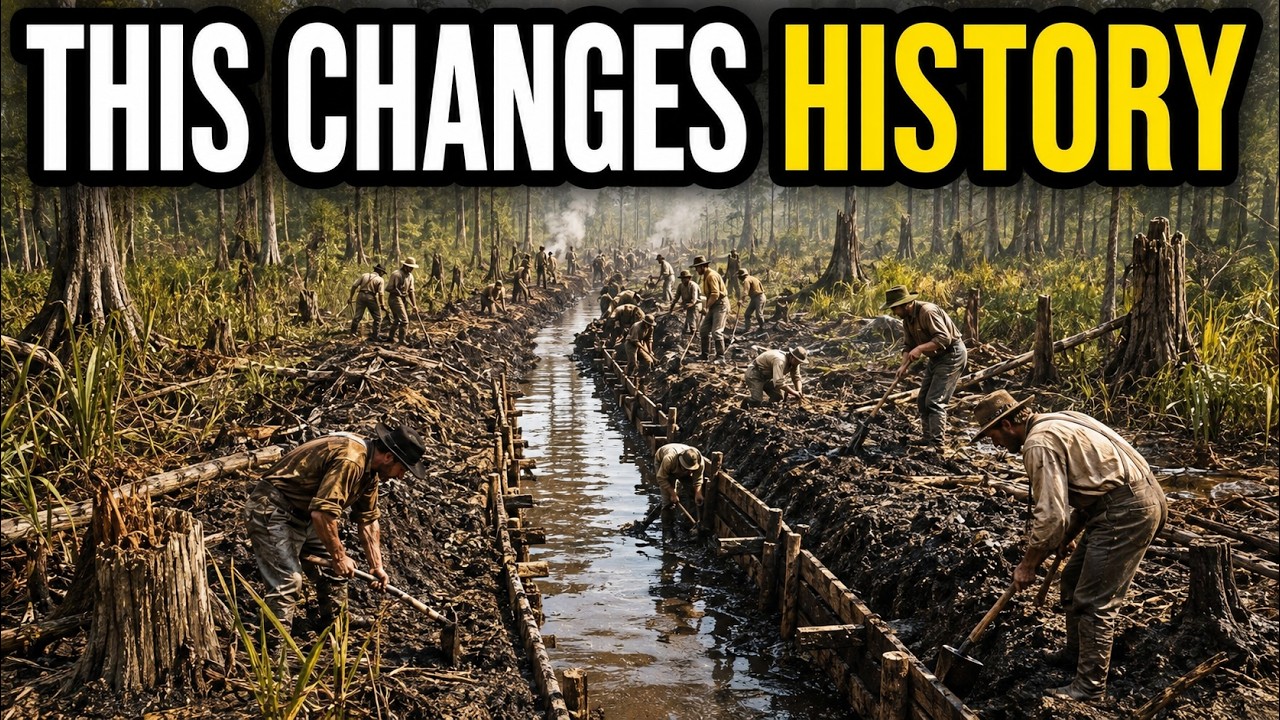
There was no machine on earth capable of digging a canal in those years, so every yard was opened by human muscle. The one named witness to this labor was Moses Grandy, an enslaved boatman born on these waters around 1786. He lived long enough to reach freedom and dictate his story to an abolitionist, leaving behind a rare first-hand account of what the canal work did to the people forced into it. The men who actually dug the channel were enslaved, hired out to the canal company by the season, rented from plantations like tools.
The company’s books recorded the miles cut and the money spent, but the men paid were the owners, not the workers. Because no one thought the laborers’ lives worth recording, there are no known records of the deaths that occurred during the twelve-year project in fever country. The ditch survived. The names did not.
The Great Dismal Swamp once covered more than a million acres, grown thick with Atlantic white cedar, bald cypress, and black gum. At its heart lies Lake Drummond, a shallow lake stained the color of strong tea by tannin, sitting oddly high near the center of the swamp. The ground is peat, deep beds of half-rotted plant matter, soft and wet, that will not hold a road, a building, or barely a standing man. The first great effort to conquer it began in 1763, when the colonial government of Virginia granted 40,000 acres to a group of investors called The Adventurers for Draining the Dismal Swamp.
Among the founders was a young George Washington. Their plan was to drain the swamp, cut the timber, and turn the peat into farmland, using enslaved labor. At a shareholders’ meeting in Williamsburg, the company wrote that the task could not be done with less than 50 able enslaved men. In the summer of 1763, 54 enslaved people, men, women, and children, were brought to a tract the company called Dismal Plantation.
They felled cedar, hauled logs, and dug drainage ditches. One ditch ran from the western edge of the swamp all the way to Lake Drummond, the first cut ever driven clean through to the lake. People still call it the Washington ditch today. The drainage dream mostly failed, but the ditches proved a lesson.
You could, if willing to spend enough human labor, cut a straight permanent channel through this ground. That lesson would be used for something far more ambitious: cutting all the way across the swamp. The idea was a shortcut. Ships moving goods between the Chesapeake Bay and the Albemarle Sound had to go the long, dangerous way around, past Cape Hatteras, one of the deadliest stretches of coast on the continent.
An inland canal connecting the rivers on either side of the swamp would allow boats to pass entirely in protected water. North Carolina political figure Hugh Williamson pushed hardest for the idea. Virginia chartered a private company to build the canal in 1787, and North Carolina agreed in 1790. The plan was a 22-mile channel running from Deep Creek in Virginia down to South Mills in North Carolina, about 32 feet wide and 8 feet deep, with a set of locks to carry boats over the swamp’s higher central level.
To save time, the company decided to dig from both ends at once, one crew starting in Virginia, another in North Carolina, aiming at each other across the worst ground in the region. Work began in 1793. The men sent to do it were enslaved, hired out to the company by their owners. Each morning, they cleared cane and root, then dug downward through peat and black water while the swamp tried to fill the ditch back in behind them.
In summer, heat and insects were merciless, and fever came off the water. In winter, the standing water turned to ice. Progress was measured not in miles but in feet. By one account, the crews extended the cut by about 30 feet on a good day.
The engineering was crude. A French traveler who watched the digging wrote flatly that no levels had been taken, meaning the builders did not even know for certain which way the water would run. They planned seven locks to lift a loaded boat up to the higher central level and lower it down the far side. Two gangs of enslaved men, miles apart, dug toward a meeting point neither could see.
Grandy grew up on the Pasquotank and around this canal. In his narrative, he described what the diggers endured. They worked up to their middle, or much deeper, in mud and water. When the day was done, they were given no bedding and lay down at night in the mud that had dried onto them beside a fire.
In the morning, men were flogged before work even began, punished because they had not finished the previous day’s task in ground that made finishing nearly impossible. He described yellow flies and mosquitoes settling on freshly beaten, bleeding backs. He recorded one overseer, a man named McPherson, who he said kept 500 to 700 people at this labor. The project contained one piece of genuinely clever engineering.
A canal that climbs over higher ground in the middle is in danger of running dry at its highest point. But Lake Drummond, that strange high lake near the center of the swamp, sat above the level of the canal’s summit. The company cut a feeder ditch running about 3 miles from the lake to the top of the canal, letting the lake pour its own water downhill into the channel. That feeder was finished in 1812, and it is the quiet key to the entire thing.
There is another layer of human life in this swamp that changes how you see the place. For generations, the swamp’s great value was its cedar and cypress, and enslaved men were sent deep into it to cut timber and split it into shingles. The juniper shingles roofed a huge swath of the coastal South, prized because the cedar resisted rot. Getting them out was skilled, solitary work done far from any overseer’s eye, running on the task system.
Some enslaved shingle getters lived for much of the year deep in the swamp in a rough half independence, out of sight, answerable to a quota rather than a lash. That world shaded into something more remarkable. The same qualities that made this swamp murder to dig a canal through made it one of the best hiding places on the continent. These were the maroons, self-emancipated people who fled slavery and ran into the swamp, onto high dry islands buried deep in the interior, building lives beyond the reach of any owner.
The record shows that shingle getters and the maroons forged a quiet informal economy, with the getters subcontracting some of their own tasks out to the hidden communities. For a long time, this was treated as legend. Then archaeologist Dan Sayers went looking. Beginning in 2002, Sayers surveyed and excavated the interior islands and found the footprints of real, stable, long-lived communities.
He found traces of cabins, work areas, and tools. He found very few objects because people with almost nothing leave almost nothing, and no human remains because the acid swamp water dissolves bone. But the pattern was unmistakable. Sites so remote that a modern team could barely reach them had held families who emancipated themselves and stayed free.
As Sayers put it, no overseer was going to whip anyone out here. They were free because they had freed themselves. A person could have been born on one of those islands, grown old, and died without ever setting foot in the world of plantations just a few miles away. Historian Sylviane Diouf gathered the wider written record, and estimates place the swamp’s hidden population in the many hundreds, by some counts into the thousands, living there across the better part of two centuries until the Civil War.
A few come down to us as more than a number. In September 1856, artist David Hunter Strother published an account of the swamp with an engraving of a maroon he called Osman, crouched and watchful with a gun across his knee. That image is believed to be the only portrait of an American maroon ever published in a national magazine of the era. Back in 1769, a Virginia enslaver named John Mayo placed a newspaper advertisement seeking an enslaved man named Tom, who, the notice said, was supposed to be somewhere about the Dismal Swamp.
A runaway advertisement is a cruel kind of document, but read the other way, it is also a receipt, the enslaver himself admitting in print that a man had gotten into the swamp and could not be found. In the same swamp, in the same years, enslaved men were worked to exhaustion digging a canal, other enslaved men lived half free cutting shingles, and free maroon families raised children on islands the owners could not reach. The canal was slavery cutting a road through the swamp. The maroon islands were freedom hiding inside it.
Grandy did not spend his life digging. He became a boatman and then a captain, running freight boats up and down the canal and the Pasquotank River. He was good at it, trusted with valuable cargo, and by his own account came to command up to four boats. During the War of 1812, when the British Navy blockaded the Chesapeake Bay, the inland canal became the only navigable path between Elizabeth City, North Carolina, and Norfolk, Virginia.
An enslaved captain named Grandy was one of the men keeping the goods moving. Grandy earned money on the water over years and used it to try to buy himself out of slavery. He saved, paid the full sum he had agreed to, and was cheated of it, the money taken and freedom withheld. He had to begin again and raise the price of himself a second time.
By the end, he had been made to purchase his own body more than once before the sale finally held. Late in life, unable to read or write, he dictated his story to abolitionist George Thompson. It was published in 1843 as The Narrative of the Life of Moses Grandy, with proceeds going toward buying the freedom of members of his own family. That book is the reason we can describe what the canal diggers endured in the words of someone who was actually there.
Against every reasonable expectation, the canal got finished. The two crews digging from opposite ends met. The channel was open for through traffic in 1805, and the feeder from Lake Drummond in 1812 gave it dependable water. It was never a perfect canal, too shallow at first for the largest boats, and it never quite carried the traffic investors dreamed of.
The men who put up the money never really made their fortune. The lasting thing they left behind was the ditch, which outlived every one of them. But it worked. Boats loaded with shingles, cedar, lumber, tobacco, cotton, grain, and barrels of turpentine moved through the swamp on water cut by hand, and it simply never stopped.
That same channel, widened and deepened over the centuries, is still open today. It is the oldest continually operating artificial waterway in the United States, now part of the Atlantic Intracoastal Waterway. When a pleasure boat idles through the Dismal Swamp Canal now, it floats on the single oldest working piece of American canal engineering there is. The Dismal also became one of the only known water-based refuges on the Underground Railroad.
Freedom seekers used the cover of the swamp and its channels, hiding in it and slipping through it by boat on their way north. The same drowned corridor that enslaved men had been forced to cut helped carry other people out of slavery altogether. The swamp itself mostly lost. The drainage that Washington’s company dreamed of, later generations achieved, ditch by ditch, until the great million-acre swamp was cut down to a fraction of itself.
Today, the Great Dismal Swamp National Wildlife Refuge protects roughly 112,000 acres, close to a tenth of what once stood there. This one swamp produced two very different monuments at the same time. One is the canal, a genuine feat of pre-machine engineering, 22 miles of working waterway still carrying boats today. The other is the swamp interior, where families made themselves free and stayed free for generations, ground that now holds the largest collection of maroon archaeology anywhere in America.
The same black water carried both, the enslaved diggers whose deaths no one bothered to count, and the free maroon children whose names no one ever learned either, hidden on purpose this time for their own protection.