In the late 1970s, a beloved purple bottle quietly disappeared from American grocery stores. Grapette, the grape soda that had defined a generation of childhoods, simply ceased to exist—no dramatic announcement, no public mourning, just a sudden absence from the shelves. At its peak, this Arkansas creation was a national phenomenon, selling over a billion bottles a year and standing toe-to-toe with industry giants like Coca-Cola and Pepsi. Yet within a few short years of a corporate buyout, the original formula was altered, the vast bottling network dismantled, and a multi-million dollar empire evaporated into nothing.
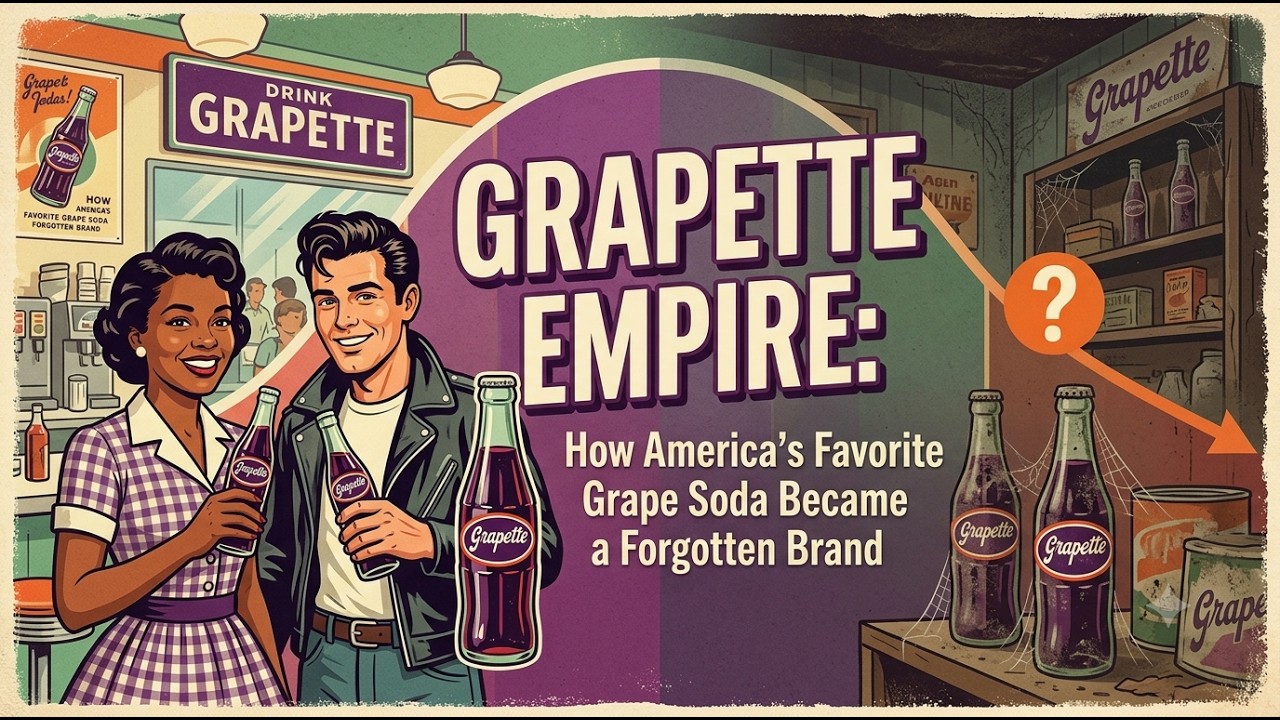
The story begins in 1939 in Camden, Arkansas, where Benjamin Tindel Fuks, known as BT Fuks, owned a struggling local bottling plant. While Coca-Cola and Pepsi fought their bitter cola wars, regional bottlers like Fuks survived by selling localized fruit sodas. But Fuks had a specific ambition: he wanted to create the perfect grape soda. At the time, grape was considered the great unsolvable challenge of flavor chemistry.
Existing grape sodas tasted harsh and medicinal, carrying the syrupy profile of cough remedies. Major bottlers had abandoned the flavor entirely. Fuks saw this not as a warning, but as an unguarded frontier. For months, he worked in his Camden facility, mixing dozens of different grape extracts, synthetic compounds, and natural fruit oils.
He carefully adjusted acidity, tweaked carbonation levels, and tested his formulas on himself, his employees, and local residents. Most attempts failed, often veering back into that dreaded cough syrup territory. In the early spring of 1939, his rigorous trial-and-error finally produced a breakthrough. Fuks developed a proprietary blend that neutralized the harsh chemical notes plaguing the industry.
The resulting liquid was bright, crisp, and tasted like sun-ripened Concord grapes, with a clean finish rather than a medicinal aftertaste. He named it Grapette. Initially, Fuks made a highly unconventional packaging decision. While competitors pushed larger bottles, he introduced Grapette in a distinctive lightweight 6-ounce clear glass bottle.
Industry insiders considered this commercial suicide, but Fuks understood the clear glass showcased the beverage’s brilliant purple hue, acting as its own silent billboard in water-filled coolers. The smaller size also served a chemical purpose. The syrup was formulated to be exceptionally dense in flavor, intended to be consumed ice cold without ice, so the drink remained sharply carbonated and perfectly chilled from first sip to last. The gamble paid off spectacularly.
Demand immediately outpaced the small Camden facility’s production capacity. Fuks implemented a sprawling franchise bottling system, selling exclusive rights to independent operators across the country. He shipped concentrated syrup from Arkansas by rail and truck, and local entrepreneurs handled carbonation, bottling, and distribution. By the end of World War II, over 600 independent bottling plants were producing Grapette across the United States.
Annual sales eventually crossed the astonishing billion bottle mark globally. The brand became the undisputed king of fruit-flavored sodas, backed by a ubiquitous marketing slogan: “Thirsty or not. ”
But the empire was built on a fragile foundation. Grapette owned the syrup and the brand name, but independent bottlers controlled the final miles of delivery.
In the 1950s, as television advertising and modern supermarkets transformed American retail, the cola giants awakened and targeted that exact vulnerability. The corporate assault was not a direct attack on Grapette’s formula. It was an infrastructural siege. Coca-Cola and Pepsi offered local bottlers highly lucrative franchise agreements—but with a brutal condition of total exclusivity.
Any bottler who wanted the financial security of a cola contract was strictly prohibited from bottling competing products. One by one, the independent bottlers that formed Grapette’s network severed their contracts. Some accepted the cola alliances to survive; others refused and went bankrupt. BT Fuks watched helplessly as his empire was dismantled by macroeconomic forces far larger than flavor, quality, or loyalty.
In 1969, facing the impossible mathematics of competing with consolidated giants, Fuks sold the Grapette Company to the Rinold Corporation, a New York-based conglomerate known for its brewing operations. On paper, it appeared to be a strategic partnership. In reality, it marked a fatal separation of the brand from its soul. The new owners had no connection to the product or the community that built it.
To them, Grapette was merely an asset to be optimized. Their first target was the 6-ounce glass bottle, which they viewed as a logistical nightmare in a market shifting toward larger containers. They also saw the premium ingredients as an excessive expense. Rinold’s chemists stripped away the expensive natural components and replaced them with cheaper synthetic flavorings.
The iconic ribbed bottle was scrapped in favor of generic packaging. The loyal network of independent franchise bottlers was dismantled entirely. Grapette was no longer a specialty item—it was just another flavor in a homogenized corporate portfolio. The public reaction was silent but immediate rejection.
Consumers who had grown up with the crisp original recipe took one sip and recognized the betrayal. The new drink was overwhelmingly sweet, flat, and carried that exact medicinal aftertaste Fuks had worked so tirelessly to eliminate. Poured into large bottles, the soda went warm and syrupy long before it could be finished. Sales figures entered a terrifying freefall.
By the mid-1970s, Grapette had become a toxic asset. Rinold sold it off, and the brand was passed between various holding companies like a corporate hot potato. Each new owner slashed marketing budgets further, reducing the once-mighty empire to a forgotten product on bottom shelves. The original Camden facility was shut down.
Assembly lines were silenced, wooden crates gathered dust, and workers who had dedicated their lives to the brand were sent home. By the late 1970s, distribution simply stopped. A child born in 1980 would have no idea Grapette had ever existed. But the corporate executives who signed the brand’s death warrant had overlooked one critical detail.
When BT Fuks sold his domestic empire in 1969, his son-in-law J. Paul Brooks had secured the rights to the brand and the original 1939 formula for all markets outside the United States. He formed a separate entity called Grapette International. Throughout the 1970s, while Rinold was stripping quality from the American product, Brooks was doing the exact opposite.
He took the original formula to Latin America, South America, and the Caribbean, partnering with independent regional bottlers in countries like Brazil, Peru, and Mexico. Crucially, he refused to compromise the chemistry. The same formula that Rinold’s auditors had deemed too expensive for the American market was being produced with sustainable profitability in developing economies. While American factories went dark, international bottling plants hummed to life.
Grapette had not died—it had been forced into exile. For over 20 years, the brand lived a bizarre double life. In the United States, it was an artifact of nostalgia, mourned as a casualty of corporate consolidation. The American public had no idea that just a few thousand miles away, teenagers were pulling the exact same drink from refrigerators.
The trademark rights for the U. S. were held hostage by indifferent holding companies, making it legally impossible to bring the authentic recipe home. It would require a force of unimaginable economic gravity, backed by deeply personal nostalgia, to break the legal deadlock.
That force was Sam Walton, founder of Walmart. Walton had grown up in the 1940s and 1950s, and the taste of Grapette pulled from a water-chilled cooler at a roadside station was a sensory memory he never forgot. As Walmart became the most powerful retailer on earth, Walton’s executive team recognized an opportunity in the waves of aging consumers hungry for the tastes of their youth. At the top of their wish list sat Grapette.
Walmart’s legal teams launched a quiet campaign to unearth the fragmented trademark rights. Then they reached out to Grapette International, still guided by the descendants of J. Paul Brooks. The mandate was surprisingly respectful.
Walmart did not want to slap a legacy name on a cheap store brand soda. They wanted the real thing—the precise, uncompromising chemistry of the 1939 formulation. Grapette International agreed to supply the authentic proprietary blend, locking out the synthetic shortcuts introduced by Rinold decades earlier. In the early 2000s, the genuine purple bottles returned to American shelves exclusively through Walmart’s massive nationwide footprint.
The public response was overwhelming. Elderly shoppers stopped in the aisles, staring at the familiar script logo with disbelief. Grandparents brought their grandchildren to the beverage aisle, sharing stories of the gas stations where they once bought Grapette for a nickel. The taste was completely authentic, carrying that crisp, sun-ripened Concord grape bite without any medicinal aftertaste.
The resurrection proved a fundamental truth: supply chains can be dismantled, formulas altered, and factories silenced, but true cultural resonance cannot be erased by a balance sheet. Grapette survived its dark decades in exile because its foundation was built on an uncompromising commitment to quality—and a memory that refused to let it die.