On the morning of February 21, 1960, in a government resthouse in Jesselton, North Borneo, an assistant opened a bedroom door and found her mistress dead.
Scattered across the bed beside her lay a pile of letters. Every one of them was written in the hand of the Prime Minister of India.
The woman was Edwina Mountbatten, Countess Mountbatten of Burma, great-granddaughter-in-law of Queen Victoria, godchild of a king, and the woman whose secret life had for three decades threatened to bring the British Crown to its knees.
Before she was the most scandalous woman in England, Edwina Ashley was a nine-year-old girl watching her mother die.
Maud Ashley had been ill for some time. Consumption, they called it then. The polite word for a disease that hollowed you out from the inside while everyone pretended not to notice.
In the autumn of 1910, Maud slipped away at the family's estate in Broadlands, Hampshire. Edwina was nine years old, and the one person in her life who had offered her warmth was gone.
Her father, Wilfrid Ashley, was a politician. He was not unkind, exactly. He was simply absent in the way that Edwardian fathers of a certain class were always absent.
Wilfrid remarried within two years. His new wife, Molly, made it immediately clear that her stepdaughter was an inconvenience.
Edwina would later describe her childhood in terms that left no room for misunderstanding. Boarding school was, in her own words, sheer hell.
She learned very early a lesson that would shape every relationship she ever had. Love was not something you could count on. Love arrived and then it left.
But money did not leave. Money was the one thing in Edwina's world that never abandoned her.
Her grandfather was Sir Ernest Cassel, one of the richest men in England. He had arrived from Cologne as a young man with almost nothing. By the time Edwina was born, he was the personal financier to King Edward VII.
When he died in 1921, he left her the bulk of his estate. The figure reported at the time was two million pounds. To put that in perspective, the average English house in 1921 cost roughly £500.
Edwina, at the age of 20, could have bought 4,000 of them without breaking a sweat. She was, overnight, one of the wealthiest women in the country.
She was also one of the loneliest.
She had beauty. She had fortune. She had a name that opened every door in England. What she did not have was any template for how a loving relationship actually worked.
The man who came for her was handsome, ambitious, and connected to every throne in Europe. He was, also, in his own way, just as lonely as she was.
8,000 people lined the streets to watch Edwina Ashley marry a man she barely knew, and a king stood witness.
The date was July 18, 1922. The church was St. Margaret's, Westminster. King George V and Queen Mary attended. So did the Prince of Wales, the future Edward VIII, who served as best man.
The groom was Lord Louis Mountbatten. Everyone called him Dickie. He was 22 years old, a Royal Navy officer, and a great-grandson of Queen Victoria.
Dickie was tall, sharp-featured, and relentlessly charming. He also had almost no money. The Mountbatten name carried enormous prestige, but very little cash.
When he met Edwina at a dance in 1920, he was immediately struck by two things. The first was her beauty. The second, which he mentioned in letters with remarkable candor, was her fortune.
Dickie was a man who believed with total sincerity that he was destined for greatness, and who understood that greatness required funding. That career needed a wife who could host, who could dazzle, and who could pay the bills. Edwina was all three.
For her part, Edwina saw something in Dickie that she had never encountered before. Certainty.
Their courtship lasted less than a year. They barely knew each other.
He wanted her money and her beauty. She wanted his certainty and his name. Neither of them had asked the harder questions.
The honeymoon should have been the first warning. It lasted six months. They sailed across the Atlantic, visited Hollywood, attended parties with Charlie Chaplin and Douglas Fairbanks.
Behind the flash bulbs, the cracks were already forming. Dickie was obsessive, meticulous, controlling. He planned every day of the honeymoon with military precision.
Edwina wanted spontaneity. She wanted to feel things. She wanted, though she could not have said it then, to be seen. Not admired. Not displayed. Seen.
And Dickie, for all his charm, did not know how to see her.
They returned to England as the golden couple. They took up residence at Brook House in the vast marble apartments that Edwina had inherited from Sir Ernest Cassel.
From the outside, their life was flawless. From the inside, Edwina was already restless. She had traded one gilded cage for another.
Brook House had 800 tons of marble, a staff of dozens, and not a single room where Edwina Mountbatten felt at home.
The late 1920s were the Mountbattens' golden age. They threw parties that became legend. Noel Coward was a regular. So was the Prince of Wales.
Edwina was the undisputed queen of this world. She dressed in the finest couture. She danced until dawn. She was photographed constantly.
But the world that sustained the Mountbattens' social reign was already dying. The British Empire still covered a quarter of the globe, but the first cracks were visible to anyone who cared to look.
The general strike of 1926 had revealed a country more divided than the people at Brook House wanted to admit. While Edwina hosted dinners for a hundred, millions of working people could not afford meat.
She did not see this. Not yet. That awareness would come later. And when it came, it would transform her.
The scale of the Mountbatten lifestyle almost defies belief. They maintained Brook House in London and Adsdean, a country estate in Hampshire. Their household expenses ran to tens of thousands of pounds a year.
Dickie, meanwhile, was building his naval career with the same manic energy he brought to everything. He was posted to the Mediterranean. He was away for long stretches.
And every time Dickie left, Edwina was alone again. Alone in a marble palace, surrounded by staff, drowning in invitations, and empty.
The emptiness was the engine. It had always been the engine.
By the end of the decade, the noise was not enough. Edwina Mountbatten stood at the summit of English society. She had everything the world said a woman should want. A title, a fortune, a handsome husband with a royal bloodline.
And she was about to blow it all apart.
A flustered housekeeper stood in the hallway of Brook House with a problem no etiquette guide had prepared her for. Five gentlemen had arrived at the house, each expecting to see Lady Mountbatten. Each believed he was the one she was waiting for.
The housekeeper showed each man to a separate room. Edwina then moved between them, room to room, giving each the impression he had her full attention.
The story comes from Edwina's own daughter, Pamela. Years later, Pamela would describe her mother with a word that carried equal measures of awe and resignation. Man-eater.
Edwina's affairs began in the mid-1920s. When Dickie discovered the truth, he was devastated.
The letters he wrote during this period revealed genuine anguish. He loved Edwina. That was the terrible irony at the heart of their marriage.
What emerged was an arrangement. It was never announced. It was never written down in any formal way. But by the late 1920s, the Mountbattens had reached an unspoken understanding.
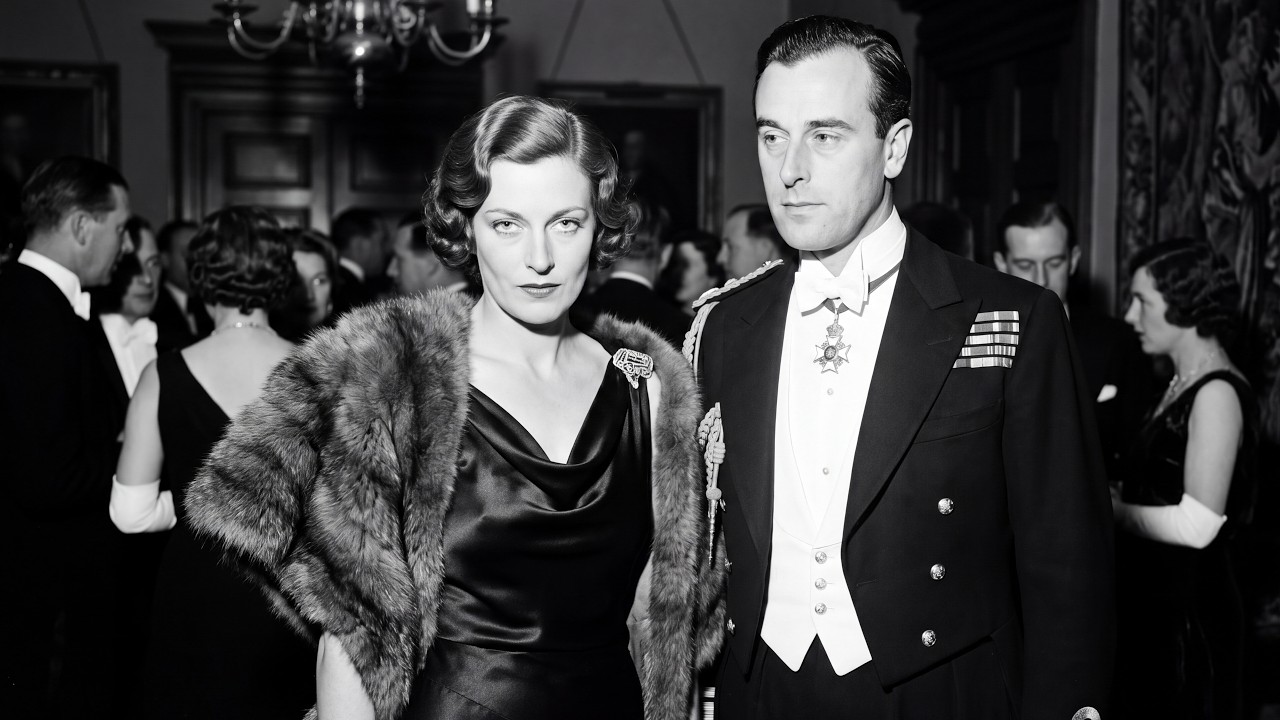
They would remain married. They would present a united front. And behind closed doors, they would each live as they chose.
For Edwina, it meant a private life of almost staggering scope.
The list of Edwina's lovers, to the extent that historians have been able to reconstruct it, is long. She was drawn to men who were talented, charismatic, and often outside the conventional boundaries of her class.
She crossed lines of nationality, profession, and most dangerously of all in the Britain of that era, race.
Edwina was not at her core a woman who wanted conquest. She was a woman who wanted connection. Real, raw, unmediated connection.
Every new lover was another attempt to feel. Every affair was another experiment in intimacy. And every time, eventually, the feeling faded.
She was searching for something that none of these men could give her, because what she was searching for had been taken from her at the age of nine.
Within the Mountbatten social circle, Edwina's behavior was an open secret of the kind that the English upper classes had perfected over centuries. Everyone knew. No one said anything.
Edwina broke all three rules. She was not discreet. She gave gifts that could be traced. She was seen in public with men who were not her husband.
Dickie knew about the affairs. He tolerated them because he had no choice, because he loved her, and because his own ambitions required the marriage to survive.
But in the early 1930s, Edwina took a lover who changed everything. He was not an aristocrat. He was not white. And he was the most famous entertainer in Britain.
His name was Leslie Hutchinson.
They called him Hutch. He was born in 1900 in Gouyave, a small town on the island of Grenada in the British West Indies.
He arrived in New York as a young man, studied music, and fell into the orbit of Cole Porter. By the mid-1920s, Hutch was in London, and London was at his feet.
He performed at Quaglino's, at the Café de Paris, at every venue where the wealthy and the titled gathered to drink champagne and pretend that the outside world did not exist.
He sang in a voice that was warm, intimate, and aimed, always, at a single person in the room. Women adored him.
He was also black. In the Britain of the 1920s and 30s, this fact contained a contradiction that the establishment could not resolve.
Hutch was welcome in the finest drawing rooms. He was invited to the best parties. He was celebrated, applauded, showered with money.
But the equality had a limit. An invisible line drawn in the air of every ballroom. That line said, you may entertain us. You may charm us. You may even, in private, sleep with us. But you may not be one of us.
Edwina crossed that line without hesitation.
She met Hutch in the late 1920s at one of the endless parties that filled her calendar. The attraction was immediate.
The affair began. It was, by all accounts, passionate.
Edwina gave Hutch gifts that were reckless in their extravagance. The most famous was a jeweled cigarette case from Cartier, encrusted with diamonds, bearing an inscription that left no doubt about the nature of their relationship.
They were seen. They were seen at restaurants, at parties, at Hutch's performances. The talk began.
In the clubs of Mayfair and the drawing rooms of Belgravia, the whisper was always the same. Edwina Mountbatten and Hutch.
The phrase was spoken with a mixture of fascination, envy, and something darker. Something that had less to do with adultery and everything to do with race.
Because this was the 1930s. The British Empire ruled over hundreds of millions of non-white subjects. The entire edifice of imperial power rested on an unspoken assumption of racial hierarchy.
An aristocratic woman could take a lover. That was practically traditional. But an aristocratic woman, a woman connected to the royal family by marriage, taking a black lover, that was not a private scandal. That was an assault on the foundational myth of empire.
The establishment could forgive adultery. It could not forgive that.
Hutch, to his credit or perhaps to his peril, did not hide. He was proud. He was successful. He earned more than almost any other performer in Britain.
By 1931, the affair between Edwina and Hutch was, in Noel Coward's phrase, the talk of the West End. It had moved beyond whispers. It was approaching the one threshold that could not be crossed. The press.
The crisis arrived in the form of a newspaper called The People. It was a Sunday tabloid, populist, and aggressive.
In 1932, The People published an article that, without naming Edwina directly, made an unmistakable insinuation. A society woman had been conducting an affair with a colored man.
There was, however, a twist. The People identified the man not as Leslie Hutchinson, but as Paul Robeson.
Robeson was an American singer and actor of enormous fame. The identification was wrong.
The article existed. The implication was clear. And the palace was watching.
King George V was not a man who tolerated embarrassment. He had spent his reign projecting an image of the monarchy as the moral anchor of the nation.
The Mountbattens were, at that moment, stationed in Malta, where Dickie was serving with the Mediterranean Fleet. They received a summons. Return to London immediately.
What happened next reveals how the British ruling class protected itself. This was not a clumsy cover-up. It was a precision operation.
The key figure in the operation was Norman Birkett. He was one of the most celebrated barristers in England.
Birkett was retained to represent the Mountbattens in a libel action against The People.
The strategy was elegant. The newspaper had named Paul Robeson. Edwina had, in fact, never had an affair with Paul Robeson. She could therefore swear under oath that the specific allegation in the article was false.
The technical truth. The narrow, lawyerly, save-your-skin truth.
Dickie Mountbatten understood the stakes with perfect clarity. His wife's behavior threatened everything he had built.
He did not rage. He did not make scenes. He called in favors. He deployed connections. He activated the network of aristocratic, military, and royal relationships that were his real inheritance.
The trial that followed would be one of the most carefully staged performances in British legal history.
The Lord Chief Justice opened his court at half past nine in the morning for one reason, to finish before the reporters arrived.
The date was March 4, 1932. The case was Mountbatten versus Odhams Press, the publisher of The People. The man presiding was Lord Hewart, the Lord Chief Justice of England.
The Lord Chief Justice did not ordinarily hear libel cases. This was the Crown protecting its own.
Norman Birkett rose to speak. He was magnificent. He presented Edwina Mountbatten as a woman of unimpeachable character who had been grievously wronged by a reckless and irresponsible newspaper.

Then Edwina took the stand. She swore under oath that she had never met Paul Robeson. She had certainly never had an improper relationship with him.
She was telling the truth. Every word of it was technically, narrowly, precisely true.
The actual truth, the truth about Leslie Hutchinson, was never mentioned. Hutch's name did not appear in the court record.
The People's lawyers capitulated. They had no choice. They issued a groveling apology. They paid damages. They retracted the story entirely.
The whole thing was over in a matter of hours.
That afternoon, Edwina Mountbatten attended a luncheon at Buckingham Palace. The palace received her warmly. The message was unmistakable. You are one of us. You are protected.
This was not justice. This was machinery.
But every machine requires fuel. And the fuel for this particular machine was a human life.
Edwina Mountbatten walked back into Buckingham Palace. Leslie Hutchinson walked into oblivion.
The punishment was not announced. There was no trial, no formal blacklist, no document stamped with a royal seal.
The establishment worked through whispers, through phone calls, through the quiet exercise of influence by men who never had to raise their voices.
Lord Beaverbrook owned the Daily Express and controlled a press empire. After the libel trial, a word went out. The word was simple. Do not write about Hutch.
The result was a silence so complete that a man who had been the most photographed entertainer in Britain effectively vanished from the newspapers overnight.
The BBC followed suit. Hutch had been a regular on the airwaves. After 1932, the BBC stopped booking him.
Royal command performances, which had been a staple of his career, ceased.
The speed of his fall was breathtaking. At his peak, Hutch was earning tens of thousands of pounds a year. He performed at the most exclusive venues in London.
Within a few years of the trial, the bookings dried up. The London venues stopped calling. The press stopped reporting. The invitations stopped arriving.
By the 1940s and 50s, the man who had once played the Café de Paris for London's elite was playing provincial theaters and holiday camps.
Hutch never recovered. He never publicly discussed the affair with Edwina.
He died on November 18, 1969. He was 69 years old. His estate, when it was probated, was valued at £1,949.
The man who had earned fortunes, who had lived like a prince, left behind an amount that would not have covered the cost of the cigarette case Edwina had once pressed into his hands.
He was buried at Highgate Cemetery in London. The grave was paid for by Lord Mountbatten.
Let that detail breathe. Dickie Mountbatten, the man whose wife's affair with Hutch had nearly destroyed his career, paid for his grave.
Was it guilt? Was it a final gesture of noblesse oblige? We do not know. Dickie never explained.
What we can say is this. When the crown protects its own, the cost is not borne by the protected. It is borne by whoever is closest and least powerful.
Edwina, meanwhile, kept living. And she was about to find what she had been searching for in the most unlikely place on Earth.
Dickie Mountbatten noticed something no one else would have thought to check. Nehru's letters to him were always typed, but the letters to Edwina were always written in his own hand.
The observation is small. It is also devastating.
In the world of mid-20th century diplomacy, a handwritten letter was an act of intimacy. Typed letters were for business. Handwritten letters were for love.
Jawaharlal Nehru was the first Prime Minister of independent India. He was a Kashmiri Brahmin, educated at Harrow and Cambridge.
He was also, beneath the statesman's composure, a deeply lonely man. His wife, Kamala, had died of tuberculosis in 1936. He had spent years in British prisons for his role in the independence movement.
He met Edwina in 1946 in Singapore, where the Mountbattens were stationed as Dickie oversaw the surrender of Japanese forces in Southeast Asia.
Something happened between them. Something that neither of them expected and neither of them could control.
By the time Dickie was appointed Viceroy of India in 1947, tasked with overseeing the transfer of power from British rule to Indian independence, the relationship between Edwina and Nehru had deepened into something extraordinary.
They saw each other daily during the agonizing months of partition. They worked together on the humanitarian crisis that engulfed the subcontinent.
Edwina threw herself into relief work with a ferocity that stunned everyone who witnessed it. She visited refugee camps. She organized food and medical supplies.
For a woman who had spent much of her life at parties, the transformation was remarkable.
It also gave her Nehru.
There is a photograph from this period that has become iconic. Nehru is seated on the floor at Edwina's feet, looking up at her. She is on a chair looking down at him.
The question of whether their relationship was physical has occupied biographers for decades. Edwina's letters to Dickie, written in 1952, suggest that it was.
She wrote to her husband with unusual candor, confessing the depth of her feelings for Nehru in terms that went beyond friendship.
Dickie, remarkably, accepted it. He replied with a generosity that is hard to square with the possessive young officer who had been devastated by her first affair decades earlier.
The three of them formed a triangle that was, in its way, one of the most remarkable arrangements in modern political history. The last viceroy, the first prime minister, and the woman who connected them.
They exchanged letters for the rest of Edwina's life. Nehru wrote to her by hand, always by hand.
The letters were extraordinary. They discussed politics, philosophy, loneliness, love, the passage of time. They wrote as equals.
Edwina, for the first time in her life, was not restless. The hunger that had driven her from lover to lover was finally quiet.
The political implications were immense. During the partition crisis, Edwina's closeness to Nehru gave her a degree of influence that no vicereine had ever possessed.
But the crown could never let her claim it. An English countess and an Indian prime minister. The symbolism was impossible.
The woman who had been punished for loving a black musician would never be permitted to publicly love an Indian leader.
Edwina accepted this. She had to. She wrote to Nehru. He wrote to her. They met when they could.

By 1956, Edwina's heart was failing and she responded by flying 33,000 miles.
Her body had been sending warnings for years. Angina, a minor stroke, a lingering infection that sapped her strength and left her in pain.
Her doctors told her to rest. She ignored them.
After India, Edwina had discovered a purpose that no amount of money or scandal or society had ever given her. She became, in the last decade of her life, one of the most dedicated humanitarian figures in Britain.
She served as Superintendent-in-Chief of the St. John Ambulance Brigade. She traveled constantly. She inspected hospitals, clinics, and aid stations across the Commonwealth.
In a single year, she might visit India, Southeast Asia, Africa, and a dozen other countries. She worked 18-hour days.
Why? The easy answer is guilt. But that explanation is too simple.
The truth is that the work gave her the same thing the affairs had once given her. Intensity, purpose, the feeling of being fully alive.
Through it all, she wrote to Nehru. Every day, or nearly every day. The letters were her anchor.
She was 58 years old. The photographs from her final years show a woman who has been worn thin by the life she has lived.
Her family begged her to rest. She would not. She could not.
In February 1960, she set out on another tour. This one took her to the Far East. She was exhausted before she even left. She went anyway.
When they found Edwina Mountbatten dead in Borneo, the Indian Parliament rose for two minutes of silence.
The date was February 21, 1960. She was in Jesselton, North Borneo, staying at a government rest house during yet another tour.
Her assistant entered the bedroom that morning and found her in bed, motionless, her cheek cold.
Besides her, scattered across the sheets, lay a pile of letters. They were all from Nehru.
She had been reading them when she died. Or had fallen asleep holding them. Or had arranged them around her like a final collection of all the love she had ever received that was truly hers.
She was 58.
In New Delhi, Nehru received the news and was, by all accounts, devastated. He spoke of her in Parliament. He called her a friend of India.
The words were measured, official, correct. The grief was not.
Edwina's funeral was unlike anything that had been seen before. She had asked to be buried at sea. The request was honored aboard HMS Wakeful, which carried her body into the English Channel.
It was an honor that had never before been extended to a woman other than the sovereign.
Nehru sent the Indian Navy frigate INS Trishul to the site. The ship carried a wreath from the Prime Minister of India.
As HMS Wakeful committed Edwina's body to the water, the Indian vessel cast Nehru's wreath upon the waves.
Two navies, two nations honoring a woman whose love had crossed every boundary that empire, race, and protocol had tried to erect.
The Queen Mother, upon hearing of the burial arrangements, is reported to have said, Oh, Edwina. She always liked to make a splash.
Nehru did not long survive her. He died in 1964, four years later. Those who knew him said he was never quite the same after Edwina's death.
Dickie lived on. He continued his career, his projects, his ceaseless scheming and charming. He remained close to the royal family. He mentored the young Prince Charles.
On August 27, 1979, Dickie Mountbatten took his fishing boat, the Shadow V, out into the waters of Mullaghmore, County Sligo, Ireland.
A 50-pound bomb planted by the Provisional IRA detonated beneath the deck. Dickie was killed. So was his grandson Nicholas, aged 14. So was a local boy, Paul Maxwell, aged 15.
He was 79 years old.
The Crown survived them both. The Crown always survives.
Open any official document bearing the surname Mountbatten-Windsor, and you are reading the legacy of a marriage that was never what it seemed.
The name exists because of Dickie. That was always his project. He wanted the Mountbatten name on the throne of England.
He achieved it. When his nephew Prince Philip married Princess Elizabeth in 1947, the Mountbatten connection to the Crown was sealed.
When Philip and Elizabeth's descendants were given the surname Mountbatten-Windsor, Dickie's project was complete.
Edwina nearly destroyed that project. Every affair, every scandal, every whispered conversation in every drawing room in England threatened to sever the link between the Mountbattens and the throne.
The Crown protected itself. That is what the Crown does. It absorbed the scandal, silenced the press, sacrificed the people who could not defend themselves, and carried on.
This is what Edwina's story tells us about the monarchy. It is not at its core a story about sex or scandal. It is a story about what happens when a human being collides with an institution that demands perfection.
The monarchy requires that its members perform as symbols. They must be steady, respectable, and above reproach. They must suppress whatever is inconvenient, messy, or real.
But human beings are inconvenient. Human beings are messy. Human beings fall in love with the wrong people. They grieve in ways that cannot be controlled. They search for connection with a hunger that no protocol can satisfy.
Edwina was not a villain. She was not a victim. She was a woman of extraordinary energy and intelligence who was shaped by a childhood of loss, trapped in a marriage of convenience, and driven by a need for intimacy that her world could neither satisfy nor tolerate.
She caused real harm. Leslie Hutchinson's life was destroyed, and Edwina bore a share of that responsibility.
She was also brave. She remade herself in the second half of her life into a woman of genuine purpose. She confronted suffering on a scale that most people cannot imagine, and she did not look away.
She loved Nehru with a depth and a constancy that redeemed, if anything could, the wreckage of her earlier years. She died reading his letters.
The Crown endured her. It managed her. It buried her secrets and carried her name forward on documents that the King himself would sign.
The Mountbatten-Windsor surname is, in its way, a monument to everything that Edwina lived through. The ambition, the scandal, the love, the sacrifice, and the system that consumed all of it without ever acknowledging the cost.
What did the Crown sacrifice to survive Edwina's secrets? It sacrificed the truth. It sacrificed Leslie Hutchinson. It sacrificed the possibility that Edwina and Nehru's love might have been celebrated rather than hidden.
It sacrificed, in the end, the very humanity of the people it claimed to protect.
And somewhere in North Borneo, in a room that no longer exists, a pile of handwritten letters lay scattered on an empty bed. They were written by the Prime Minister of India to a woman he could never publicly claim.
They were the last private thing she had. And they are, perhaps, the truest monument to a life that the Crown tried to own, but could not.