In the autumn of 2022, a young couple named Aaron and Beth Halberstam purchased a two-story, tin-roofed farmhouse on 18 acres about nine miles outside the small town of Grove Spring, Missouri. Aaron was a civil engineer from Rolla. Beth was a nurse anesthetist from Iowa. They had two children under the age of five and plans to restore the property, keep chickens, and grow a garden.
The seller was an elderly man in his early 80s living in a nursing facility in West Plains. He had inherited the house from his uncle, who had inherited it from his father, the original builder. The seller had only visited the property twice in his life, both times as a small child, and both times he had refused to sleep there. The listing agent passed this along as a colorful detail.
The family moved in during the second week of October. The hillsides were at their peak color. Beth walked the property with coffee and cried out of gratitude. Aaron made a list of repairs, and the first item was the kitchen floor.
The kitchen was on the north side of the house with a low ceiling and a wide window overlooking a spring. The floor was original heart pine, six inches wide, laid down in the 1890s. A section in the middle of the room, about eight feet by ten feet, had gone soft. Aaron planned to pull it up over Thanksgiving weekend and replace the joists.
He started the Friday morning after Thanksgiving with his father-in-law, Carl, a retired shop teacher from Iowa. They cleared the kitchen, rolled up the rag rug, and moved the furniture. Aaron knelt down, hooked the pry bar under the first board, and pulled.
The board came up too easily. There were no nails in the underside. The next board was the same, and the next, until they had lifted the entire soft section in less than 20 minutes. Instead of joists and subfloor, they found a rectangle of hand-fitted dolomite blocks mortared with lime, with a set of stone stairs going down into the dark.
Carl said a word a retired shop teacher from a Lutheran church in Iowa is not supposed to say. Aaron stood silent with the pry bar in his hand, then reached for his phone and turned on the flashlight.
The beam fell down the stairs and stopped about 12 or 14 feet down. Aaron counted seven steps cut from the same dolomite as the walls, worn smooth in the middle in a concave way that only comes from generations of feet. He said this was not a root cellar. Root cellars in the Ozarks were dug roughly and lined with fieldstone. Nobody in the 1890s in Wright County, Missouri, cut dolomite blocks and laid church stairs into the ground under a farmhouse kitchen.
The first thing Aaron noticed when he put a foot on the top step was the temperature. It was not cold the way a cellar is cold. It was cold the way a cave is cold, a still, mineral cold that does not move. The second thing was the smell. It was not damp or moldy. It was a smell like beeswax and old tallow, and underneath that, something he could not name.
He went down five steps and stopped. The room was about 15 feet square. The walls were dolomite blocks with a low vaulted ceiling. The floor was flagged with cut stone. Along the left wall were four low wooden benches that looked more like pews than farmhouse furniture. Along the right wall was a shelf cut into the stone.
On the shelf were three objects. A wooden bowl blackened with age. A small iron oil lamp of a shape that Carl, who collected such things, would later swear was not American. And a book bound in dark leather with no title, resting on a folded piece of cloth that had once been white.
But it was the back wall that Aaron did not want to look at. The flashlight beam kept sliding off it. The wall was carved deeply into the dolomite, running floor to ceiling and wall to wall. In the center, at about eye height for a kneeling adult, was a figure. It was roughly human in outline, but its proportions were wrong. Its face had features that did not correspond to any face Aaron had ever seen.
Around the figure were concentric rings. Inside the rings was writing. It was not English. It was not any alphabet Aaron recognized. It was made of angles and hooks and small crossed marks, filling every inch of every ring, and it did not repeat.
Aaron did not go all the way down. He could not physically make his legs take the last two steps. He stood on the fifth step and looked at the wall for more than four minutes without moving. Then he turned around, walked back up into the kitchen, past his father-in-law, and out onto the back porch, where he sat down and put his head between his knees.
Carl came out a few minutes later. He said he had gone the rest of the way down. He had looked at the book but not opened it. He wanted Aaron to know that the mortar in the walls was old. Not 1890s old. Old in the way lime mortar gets when it has been curing for two or three centuries. And there was a channel cut into the flagstone floor running from the base of the carved wall to a small drain in the northeast corner. The channel was stained. Not with water. With something that had at one time been red.
Beth said she did not want the children in the kitchen. They put the boys in the parlor with a movie. They closed the kitchen door and put a chair in front of it. Aaron drove into Grove Spring to get a real flashlight and to think.
While in town, he made two phone calls. The first was to the listing agent, who did not answer. The second was to the county historical society, staffed on Saturdays by a volunteer named Loretta Munn. Aaron asked if she knew anything about hidden cellars in old farmhouses toward the north end of the county. Loretta was quiet for a long time. Then she said he should come by the office on Monday morning and bring photographs. In the meantime, he should not disturb anything he had found.
Aaron and Carl went back down with the real flashlight and took 47 photographs. Carl photographed the book from every angle without touching it. At Carl's insistence, Aaron did not photograph the drain in the corner or the stained channel leading to it. Carl said some things did not belong in a photograph a person might have to look at in the middle of the night.
They put the floorboards back loosely, laid the rag rug over them, and put the furniture back. From the doorway with the lights on, there was no way to tell anything had been touched.
That night, Aaron sat at the kitchen table with his laptop and tried to describe what he had found. Concentric rings. Hidden cellar. Farmhouse. Missouri. Carved figure. Unknown alphabet. He got nothing useful. He got results about Freemasons, which did not match. He got results about Appalachian hex signs, which did not match. He got results about a fringe internet subculture that used the word Tartaria. He read for about 20 minutes, then closed the laptop because it felt like he was going in a direction he did not want to go without an adult in the room.
He went to bed but did not sleep. He lay in the dark with his eyes open, listening. He did not know what he was listening for. He was certain that if he fell asleep and the noise came, he would not be able to stop it or protect his family from it.
At 6:30 in the morning, he called Loretta Munn and left a message asking her to come out to the house. She was there by 10:00, and she brought a professor with her.
The professor was a small, gray-haired man in his early 60s named Dr. Emmett Vause. He taught comparative religion at Drury University in Springfield, with a subfocus on syncretic folk traditions of the American interior. Loretta told Aaron in the driveway that Dr. Vause was the person the county called when somebody found something in an old house that nobody wanted to write down in a report. In the last decade, he had been to 17 properties in the four-county area. He had only ever written a public paper about two.
Dr. Vause was polite. He asked to see the kitchen. Aaron led him and Loretta through the house, and the three of them stood in the doorway looking at the rag rug. Aaron said he would move it. Dr. Vause said, "No, wait." He stood in the doorway for a long time just looking at the room. He asked if the wife and children were somewhere else. Aaron said Beth had taken the boys to her sister in Rolla for the weekend. Dr. Vause nodded and said that was probably wise.
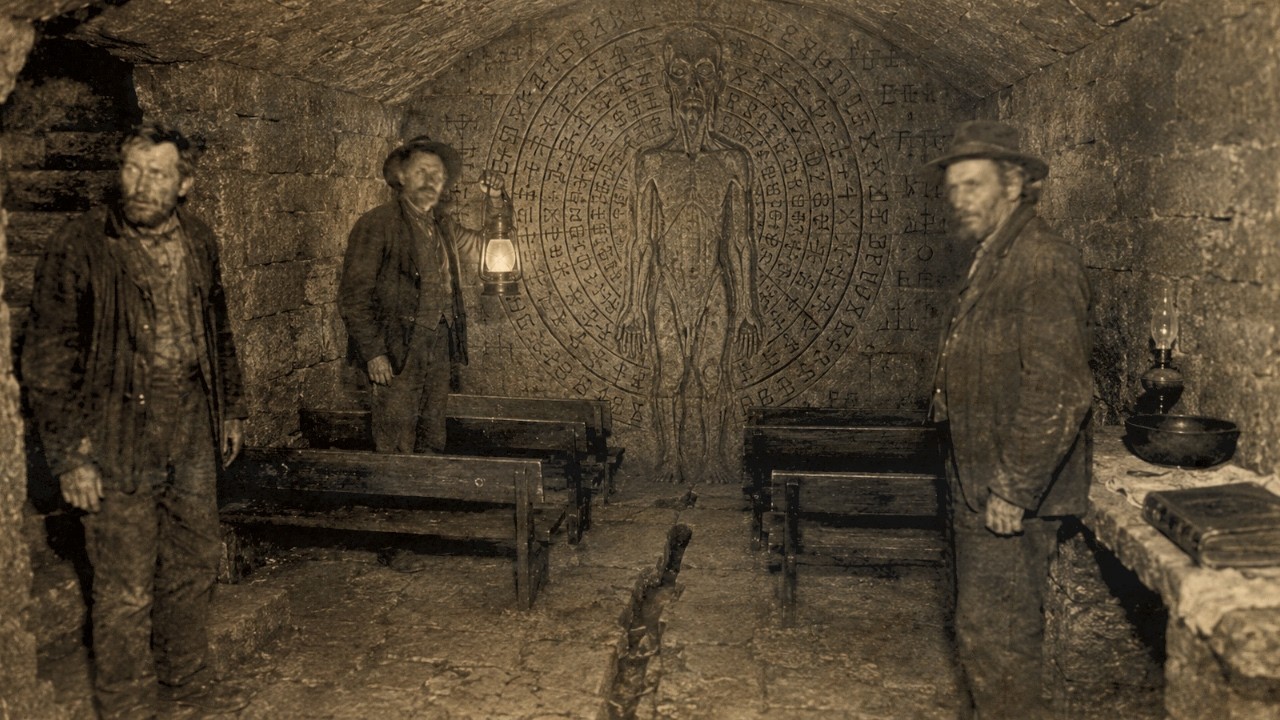
Aaron and Carl moved the rug and the boards. Dr. Vause looked down the stairs for a long time before taking a step. He did not use a flashlight. At the bottom, he stood in the center of the flagged floor and turned in a slow full circle, looking at the walls, the shelf, the benches, and the carving. Then he sat down deliberately on one of the low wooden benches and put his head in his hands. He stayed that way for nearly 10 minutes.
When he lifted his head, he said he had been afraid this was what Loretta was going to show him. He had hoped it was going to be something else. Aaron asked what it was.
Dr. Vause walked to the back wall and traced the outline of the carved figure in the air an inch above the stone. He said the figure was called, in one of the very few written records of it that survived, the Watcher on the Threshold. The writing in the concentric rings was not a random script. It was what remained of a language that did not officially exist.
He said it had been spoken and written by a specific migratory group that came into the interior of the North American continent by way of the Mississippi Valley sometime in the middle of the 1700s. On paper, they had come from the Alsace region of France. But their surnames, their liturgical calendar, their marriage customs, and their alphabet did not match anything from Alsace. They matched something much further east, something that cartographers had described for two centuries under a name the modern academic world had spent 150 years pretending was a mistake or a myth.
The name Dr. Vause said was Tartaria.
He said the last time he had seen a room like this one was in the basement of a torn-down general store in Cabool, Missouri, in the summer of 2013. Three people had died within 18 months of it being opened. He had spent the rest of that decade convincing himself it was a coincidence. He was no longer convinced.
Dr. Vause explained that the room was, in the technical sense, a chapel. Chapels in this tradition were built by families, not congregations. They were used by at most six or eight people at a time. Once consecrated, they could not be deconsecrated. They could be sealed, forgotten, built over, but not undone. Every family in the migratory group was supposed to build one, and every family was supposed to keep it in continuous use until the last living member of the family was buried.
The farmhouse was built by a man named Joseph Halper in 1887. He had come to Wright County in 1868 from Buffalo, New York, where he had lived for about 10 years after arriving from Europe. Before Buffalo, according to the passenger manifest, he had come from a village in Alsace called Riemersdorf. Dr. Vause had found 14 other families in the four-county area with the same story. Same region of origin, same decade of arrival, same masonry techniques, same style of house. In five of those houses, workers doing renovations had found rooms matching the one under the Halberstam kitchen.
Aaron asked what the room was for. Dr. Vause said the room was for what the group called "the keeping." It was not a religion in the usual sense. It was a set of obligations a family took on in exchange for something. The obligations were owed to the figure carved into the back wall. The something the family received in exchange was protection.
Aaron asked, "Protection from what?"
Dr. Vause said he did not know. In the fragments he had translated, the thing the families were being protected from was never named directly. It was referred to only by circumlocution. "That which comes over the ridge." "The arrival at the third watch." "The visitor whose feet do not touch the road."
Aaron asked what happened to families who did not fulfill the obligation. Dr. Vause was quiet for a long time. Then he said there were only two documented cases of families who tried to stop. One was in 1894 in Douglas County. The other was in 1951 in Texas County. In both cases, every member of the household above the age of 12 died within nine months. The 1894 case was recorded as an outbreak of brain fever. The 1951 case was recorded as a murder-suicide, although the physical evidence did not support that classification, and the state investigator who worked the case was quietly reassigned within a year.
Dr. Vause said the room had been in continuous use from sometime in the 1880s down to a date he estimated to be no earlier than the summer of 2022. That was the same summer the elderly man in the nursing facility signed the paperwork to sell the property. Somebody had been coming to this room. Somebody who was not, on paper, the owner. Somebody who had a key or another way in, and who had been using the room on the correct calendar until weeks before the Halberstams moved in.
Dr. Vause laid out the paperwork on the flagged floor. The founder was Joseph Halper, born 1836 in Riemersdorf. The village appeared on maps of Alsace printed around 1850 and stopped appearing on maps printed after 1870. When Dr. Vause spent a sabbatical year in the French National Archives in Strasbourg in 2011 trying to locate any record of Riemersdorf predating 1850, he found nothing. Not a tax record, not a church register, not a birth certificate. The village existed on paper for exactly one generation and then vanished in both directions, as if it had been inserted into the historical record to provide a plausible European origin for a group of people who needed to appear to have come from Europe.
The pattern held in every generation. The Halpers, later shortened to Halber and then Halberstam, married only into the other 13 families who shared the same origin story. In 135 years, there were no marriages outside that group. Every wedding was performed not by a local minister, but by a traveling officiant listed only as an elder of the fellowship, with a different name on nearly every document. Dr. Vause suspected it was only three or four different men using rotating pseudonyms over the course of nearly a century.
The man in the nursing facility was the last member of the family on paper. But the fellowship was still operational. Dr. Vause estimated there were between 40 and 60 living descendants of the original 14 families scattered across seven counties in southern Missouri and northern Arkansas. One of them, in the summer of 2022, had still been coming to this house on the correct nights to fulfill what he or she believed was a 235-year-old family obligation.
The sale of the house had not been sanctioned by the fellowship. Whoever had been maintaining the room had been abruptly and involuntarily cut off from a place they had understood to be the one place in the world where they were required to be present on a specific set of dates. One of those dates was 31 days away.
Aaron asked what Tartary had to do with any of this.
Dr. Vause said this was the part that had cost him most of his credibility, most of his grant funding, and most of his friendships in his academic department. On maps of the northern hemisphere printed between roughly 1500 and 1750, a very large area of what is now Russia, Central Asia, and parts of the Ottoman and Chinese spheres of influence was labeled consistently with a single word: Tartaria. The mainstream academic explanation was that Tartaria was a European catch-all term for the nomadic Turkic and Mongolic peoples of the steppe, and that the borders were vague because mapmakers had no reliable information. On this explanation, Tartaria was not a country. It was a misunderstanding.
Most of that was true. But there was a smaller, more specific question buried inside the story. What happened to the people who, on some of those older maps, were labeled not as generic Tartars, but as members of specific subgroups with specific names in specific locations, whose descendants did not survive under those names into the record?
Dr. Vause gave an example. On several maps printed in the 1600s, there was a region near the border between modern-day Russia and Finland marked with the sub-label "the Old Fellowship," or in some Latin editions, the "Antiqua Fraternitas." This group appeared on maps for roughly 130 years and then vanished from the cartographic record entirely. They never appeared in the ethnographic record, never appeared in a European traveler's account, never left a documented linguistic or genetic trace. It was as if 100,000 people had been on the map and then had been removed from the map and had never existed in any other record at all.
The mainstream explanation was that the sub-label was probably an error or a folk memory. Dr. Vause had come to believe that a small remnant of the Antiqua Fraternitas had, in the middle of the 18th century, migrated westward across Europe under assumed regional identities, crossed the Atlantic in three separate waves between roughly 1750 and 1860, and settled quietly in specific rural areas of the American interior. The areas they chose were consistent. They preferred limestone country, deep hollows, and land with reliable spring water. That was a very good description of the southern Ozarks.
They brought three things. A language, of which only fragments survived. A specific set of ritual obligations, of which the room was a physical example. And a figure, an object of veneration, which they referred to as the Watcher on the Threshold.
Aaron asked what the Watcher was. Dr. Vause said the Watcher was not a god in the usual sense. It was not worshipped the way a Christian worships God or a pagan worships a nature spirit. The Watcher was a kind of guarantor. It had made an agreement with the ancestors of the 14 families. As long as the families continued to keep the room and perform the keeping on the correct calendar, the Watcher would prevent a certain other thing, a thing whose name was never written down, from crossing over into the world in the specific location where the family lived. The Watcher was not the thing the families were afraid of. The Watcher was the thing that stood between them and the thing they were afraid of.

Aaron asked what happened if the reminder stopped. Dr. Vause said he did not know in any specific detail. But in every documented case where the reminders had stopped, something had come.
Aaron and Beth spent the next three days at Beth's sister's house in Rolla. They told the sister the kitchen floor was worse than they had thought. Beth sat at the kitchen table and looked at the photographs and did not sleep well. Aaron drove back to Grove Spring twice. Once to meet Dr. Vause. Once to meet a retired county sheriff from Douglas County named Homer Boyd.
Homer Boyd was in his mid-70s and lived alone in a small brick house on the edge of Ava, Missouri. In his working career, he had quietly investigated two of the cases Dr. Vause had mentioned. One was the 1951 case in Texas County. The other was a case from 1978 in Ozark County that had never been recorded as anything at all, because the family in question, all seven of them, had simply disappeared from the property one weekend in the late autumn, leaving the front door open, the kitchen table set for supper, and a hot cast iron skillet still on the stove.
Homer Boyd had been the first officer to respond. He told Aaron three things.
The first thing was that both families had, in the months before whatever happened to them happened, allowed a stranger to enter the family chapel. In the 1951 case, it had been a Baptist preacher from Springfield called in by the wife of the head of the household after she decided she could no longer tolerate the arrangement. In the 1978 case, it had been a college student from Kansas City renting a room for the summer while working on a research project on Ozark folk architecture. In both cases, the stranger went into the chapel, spent some time in it, left, and within weeks either died or disappeared. In both cases, the family followed within months.
The second thing Homer told Aaron was that he was right now a stranger who had entered the chapel. Carl was a stranger. Dr. Vause was a stranger. Loretta, although she only stood at the top of the stairs, was also a stranger who had crossed the threshold.
The third thing Homer told Aaron was that in the two cases he investigated, the only person who had gone into a chapel and had not subsequently died or disappeared was himself. He did not know why. He had one theory. In both cases, he had said something out loud when he entered the room. He had addressed the room. In the 1951 case, he said he was sorry, and that he was not there to disturb anything, and that he would leave everything as he had found it. In the 1978 case, he said the same thing in almost the same words. In both cases, he felt at the moment the words left his mouth that something in the room had heard him, considered him, and decided to let him leave.
He said Aaron should probably say something similar the next time he went down into the cellar. He should probably mean it when he said it, because whatever was down there could tell the difference.
Aaron drove back to Rolla. He did not tell Beth about the conversation with Homer Boyd. He told her only that Dr. Vause had a plan of a kind, and that they had a choice to make.
The choice was between two doors. The first door was to seal the room, fill the stairwell with concrete, put down a new subfloor, put down new pine, and never tell anyone what was underneath. This was the option most homeowners in this situation had historically chosen. It was also the option that had, in every documented case Dr. Vause could trace, ended badly. Not always immediately, not always dramatically, but always, eventually, badly.
The second door was to keep the room. Not to participate in it. Not to become members of the fellowship. But to allow the fellowship quietly, discreetly, on the correct nights of the correct months, to continue to enter the property and perform the keeping in the room that had been built for that purpose. In exchange, the fellowship would maintain the room, leave the rest of the property alone, and extend to the current occupants a category of protection the family lineage had previously extended to itself.
Beth chose the second door first, before Aaron did. She said she was not going to raise their two boys in a house where seven other people had walked out one Sunday supper and had never been seen again. If the price of not being that family was allowing a small group of quiet elderly people to enter the property on the correct nights and sit for an hour in a stone room under the kitchen and leave without speaking to anyone, that was a price she was willing to pay.
Dr. Vause made the arrangements. Within a week, an envelope was delivered to the Grove Spring post office box in Aaron's name with no return address. It contained a single sheet of paper with a list of 12 dates in the calendar year, six in the winter half, six in the summer half. Below the list was a short paragraph of instructions typed on an old-fashioned mechanical typewriter.
The instructions said that on the evenings of the listed dates between the hours of 11:00 and 3:00, the Halberstam family should remain upstairs, should keep the kitchen door closed, and should not, under any circumstances, come down into the kitchen or into the parlor for any reason. On all other nights, the room would be quiet, the door would be locked from the inside on the fellowship side, and no one from the fellowship would enter the house or the property. The instructions were signed at the bottom with a small hand-drawn version of the concentric rings.
The first of the 12 dates was 31 days after the day Aaron first pulled up the kitchen floor. It fell on a Thursday in early January.
Aaron and Beth put the boys to bed at 7:30. They stayed upstairs. They watched a movie quietly in the bedroom with the door closed. Beth would say later that she did not at any point see the screen. At about 11:15, they heard the back door open. They heard footsteps in the kitchen. They heard the pantry door being opened and then closed again. Then they heard nothing for a long time.
Sometime after 1:00 in the morning, they heard from below the floor a sound they would both independently describe as a chant or a recitation in a language they did not understand, in what sounded like the voices of three or four people in a low, steady rhythm that went on for approximately 40 minutes and then stopped. About 20 minutes after that, they heard the back door open and close again. Then nothing else.
At 3:15 in the morning, Aaron could not stand it any longer. He opened the bedroom door and went down the stairs. The kitchen was as they had left it. The rag rug was in place. The pantry door was closed. There was no smell, no residue, no sign anyone had been in the room.
In the pantry, on the shelf where Beth kept the coffee, there was a single object that had not been there before. It was a small piece of dolomite, roughly the size of a chicken egg, polished smooth with a symbol carved into one face. The symbol was the same concentric rings.
Aaron picked up the stone. He held it in his hand for a long moment. Then he put it back on the shelf exactly where he had found it, and he went upstairs and got back into bed.
They have lived in the house now for slightly over three years. They follow the calendar. On the nights of the 12 observances, they stay upstairs. On the other nights, they live their lives. The two boys, now 7 and 5, have never been in the cellar and have never been told what is under the kitchen floor.
Beth's garden has produced yields that the county extension agent has, on two separate visits, described as agriculturally unusual. Aaron has been promoted twice. The children have not been sick, not once, not even with a cold, in three years of living in the farmhouse.
Beth does not talk about the room. Aaron does not talk about it either. But once, in the summer of 2024, Beth was standing at the kitchen sink washing dishes, and she said, without turning around and without any particular emphasis, that she thought whoever was down there was, on balance, a good neighbor. Aaron said he agreed. Neither of them elaborated.
Dr. Vause has, in the three years since he first came out to the farmhouse, quietly documented four other properties in the four-county area that appear to have similar rooms. Two are still occupied by descendants of the original fellowship families and have never been disturbed. One was sold in 2019 to a couple from Kansas City who never noticed the anomaly under their kitchen, and who have been entirely fine, which Dr. Vause takes to mean either that the fellowship has been quietly maintaining that property without the owner's knowledge, or that the arrangement in that particular house has expired. The fourth is a house on the western edge of Douglas County that was abandoned in 1996, has been standing empty ever since, and about which Dr. Vause has said publicly only that he does not recommend anyone attempt to enter it.
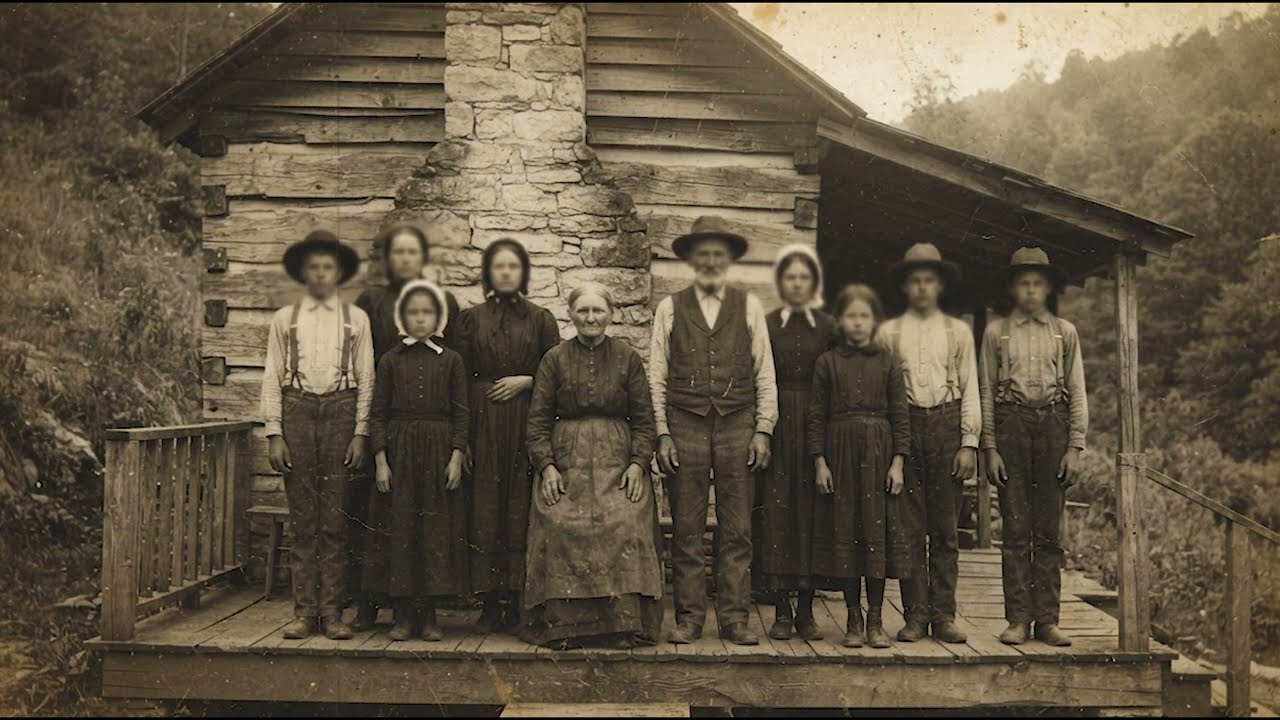
He has also documented six additional properties outside the four-county area that appear to follow the same pattern. One is in northern Arkansas. One is in western Kentucky. One is in southern Illinois in what is called Little Egypt. One is in eastern Oklahoma. And two, about which he has said the least, are in what is now suburban development on the outer western edge of St. Louis County, in subdivisions built in the 1970s and 1980s on land that used to belong to two of the original 14 fellowship families.
He has not been able to make direct contact with the current owners of those houses. He does not know whether the rooms in the basements or crawl spaces are still being maintained. He knows only that the pattern exists, that it repeats, and that in every case where the pattern has been broken, something has followed.
There is one other thing Dr. Vause has documented. In the same summer the Halberstams bought their farmhouse, three additional properties in southern Missouri and northern Arkansas were sold by elderly members of the fellowship to unrelated buyers from outside the region. All three sales were unsanctioned. In two of the three cases, the new owners renovated, discovered the rooms, and made a choice Dr. Vause has not disclosed. In the third case, the new owner discovered the room, panicked, filled the stairwell with concrete over a single weekend in the spring of 2023, and moved out four months later, listing the house at a substantial loss and citing "personal reasons for the relocation."
The property was purchased at the reduced price by a young couple from Little Rock. They moved in in the autumn of 2023. The wife was 32. The husband was 34. They had one child, a daughter aged three.
In February of 2025, all three members of the family were reported missing by the wife's mother, who had driven up from Arkansas after two weeks of unanswered phone calls. The house was locked. The car was in the driveway. The child's toys were in the yard. There was food on the kitchen counter.
In the middle of the kitchen floor, in the exact location where the previous owner had poured concrete over a set of stone stairs, the concrete had developed a crack. A single crack, roughly six feet long, running in a straight line from the north wall to the south wall of the kitchen. The official incident report noted the crack as a structural anomaly. It did not speculate on its cause.
The family was never found. The case is still open technically in the files of the county sheriff's office, but is no longer being actively investigated.
Dr. Vause has, at Aaron's request, driven past the house exactly one time in the summer of 2025, in the middle of the afternoon with two other people in the car and without stopping. He said the house was, from the road, unremarkable. He said the crack in the kitchen floor had widened, and he could see it through the kitchen window from the driveway as a dark line running from wall to wall. He said the yard was overgrown. He said he did not at any point feel the desire to get out of the car.
He said that when he had driven past the house, he had, without thinking about it and without deciding to do so, said out loud in the direction of the kitchen window the same words Homer Boyd had told him he had said in the two cases he investigated in the previous century. He said he was sorry. He said he was not there to disturb anything. He said he would leave everything as he had found it. Then he drove away, and he has not gone back.
He said that in the months since he made that drive, three other properties in the extended pattern have been sold by elderly members of the fellowship to buyers from outside the region. He has not been able to make contact with the new owners. He is watching and documenting and hoping that one of the three houses will be the kind of house where the new owners never notice the anomaly and where nothing will happen. He said he does not, based on the pattern he has documented over 30 years, expect that to be the case in all three houses.
He said he expects that one of the three will follow the pattern the young couple from Little Rock followed. And he said that when it does, there will not be in the local newspaper or on the county sheriff's website or in any official record of any kind an account that connects the disappearance of that family to the disappearance of the family in Little Rock, or to the disappearance of the family in Ozark County in 1978, or to the deaths of the family in Texas County in 1951.
The pattern, Dr. Vause said, does not connect itself in the public record. It is the kind of pattern that only becomes visible when a person spends 30 years in a small office in a small college in southern Missouri quietly assembling records that no one else has thought to assemble and holding them next to each other and noticing what they have in common.
Dr. Vause said he did not expect anyone to believe him. He said he did not need anyone to believe him. His purpose in agreeing to give the interview was to make sure the pattern was somewhere on the public record in a form that a person who had begun to notice the pattern in his own life, in his own house, in his own hollow, in his own county, might be able to find at 3:00 in the morning with a soft spot in his kitchen floor and a pry bar in his hand and no idea what he was about to do.
He said he hoped that person would read it slowly and sit with it for a while, and before he went back into the kitchen and pulled up the boards, make the phone call. He said the phone call was, in his experience, the single most consequential decision that person would make in his adult life. The outcomes in the cases where the phone call was made were, without exception, better than the outcomes in the cases where it was not.
There is a question Dr. Vause has been asked by every homeowner he has ever spoken to about this material. It is the question he says he finds the hardest to answer honestly. The question is whether the arrangement is a real one. Whether the Watcher on the Threshold is, in some literal sense, a being that exists, that made an agreement, that keeps an agreement, and that will, if the agreement is broken, permit something to enter the world. Or whether the arrangement is a kind of collective psychological structure, a very old and very well-maintained folk belief that has, through generations of consistent behavior, taken on the appearance of causal power in the lives of the people who believe in it.
Dr. Vause says he does not know. He says he is certain the people involved believe the arrangement is real. He says he has documented enough historical cases of families who broke the arrangement and of what happened to those families to be certain that something reliably follows the breaking of the pattern, whether that something is supernatural in origin or whether it is a series of unrelated tragedies that have been retroactively assembled into a pattern by frightened people looking for one.
He says he cannot from the historical record alone tell the difference between those two possibilities. And he says that in his own private life, in the way he arranges his own affairs and in the choices he has made about which properties he will and will not personally visit at night, he has over the course of 30 years been quietly behaving as though the first possibility were the correct one.
He asks only that anyone who lives in the geographic areas he has described and who happens to have bought an old farmhouse in one of those areas and who happens to find in the course of a renovation a soft spot in a kitchen floor over a section of foundation that does not appear on any survey do one thing before they pull up the first board. He asks that they call him, or that they call someone like him, or that they at least before they lift the pry bar sit down at the table for a moment and think carefully about whether they are ready for the possibility that what is under the floor might not be an empty crawlspace and might not be something they are able to close back up and forget about.
Because the pattern, Dr. Vause says, is not confined to 14 families in southern Missouri. The migration was larger than that. The fellowship in its various regional forms arrived in the interior of the North American continent in multiple waves over the course of a century and settled in a much wider set of locations. There are, he estimates conservatively, somewhere between 80 and 140 properties in the eastern half of the United States that were built in the 19th century by families following the same tradition in the same way, with the same rooms in the same locations under the same floors.
Most of those properties are still standing. Most of them have been sold at least once to families outside the original fellowship. Most of the current owners have no idea what is under their houses. Some of them will find out. Some of them already have. Most of the ones who have found out have, for reasons that will be obvious to anyone who has followed this account to its end, chosen not to talk about it publicly.
The Halberstams have not spoken publicly either. This account was reconstructed with their partial cooperation by Dr. Vause from his own notes and recordings and shared with their reluctant permission on the condition that certain identifying details, including the exact location of the house and the actual last name of the family, would be changed in any public retelling. Their names in this account are not Halberstam. The town near their house is not called Grove Spring. The county they live in is a county in southern Missouri, but it is not, in fact, Wright County.
The house exists. The room exists. The professor exists. Everything else in this account is, in the details that matter for the argument, exactly as it was described. In the details that do not matter, it has been altered enough that no one who has read this will be able to drive out to the house on a Saturday afternoon and knock on the door.
Aaron and Beth asked for that condition. Dr. Vause insisted on it. The reason he insisted on it, he said, was not to protect the Halberstams from public attention, although that was a factor. The reason he insisted on it was to protect the fellowship.
The people who come to that house 12 nights a year on the correct calendar to perform the keeping in the stone room under the kitchen are old. Most of them are in their 70s and 80s. They are the last generation of a tradition that has been continuously maintained in secret in the American interior for nearly 250 years. Their identities and the identities of the houses they still visit are, in a way that Dr. Vause does not fully understand and does not fully want to understand, load-bearing. They are holding something up.
He does not know what happens when they are no longer able to hold it up. He does not know what happens when the last of them is buried and there is no one left who knows the calendar or the words or the way to enter the room without being counted as a stranger. He does not know what happens to the 80 to 140 properties across the eastern half of the country when the last person who knew what was under the floors is no longer alive to tell anyone.
He suspects that some of us are going to find out. Not all of us, but some. And he hopes, when the finding out happens, that whoever is standing in the kitchen with the pry bar in his hand will remember what Homer Boyd told Aaron in a small brick house on the edge of Ava, Missouri in the winter of 2022.
He hopes they will remember to say something out loud before they go down the stairs. And he hopes they will mean it when they say it. Because the thing in the room can tell the difference.