Bavaria’s King Ludwig II was found dead in Lake Starnberg on June 13, 1886, less than 48 hours after being declared insane and removed from power. The official verdict was suicide by drowning, but the autopsy found no water in his lungs, and the death was listed as cardiac arrest. The circumstances have fueled more than a century of unanswered questions. Ludwig was born on August 25, 1845, at Nymphenburg Palace.
His father, Maximilian II, expected an heir capable of strengthening Bavaria’s position among the fractured German states. Instead, the young prince spent his childhood absorbed in books about medieval knights and fairy tales, sketching castles in the margins of his textbooks and memorizing poetry instead of population statistics. At age 15, Ludwig discovered the operas of Richard Wagner. The story of the swan knight Lohengrin transformed his worldview.
Here was a realm where beauty mattered more than politics and dreams could be made real through art. Wagner’s operas became Ludwig’s religion, and the composer himself became something close to a god. When his father died in March 1864, the 18-year-old Ludwig became king. One of his first acts was to summon Wagner to Munich, pay the composer’s debts, fund new operas, and build him a dedicated theater.
The Bavarian treasury hemorrhaged money, but Ludwig saw kingship not as a matter of treaties or armies, but as the power to make beauty real. Bavaria at the time was caught between worlds, too small to compete with the great powers and too proud to surrender its independence. The Prussian-Austrian War of 1866 devastated Bavaria’s military and treasury. Forced into a humiliating alliance with Prussia, Bavaria lost four million florins and its military independence.
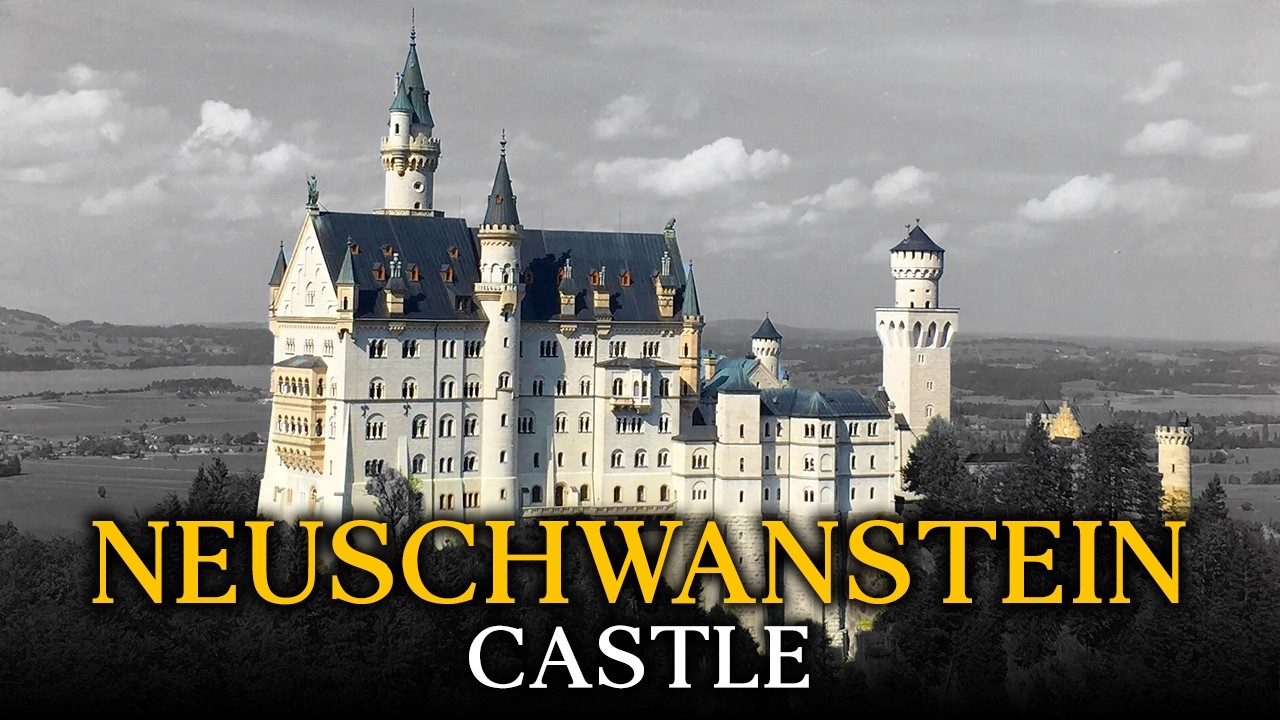
Ludwig signed the treaty without reading it, more concerned with the proper height of a throne room ceiling. Construction of Neuschwanstein began in September 1869 on a rugged crag overlooking the Pöllat gorge. The remote location forced workers to haul every brick and beam up steep mountain paths. In the first year alone, costs exceeded 300,000 marks.
The king kept adding features: a throne room modeled on Byzantine churches, a singer’s hall based on Wagner’s Tannhäuser, and bedrooms with ceilings painted to resemble starry nights. In 1870, Bavaria was forced to fight alongside Prussia in the Franco-Prussian War. Bavarian soldiers died fighting a war their king barely noticed. When the German Empire was proclaimed in January 1871, Bavaria lost what remained of its independence.
Ludwig was still technically king, but real power rested with Berlin. He reportedly felt relieved: fewer responsibilities meant more time for his castles. By 1877, construction costs at Neuschwanstein reached 1. 2 million marks.
By 1880, they had climbed to 2. 4 million. When ministers warned that he was spending a sixth of the kingdom’s annual revenue, Ludwig borrowed money from private banks, sold royal properties, and mortgaged future revenues. When those sources ran dry, he begged relatives in other German royal houses for funds.
Most refused. The interior of the castle reflected Ludwig’s obsession. The throne room spanned two floors, its ceiling soaring 60 feet above a floor that would never hold a throne; Ludwig died before the throne could be made. The bed in his bedroom took four and a half years to complete, with 14 carvers working full-time on oak panels depicting scenes from Wagner’s Tristan und Isolde.
The washstand was solid silver. By the spring of 1886, Neuschwanstein had cost six million marks. It served no strategic purpose, housed no government offices, and could not even serve as a proper residence because half its rooms remained unfinished. The grand staircase stopped abruptly, the heating did not work, and the plumbing was incomplete.
The ceiling in the bedroom was painted with every star in its proper position. Ludwig’s behavior grew increasingly erratic. He reversed his sleeping schedule, holding dinners at two in the morning and meetings just before dawn. He gained weight rapidly, stopped exercising, and refused to see doctors, convinced they were plotting against him.
He reportedly accused his architects of sabotaging his vision and screamed at workers for hours over minor delays. He built Linderhof Palace, a miniature Versailles filled with grottoes and a mechanical moon, and began Herrenchiemsee in 1878, another massive castle meant to surpass Versailles. Neither would ever be completed. By 1886, Ludwig owed creditors more than 14 million marks.
His ministers met in secret and brought in Dr. Bernhard von Gudden, Bavaria’s leading psychiatrist. Von Gudden never examined Ludwig in person. Instead, he collected testimony from servants and compiled a case file.
He diagnosed paranoia, megalomania, and detachment from reality. A commission of four doctors declared Ludwig unfit to rule. On June 10, 1886, a delegation arrived at Neuschwanstein to take the king into custody. Ludwig ordered the local fire brigade to defend the castle and instructed staff to bar the gates.
For several hours, there was a standoff. Local police loyal to the king arrested some members of the delegation, and the delegation retreated to reorganize. On June 12, a larger delegation returned, this time prepared for resistance. Ludwig did not resist when they finally entered.
He had spent the night burning documents and letters he did not want found. After the formal reading of the declaration, he quietly agreed to go peacefully, asking only for time to pack personal belongings. He was taken to Berg Castle on Lake Starnberg, where Dr. von Gudden took charge of his care.
Ludwig was isolated, denied visitors, and had his correspondence monitored. According to those present, he behaved not like a raging madman but like a man who was merely depressed and defeated. On the evening of June 13, Ludwig requested a walk. Dr.
von Gudden dismissed the usual guards and accompanied him alone along the lakeshore. When they did not return, a search party found both men in shallow water around 10:30 that night. Ludwig was floating face down. Von Gudden showed signs of a violent struggle, his face bearing scratches.
The water was only waist deep. The official verdict was suicide. But the autopsy found no water in Ludwig’s lungs, and the cause of death was listed simply as cardiac arrest. Witnesses reported hearing gunshots from the direction of the lake around the time of the deaths.
A coat belonging to Ludwig, found on the shore with what appeared to be bullet holes, disappeared from evidence. Ludwig was buried in the crypt at St. Michael’s Church in Munich. Within seven weeks of his death, Neuschwanstein was opened to the public for paid tours.
The government, inheriting debts of 14 million marks, used the castle’s revenue to cover the financial catastrophe. Within a decade, the castles had paid off a significant portion of the debts. Over time, Neuschwanstein became one of Germany’s most visited tourist sites, drawing more than a million visitors a year by the 1980s and around 1. 4 million annually in the early 21st century.
It also generated over 15 million euros in annual tourism revenue. In 1955, Walt Disney used the castle as the inspiration for Disneyland’s Sleeping Beauty Castle, giving it worldwide recognition. Historians and researchers have continued to debate the circumstances of Ludwig’s death. Some argue the timing, the swift burial, and the suppression of evidence suggest murder orchestrated by the government.
Others point to von Gudden’s own death as evidence of a struggle gone wrong. Some suggest Ludwig rily fled to Austria or Switzerland, while darker theories allege that a scandal related to his relationships with male servants was the motive. Modern forensic investigations have been proposed but have been repeatedly blocked by the Bavarian state and Ludwig’s surviving relatives. The official position has remained that the case is closed.
Neuschwanstein still stands above the Bavarian Alps, incomplete and magnificent. Ludwig built it to escape the world, but the castle has become one of the world’s most recognizable landmarks. The price of the dream included a bankrupted kingdom, the lives of workers who died in its construction, and the king’s own sanity and life.
Yet the castle survives, a permanent monument to a question that every visitor must answer for themselves: was it worth it?