The official history of the Battle of Manzikert was written by a man contemporaries called the most brilliant mind alive. Michael Psellos, a philosopher and palace insider, shaped the account of Emperor Romanos Diogenes as a vain, reckless fool who marched the Roman army into ruin. His version has governed the story for a thousand years. It was also, according to a second writer, a lie built on purpose.
Michael Attaleiates was not a philosopher but a judge, and he was there. He rode with the army, tasted the dust of the march, and watched the betrayal with his own eyes. His chronicle is not polished palace propaganda. It is the testimony of a witness to a killing that began with ink and was finished later with a needle.
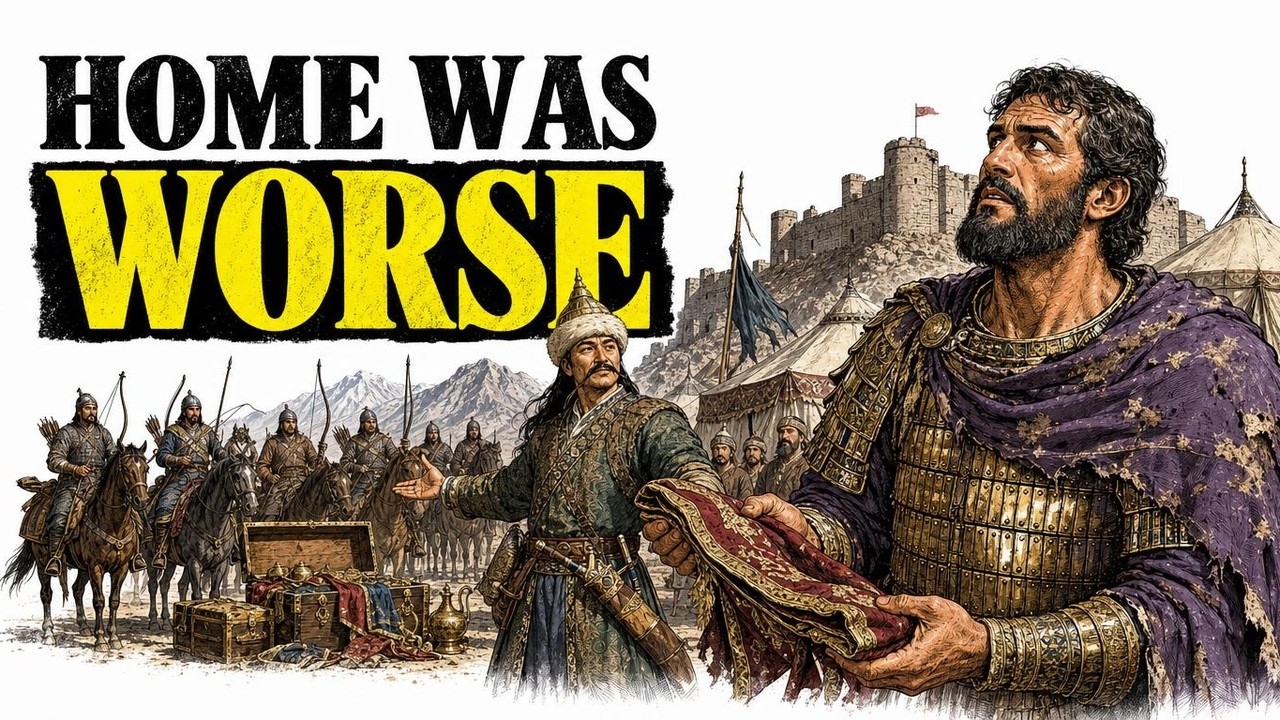
On August 26, 1071, something happened that had not occurred in nearly a thousand years of Roman warfare: an emperor was taken alive on the battlefield by a foreign enemy. The Seljuk Sultan Alp Arslan held the most powerful man in Christendom and treated him as a king. He gave him a seat at his side, negotiated a treaty that cost the empire no land, and sent him home under armed escort weighed down with gifts. Romanos Diogenes came back not as a broken slave but as a monarch carrying peace.
The problem was that the men he had left in charge did not want peace. They wanted him erased. The Sultan honored him as a rival emperor while his own officials declared him a public enemy, pronounced him deposed, and raised armies to hunt him across his own provinces. The foreign conqueror showed him mercy.
His own people showed him none. The defeat at Manzikert was a wound, not a death. The true catastrophe was not the blunder on the field but the calculation made in the capital. The men who ruled from Constantinople had come to fear their own emperor more than any army beyond the frontier, and they were willing to shatter the army and abandon the border to pull him off the throne.
For fifty years before Romanos wore the purple, the empire had been captured not by a foreign army but by its own civil service. A government of aristocrats and scholars had convinced itself that the deadliest threat was not a Turkish horseman on the eastern border but a Roman general with a loyal army behind him. Sixteen years earlier, in 1057, General Isaac Komnenos had marched his eastern troops on the capital and forced the reigning emperor to abdicate into a monastery. The palace men drew the wrong conclusion from that lesson.
Instead of trusting their soldiers, they decided to break them. They starved the professional soldiers of money. Emperor Constantine X Doukas, who reigned from 1059 to 1067, made it policy. He cut military rolls and let the frontier fortresses of Armenia and Mesopotamia decay.
In 1064, the great border city of Ani fell to the Seljuks under Alp Arslan. The bureaucrats dismantled the old thematic system, in which free farmers held land in exchange for military service. Those soldier-farmers were the spine of the empire’s defense. The administrators converted them into taxpayers and replaced them with mercenaries.
From a palace desk, mercenaries were perfect: they cost money, which kept them tied to the paymasters in the capital, and they were foreign, meaning they felt nothing for an ambitious general. The theory failed because the raids stopped being small. Alp Arslan, whose name meant the heroic lion, had inherited the throne from his uncle Tughril in 1063 and spent every year since expanding it. His raiding columns grew bolder every season.
In 1067, they struck deep into Cappadocia and sacked Caesarea, stripping the shrine of St. Basil of its silver. The bureaucracy needed a soldier they could hold on a leash, and the leash they chose was a marriage contract. In late 1067, Constantine X Doukas died, leaving his wife, Empress Eudokia Makrembolitissa, as regent for their young sons.
She had sworn a written oath never to remarry, deposited in the archives of Hagia Sophia under the guard of the patriarch. The Doukas family, steered by the powerful Caesar John, the dead emperor’s brother, meant to rule through her. But the crisis in the east demanded a man on a horse at the head of an army, so the clan needed a military caretaker who would beat back the Turks and then step aside. Romanos fit the mold: a respected general from a powerful Cappadocian family, popular with the soldiers, and in 1067 he had been arrested for allegedly plotting a coup, which made him both qualified and easy to threaten.
Attaleiates, who saw him then, describes a man brought before the court expecting the executioner. Instead, Eudokia looked at him and chose him. They pulled him out of prison, pardoned him, and on January 1, 1068, she married him and made him emperor. The empress had broken her written oath to do it, and the patriarch had to be persuaded to release her from it.
Romanos gave his oath to defer always to Eudokia and her sons, never to rival them. The contract was not the beginning of a new dynasty. It was a chain with a title attached. They called him emperor, but the real power stayed with the Doukas clan.
Near the front of that group stood Michael Psellos, who had been tutor to the boy Michael VII and had no intention of watching his pupil pushed aside. In the pages of his Chronographia, Psellos writes with contempt, showing Romanos as a coarse soldier whose mind was dull. Attaleiates shows a different person: a commander fighting impossible odds, a man who spent three years crossing Anatolia. In 1068, he marched into Syria and retook the fortress of Hierapolis after a hard assault.
In 1069, he pushed east across the Armenian highlands. He shows an emperor who ate the same rations as his troops and rode at the front of his own charges. The armies handed to him were half-trained and underpaid. Attaleiates described soldiers whose breastplates were rusted through, whose horses were broken-down nags, whose officers had bought their ranks and never drawn a sword in anger.
The bureaucracy in Constantinople delayed his funds, second-guessed his strategy, and salted his command staff with men whose real loyalty belonged to his rivals. By the spring of 1071, Romanos knew the clock was against him. He needed a victory so total it would end every argument at once. He decided to gather the largest imperial army seen in generations and march east to corner the Sultan and force a single battle.
The army left Constantinople in March of 1071, crossing the Bosphorus in a stream of ferries that took days to move the baggage alone. On the march, Attaleiates recorded the mood was not confident. A section of an old imperial palace collapsed behind Romanos as he left it. His own tent caught fire another evening, and his favorite warhorse bolted into the dark and was found only at dawn.
A standard broke in a soldier’s hands during a review. The host was enormous, with a sober count landing between 40,000 and 70,000 men. But it was a fragile patchwork. Norman cavalry from Italy rode under the ambitious Roussel de Bailleul, men who had spent a decade cutting a private kingdom out of the empire’s Italian provinces.
There were Frankish and German infantry, the Varangian Guard of axe-bearing northmen, and cavalry squadrons of Pechenegs and Oghuz Turks who shared the same customs as the enemy they were paid to kill. Into that barrel, the Doukas faction had already set the fuse. The commander of the reserve, the anchor at the rear on which the whole formation depended, was Andronikos Doukas, the Caesar’s own son and the man who would inherit the throne if Romanos fell. Romanos knew it, and he had asked for the young man to be placed under his eye rather than left behind to plot.
It would prove the worst decision of his life. By August, the army reached the highlands near Lake Van. There, beside a fortress town called Manzikert, Romanos split his army, sending a large portion south under General Joseph Tarchaneiotes to secure a second fortress at Khlat. Then he learned that the Sultan he believed to be far away in Aleppo was close, and the column he had sent south did not come back.
The ease of taking Manzikert was a trap dressed as victory. Alp Arslan had lifted the siege of Edessa, crossed the Euphrates, and force-marched his men north. Tarchaneiotes rode straight into the vanguard of the Sultan’s host, and the record simply stops. Attaleiates, who was in the emperor’s half of the army, records the fact and nothing more.
The western column was gone, and he never saw those men again. Alp Arslan did not want this fight at all. His real ambition lay south, in the conquest of Fatimid Egypt. He sent an embassy offering a truce, but for Romanos a truce would be carried back to Constantinople and rewritten by Psellos and the Doukas clan into a single word: failure.
Romanos sent the envoys away and told them he would discuss terms in the Sultan’s own capital. The night before the battle, the Oghuz mercenaries within the emperor’s own army began slipping away toward the Seljuk fires in the dark. On the morning of Friday, August 26, 1071, the Byzantine army marched out in full battle order. At its center stood the imperial standard, the sacred banner of the Christian Empire, raised on a tall staff and ringed by the Varangian guard.
The Seljuks did not form a line to be broken. They swarmed, a loose crescent of horse archers who rode in, loosed volleys, and wheeled away before the heavy cavalry could reach them. For hours the Roman line pushed deeper into open country. By late afternoon, Romanos made the only sound choice left: he ordered a halt and a reverse march back to camp in formation.
This is the most dangerous order in all of warfare. The entire maneuver rested on one thing: the reserve line under Andronicos Doukas had to hold its ground and cover the main body as it pulled back. As the imperial standard began its slow move to the rear, the Seljuks, who had feigned flight all day, turned as one and charged. In the same breath, the imperial reserve turned its back and marched off the field.
Michael Attaleiates does not hedge. He writes that Andronicos Doukas had long been an enemy of the emperor, that he looked at the chaos, spread a false rumor that the emperor was already dead, and treacherously abandoned him. The versions written decades later speak of poor visibility and a tragic misreading of orders, but they build a careful fog of war to hide a political crime. The sight of that entire second line walking off the field killed the army’s will in an instant.
The Norman cavalry cut their way out of the closing ring. The Pecheneg and Oghuz horsemen changed sides. Within minutes, the emperor and the elite troops of the center were surrounded. Romanos fought on with his army breaking apart around him.
An arrow drove through his hand. His horse was killed under him, and he fought on foot until the enemy closed over him. A Seljuk soldier seized him without knowing who he was. Only when a captured Byzantine courtier fell weeping at the sight did the Seljuks realize they had taken the emperor of the Romans alive, the first such capture in almost a thousand years.
Every telling of Manzikert loves the scene in the tent. The Muslim chroniclers say Alp Arslan pressed a boot to his neck before raising him up. The Sultan asked what Romanos would have done had the roles been reversed, and Romanos answered that he would have had him killed. The Sultan’s reply became famous: his own punishment would be heavier, he would forgive him.
He sat the emperor at his own table for a week and sent him home with a treaty that took no land. Weeks before he rode back through the gates of his own empire, the men he left behind had been staging their coup. The Caesar John Doukas and Michael Psellos forced Empress Eudokia to give up power, and packed her off to a convent. They crowned her son Michael VII as sole emperor.
Then they issued the decree that mattered: Romanos Diogenes was a traitor who had bargained with the enemy, his treaty was void, and the armies of the empire were ordered to hunt him down. The civil war had begun. Romanos gathered the few loyalists who would still stand with him and tried to fight his way back toward the capital. The Doukas regime sent an army against him under Andronicos Doukas, the same man who had turned his back at Manzikert, now promoted and rewarded for his treason.
The real disaster was the decade that followed. Every ambitious general in the Byzantine world had learned that power was for sale, and the coin it was priced in was Turkish cavalry. The Doukas regime hired Turkish war bands to fight Romanos. Romanos hired other Turkish war bands to fight the Doukas Turks.
Anatolia was not conquered in a great campaign. It was sold field by field, town by town, by Romans paying Turks to kill other Romans. Romanos fought on for months, proving himself the better general and beating back the first force sent against him. But skill does not beat a treasury.
In the end, he was cornered in the fortress of Adana in Cilicia. He demanded a written guarantee for his life, and his surrender was sealed by three metropolitans who promised in the name of God that no harm would touch him. Romanos laid down his arms and took the monastic habit. The order that came back from the palace was not for a quiet retirement.
It was for mutilation. Blinding was the empire’s chosen instrument for this kind of problem, a way to disqualify a rival from the throne without the open sin of murder. The order did not come from a foreign sultan. It came from cultured civil servants in the gilded chambers of the great palace.
Attaleiates records that the sentence was carried out with brutal incompetence by a man with no skill for the work. The broken man was set on a boat and carried to a monastery on the island of Prote, close enough to the capital that on a clear morning a whole man could have seen the domes he once ruled from. The wounds turned septic in the summer heat. And then came the final cruelty, and it arrived in writing.
Before the end, Romanos received a letter from his old enemy, Michael Psellos. It was a note of congratulation, praising God that the emperor’s earthly eyes had been taken from him so that he might now perceive the light of heaven with the eyes of the soul. A few days later, Romanos Diogenes was dead. He died of the peace his own rivals forced on him, on an island a morning sail from the throne he had brought home safe.
Ten years was all it took for one act of political vengeance to become permanent. With Romanos dead, Anatolia slid into chaos. The Turkish warlords became the masters of the land. By 1081, a new and permanent Turkish state stood in the heart of the old Roman provinces, the Sultanate of Rum, with its capital at Nicaea, less than a hundred miles from the walls of Constantinople.
The defeat on the field in 1071 did not seal the fate of the Eastern Roman Empire. The fate of the empire was sealed in the summer of 1072 when the government in Constantinople chose to blind its own defeated emperor rather than close ranks behind him and honor the peace he had carried home. That single act of calculated cruelty broke the army, shattered the legitimacy of the state, and lit a generation of civil war. Decades later, Emperor Alexios Komnenos, the same young officer who had once hired Turks to crush the Norman rebel, wrote west to Pope Urban II asking for a modest force of Western mercenaries.
What answered his letter was the First Crusade, tens of thousands of armed Westerners pouring across his lands in 1096. The court of Constantinople had feared its own general so deeply that in destroying him, it opened the door to the Turks, and in straining to shut that door again, it opened a far larger one onto two centuries of holy war that would end in 1204 with a crusader army sacking Constantinople itself. The judge Michael Attaleiates lived to see the ruin gather. He finished his history knowing exactly what his masters had done, and he set the truth down anyway, so that the brilliant lie of Michael Psellos would not be the only voice left standing.
A thousand years later, we are reading the judge, not the philosopher.