Suzanne Somers built one of Hollywood’s most unexpected second acts, but the people closest to her say her real legacy had nothing to do with fame or fitness products. When she died at her Palm Springs home on October 15, 2023, one day before her 77th birthday, her son and two stepchildren were by her side. Born Suzanne Marie Mahoney on October 16, 1946, in San Bruno, California, she grew up in a working-class Irish Catholic family as the third of four children. In her memoir, she described her father as a charming and brilliant man who became abusive when he drank, leaving her terrified much of the time.
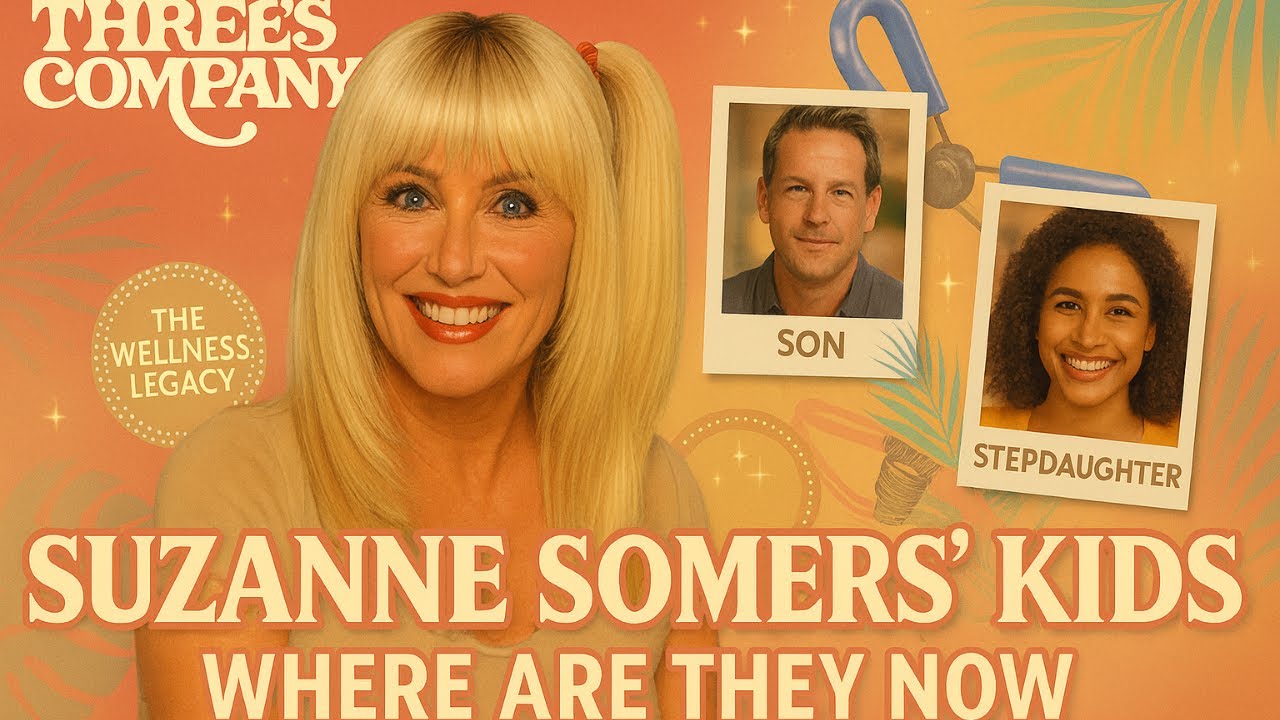
She credited her mother as the anchor who held the family together. At 18, she became pregnant, married Bruce Somers in 1965, and gave birth to her only biological child, Bruce Somers Jr. , that same year. The marriage ended three years later.
Determined to support her son, she took small acting jobs and modeled for local ads before landing a brief but memorable role in George Lucas’s 1973 film American Graffiti as the blonde in the white Thunderbird. Her career took off in 1977 when she was cast as Chrissy Snow on Three’s Company. Her sunny demeanor, comedic timing, and signature giggle made her one of television’s most recognizable stars. She left the show in the early 1980s, a move many assumed would end her career.
Instead, she reinvented herself through Las Vegas performances and television appearances before finding unexpected success in the 1990s with the ThighMaster, a simple plastic exercise device sold through playful infomercials. The product sold millions of units worldwide and transformed her into a home fitness icon. She later joked, “I laughed all the way to the bank. Who knew squeezing your thighs together would change my life?
”
She expanded into beauty products, nutritional supplements, and skincare lines, and wrote more than 25 books, including autobiographies and wellness guides such as Ageless and Breakthrough. Her advocacy for hormone replacement therapy, organic living, and alternative cancer treatments drew both criticism and praise. She maintained that she was not prescribing but sharing her own experience, telling audiences, “I’m not a doctor, but I am a patient, and this is my truth. ”
In 2000, she was diagnosed with breast cancer and chose alternative therapies over traditional medical paths, a decision that reshaped her public identity.
She documented her journey in her books and remained one of the most outspoken celebrity advocates for non-traditional treatments through the 2000s and 2010s. At the center of her later life was her partnership with Alan Hamel, whom she married in 1977. The couple worked, traveled, and spent nearly all their time together for more than four decades. In her final years, Alan became her primary caregiver as cancer returned.
In a statement after her death, he called her “the love of my life for 55 years” and said, “We never spent a day apart. Life with her was a joy. ”
Her family was a blended one that she embraced fully. Through her marriage to Alan, she became stepmother to his children, Steven and Leslie Hamel.
She rejected the idea of stepchildren, saying, “In my heart, there’s no such thing as a stepchild. When I married Alan, Steven and Leslie became my children, too. Love doesn’t divide, it multiplies. ”
Bruce Somers Jr.
chose a quieter life away from the spotlight. He studied at the University of California, Berkeley, and founded Summer Media, a brand and marketing company where he worked behind the scenes on his mother’s books, products, and television projects. He married Carolyn Somers, a writer and producer who also collaborated with Suzanne, and the couple had two daughters, Cameile and Violet. Steven Hamel built a successful career as a film producer, co-founding a production company with actor Keanu Reeves and working on several high-profile projects.
Leslie Hamel pursued fashion and costume design, collaborating occasionally with Suzanne, who described her as “an artist with fabric and imagination. ” Both chose to stay largely out of the tabloids. Suzanne often said her greatest achievement was the family she built. Having grown up in a chaotic household, she dreamed of creating a happy one.
After her death, her children shared tributes focused not on her fame but on the warmth and unity she brought to their lives. Bruce called her “the light that guided us, the heart that kept us together. ” Steven remembered her as a second mother who gave unconditional love, while Leslie said Suzanne made her feel like she had two mothers. Her grandchildren brought her renewed joy in her later years.
She once reflected, “At the end of the day, it’s not the shows or the money that matter. It’s sitting at the table with your family, laughing and loving each other. That’s real success.
”