In the summer of 1997, a woman on a small Scottish island kept writing letters to her daughter. The letters kept coming back unopened.
The daughter was Diana, Princess of Wales. They never spoke again.
On August 31, Diana died in Paris. Her mother had not heard her voice for about four months.
Almost 30 years earlier, the same mother had lost the same child in a custody case. The witness who helped the father win was her own mother, a lady-in-waiting to the Queen Mother.
Society had a word for her: the Bolter.
Did Frances Shand Kidd hate her daughter? Or did each of them spend a lifetime believing the other had left first?
### The Girl Born the Day a King Died
On January 20, 1936, a baby girl was born at Park House. About a mile away, a king was dying.
King George V died that same day at Sandringham House, the royal family's great country retreat in Norfolk. The baby was born at home in a house that stood on his own estate. Her name was Frances Ruth Roche.
Decades later, her son would write it down with a kind of wonder. "On the very same day she was born, King George V died one mile away in Sandringham House."
It was a strange first day for anyone. For this child, it was a fitting one.
Frances would spend her whole life close to the crown, sometimes warmed by it, sometimes burned.
Park House was a large, solid country house built by the royal family for the use of the royal household. For decades, it served the court as a house near enough to the great house to be useful, a short walk across the park.
The Roche family rented it from the crown. To hold the lease on Park House was to be trusted, liked, and kept close.
The man who held the lease was Frances's father, Maurice Roche, the fourth Baron Fermoy. He was a friend of the Duke of York, who would one day reign as George VI. The two men shot together at Sandringham.
Frances's mother was a different kind of person altogether. Ruth was born in Aberdeenshire in the northeast of Scotland. She was a gifted pianist who had studied in Paris under one of the most celebrated teachers of the age.
She married Maurice Roche in 1931 and became Lady Fermoy. She did not give up music. In 1951, she founded the King's Lynn Festival. But her true stage turned out to be the court.
In 1956, she became an extra woman of the bedchamber to Queen Elizabeth, the Queen Mother. In 1960, she was made a full woman of the bedchamber. Ruth would hold that place for about 33 years.
Few women outside the family itself stood nearer to the Queen Mother than Ruth Fermoy. When she spoke, she spoke with the authority of that closeness.
Frances grew up in the rhythms of the estate, the shooting seasons, the royal Christmases. It was a world with firm rules, and Ruth kept them more firmly than most.
She believed deeply in the sanctity of marriage. A marriage, in her view, was a duty to be kept whatever it cost the people inside it.
### The Youngest Bride in the Abbey
On June 1, 1954, a girl of 18 left a house in Wilton Crescent on her father's arm, bound for Westminster Abbey. A press photographer caught the moment. The caption called it the wedding of the year.
The bride was the Honorable Frances Roche. The groom was John Spencer, known to everyone as Johnny. He held the courtesy title of Viscount Althorp.
He was 30 years old. He had already spent years in royal service, serving as an equerry to King George VI and then to the young Queen Elizabeth II.
He was, by the reckoning of the day, a fine catch. The girl he married had been a child in the schoolroom while he was already standing behind a king.
The royal family came to see it done. The Queen was there, and the Duke of Edinburgh, and the Queen Mother, and Princess Margaret.
Frances was 18. By one reckoning, she was the youngest woman to marry in Westminster Abbey since 1893.
Put the day in numbers, and its shape is plain: a bride of 18, a groom of 30, 12 years between them.
What did the marriage require of her? The great families of England passed their titles and their land to the eldest son. An earldom needs an heir. A daughter could not inherit the title. Only a boy would do.
Frances was expected to provide him. Her whole value to the house of Spencer rested on that one task.
Her own mother, who would later sit in judgment on that marriage, believed in exactly this kind of union. Duty first. The marriage kept, whatever it cost the two people inside it.
### The Son She Was Never Allowed to See
Sarah arrived in March 1955 and Jane in February 1957. Each time, the house waited for a boy.
In January 1960, the question seemed to be answered. On the 12th of that month, Frances gave birth at Park House to a boy. He was named John for his father.
He lived for about 10 hours.
What happened to his mother in those hours is darker still. Frances did not see her son.
"My baby was snatched away from me," she is reported to have said many years afterward. "And I never saw his face, not in life, not in death."
The writer Tina Brown gives the scene its full weight. "She struggled from the bed," Brown writes, "and banged frantically on the locked doors of the nursery to which he had been snatched away."
That was the thinking of the time and of the class. Grief was to be managed, spared, closed behind a door. The mother lying in the bed was not asked.
Then came the part that turned grief into humiliation. According to the biographer Andrew Morton, the family began to ask what was wrong with the mother.
Frances, still only in her early 20s, was sent to various Harley Street clinics in London to be examined. The examinations were meant to find out why she had not produced a healthy son. Morton calls it a humiliating and unjust experience.
The possibility that the fault might not be hers does not seem to have been raised.
Her son, Charles, not yet born when any of this happened, later gave Morton his own verdict. "It was a dreadful time for my parents," he said, "and probably the root of their divorce because I don't think they ever got over it."
### The Girl Who Was Supposed to Be a Boy
Diana was born at Park House on July 1, 1961, in the same house where her mother had been born. She was the fourth child and the third daughter.
Years later, speaking into a tape recorder for Andrew Morton's book, she put it without softening. "I know I was the girl who was supposed to be a boy," she said.
She went further. "The child who died before me was a son, and both of them were crazy to have a son and heir, and there comes a third daughter. What a bore."
It is impossible to know whether either parent ever said such a thing aloud. What matters is that the child believed it.
The son came at last on May 20, 1964. He was named Charles, and he would one day be the ninth Earl Spencer. His mother was 28.
The children who remember Frances from those years describe a mother of real spirit. At her funeral, her son would call her fearless, a woman more interested in truth and fun than in convention, with a sharply infectious sense of humor.
Someone like that does not fit easily into a marriage run on duty.
Diana carried one memory from those years that she never let go of. "I remember seeing my father slap my mother across the face," she told Morton. "And I was hiding behind the door and she was crying."
Penny Junor went further than the single memory. "Johnny could be violent," she said, "and Frances felt she and her children would be safer out of the home."
Others have painted a softer man. Tina Brown called Johnny a bully, not a batterer.
What can be said is that by the middle of the 1960s, the marriage was unhappy. The loss of the first son still lay across it.
In 1966, at a dinner party in London, Frances met a man who made her laugh.
### The Skiing Holiday That Ended a Marriage
The Althorps met Peter Shand Kidd and his wife Janet at a dinner party in London, and the four of them went skiing in Switzerland.
Peter Shand Kidd was an unusual figure to walk into the Althorps' world. His family money came from trade. His father had built a fortune in wallpaper.
Morton's description of him has a warmth that none of the accounts of Johnny ever manage. He calls Peter an amusing bon viveur with an attractive bohemian streak.
He was also married. He had married Janet in 1952, and together they had three children.
What did Frances see in him? Her own answer is modest and very human. "It wasn't love at first sight," she said. "But I do remember we made each other laugh."
And then a second sentence, which carries more weight than the first. "If Johnny and I had had a strong marriage, it wouldn't have happened."
In September 1967, the two eldest girls went away to boarding school. The parents agreed on a trial separation.
Frances left Park House and took a rented flat in Cadogan Place in Belgravia. She did not go alone. The two youngest children, Diana and Charles, came with her.
Diana was 6 years old. Charles was 3.
Diana did not remember it that way. When she came to speak of those months on tape, she used a phrase that has followed her mother ever since.
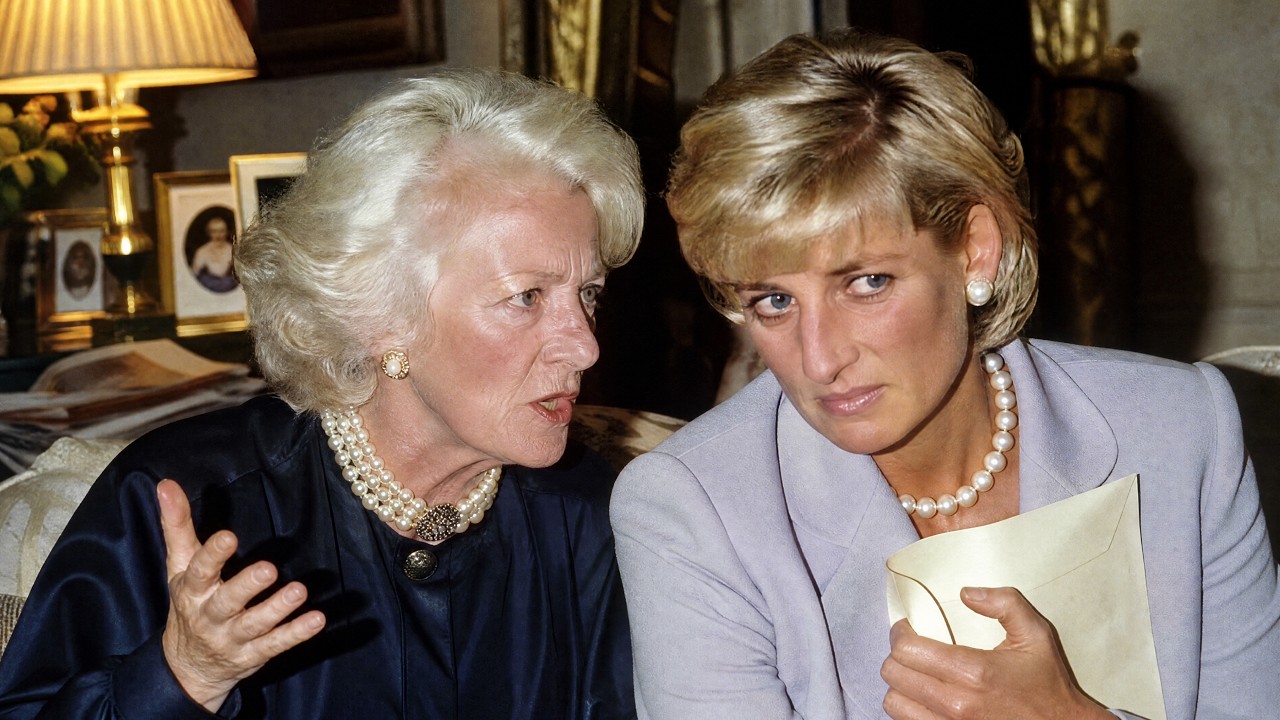
"The biggest disruption," she said, "was when mommy decided to leg it."
To leg it is British slang for running off, fleeing in a hurry.
"That's the vivid memory we have," she went on. "The four of us, people took sides."
Two women remembering the same autumn used words that could hardly be further apart. One said the separation was agreed. The other said her mother ran.
### The Christmas the Children Stayed Behind
The children went home to Park House for Christmas in 1967, and their mother went with them. She would never live in it again.
Over the holiday, Johnny told his wife that the children would not be going back to London with her. In Morton's words, Viscount Althorp insisted, against his wife's fierce objections, that the children return permanently to Park House.
Frances gave her own version in 1982. Her husband, she said, now insisted that Diana and Charles should be sent to school in King's Lynn. He refused to let them return in the new year to London.
The headline over the story in 1982 put it as plainly as a headline can: "Diana's mother says she did not desert her children."
The weekends now ran the other way. Instead of coming home to Park House to see their father, the children went to London to see their mother.
Morton records one of the scenes in a single line of dialogue. The children would find their mother upset. "What's the matter, Mommy?" they would chorus. And she invariably answered, "I don't want you to go tomorrow."
Diana's own summary of those months is almost clipped. "Parents were busy sorting themselves out," she said. "Always seeing my mother crying. Daddy never spoke to us about it. We never asked questions."
That last line is the key to the whole house. Nobody explained.
Diana's memory of her mother's going has become the most quoted image of all. In Morton's telling, she remembered the sound of a car engine revving and then slowly fading as her mother drove through the gates of Park House and out of her life.
Diana was 6 years old.
For Diana, the story began with a car leaving. She said it again and again in different ways. People took sides, and a family that takes sides over its children leaves the children standing in the middle.
### The Law Written Against the Wife Who Left
In the England of 1968, a marriage could only be ended if one of the two was found to be at fault. That was the law as it stood.
In the eyes of that law, a wife who had fallen in love with another man and left the marital home was the guilty party before anyone had said a word.
The question of the children was supposed to be separate. Since the Guardianship of Infants Act of 1925, English courts had been bound to regard the welfare of the child as the first and paramount consideration.
In practice, as the senior judge Sir James Munby has written, the judges of that age carried Victorian attitudes to adultery into their decisions about custody. A mother's conduct in the marriage could weigh heavily against her.
Andrew Morton put his finger on one of the other disadvantages. "Custody," he wrote, "usually went to the mother unless the father is a nobleman."
Then there was the other divorce before Frances's own case came on. Janet Shand Kidd divorced Peter. In that divorce, Frances was named as the other woman.
The story that would follow her for the rest of her life had its first official form.
The law asked very little of Johnny. The children were already in his house. He had only to stand still and ask the court to leave things as they were.
The reform that would sweep fault away came too late to help her. The Divorce Reform Act would receive royal assent in October 1969 and come into force in January 1971. By then, Frances's case would be two and a half years in the past.
And yet, according to Morton, Frances began the fight confident. "Lady Althorp sued for custody of the children," he wrote. "An action started with every hope of success."
What she could not know as she prepared for the hearing was what the other side would bring to court.
### Her Own Mother Took the Stand
The witness who did the most damage to Frances in June 1968 had known her since the day she was born.
Ruth, Lady Fermoy, was 59 years old. She had been a widow for 13 years. For eight of them, she had been a woman of the bedchamber to the Queen Mother.
When her younger daughter's marriage broke apart, Ruth chose. She took her son-in-law's side.
The details of what she said in court do not survive in any public transcript. The court record is closed.
What survives is the fact of it, reported again and again, including by The Times when Ruth died in 1993. Ruth, Lady Fermoy, gave evidence against her own daughter, and her evidence helped Johnny keep the children.
The clearest glimpse of what Ruth thought comes from the Daily Telegraph in its obituary of Peter Shand Kidd in 2006. "Lady Fermoy," the paper wrote, "took his side against her daughter, whom she considered to be a bolter."
A bolter. In the language of the English upper classes, a bolter was a wife who ran off. It was a word with contempt folded into it.
The result was never really in doubt. Johnny was granted custody of the children.
Morton, who heard the family's account through Diana, called what Ruth did "the greatest betrayal of her life, and one she never forgave."
He also described what the case did to Frances's public name. "It was then," he wrote, "that the myth of the Bolter was born."
A myth, Morton called it. He meant that the story was simpler than the truth. A wife who asks a court for her children and is refused has not deserted them in any ordinary sense of the word.
Why did Ruth do it? The record gives only her beliefs. She held marriage to be sacred. She had spent her life in a household where duty came before feeling.
To her, the daughter who left was the one who had broken the rule. The son-in-law who stayed was the one who had kept it.
Whether Ruth ever regretted what she said that day is simply not known. It would be wrong to invent an answer.
The man who won did not come out of it happy, either. Charles Spencer described his father in the years after the divorce to Andrew Morton. "He was really miserable after the divorce," he said. "Basically shell-shocked. He used to sit in his study the whole time."
The rest moved quickly. The hearing was in June 1968 when Frances was 32. The divorce from Johnny went through in April 1969.
On May 2, 1969, about a month later, Frances married Peter Shand Kidd.
By then, Diana was seven and Charles was four. Four children remained in the care of their father.
Years later, she put the loss into one sentence without adornment. "I lost the case," she said, "and the custody of the children."
### The Little Girl Waiting on the Doorstep
Charles Spencer remembers his sister sitting on the front step of Park House waiting for a car that did not come.
He told the story in September 2020 in an interview with the Sunday Times, and he told it without softening. "While she was packing her stuff to leave," he said, "she promised Diana she'd come back to see her. Diana used to wait on the doorstep for her, but she never came."
It is one of the saddest images in the whole story. A small girl sitting on the front step of a big house on a royal estate, watching the drive for a car, waiting for a mother who had promised.
Frances would have told it differently. She had promised, and she had been refused. She had come to court asking for those same children and lost.
The girl on the step was waiting for her. She, on the other side of the law, was waiting for them. Each of them was waiting for the other.
Diana spoke about those years herself in a set of tapes recorded with Peter Settelen in the early 1990s. Asked whether her father had ever explained where her mother had gone, she hesitated.
"Well, she—no, she had to go away," she said. "The court said, if I remember right, she had to go away."
So the child was not told. She was left to work it out.
On the same tapes, she spoke about what was missing. "My parents," she said, "they never said they loved me. There was always a kiss there, no hugs or anything like that."
Life at Park House went on around the gap. The household was run by nannies, and the nannies came and went. They changed, Morton writes, with alarming frequency.
At weekends, the journey ran to London. Charles and Diana took the train with their nanny from Norfolk to Liverpool Street Station, where their mother met them.
Morton sums up those years in a single sentence that has been quoted ever since. It was a childhood, he wrote, where she wanted for nothing materially but everything emotionally.
The nights were the hardest part. Morton records that Diana, lying in her bed surrounded by her cuddly toys, could hear her brother sobbing, crying for his mother. She never went to him.
"I could never pluck up enough courage to get out of bed," she said.
Charles has told the same story from the other side of the wall. "Diana," he said in 2020, "could hear me crying down the corridor, but was too scared of the dark to come to me."
Charles in that same interview gave the verdict that stung his mother's memory more than any other. "Our father was a quiet and constant source of love," he said. "But our mother wasn't cut out for maternity. Not her fault. She couldn't do it. She was in love with someone else. Infatuated, really."
### The Stepmother Nobody Was Told About
In 1975, Johnny Spencer became the eighth Earl Spencer, and the family left Park House for Althorp in Northamptonshire. Diana was 14.
She lost Park House, the only home she had ever had, the house on the royal estate where she and her mother had both been born.

Althorp came with a change the children had not been warned about. Their father was about to marry again.
Her name was Raine. She was the daughter of the romantic novelist Barbara Cartland. Until recently, she had been the Countess of Dartmouth, the wife of another earl.
On July 14, 1976, at Caxton Hall in London, Johnny married her. He did not tell his children first. They found out from the newspaper.
Diana described the moment on the Morton tapes. "Sarah rang me up," she said. "She said, 'Have you seen the newspaper? Daddy's married Raine.'"
The children's reaction was fierce, and Diana herself confessed to the fiercest part of it. She slapped her father across the face.
"That's from all of us," she told him. "For hurting us."
The children who had been told nothing when their mother left were told nothing again when a stepmother arrived. The same silence had come round twice.
The children gave her a name that stuck for decades. They called her Acid Raine.
Then in 1978, their father suffered a severe stroke. Johnny was 54. He survived it.
Where was Frances in all of this? A long way off and happier than she had been in years.
After their wedding, she and Peter had lived first at a house called Appledore at Itchenor in West Sussex. Then in 1972, three years after the wedding, they bought a farm on the Isle of Seil, south of Oban on the west coast of Scotland.
The children came to her in the holidays, and for them, Seil became something close to a paradise. Morton describes their summers there as a "Swallows and Amazons idyll," spending their days mackerel fishing, lobster potting, and sailing, and on fine days having barbecues on the beach.
Peter, he writes, was a generous, demonstrative, and easygoing stepfather.
This is the part of the story that rarely makes it into the legend of the cold mother. For a few weeks every year on a Scottish island, the four Spencer children had a mother who took them fishing and a stepfather who made them laugh.
Frances also went into business with Peter. She opened a gift shop in Oban, the nearest town. A baron's daughter and an earl's former wife was now a shopkeeper.
It was in its way a good life, a quiet one. It lasted until the week in 1980 when the newspapers discovered her youngest daughter.
### The Mother of the Future Princess
For her 18th birthday in July 1979, Diana was given a flat at Coleherne Court in London. The gift came from her mother.
It was a generous present and a telling one. The girl who had shuttled on trains between two parents now had a front door of her own, bought for her by the mother the legend said had left her.
Then in the summer and autumn of 1980, the press noticed that Lady Diana Spencer was being seen with the Prince of Wales.
What followed was a siege. The press camped on the family's doorsteps.
Her mother wrote to The Times. The letter was a protest against the harassment of her daughter by the newspapers. It was the act of a mother standing up for her child.
In February 1981, with the engagement only weeks away, Diana went to Australia with her mother and Peter for about three weeks. The press, guessing where she had gone, waited outside the Shand Kidd property near Yass. Diana was actually miles away, staying quietly in a beach house near Mollymook on the coast of New South Wales.
For three weeks on the far side of the world, the future Princess of Wales was hidden by her mother in plain sight.
The engagement was announced on February 24, 1981. From that moment, Frances, who had spent 12 years avoiding attention, became the mother of the future Princess of Wales.
The roles of the custody case were reversed in an odd way. Now it was the mother who stood outside, and the royal household that took the daughter in.
Someone else had a view on the match. Ruth, Lady Fermoy, still at the Queen Mother's side, gave her granddaughter a warning. "Darling," she said, "you must understand that their sense of humor and their lifestyle are different, and I don't think it will suit you."
The wedding took place at St. Paul's Cathedral on July 29, 1981. Thirteen years after their custody case, Frances and Johnny sat side by side to watch their daughter marry the heir to the throne.
For the wedding, Frances gave Diana a gift. It was a gold bracelet, and Diana wore it on the day.
Diana's own memory of her mother at the wedding was sharper. "She kept crying," Diana told Morton, "and being all valiant and saying that she couldn't cope with the pressure. I tended to think I was the one under pressure because I was the bride."
### The Marriage That Broke Under Diana's Fame
In August 1982, a year after the wedding, the story of the custody case came out in print, and it came out in Frances's own words.
The occasion was a book, "The Year of the Princess" by Gordon Honeycombe, serialized in the Daily Express. For the first time, Frances told her side.
The separation had been agreed. The children had lived with her in London. Their father had kept them at Christmas. She had lost the case, she said, and with it the custody of her children.
The reaction from Althorp was immediate. Earl Spencer called it "cheap and hurtful."
"It can only hurt Diana," he said. "Why did she do such a thing?"
There is an irony buried in that summer's quarrel. Ten years later, when Andrew Morton published the book that Diana had secretly helped him write, it carried both women's truths at once.
It gave the world Diana's memories: the crying, the car, the doorstep. And it described the story of the Bolter, in Morton's own word, as a myth.
From the engagement onward, by her own account, the press never really left Frances alone. In an interview in 1997, she described it with weary precision. "The media descended here 16 years ago," she said, "and have never left me since. I've now accepted they never will."
It was hardest, she believed, on Peter. "I think the pressure of it all was overwhelming and finally impossible for Peter," she said. "They didn't want him. They wanted me. I became Diana's mom, and not his wife."
In June 1988, the marriage ended. "Peter and I drifted apart," she is reported to have said.
Four years later, the other adult from the custody case was gone. On March 29, 1992, Johnny Spencer, the eighth Earl, died of a heart attack at the age of 68.
Diana understood something about her mother in those years that the public did not. She put it in words that reveal as much about the daughter as the mother.
"I've got what my mother's got," she said. "However bloody you're feeling, you can put on the most amazing show of happiness. My mother is an expert on that."
One more death closed a chapter. On July 6, 1993, Ruth, Lady Fermoy, died at her home in London, aged 84. She had served the Queen Mother for 33 years.
There is no record of any late reconciliation with the daughter she had testified against a quarter of a century before.
### A Court in Oban and a Magazine Interview
In 1994, Frances Shand Kidd was received into the Roman Catholic Church, guided by a local bishop. It was a private step made on a Scottish island, far from the eyes of London.
The faith gave her a community she had never had in the grand houses of her youth. She helped take very unwell children on pilgrimage to Lourdes. She worked for the fishing communities of the West Coast and for the Highland branch of the Search and Rescue Dog Association.
The woman the newspapers called the Bolter spent her 50s helping take sick children to Lourdes and working for the fishermen of the west coast.
But the island life had its shadows. In 1996, one of them reached a courtroom.
On April 5, 1996, Frances was stopped while driving and arrested on suspicion of drink-driving. The case came to trial before a jury at the sheriff court in Oban.
A police officer told the court that she had mumbled incoherently and staggered. The reading, the court heard, was more than two and a half times the legal limit.
On November 22, 1996, the jury found her guilty.
She had an explanation, and it hung in the air unanswered. She said that on the day in question she had been upset by a letter that had arrived by special delivery.
Who had sent it and what it said was never disclosed. She kept it secret.
The penalty was a ban from driving for a year and a fine of £400.
Diana that same year was going through her own ordeal in public. Her divorce from the Prince of Wales was completed in 1996. Under its terms, she remained Diana, Princess of Wales, but she lost the style of Her Royal Highness.
Then in May 1997, Frances gave an interview to Hello magazine. She spoke about her daughter. She spoke, by several reports, about Diana's divorce and about her bulimia.
And when she came to the loss of the royal title, she said something that her daughter could not forgive. It was, Frances said, "absolutely wonderful" that Diana had lost the title Her Royal Highness.
What did she mean? Her own fuller explanation does not survive in the record. The two words stand alone, and they have been read ever since as cruelty.
It is possible she meant something else. That Diana was free now. That she no longer needed the title to be herself.
There is no way now to know. What is known is how Diana heard it. She was deeply upset.
The quarrel that followed was bitter, and it would turn out to be the last one.
### The Phone Call Only the Butler Heard
Paul Burrell said he was standing in his pantry beneath the main staircase at Kensington Palace when the princess called him to listen.
Burrell was Diana's butler, the man she called, among other people, her rock. He has told the story of that call many times in many places over many years.
Everything about the call itself rests on his word alone. No one else has ever said they heard it. Frances herself did not live to answer him.

The call, he said, took place in June 1997. By his account, Diana wanted a witness, and so she let him hear.
Then he told the court what her mother had said. She called the princess a bitch, Burrell testified, and she said that she was messing around with effing Muslim men and she was disgraceful and said some very nasty things.
According to Burrell, that call was the end. Diana, he told the inquest, stopped contacting her mother.
It is a devastating story, and it must be held carefully. In later years, Burrell told it again on television and in the newspapers, and each time the words changed.
There is also a problem of dates. Burrell put the call in June, but the reported silence between mother and daughter ran for about four months before Diana's death at the end of August, which would place its beginning in late April or May, the month of the Hello interview.
The two accounts may both be partly right. The quarrel may have begun with the magazine and been sealed by the telephone.
What is not in dispute is the silence. Diana herself left no account of the call or of the quarrel. Every word about how the last conversation between mother and daughter went comes from the mother, from the butler, or from the reporters who spoke to them.
The daughter's side of it died with her in Paris.
Frances confirmed it herself under oath at the Old Bailey. She and Diana had been estranged for four months when Diana died.
During those months, Frances kept writing to her daughter, and Diana sent the letters back unopened.
She wrote from the island through the long evenings of that summer. She wrote, knowing her daughter was angry, and believing perhaps that anger passes.
And each time the envelope came back, still sealed with her own handwriting on the front, returned by a daughter who could not bring herself to read it.
There is a bitter echo in it. Seventeen years earlier, Frances had written a letter to The Times to protect her daughter from the newspapers. Now she was writing to the daughter herself, and those letters were coming back.
On August 31, 1997, in the tunnel beneath the Pont de l'Alma in Paris, the car carrying Diana crashed. She died. She was 36 years old.
There would be no more letters, opened or unopened.
### The Mother Who Buried Her Daughter
"I thank God for the gift of Diana."
Her mother wrote in the first days after Paris. The statement Frances issued was short, and it read like a prayer.
"I thank God for the gift of Diana and for all her loving and giving. I give her back to him with my love, pride and admiration to rest in peace."
There is no bitterness in it and no mention of the quarrel.
According to conversations she later had with the journalist Mike Merritt, reported years afterward in The Scotsman, she considered not going to the funeral at all.
She went. After the service in the abbey, Diana was taken home to Althorp to be buried on an island in the lake in the grounds of the house that had been her father's. Her mother, according to the accounts of the burial, was among the few family members there.
The funeral was held in Westminster Abbey. It was the same church in which Frances had married Johnny Spencer 43 years earlier, a girl of 18 with the Queen in the congregation.
"The last time I'd been there," she said later, "I had walked up the aisle to marry her father."
And then she said the thing that surprised everyone who heard it. "In the end, strange as it may seem, Diana's funeral was probably the proudest day of my life as a mother."
Proud. Few people would expect that word from a woman who was supposed to have hated her daughter.
According to The Scotsman's account of her conversations, some 31,000 letters of sympathy reached her, and she answered 7,000 of them by hand.
A year later, she spoke about it on television. "With literally thousands of people comforting, sharing," she said. "We were sharing a very deep hurt."
She also spoke of how she grieved. "I've cried in public only once since Diana died," she said. "I know it doesn't matter, but I always felt if I started, I might never stop."
On each anniversary of Diana's death, The Scotsman later reported, she drove alone to a deserted beach.
There was practical work to be done as well. Frances was one of the executors of Diana's will. In the weeks after the funeral, she and her eldest daughter, Lady Sarah, went through Diana's private papers at Kensington Palace, and some of those papers were destroyed.
Lady Sarah told the coroner that she and her mother had shredded sensitive documents that might be distressing to Diana's sons.
What was in those papers is unknown, and it will stay unknown.
### The Jewels Stolen While She Testified
On October 24, 2002, Frances Shand Kidd gave evidence at the Old Bailey in the trial of Paul Burrell.
Frances was 66. She had come to stand in a witness box and talk in front of the press of the world about her dead daughter and the man who had called himself her daughter's rock.
She did not warm to the description. "Diana called many people her rock," she told the court. "This was a term she used regularly and said to many people."
She confirmed the estrangement. Yes, she and Diana had not spoken for four months when Diana died. Yes, Diana had returned her letters unopened.
While she was in London giving that evidence, her house on Seil was burgled. The thieves were thorough. The telephone lines were reportedly cut and the alarm disabled.
They took her jewelry, all of it, to a value later put at £100,000. None of it was insured.
She made a public appeal. In December, in an appeal broadcast on the television program Crimewatch, she described what she had lost in words that went far beyond money.
"The bracelet and earrings," she said, "were tangible links to my deceased children, as was the ring my father gave me, and the pearl choker I wore to the weddings of all my children."
Read her list again, and it becomes a map of her life. A ring from her father. A pearl choker worn at the weddings of all her children. And a bracelet and earrings she tied to her dead: the boy who lived 10 hours, and the daughter who died in Paris.
"I gave the bracelet to Diana for her wedding," Frances explained. "She wore it on the day, and it was with her for the rest of her life."
The gold bracelet a mother gave her daughter in July 1981, the one piece of the wedding that Diana kept with her to the end, had by then come back into its giver's keeping. And now, while she was in court, it had been stolen from her house.
The accounts of the burglary do not record its return.
### The Only One Resting in Peace
She died at home on Seil on June 3, 2004, 68 years old, with a priest beside her.
The last months had been hard. The Scotsman reported that she was understood to have been diagnosed with Parkinson's disease the previous December, and that she died after a six-month battle with a debilitating brain condition.
She had prepared for her own end. She had received the last rites. She had already bought a burial plot in Oban.
Her grandsons issued a line of their own, simple and unguarded. "We are very upset by the death of our grandmother," William said on their behalf. "And we will miss her a lot."
The funeral was held on June 10 at St. Columba's Cathedral in Oban. Fifteen priests took part in the requiem mass. Prince William read from the letter to the Romans, the passage that says, "Nothing can come between us and the love of God."
Prince Harry was there. The coffin was piped out of the cathedral.
Her son gave the eulogy, and it was a portrait of a woman the legend had never allowed.
"My mother was an open book," he said. "A woman who was afraid of nothing and of nobody, somebody not interested in convention but in truth and fun."
He called her first marriage a passionate and happy union. The death of her baby son, a crushing blow. Her marriage to Peter, a loving relationship. And he said that her bond with Diana had always been a close one.
So what was the truth about Frances and her daughter?
The record does not stand still. In 2020, her son said their mother wasn't cut out for maternity. In 2024, he wrote of a home that lacked a mother. And in September 2026, in his book "Swan Song," he returned to her again, and even the critics could not agree what he had said.
In all the words that survive from Frances, from Diana, from their family, from the court and the newspapers and the butler, there is no record of either woman saying she hated the other.
There are harsh words. There is the phrase "absolutely wonderful" and the silence that followed it. There is a butler's memory of a telephone call.
And there is a long record of grievance on both sides, each of them certain she was the one who had been left.
It was never hatred. It was grief pointed in two directions.
Frances once summed up her relationship with her daughter in a sentence that sounds almost like a shrug. "Of course, we argued," she said. "Who wants a wishy-washy mom?"
Each of them was waiting for the other. On a doorstep at Park House in the 1960s, a small girl waited for a car. On an island in Scotland in the summer of 1997, a woman waited for an envelope to be opened.
Neither wait was ever answered.
In her last years, alone on Seil, Frances said something about the daughter she had lost twice, once in a courtroom and once in a tunnel in Paris, and about herself.
"Sometimes," she said, "I think the only one resting in peace is Diana."
She is buried now in Oban, a long way from the abbey and the house on the royal estate where she was born.
The letters she wrote that last summer went back to her unopened, and no one knows what they said. Whatever she wanted her daughter to read, she kept writing it until the end.