In the spring of 1863, the Army of Northern Virginia was on the brink of annihilation. Around 60,000 hungry, half-supplied Confederate soldiers were surrounded on three sides by a Union force more than twice their size. The story told for 160 years is that Robert E. Lee calmly split his army and won the most brilliant victory of his career. That story is true, but it is incomplete.
The men who wrote the history were not impartial historians. They were Lee’s own officers, and they had a reason to obscure how close the battle came to going the other way. Chancellorsville sits in a stretch of tangled Virginia woodland known as the Wilderness, about ten miles west of Fredericksburg. It was a single crossroads with a two-story brick mansion. The battle happened there almost by accident, and one of the armies should have lost.
The Union commander was Major General Joseph Hooker. History remembers him mainly for his failure, a reputation that was deserved in the end but not earned overnight. Hooker took over the Army of the Potomac in January 1863 after the Fredericksburg disaster had gutted its morale. By every measure, he fixed it. He reorganized the supply system, created a functioning cavalry corps, and built the Bureau of Military Information, the Union’s first real intelligence operation.
Hooker knew Lee’s strength and dispositions. He knew that Lee’s most experienced corps under James Longstreet was 200 miles away foraging for food in southeastern Virginia. Hooker called his army the finest on the planet. He had roughly 130,000 men. Lee had barely 60,000. On paper, this was not a battle but a formality.
Hooker’s plan was good. He left part of his force at Fredericksburg to pin Lee in place and marched the rest of his army in a wide loop to cross the Rappahannock and Rapidan rivers upstream, landing on Lee’s exposed flank. It worked. By April 30th, Union forces were assembled around Chancellorsville, sitting behind Lee’s lines, and Lee did not know it yet. For about a day, the Army of Northern Virginia was in more danger than at almost any other point in the war.
Then Hooker stopped. Instead of pushing his advantage into the open ground east of Chancellorsville, where his numbers and artillery would have overwhelmed the Confederates, Hooker pulled his forward divisions back into the Wilderness and dug in around the crossroads. His own corps commanders objected. The terrain was thick second-growth timber choked with underbrush, where his artillery advantage meant nothing and his numerical advantage was hard to bring to bear.
Historians have argued for over a century about why he did it. Some blame a loss of nerve. Some point to old drinking habits. Whatever the cause, the decision handed Lee a second chance he had no right to expect.
Lee’s next move is usually described as bold and visionary. What actually happened was closer to a man staring down a losing hand and deciding that folding was worse than the risk of losing everything. Lee’s army was already outnumbered more than two to one. He chose to split it again. He left about 10,000 men under Jubal Early to bluff an entire Union corps at Fredericksburg and took the rest west to face Hooker directly.
On the night of May 1st, Lee met Stonewall Jackson at a fire in the woods. Cavalry scouting had found something extraordinary. The Union right flank, held by the 11th Corps, was not anchored on anything. No river, no ridge, no natural barrier. It was, as the officers put it, hanging in the air.
Lee and Jackson spent the night working out a plan that nearly any other command team would have rejected as reckless. Jackson would take nearly 30,000 men, more than half of what remained of Lee’s already divided army, and march them 12 miles along narrow country roads around the entire Union position to fall on that exposed flank. Lee would stay behind with barely 14,000 men to face the bulk of Hooker’s army alone. If Hooker had realized what was happening and struck Lee’s remaining force before Jackson arrived, the Army of Northern Virginia would likely have been destroyed in a single afternoon.
Jackson’s march on May 2nd was not the flawless invisible maneuver it is often described as. Union soldiers spotted the marching column multiple times through gaps in the trees. Federal General Daniel Sickles sent out a probing attack that briefly struck Jackson’s rear near Catherine Furnace and captured part of a Georgia regiment before being driven off. Reports of Confederate infantry moving south reached Hooker’s headquarters more than once that day.
Hooker looked at the reports and decided Lee was retreating toward Richmond. He told his officers to let the Confederates go. It was one of the worst tactical misreads by any Union commander in the entire war, and it is the single biggest reason Jackson’s flank march worked. Not because it was undetectable, but because the man receiving the warnings chose not to believe them.
At around 5:30 in the evening, Jackson’s men came out of the woods along the Orange Turnpike and hit the Union 11th Corps while many of its soldiers were cooking dinner. Muskets stacked, no order to fight. The corps, made up largely of German immigrant regiments who would be unfairly scapegoated for the collapse for decades, broke almost immediately. It wasn’t cowardice. It was an ambush executed against troops who had received repeated warnings and been told to ignore them by officers above their pay grade.
Then came the moment that turned a stunning victory into a permanent wound. After dark, Jackson rode forward past his own picket line with a handful of staff officers to scout the ground for a possible night attack. Returning through the darkness, his party was mistaken for Union cavalry by North Carolina infantry from his own corps. The soldiers opened fire. Jackson was hit three times. One of his own aides screaming that they were firing on their own men was met with disbelief.
Jackson’s left arm was amputated. He developed pneumonia in the days that followed and died on May 10th. Lee, on hearing the news, said that Jackson had lost his left arm, but he himself had lost his right.
The battle didn’t end with Jackson’s wounding. On May 3rd, Lee launched a series of brutal assaults to reunite his divided forces in fighting so intense that the day ranks among the bloodiest single days of the entire war. While Lee was consolidating his position, word reached him that Union General John Sedgwick had broken through the thin Confederate line at Fredericksburg and was marching directly toward Lee’s rear.
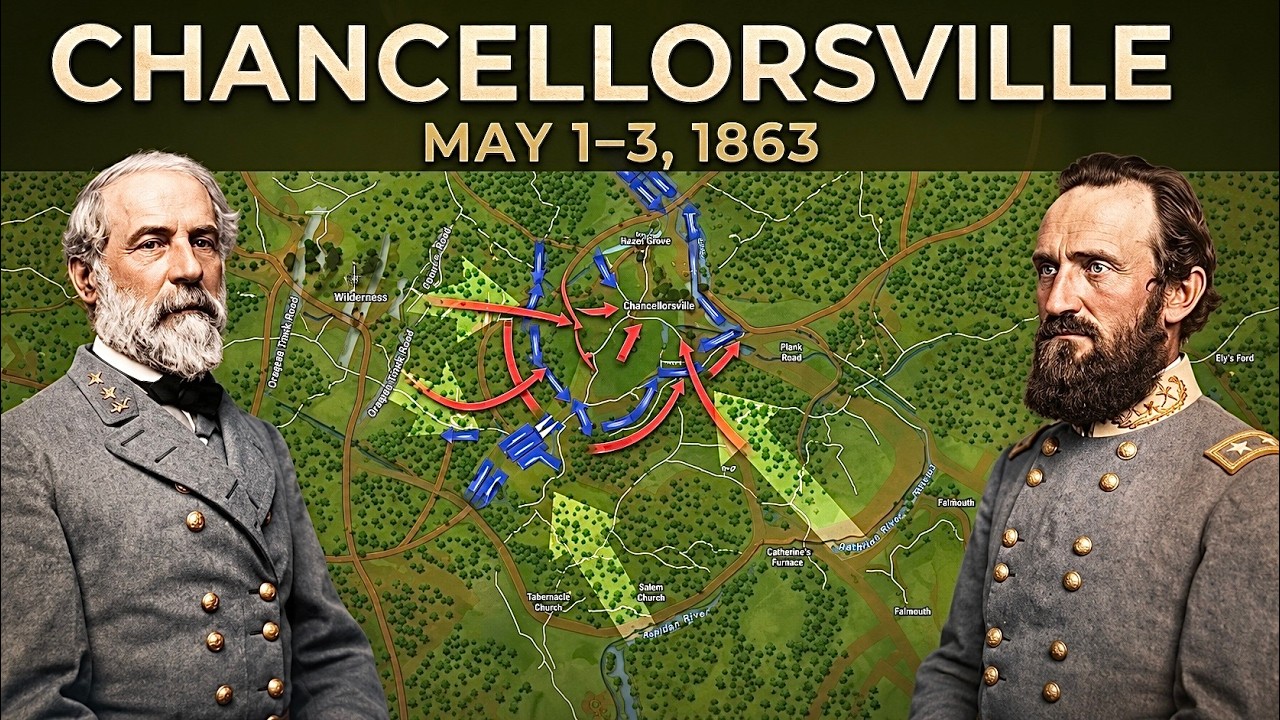
For a second time in three days, Lee’s decision to divide an already outnumbered army had opened a door that could have ended the campaign in Union favor. Lee had to detach forces yet again, splitting an army that by this point existed in four separate pieces, all of them individually outnumbered. It worked. Sedgwick was checked and pushed back across the river. But the margin between greatest victory and catastrophic destruction was thinner on those four days than in almost any other campaign Lee ever fought.
By May 6th, Hooker had withdrawn his entire army back across the Rappahannock. The numbers alone tell you how strange the outcome was. A Union army of roughly 130,000 men had been beaten by a Confederate force less than half its size. Abraham Lincoln, on hearing the news, reportedly could only repeat, “My God, my God, what will the country say?”
Confederate casualties, however, were proportionally worse than Union losses. The death of Jackson alone would prove more costly to the Confederacy’s long-term prospects than almost any single battlefield loss of the war. Lee had won, but he had also demonstrated exactly how little separated his army from complete destruction.
There is another detail usually left out of the highlight reel. Two months earlier, Lee had detached James Longstreet along with two full divisions and sent them southeast to forage for food and supplies around Suffolk, Virginia. That decision was about survival. The Army of Northern Virginia was starving. The result was that Lee walked into the most dangerous week of his command career missing roughly 15,000 of his most seasoned troops. Longstreet did not arrive in time to take part in the battle at all.
It is worth sitting with how thin the Confederate position actually was during Jackson’s march. While nearly 30,000 men filed off into the woods, Lee kept the remaining pieces of his army stretched across more than three miles of front, deliberately staging skirmishes to convince Hooker that a much larger force was still opposite him. It was a bluff, plain and simple. A determined push by any part of Hooker’s army could have rolled straight through Lee’s thin line and reached Jackson’s rear before the flank attack ever developed.
The route of the 11th Corps deserves one more honest look. In the years after the war, the collapse became shorthand in southern accounts for Union cowardice. The German American soldiers who made up much of that command bore the brunt of the blame in print for decades. What actually happened is that an entire corps was hit from a direction its own commanders had been warned about repeatedly and told not to worry over. Their collapse wasn’t a referendum on their courage. It was the predictable outcome of superiors ignoring scouting reports for most of an afternoon.
This is where the second, quieter story begins. What happened to the memory of Chancellorsville after the war is arguably more revealing than the battle itself. Lee died in October 1870. Almost immediately, a coordinated effort began among his former subordinates to shape how he would be remembered. The man leading that effort was Jubal Early, the same general who had held the thin line at Fredericksburg during the battle.
Early became the driving force behind the Southern Historical Society, founded in 1869, which published its own journal specifically to control the historical record of the war from a Confederate point of view. Early’s central project was building the idea of Lee’s total infallibility. Any battlefield failure had to be explained as someone else’s fault. His most frequent target was James Longstreet, who had the added misfortune of joining the Republican party after the war, making him an easy and politically convenient scapegoat.
In the years immediately following the war, southern writers were actually willing to criticize Lee. Edward Pollard, who coined the term “Lost Cause” in his book of the same name in 1866, argued that Lee’s overall influence on Confederate fortunes had been mixed at best. Chancellorsville in this earlier window was still described honestly by people who had been there as an audacious gamble that had worked, not as evidence of untouchable genius.
That honest window closed fast. Once Early and the Southern Historical Society got control of the narrative pipeline, deciding which veteran accounts got published and which quietly disappeared, the story hardened into something closer to scripture. By the 1880s, articles were making the claim that Lee had essentially never lost a battle he was allowed to fight on his own terms. An idea that does not survive contact with the actual record of Gettysburg, Antietam, or the Overland campaign.
Early’s approach worked because he controlled the pipeline. Veterans who wanted their own accounts published often had to go through the Southern Historical Society papers, which meant his allies effectively decided which memories survived into print. Accounts that praised Lee’s boldness while still noting how badly things could have gone were gradually replaced by accounts that treated every decision as flawless from the outset.
Douglas Southall Freeman’s Pulitzer Prize-winning biography of Lee, published in the 1930s, cemented the image for the 20th century, presenting Lee as something closer to a secular saint than a battlefield commander who took enormous risks because his army’s manpower situation left him no better options. Historian Thomas Connelly later described this constructed version of Lee as the “marble man,” a figure so scrubbed of personality, doubt, and error that he stopped being a person and became a monument.
Jackson received the same treatment almost immediately after his death. He was remembered by Lost Cause writers less as a general who had gambled with more than half of his commander’s army and more as a flawless, deeply religious martyr whose death was simply tragic rather than the predictable outcome of riding unannounced past your own nervous pickets in pitch darkness.
None of this means Chancellorsville wasn’t a genuine tactical achievement. It was. Dividing an outnumbered army twice in three days and still winning is one of the most audacious sequences of decisions in American military history. What the post-war myth machine did was strip away the parts of the story that made Lee look human. The fact that his opponent handed him the battle by losing his nerve at the exact moment he held every advantage. The fact that Jackson’s famous flank march was spotted multiple times and only succeeded because Hooker refused to believe his own scouts. The fact that his own subordinate was killed by his own soldiers.
The real story of Chancellorsville isn’t that Robert E. Lee was infallible. It’s that he was willing to accept catastrophic risk because the alternative was almost certain defeat. And that risk paid off largely because of decisions made by the man across the field from him. That’s not a lesser story. It’s a more honest one.
If you want to understand how the Confederacy lost the war but won the memory of it for the better part of a century, Chancellorsville isn’t a footnote to that story. It’s where the pattern started.