In late 1941, a young naval intelligence officer named John F. Kennedy began a secret affair with a Danish journalist who had once interviewed Adolf Hitler and been personally praised by him as the perfect example of Nordic beauty. The relationship quickly became one of the most dangerous romances in American political history, drawing the attention of FBI Director J. Edgar Hoover, who ordered agents to plant listening devices inside the woman’s mattress.
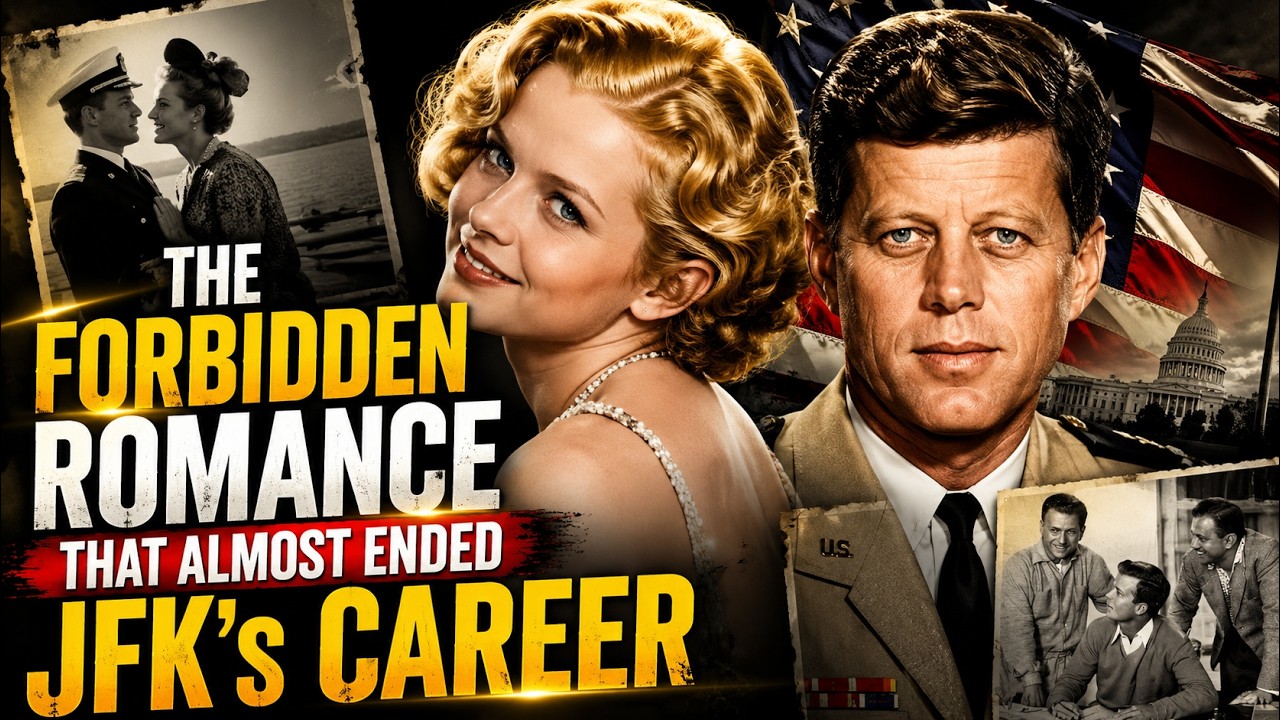
Inga Arvad was born in Copenhagen in 1913. Her childhood was dominated by strict classical piano training imposed by her parents, who hoped she would become a concert pianist. By her late teens, she concluded that her appearance offered a faster route to independence than her musical talent. In 1931, at age 17, she won the Miss Denmark pageant and later traveled to Paris as a finalist in the Miss Europe competition.
She used the pageant circuit as a networking tool, observing how powerful men lowered their guard around a young beauty queen. She later married an Egyptian diplomat, Kamal Abdel Nabi, and moved to Cairo, but found the restrictive role of a diplomatic wife intolerable. The marriage lasted two years. In 1935, she married Hungarian film director Paul Fagos, traveling with him on expeditions and taking minor acting roles before deciding she wanted more direct agency over her own life.
Arvad returned to Copenhagen and convinced the editors of Berlinske Tidende, Denmark’s largest newspaper, to hire her as a foreign correspondent despite her lack of formal journalistic training. She was dispatched to Berlin, where the Nazi propaganda ministry tightly controlled foreign press access. Rather than operating as a traditional reporter, she embedded herself in the hotels, cafes, and private clubs frequented by the Nazi elite, playing the role of a harmless Scandinavian admirer. Her strategy worked.
She gained access to events other journalists could not, including the wedding of Luftwaffe chief Hermann Göring. In 1936, she secured a private 90-minute interview with Adolf Hitler, asking him about his routines, diet, and personal philosophy rather than confronting him with political questions. The interview was published internationally and appeared on the front page of London’s Sunday Dispatch. Hitler personally invited her to the 1936 Berlin Olympics and gave her a seat in his private VIP box, where she was photographed sitting rows away from him.
After the Olympics, the Gestapo approached Arvad and pressured her to gather intelligence on foreign diplomats. When she declined, the requests became threats. Fearing for her safety, she fled Berlin in the middle of the night, taking only her passport and essential documents. She left behind the Olympic photograph, which remained in international press archives and later became a catalyst for suspicion in Washington.
Arvad arrived in New York in February 1940 and enrolled at the Columbia University School of Journalism, which she used as a way to understand how information was brokered in the American press. She also began formal separation proceedings from Paul Fagos. After graduating in June 1941, she moved to Washington, D. C.
, and secured a position at the Washington Times Herald, where she was given a prominent interview column profiling the capital’s power brokers. Through her networking, she became roommates with Kathleen Kennedy, the daughter of wealthy former U. S. ambassador Joseph P.
Kennedy Sr. In the fall of 1941, Kathleen introduced her roommate to her older brother John F. Kennedy, then a 24-year-old ensign in the Office of Naval Intelligence. Jack Kennedy was not the golden heir of the Kennedy family; that role belonged to his older brother, Joe Jr.
He was known as the spare, a physically frail second son living in his brother’s shadow. The attraction between Jack and Inga was immediate and intense. She was four years older, intellectually hardened, and entirely unimpressed by his family’s wealth. He found her unlike the young American debutantes he usually dated.
She offered him an intellectual sanctuary from the crushing pressure of the Kennedy family machine, while he offered her proximity to the future of American political power. She became his primary confidant, the first person to whom he explicitly confessed his ambition to reach the highest levels of American government. Their intimacy created a catastrophic vulnerability. Despite being an active-duty intelligence officer with high-level security clearance, Jack began dropping details about his work at the Office of Naval Intelligence during private conversations.
He discussed restricted information regarding Anglo-American naval relations and the focus of U. S. strategic planning, treating classified national security data as casual dinner conversation. He was sharing this information with a woman who had spent critical pre-war years in Berlin and had been targeted for recruitment by the Gestapo.
The relationship began to fracture over the issue of marriage. Inga wanted a legal union and brought the subject up repeatedly. Jack deflected, knowing that marrying a twice-divorced Protestant foreigner would be politically disastrous for a Catholic politician in the 1940s. Inga recognized his evasion and expressed bitter disappointment to close friends, concluding that when forced to choose between his personal feelings and his political ambition, Jack would choose ambition.
The end of their private sanctuary came when the 1936 Olympic photograph began circulating among Washington journalists and political insiders. The context of the image was stripped away, and the rumor mill branded Arvad with the fabricated title of chief of Nazi propaganda in Denmark, an accusation that was entirely baseless. Believing the American justice system was rational and that the truth would protect her, Arvad made a fateful decision. She took the photograph to FBI headquarters and demanded a meeting to clear her name.
J. Edgar Hoover did not believe in coincidences. He saw a foreign national with documented access to the Nazi hierarchy now maintaining a covert relationship with a naval intelligence officer handling classified communications. He did not care that the rumors were unfounded.
Hoover officially classified Arvad as a suspected espionage agent and ordered comprehensive surveillance. FBI agents tailed her, intercepted her mail, and tapped her telephone lines. Agents also entered her apartment while she was out and planted a listening device inside her mattress. Jack and Inga were entirely unaware that their private conversations were being recorded.
FBI agents listened as the young officer discussed the internal politics of the Navy and the Roosevelt administration, mixing state secrets with pillow talk. Hoover compiled a dossier that eventually swelled to over 1,200 pages. He bypassed the military chain of command and sent detailed summaries directly to President Franklin D. Roosevelt, making himself indispensable by proving the FBI could see through walls.
In January 1942, Hoover dropped the intelligence on the Navy. The Office of Naval Intelligence was humiliated. Standard protocol would have demanded severe punishment, but the Navy brass recognized the explosive political fallout of court-martialing the son of Joseph P. Kennedy Sr.
Instead, they swiftly revoked Jack’s security clearance and transferred him to a desk job in Charleston, South Carolina. The Navy issued a punitive order forbidding him from traveling more than 30 miles from the base. The Navy underestimated Arvad’s resolve. She did not retreat and instead traveled to South Carolina to continue the affair.
FBI agents followed her, coordinated with hotel management, and planted listening devices in their hotel rooms as well. The surveillance logs recorded a relationship buckling under the weight of the invisible siege. Hoover then took the evidence to the only authority figure capable of breaking the relationship: Jack’s father. Joseph P.
Kennedy Sr. reacted with cold fury and applied crushing pressure on his son, issuing an ultimatum to sever all contact with Arvad or face complete financial and familial excommunication. He then used his political influence to orchestrate Jack’s transfer to the Pacific theater, ensuring physical distance would end the affair. That deployment eventually led Jack to command the patrol torpedo boat PT-109.
In March 1942, Jack capitulated and broke off the relationship. He understood the mechanics of his defeat perfectly, telling a confidant, “They shipped me out of town to break us up. ”
Once Jack was shipped out, the surveillance pressure vanished from Arvad’s life. She was never arrested, indicted, or formally charged with any crime.
Her divorce from Paul Fagos was finalized in April 1942, leaving her entirely alone. She retreated from Washington and deliberately chose a life of obscurity. In 1946, she married Tim McCoy, an American actor famous for starring in early Hollywood westerns. They moved to a quiet ranch in Nogales, Arizona, where she stopped writing, stopped conducting interviews, and focused on raising her family, giving birth to two sons.
To her neighbors, she was simply a devoted mother and a retired actor’s wife. Years later, Jack Kennedy executed the exact blueprint they had discussed in her apartment. He returned from the Pacific as a decorated war hero, ran for Congress, then the Senate, and finally the presidency. He married Jacqueline Bouvier.
Yet even as president, he would occasionally pull mutual acquaintances aside and quietly ask, “How is Inga doing? ” He never attempted to contact her, but he never forgot the woman who first listened to his ambitions. Arvad lived out her days on the Arizona ranch. She developed cancer in her late 50s and passed away in 1973 at age 60, taking most of her secrets to the grave.
However, she left behind one final revelation. When her eldest son Ronald was a college student, she told him that Tim McCoy might not be his biological father and that his real father could very well be John F. Kennedy. She imposed a strict gag order, forbidding him from discussing it publicly while she was alive.
Ronald honored her request, keeping the secret hidden for decades. The story of Inga Arvad also explains a long-debated political mystery. When John F. Kennedy became president, he appointed his brother Robert Kennedy as attorney general.
The Kennedy brothers despised J. Edgar Hoover and had the authority, political capital, and desire to fire him. Yet they never did. Historians have long debated why the most powerful family in America tolerated an insubordinate FBI director.
The answer lies in the surveillance dossier from 1942. Hoover still possessed the 1,200-page file and the audio recordings of the president as a young naval officer discussing classified intelligence in bed with a suspected Nazi spy. The file functioned as a pair of invisible handcuffs on the commander-in-chief, ensuring the FBI director’s position remained untouchable.