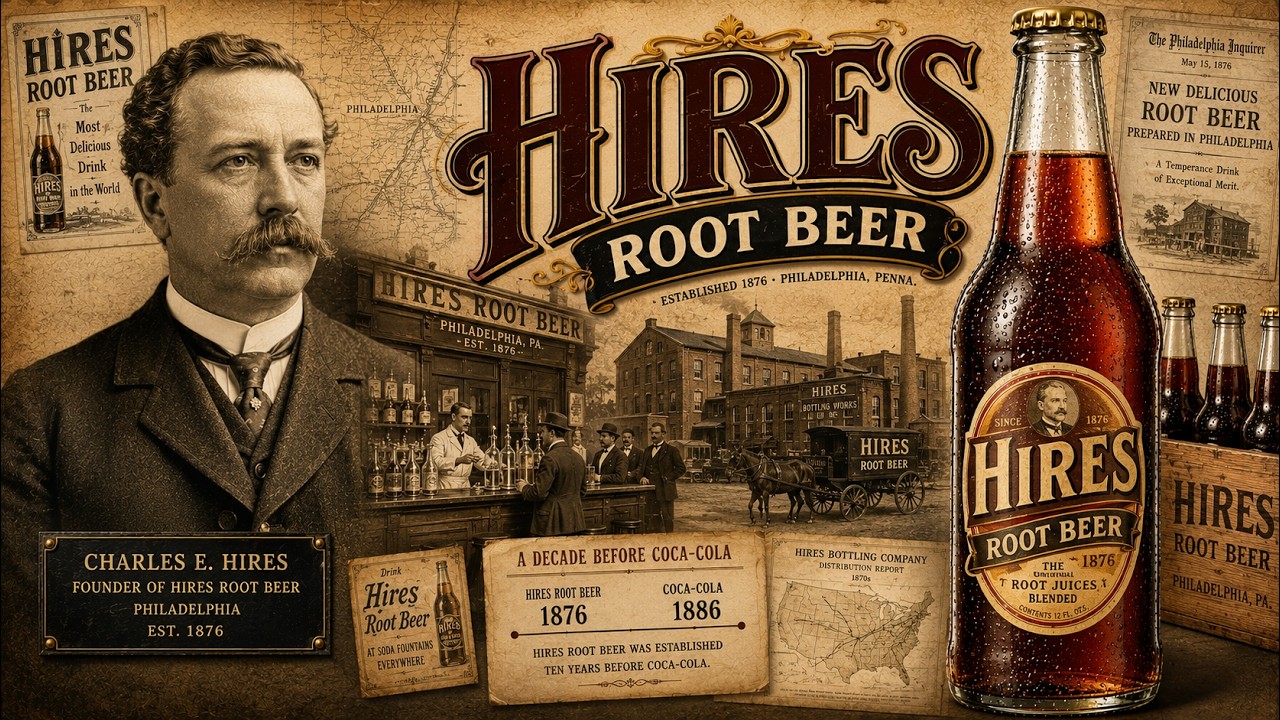
In 1876, at the Centennial Exposition in Philadelphia, a pharmacist stood behind a small stand pouring three-cent glasses of a drink he had spent a year perfecting in the back room of his own drugstore. That drink was Hires Root Beer, created a full decade before Coca-Cola existed. By the time other soft drinks entered the market, Hires was already America’s national beverage, sold by the glass, then by the packet, then by the bottle. Today, Hires Root Beer is owned by one of the largest beverage corporations on Earth, a company that also owns A&W Root Beer.
When it came time to decide which root beer received the marketing budget, the shelf space, and the future, the decision was not based on taste. It was based on which name had a better licensing deal with a restaurant chain. Hires lost that decision quietly, without a headline. This is not a story about a soft drink that lost to a bigger competitor.
It is the story of a brand that outlived Prohibition, outlived a federal ban on its own key ingredient, outlived five different owners across a century, and was finally erased by a decision made inside the very company that owned it. Charles Elmer Hires was born in 1851 on a farm in New Jersey into a family with no connections to medicine or business. At 12 years old, his parents sent him to apprentice at a drugstore owned by his brothers-in-law. It was the only trade path available to a boy from a farming family with no capital and no name.
He became skilled at the work. By his teenage years, he had left the small town drugstore behind and made his way to Philadelphia, the largest city he could reach. He worked as a pharmacy clerk and saved his earnings dollar by dollar for years until he had enough to open his own business, a small drugstore at the corner of Sixth and Spruce. Like every small pharmacist of his era, he was boxed in by thin margins, filling prescriptions and mixing tonics for pennies at a time.
He had no product of his own that could scale beyond the neighborhood that already knew his name. The spark, by his own later account, came from something almost domestic. While traveling with his new wife, Hires was served a hot herbal tea, a blend rooted in an old colonial recipe of sassafras bark, wild roots, and berries. He asked for the recipe, then spent years testing combination after combination behind his own counter: sassafras, wintergreen, juniper berries, licorice, ginger, and sarsaparilla.
He began selling it directly out of his drugstore under the modest name Hires Root Tea. It sold slowly. The temperance movement was surging through Pennsylvania, and the word “beer,” even attached to nothing alcoholic, carried a forbidden appeal that “tea” could not compete with. It was Reverend Russell Conwell, a friend and adviser who would go on to found Temple University, who told Hires plainly that hard-drinking coal miners would never touch a drink with “tea” in its name.
He advised Hires to call it root beer instead. Hires took the advice, and in 1876 he did something no drugstore owner in Philadelphia was doing. He took his relabeled product to the Centennial Exposition, the biggest stage in the country, and gave it away for free, pouring sample glasses by hand and selling 25-cent packets of powder that families could take home and mix with water and sugar. What the market was missing wasn’t a new flavor.
It was a non-alcoholic drink that could be marketed with the same appetite and ritual as a real beer. Something a temperance household could serve without guilt and a working man could drink without judgment. Each packet, when mixed with water, sugar, and yeast at home, made five gallons of root beer. A 25-cent packet bought roughly 80 glasses of a drink a family had previously been able to buy one cup at a time, hot from a tea kettle.
It was a bargain no other beverage on the market could match. Eight years later, in 1884, Hires introduced a liquid extract and syrup made specifically for fountain use. He shipped root beer in kegs to drugstores across the country and rolled out a small dispensing unit called the Hires Automatic Munaker, built so any drugstore counter in America could pour a consistent glass of Hires without a trained bartender. It was a soft drink walking straight into the local pharmacy at a moment when the soda fountain itself was becoming the social center of Main Street.
In 1890, Hires formally incorporated the business as the Charles E. Hires Company, converting his one-man drugstore product into a structured manufacturing operation with its own factory on Arch Street in Philadelphia. Incorporation meant capital, scale, and the ability to negotiate with bottlers and suppliers as a company rather than a personality. In 1893, the Crystal Bottling Company began bottling Hires Root Beer ready to drink.
Within a few years, a growing web of independent bottlers across the country signed on to produce it locally under license. Each bottler bought syrup and rights from Hires, then bottled and distributed within their own territory. That franchise bottling model became the engine of everything that followed. By the early 20th century, Hires wasn’t just an American brand.
The company held offices in Australia, Denmark, and England, ran a subsidiary in Canada, and owned a sugar plantation in Cuba to secure the raw sweetener behind every bottle it sold. None of this scale came from beating a giant rival head on. Coca-Cola wouldn’t even exist for another decade after Hires took the stage at the Centennial Exposition. By the time Coke began building its own bottling network, Hires had already spent nearly 20 years perfecting one.
From its earliest advertising campaigns, Hires built its identity around a mascot known simply as the Hires Boy, a cartoon child who appeared on trade cards, tin signs, and store displays for decades. In the early 1900s, he wore a plain dress, the way many young boys of that era were dressed in illustrations. By 1907, he’d been put in a bathrobe. By 1915, a proper dinner jacket.
That evolving costume tracked the arc of the brand’s own ambitions, from homespun drugstore remedy to respectable national product. A nickel bought a cold glass of root beer at a drugstore counter, deliberately pitched to sit inside the daily ritual of ordinary Americans. But the sharpest cultural move Hires ever made was about a name. When Charles Hires agreed to rebrand his product from root tea to root beer, he was deliberately building a drink that could occupy the emotional space of alcohol without the substance of it.
He marketed Hires as the temperance drink, positioning it directly at the hard-drinking mining and factory towns of Pennsylvania as the respectable alternative to a tavern. Hires was an active, committed member of the temperance movement himself. His advertising promoted the drink as “the greatest health-giving beverage in the world,” a tonic that supposedly purified the blood and put color back in cheeks. That positioning gave Hires a moral audience.
Churches, temperance societies, and reform-minded households across the country had a beverage they could serve at gatherings, sell at fundraisers, and recommend without contradiction. Decades later, the brand proved it could still reinvent its cultural voice. In the mid-1960s, Hires ran an advertising campaign built around the voice of jazz singer Blossom Dearie, who delivered the brand’s jingle in a breathy, playful vocal style. It was completely different in tone from the sober temperance branding of Hires’s first 50 years.
Every brand built on a moral claim eventually gets tested on that claim. For Hires, the test came in 1895. A freelance chemist made a public allegation that Hires Root Beer, marketed for two decades as the temperance drink, secretly contained a significant percentage of alcohol. For a company whose entire identity was built on being the respectable non-alcoholic alternative to a tavern drink, this was an accusation of fraud against the brand’s core promise.
The Woman’s Christian Temperance Union, the same reform movement Hires had spent his career aligning himself with, responded by launching a boycott of the product. Hires didn’t wait it out. He had already spent years defending the drink’s non-alcoholic reputation through his own testing, at one point commissioning a laboratory analysis to demonstrate that Hires Root Beer contained less alcohol than an ordinary loaf of bread. Now facing an organized boycott, he escalated, commissioning a full chemical analysis from a professor at the University of Pennsylvania, an independent credentialed authority with no financial stake in the company’s survival.
The results came back decisively in Hires’s favor. The analysis found only a trace amount of alcohol, a byproduct of natural fermentation so small it posed no meaningful conflict with the temperance pledge. Armed with independent university findings, Hires answered the boycott not with advertising, but with science. The Woman’s Christian Temperance Union called off its boycott.
By the early 20th century, Hires Root Beer stood at a height almost no soft drink founder had ever reached. Charles Hires himself remained at the head of the business well into the century, running the company alongside his sons until 1925, when he formally handed control to the next generation. He died in 1937 at the age of 85. But the very ingredient that had made Hires what it was was quietly becoming a liability.
The original formula drew its signature flavor from the root bark of the sassafras tree. Sassafras gave root beer its name, its aroma, its identity. And sassafras contained safrole, an oil that laboratory studies in the mid-20th century linked to liver damage and cancer in animal test subjects. In 1960, the U.
S. Food and Drug Administration banned the use of safrole as a food additive nationwide. The ban applied to every root beer maker in the country. For Hires, whose entire identity had been built on an authentic sassafras recipe since 1876, it forced a reformulation.
Sassafras oil was pulled from the recipe. Artificial sassafras flavoring took its place. That same year, 1960, the Hires family sold its majority ownership stake in the company to Consolidated Foods Corporation, ending 84 years of family control at almost the exact moment the federal government erased the ingredient that had defined the product’s founding recipe. Two years later, in 1962, Consolidated Foods sold the Hires division to Crush International Limited, a company built around fruit-flavored sodas.
Crush relocated the brand’s headquarters out of Philadelphia entirely, moving operations to Evanston, Illinois, the first time the company’s center of gravity sat outside the city where Charles Hires had built his first drugstore. In 1980, Crush International, and Hires along with it, was acquired by Procter & Gamble, a consumer goods giant better known for soap and toothpaste than for soda fountains. Under P&G, Hires became one line item inside a portfolio built around efficiency and shelf turnover. It was here that Hires’s diet formula was updated to use aspartame following FDA approval of the sweetener in 1981.
Nine years later, in 1989, Procter & Gamble divested its entire soft drink portfolio, and Hires passed into the hands of Cadbury Schweppes, a British confectionery and beverage conglomerate. By this point, the brand had changed owners four times in 29 years. Not one of those owners had a name connected to root beer, to Philadelphia, or to the man who invented it. In 2008, Cadbury Schweppes split off its beverage holdings into a new standalone company, Dr Pepper Snapple Group.
Then, in 2018, a merger with Keurig formed Keurig Dr Pepper. The company that now owned Hires Root Beer also owned A&W Root Beer, its most direct competitor in the exact same category on the exact same shelf. A&W had something Hires didn’t: a licensing relationship with an actual chain of A&W restaurants across the country, a built-in advertising and distribution engine that came from outside the beverage division entirely. When Keurig Dr Pepper had to choose which root beer to spend its marketing dollars defending, the decision wasn’t about which recipe was older, more authentic, or more storied.
It was about which brand name already had a restaurant chain doing free advertising on its behalf. Hires, the older brand, the original brand, the brand that predated Coca-Cola by a decade, lost that internal contest inside a company boardroom, not on a store shelf against a stranger. The final detail in the chain is the most ironic. In Canada, the Hires name is no longer sold as a soft drink at all.
Canada Dry Motts now uses it for a different kind of product: Hires Root Beer and Vodka, a canned alcoholic beverage. The brand Charles Hires built specifically to give temperance households a respectable non-alcoholic alternative to a tavern drink now carries his name on a can of liquor. There was no final day, no gate closing, no press conference. Hires Root Beer didn’t die the way a brewery dies.
It simply stopped being restocked. Through the 2000s, as Keurig Dr Pepper consolidated its root beer strategy around A&W, Hires kept a presence on shelves, but a shrinking one. Distribution thinned first in smaller markets, then in larger ones. Vending machines that had carried it for decades quietly switched to other brands.
Bottlers who had produced Hires under license for generations moved on to formulas the parent company was actually willing to promote. By the early 2010s, the traditional bottled and canned version of Hires Root Beer had largely disappeared from store shelves across the United States. No single date marks the moment it happened, because there wasn’t one. Sources on the exact year of discontinuation don’t agree, and that disagreement is itself the point.
A brand doesn’t get a headline obituary when nobody at the company that owns it bothers to announce its passing. In Canada, the retreat was even more visible. Retailers and vending operators that had carried Hires for generations replaced it with Mug Root Beer, a Pepsi-owned brand, while Keurig Dr Pepper directed its remaining root beer marketing budget towards Stewart’s. By 2023, the final formality arrived without ceremony.
Hires Root Beer was no longer listed as an active product on Keurig Dr Pepper’s own website. Not discontinued in a press release, not phased out with an announcement. Simply absent. What remains in reduced form is the syrup, the extract still occasionally used to pour Hires at old-fashioned soda fountains.
A faint echo of the delivery method Charles Hires had pioneered in 1884. The bottle was gone. The nickel-a-glass ritual was gone. What was left was a formula sitting in the back inventory of a company that had other more profitable root beers to sell.
Legally, Hires Root Beer still exists. It sits somewhere inside the vast portfolio of Keurig Dr Pepper, technically still a registered brand. But calling it still in business the way Coca-Cola or Dr Pepper are in business would be inaccurate. Hires today is closer to a name in a filing cabinet than a product on a shelf.
Present on paper, absent from daily American life. What corporations cannot buy, sell, or quietly discontinue is memory. Bottle collectors have kept the brand alive in a way no marketing department ever could. Vintage Hires extract bottles remain a fixture of the applied color label soda bottle collecting community, a hobby active enough to support its own identification guides and price references.
Collectors trade tin advertising signs, ceramic mugs bearing the Hires Boy mascot, and the small automatic dispensers the company once shipped to drugstore counters across the country. There is also a physical home for that memory. The Museum of Root Beer, which opened in Wisconsin Dells, Wisconsin in 2021, houses memorabilia from more than 2,000 root beer brands, including signage, packaging, tap handles, and bottles. It was funded initially through a public Kickstarter campaign and built from a private collector’s decades of accumulation.
In 2018, Temple University Press published “Charles E. Hires and the Drink That Wowed a Nation,” a full biography examining the life of the man behind the brand. Step back far enough from Hires Root Beer and a familiar shape appears. Most brands in this story died the way small companies usually die under American capitalism: outspent, outdistributed, starved of capital.
Hires didn’t lose that fight. It won it for decades against companies that hadn’t even been founded yet when Charles Hires was already shipping his product to three continents. Hires wasn’t beaten by an outside competitor with deeper pockets. It was quietly deprioritized by the one company that owned both it and its rival at the same time.
A decision made not on a store shelf but in a boardroom weighing a restaurant licensing deal against a hundred-year-old name. Capital didn’t just outcompete Hires from the outside. Eventually, capital owned both sides of the fight and chose a winner from within. There is no villain worth naming, no single executive who decided to kill Hires out of malice.
It was the predictable outcome of a system where brands are acquired not to be preserved but to be sorted. Hires didn’t fail as a product. It failed as a line item ranked against another line item it never should have had to compete with in the first place.