In the summer of 1968, a discreet announcement came from the house of Cristóbal Balenciaga at 10 Avenue George V in Paris. The master couturier, then seventy-three, was retiring and closing his house immediately. There was no farewell collection and no grand public bow. He had concluded that the world of discerning clients and limitless budgets he had served was vanishing, replaced by mass production and youth-driven design, and he chose to shut his doors rather than compromise his art.
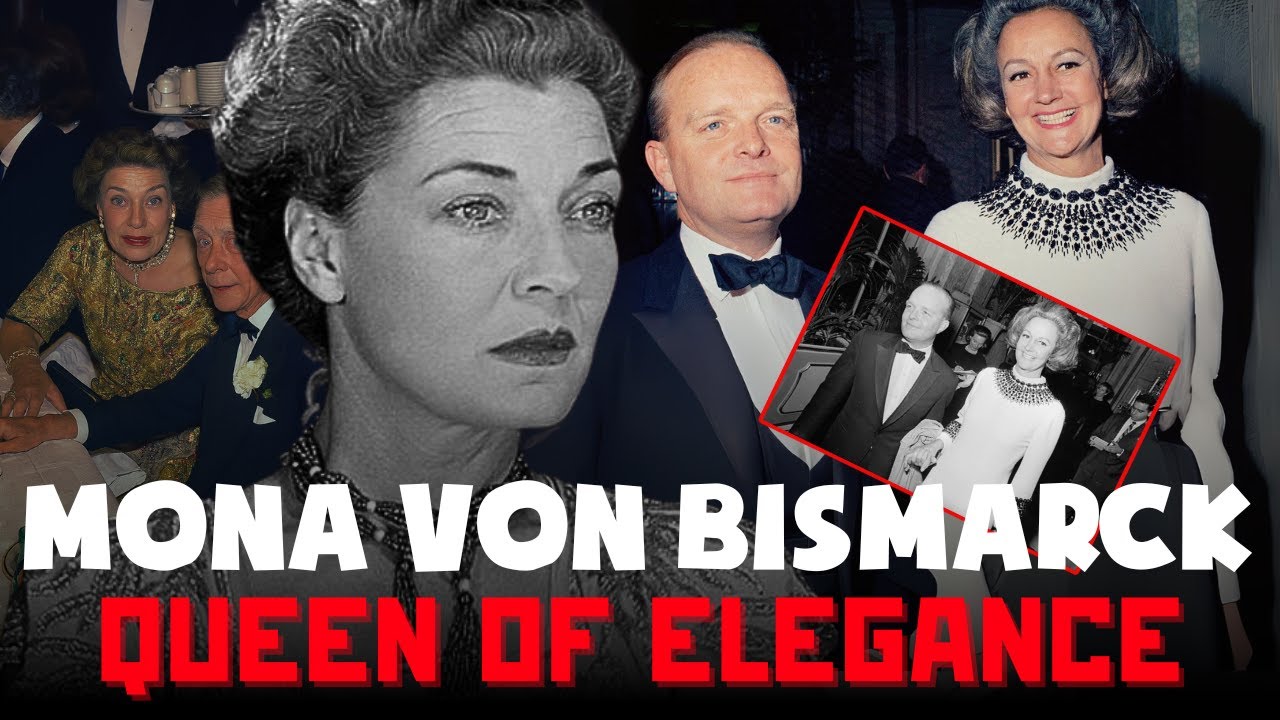
To the fashion world, the news was an earthquake. To the Countess Mona von Bismarck, it was the collapse of everything she had built her life around. The countess was on Capri when a member of her staff delivered the news to her at the Villa Il Fortino, her cliffside home overlooking the Marina Grande. She did not weep and she did not rage.
She walked past her bewildered household, entered her bedroom, drew the heavy curtains, and shut the door. For three full days and three full nights she remained there in darkness, without food, without light, without contact. The trays left outside her door went untouched. The calls from friends went unanswered.
To outsiders, it looked like the melodrama of a spoiled woman mourning a dressmaker. In truth, the woman who had spent a lifetime perfecting her public self had just lost the collaborator who made that self possible. She was not mourning a designer. She was mourning the death of her own creation.
The life that collapsed in that darkened room had begun far from the salons of Paris. Mona Travis Strader was born on February 5, 1897, in Louisville, Kentucky, into a world of gentile poverty and social codes shaped by the long shadow of the Civil War. Her father, Robert Sims Strader, trained thoroughbreds at the famous Idle Hour Stock Farm near Lexington, and Mona grew up surrounded by the discipline of breeding and bloodlines. She absorbed a brutal but useful lesson: that form dictated function, and that perfection of line was not a matter of opinion but a measurable mark of superior quality.
Her mother, Birdie, came from a respectable family, but the marriage was volatile. In 1902, when Mona was five, it ended in a public and scandalous divorce. In the image-obsessed society of the postbellum South, a broken home was a profound disgrace, and for Mona it was the first great lesson in chaos. She learned how quickly a world could come apart, and she resolved to build a future impervious to such shocks.
After the divorce, her mother remarried and largely disappeared from her life. Mona and her younger brother went to live with their paternal grandmother, Virginia Strader, in Lexington, where the family maintained appearances on a razor’s edge of near-empty coffers. It was training in the mastery of the facade. Mona learned to project effortless grace while concealing the struggle beneath, and she learned to treat relationships less as sources of emotional support than as instruments of advance.
Nature gave her an accomplice in this transformation. She grew into a tall, striking beauty with arresting sapphire blue eyes, and she carried herself with a poise remarkable for her age. Her grandmother recognized her potential as the family’s greatest asset and scraped together the funds for an elite education, eventually sending her to Miss Porter’s School in Farmington, Connecticut. There Mona studied alongside the daughters of the Rockefeller, Vanderbilt, and Whitney families, refining the social strategies that would separate the merely rich from the truly powerful.
Her assault on high society began in 1917 with a pragmatic first marriage to Henry J. Schlesinger, a Milwaukee iron-and-coke heir thirty-eight years old and extremely wealthy, whose Fairland Farm in Lexington employed her father. The marriage gave her a son, Robert Henry Schlesinger, born in 1918, and a divorce in the early 1920s that left her with a substantial settlement and her independence. It also established a pattern that would mark her entire life: custody of her son was relinquished or set aside so that she could pursue her freedom.
Robert grew up shuttled between boarding schools in the shadow of a mother becoming a public monument, and their distance would haunt the family for decades. Mona moved to New York in the early 1920s, into a social scene crackling with new Wall Street wealth. She cultivated a look of calculated understatement, favoring cool, muted palettes of gray, white, beige, and her signature aquamarine. She wore magnificent jewelry sparingly and chose severe elegance over ostentation, crafting the image of a woman who had been born to privilege rather than one who had fought her way into it.
A second marriage to the wealthy banker James Irving Bush, dubbed the handsomest man in America, ended in Paris divorce in 1925, another strategic alliance rather than a passionate bond. On July 2, 1926, she captured the ultimate prize, marrying Harrison Williams, heir to a vast utilities empire and pressing had crowned the richest man in America, with an estimated fortune of six hundred million dollars, equivalent to well over ten billion today. The marriage came with its own scandal: Williams had been engaged to Mona’s friend and business partner, Laura M. Curtis, before Mona’s intervention ended the arrangement.
Life with Harrison Williams became a spectacle of wealth so extreme it bordered on the surreal. Their headquarters was a twenty-five-room mansion on Fifth Avenue in New York, decorated with eighteenth-century English paneling and museum-quality French furniture. The heart of their empire was Oak Point, a 120-acre estate on the North Shore of Long Island, with a private nine-hole golf course, stables, pools, and vast greenhouses devoted to orchids, gardenias, and carnations. Their yacht, the Warrior, was the largest and most luxurious private ship of its time, with a crew of eighty-five, and carried them between Palm Beach, New York, and Europe.
For her wardrobe, Mona made annual pilgrimages to Paris, ordering dozens of gowns, suits, and dresses from the great couture houses. In 1933, that devotion received its ultimate validation. A committee of the most powerful names in Parisian couture, including Chanel, Vionnet, Lanvin, Patou, and Molyneux, declared Mona Harrison Williams the best-dressed woman in the world. It was the first time an American had been so honored.
She retained the title in 1934 and 1936, and in 1958 she was inducted into the International Best Dressed List Hall of Fame. Photographers like Cecil Beaton turned her into the visual definition of 1930s elegance, portraying her not as a woman of fashion but as a remote, untouchable deity. Her persona as the ice queen was complete. The decade of triumph was also a decade of gathering darkness.
The Williamses, like many of their class, inhabited a sealed bubble of privilege, espousing a willed political neutrality that often bled into a naive tolerance for the rising fascist regimes. Their social circle included the Duke and Duchess of Windsor and figures who favored appeasement. The outbreak of World War II shattered the international playground. Paris fell to Nazi occupation in 1940, halting couture production and transatlantic travel.
Mona spent the war years in America, lending her name to war relief charities, but it was a long twilight for a woman whose identity was so deeply intertwined with European culture. Harrison Williams died in 1953 at the age of eighty, leaving Mona, at fifty-six, one of the richest women in the world. In 1955, she married for the fourth time. Her new husband was Count Albrecht Eduard Heinrich Karl von Bismarck-Schoenhausen, known as Eddie, a grandson of Germany’s Iron Chancellor Otto von Bismarck.
Eddie, an interior decorator and her former secretary, provided the aristocratic lineage she craved. Together they became leading figures in the new postwar world of the international jet set, dividing their time between Paris and Capri. On Capri, Mona purchased the Villa Il Fortino, a former fortress built into the cliffs, and there she undertook her greatest creative project: a terraced garden cascading down to the sea, a battle against nature requiring tons of imported topsoil and water shipped in by boat. She imported magnolia trees and roses from Kentucky, blending her origins with her new world.
In this titled existence, one devotion deepened into something approaching worship: her relationship with Cristóbal Balenciaga. Born in 1895 in the Basque fishing village of Guetaria, Balenciaga was a couturier of unmatched technical skill, a deeply private man whose work possessed a sculptural purity and spiritual intensity. His salon was a temple of silence where models glided without music, forcing clients to contemplate the clothes as pure form. Coco Chanel, his notoriously sharp-tongued rival, called him the only true couturier among the rest.
For Mona, he was simply the Master. She was his perfect canvas: tall, statuesque, and regal, with the ideal frame for his architectural forms. From the postwar years onward, she wore Balenciaga and only Balenciaga. After a train accident destroyed much of her wardrobe, she ordered 150 pieces from him in a single season.
She even had him create gardening clothes for her life on Capri, which she wore for a season and then had copied by a local seamstress so that the precious originals could be cleaned and archived. The unwinding began with a profound personal betrayal. Around 1968, Count Eddie von Bismarck announced he was leaving her for a younger woman. He died in 1970 of a liver ailment, but the public humiliation and private heartbreak were immense.
Mona was still reeling from that emotional earthquake when the second blow landed: Balenciaga’s retirement. In the darkness of that Capri bedroom, the twin pillars of her late-life identity, the aristocratic marriage and the artistic soulmate, had turned to dust within months of each other. When the countess finally emerged, she was a changed woman. The hard, brilliant certainty that had been her hallmark was replaced by a quiet, melancholic resignation.
Balenciaga’s successor, Hubert de Givenchy, created pieces for her in a similar vein, but the magic was gone. In 1971, seeking companionship after Eddie’s death, Mona married for the fifth and final time, to Umberto de Martini, her late husband’s physician, a nobleman fourteen years her junior. He died in a sports car accident in 1979, and afterward it was revealed that he had already been married with children and had been secretly using her funds. Mona von Bismarck died in her Paris apartment on July 10, 1983, at the age of eighty-six.
She was buried in a Givenchy gown in Locust Valley Cemetery on Long Island, beside Harrison Williams and Eddie von Bismarck. Her will was her final surprising act. She bequeathed her fortune, her Parisian home, and her art collection to establish the Mona Bismarck Foundation, now the American Center for Art and Culture, dedicated to fostering cultural exchange between the United States and France. She donated her papers, jewels, and dresses to the Filson Historical Society in Louisville and to Kentucky museums, ensuring her roots were honored.
Her son, Robert, lived a difficult life far from the world of curated beauty his mother had created, and after her death he contested her will, demanding a larger share. His existence is a reminder of the personal cost of her single-minded pursuit of perfection. Mona von Bismarck had risen from genteel poverty to global icon through strategic marriages and unwavering discipline, but the fortress she built could not hold. Her three days of mourning were not an endnote.
They were the key to her entire existence, the moment the artist confronted the destruction of her life’s work. She was her own greatest masterpiece, a work of breathtaking beauty and heartbreaking fragility, and her legacy endures in the cultural bridges she built and the fashion history she shaped.