A trapper in the Ozarks disappeared in the autumn of 1873 after documenting a series of unsettling discoveries in his journal, including a track he could not identify, a strange bone in a remote cave, and disturbances around his isolated cabin. The man, Obadiah Renshaw, was last seen walking toward a ridge above his home and was never found. Renshaw was 46 years old and had lived alone in a one-room cabin in northern Arkansas for years. He ran trap lines for a living and kept to himself.
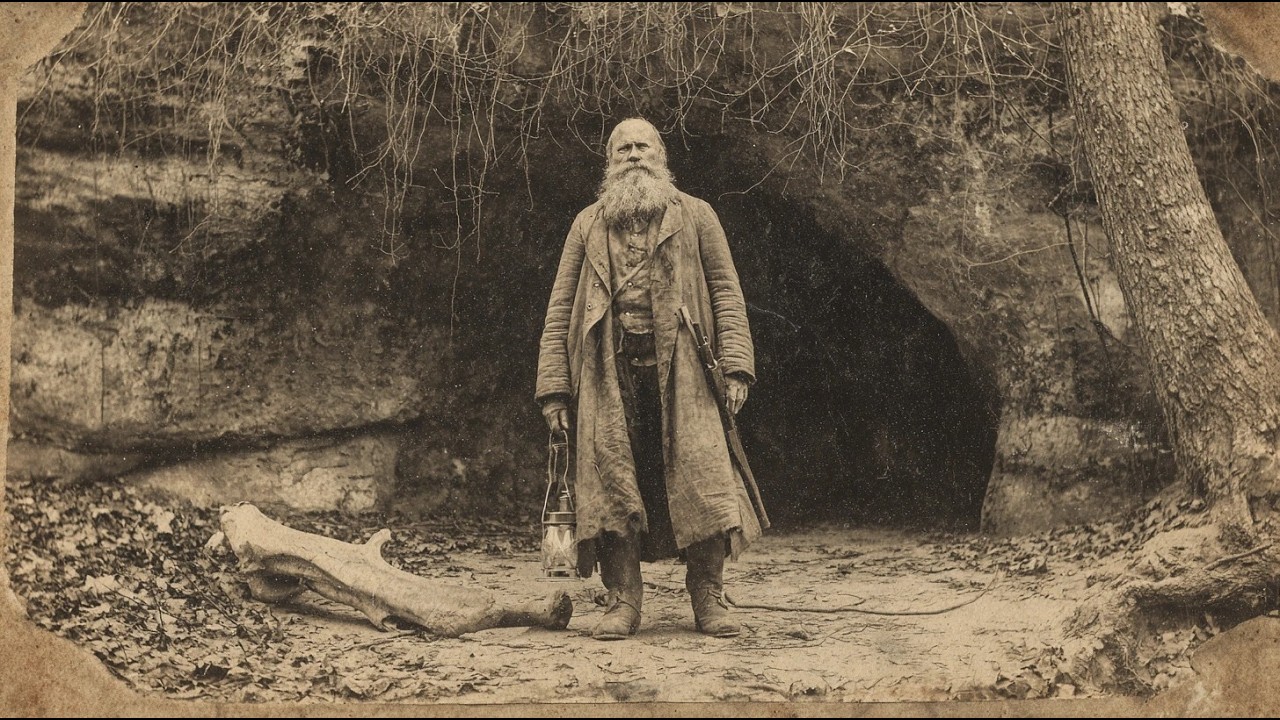
His wife had died in 1864, and he had largely withdrawn from the community, speaking more to his cow and dog than to other people. In late September 1873, while checking his traps along a creek called Sallow Branch, Renshaw found a single print in the mud. He measured it with his belt. It was 21 inches long and 11 inches across, with four long narrow toes.
He had never seen anything like it. He found no other tracks nearby. He returned home without checking his traps, took a longer route back, and wrote in his journal that the experience had put a weight in his chest. Two days later, he came home to find his cabin door standing open.
Nothing was missing and nothing had been moved, but the air inside carried a strange smell he described as wet fur and something sweet and beginning to turn. His cow refused to come out of her lean-to and trembled under his hand. His dog stayed flat against the floor and kept his eye on the door. Around 3:00 in the morning, Renshaw heard a distant sound from the ridge.
He wrote that the closest he could describe it was the sound a tree makes when bent slowly past its breaking point. The next morning, he found three split oak rounds from his woodpile arranged in a perfect line on the ground beside the stack. He left them where they were. For days, nothing else happened.
By mid-October, Renshaw had begun to convince himself the events could be explained naturally. But he also began walking toward the source of his unease rather than away from it. On October 18, he followed Sallow Branch far beyond his usual route into a high hollow. He noticed the creek ran silently there and that no birds were singing.
He found a cave set into a limestone bluff, half hidden behind dead grapevine. He went inside with a lantern. The walls felt unnaturally smooth. About 40 feet in, he found a single bone lying on the dusty floor.
It was a femur of enormous size, reaching the middle of his chest when stood on end. The ball joint was the size of a pumpkin. There were no other bones in the cave. He noticed the bone was clean, lying in dust that had no sign of disturbance except a drag mark leading from deeper in the cave to the bone.
Something had carried it there. When he came out, the sky had changed. On the ground in front of the cave, where there had been no tracks when he arrived, there were now three prints identical to the one he had found by the creek. They were arranged in a triangle around the cave mouth.
Renshaw returned home and wrote for two hours. In his journal, he stated he did not believe the bone was recent and that something had placed it there. He wrote three times that he would not go back to the cave. The journal entries continue over the following weeks.
He reported a sound of slow deliberate steps crossing his roof one night and counted them. He reported his cow going dry overnight. He reported the air around his wife’s grave feeling warm. He found a single oversized fingerprint pressed into flour on his table.
His dog would not leave the cabin and shook under the cot. Renshaw wrote that the animal knew something he did not and that he believed the animal was right. He began having dreams about the cave, each night with more bones on the cave floor. The dreams continued for several nights.
On November 2, he found his dog dead at the foot of his cot. There was no wound or sign of injury. His cow, he wrote that evening, looked at him without recognition. His final journal entry is dated November 3, 1873.
He wrote that the dreams had stopped and the smell was gone, but the woods were quiet in the wrong way. He said he was going to walk to the ridge above the cabin to see what was there. He asked that if he did not return, whoever found the journal burn it, burn the cabin, and leave the cave alone. He wrote that the thing that walks does not want to be known.
Fourteen days later, a fur buyer named Augustus Pell arrived at the cabin. He had bought Renshaw’s furs every November for 22 years. He found the door bolted from the inside, no smoke from the chimney, and unbroken snow around the property. Pell broke in.
The cabin was empty of people. The journal sat open on the table. Renshaw’s rifle and powder horn hung on their pegs. The cow lay dead in the lean-to.
In the corner, Pell found a single large dark gray feather that he could not identify. Pell climbed the ridge above the cabin and found a set of boot prints in the snow. They began in the middle of a clearing with no tracks leading to them. He recognized the heel design Renshaw had hammered into his own boots.
The prints walked in a straight line for about 40 yards. Then they stopped mid-stride. There was no sign that the man had fallen, turned, or been carried away. Pell said he stood there for about an hour and heard no living creature make a sound.
The deputy sheriff went to the site two days later with three men, but new snow had covered the ridge. The journal was taken into evidence. It survived a fire that destroyed county records in 1934 because it had been borrowed by a regional newspaper writer. It passed through several hands over the following decades before being acquired by a dealer in St.
Louis and eventually reaching an antiquarian market. The fur buyer who found the cabin later joined a hunting party that went back to the cave in April 1874. The group was looking for a missing horse and included a doctor, a blacksmith, a freight clerk, and the guide who led them to the cave. According to the doctor’s own notes, the temperature in the high hollow dropped sharply as the men approached.
Their horses refused to enter the area, and the five men continued on foot. The cave was empty. The dust was gone, the bone was gone, the drag mark was gone. The dead grapevine had been pulled clear and arranged in a tight spiral beside the entrance.
In the stone at the back of the cave, the men found a large oval depression with three smaller foot-shaped depressions around it. Each was 21 inches long and 11 inches across. The doctor knelt and placed his hand inside one of the depressions. He wrote that the rock was warm, warmer than the rock around it, in the way a chair is warm after someone has stood up from it.
As the men stood there, one of them said he heard a faint sound from deeper in the cave, like something setting an object down on stone. The party walked out without speaking and rode back to town in silence. None of the five men ever returned to the hollow. According to local accounts, no trapper worked that stretch of Sallow Branch after the 1880s, and by 1900 the trail to the cave had grown over.
The cave’s location was eventually forgotten. The county where Renshaw lived still lists him as a missing person, with his status unresolved. A narrator who claims to possess the journal says he has searched the area on several occasions using maps drawn from the original text. He reports that the hollow and the creek are there, but he has not found the cave.
The bones found in the cave were never identified, and the feather found at the cabin was sent to a naturalist who replied that he could not identify the species and would welcome further specimens. The last record of Obadiah Renshaw is the missing-persons listing. The journal’s final request, to be burned, was not carried out.
The narrator says he has kept it in a drawer and wonders on certain nights whether the thing described in its pages knows that the story was read.