For more than six decades, one story has haunted the memory of D-Day: a German officer standing alone in a concrete bunker above a beach the Americans would call Omaha, raising his binoculars in the gray dawn light to see the greatest invasion fleet in world history stretching across the horizon. He picked up the phone and tried to warn his commanders. They did not believe him. In the hours that followed, more than 2,000 young Americans fell on the sand under his guns—young men from Bedford, Virginia, and from small towns in Kansas, Alabama, and Pennsylvania.
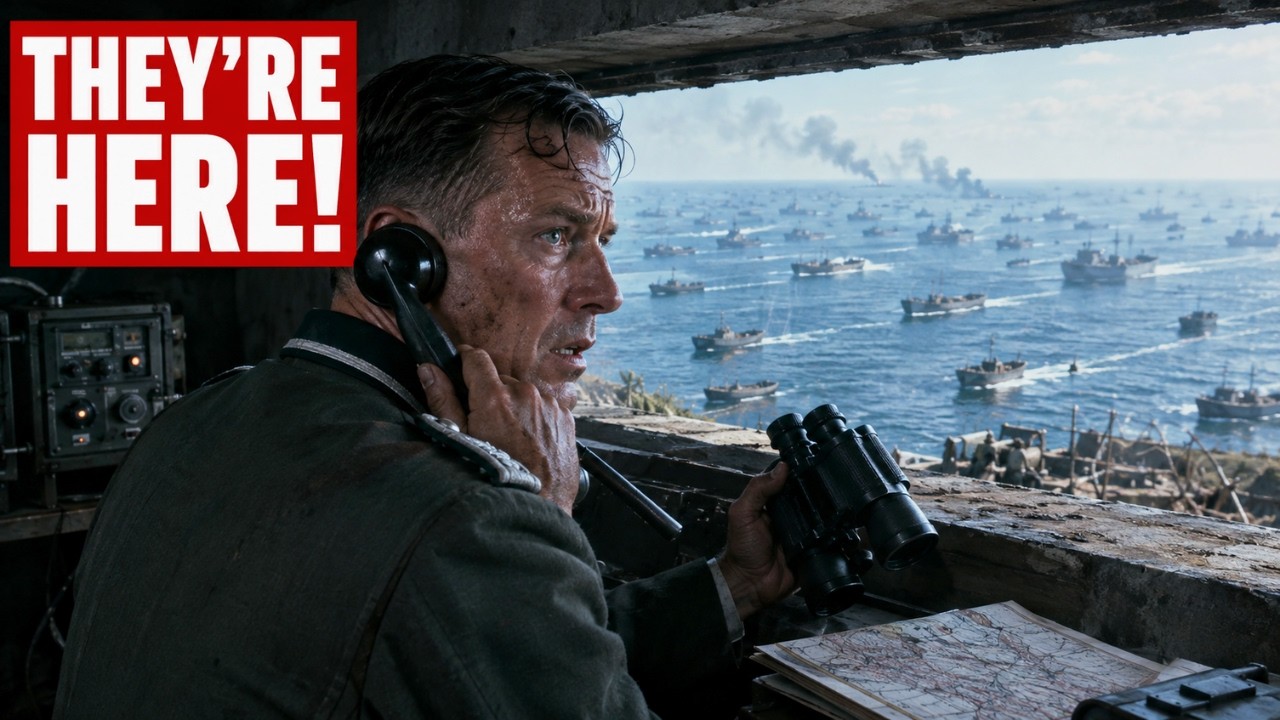
His name was Major Werner Pluskat. He was 33 years old. What he claimed to have seen that morning would become one of the most famous German memories of World War II. But there is a problem with his story.
Some men who served beside him say it never happened. To understand what Werner Pluskat claimed to see that morning, it helps to know who he was. Born in the industrial city of Halle in 1911, his childhood was shaped by the collapse of the Kaiser’s empire, the humiliation of Versailles, and the chaos of the Weimar years. Like many young Germans of his generation, he found order and identity in the army.
He joined the Reichswehr as a young man and chose artillery—a specialty that demanded mathematics, patience, and cold mental clarity. By 1939, when Germany invaded Poland, he was already a professional artilleryman. He served in the Polish campaign, then in France in 1940, then eastward to the Eastern Front in June 1941, when Operation Barbarossa began the largest land war in human history. He fought through the summer dust and the autumn mud, and through a winter that killed more Germans than Russian bullets did.
By the time he was pulled from the Eastern Front and sent west in early 1944, he had seen enough of war to know it did not end with parades in enemy capitals. It ended with exhausted men firing their last shells at machines that never stopped advancing. He took command of the 1st Battalion of Artillery Regiment 352 in France. His guns were German 10.
5 cm light field howitzers, the standard artillery piece of the German army, capable of firing a 30-pound shell more than 10 kilometers. When the time came, his targets would be soldiers coming out of boats onto the sand. Now, he had to wait, watch, and prepare. The wall he was sent to defend had a name: the Atlantic Wall.
Stretching from northern Norway to the Spanish border, it was nearly 3,000 miles of bunkers, gun positions, minefields, beach obstacles, and propaganda films. It looked impenetrable. The reality was more fragile. In November 1943, Adolf Hitler gave command of the most important section of the wall to Field Marshal Erwin Rommel, the “Desert Fox,” the commander who had outmaneuvered the British in North Africa until superior numbers and fuel shortages broke him at El Alamein.
Rommel took command of Army Group B in January 1944 and was stunned by what he found. Long stretches of coast had almost nothing: guns without ammunition, bunkers without garrisons, divisions filled with older men, wounded veterans, and foreign volunteers who spoke no German. Rommel threw himself into the work. In five months, his forces planted more than 4 million land mines.
They covered the beaches with a nightmare forest of obstacles—welded steel hedgehogs, wooden stakes rigged with mines, ramps designed to tear open the bottoms of landing craft—and flooded the low fields behind the coast to drown paratroopers. His philosophy was simple and absolute: the war would be won or lost on the beaches. He believed the first 24 hours would decide everything. Not everyone agreed.
Field Marshal Gerd von Rundstedt, the 68-year-old aristocratic commander-in-chief in the West, believed the beaches could not be held. He wanted to keep the panzer divisions in depth as a concentrated striking force, letting the Allies land and exhaust themselves, then crush them with a massive counterattack. Hitler, as usual, produced a compromise: Rommel got some panzer divisions at the front, Rundstedt kept others as strategic reserve, and a third group—the strongest of all—was placed under Hitler’s direct control. Only the Führer could order them to move.
Werner Pluskat was a small part of this vast, contradictory machine. His bunker sat on a cliff rising roughly 30 meters above the beach outside the village of Saint-Honorine-des-Pertes. He commanded 12 artillery pieces distributed across three batteries. His sector covered what German staff maps identified as beaches 62 through 68.
On Allied maps, those beaches had different names: Dog Green, Dog White, Dog Red, and Easy Green. One name would soon be written in blood: Omaha. But there was something the Allies did not know—something that would cost thousands of American lives. The 352nd Infantry Division was not supposed to be there.
Throughout 1943 and into early 1944, Allied intelligence built its invasion plans on a simple assumption: the Norman coastline that would become Omaha Beach was defended by the 716th Static Infantry Division, a low-quality formation of older men, limited transport, and foreign conscripts. It was a division designed to hold ground, not fight a mobile battle. In March 1944, Rommel, during one of his tireless inspections, decided the sector needed a stronger garrison. He ordered the 352nd Infantry Division, a full-strength formation of veterans, to move to the Normandy coast.
The 716th was not withdrawn; it was simply reduced and integrated into a combined defense. Two divisions now controlled ground where the Allies expected one. The 352nd was commanded by Lieutenant General Dietrich Kraiss, a 55-year-old professional officer with experience on the Eastern Front—a quiet, methodical man who had spent his days combing the ground, memorizing the terrain, and imagining his reserves. His division had been rebuilt in November 1943 after catastrophic losses in Russia.
The ranks were filled with experienced combat officers and NCOs mixed with young recruits who had trained hard through the spring. By German standards in the West, it was an excellent formation. And it was hidden. The Germans announced nothing about the deployment.
Wireless traffic was kept minimal. Movements were camouflaged. Allied reconnaissance photographs studied the coast obsessively, but the precise camouflage of the 352nd kept its true strength off the maps. Allied intelligence in England continued planning to fight a weak static division while about to send American soldiers against a defense twice as strong as they believed.
There was another reason the Germans were standing that spring staring at the wrong horizon. It was called Operation Fortitude—the greatest deception operation in the history of warfare. The goal was to convince Hitler and his generals that the real Allied invasion would not come from Normandy but from 200 miles northeast, at Pas-de-Calais. The logic was attractive: Pas-de-Calais was the shortest crossing from England, the obvious target, the direct road to the industrial heart of the Reich and eventually Berlin itself.
The Allies encouraged this belief with meticulous craft. They created on paper an entire army group that did not exist—the First United States Army Group—and gave it a commander famous enough that the Germans could not ignore him: General George Patton. His phantom force was stationed in southeast England across from Calais, with wooden tanks placed in fields for reconnaissance planes to photograph, inflatable rubber landing craft floating in coastal harbors, radio operators broadcasting traffic for divisions and corps that existed only in imagination, and double agents feeding German intelligence a steady stream of confirmed lies. The deception worked.
By spring 1944, the German high command had convinced itself that Calais was the target. The 15th Army was stationed there, waiting for an attack that would never come. Meanwhile, in Normandy, the 7th Army held a longer coast with fewer men. Werner Pluskat’s twelve guns, spread across an 8-kilometer front, were expected to hold off any possible attack.
By the first week of June 1944, the men in the bunkers along the Normandy coast had been on alert so long that alertness had become routine. Every dawn was a potential invasion. Every bank of fog was a potential fleet. Each night, coded messages from the BBC crackled across the Channel, and the Germans listened and waited, hearing nothing.
In the early days of June, the weather turned bad. A storm swept in from the North Atlantic. Channel waves reached 3 meters. Clouds dropped low.
Rain drove sideways across the beaches. Even veteran fishermen along the French coast said the weather was too rough for anything larger than a rowboat to cross. In the German naval weather center, meteorologists studied their maps and issued their judgment: an invasion could not happen—not this week, and probably not for the next two weeks. But the conclusion was incomplete.
The Germans had no weather stations in the North Atlantic; their observation posts had been driven out of Greenland and Iceland years before. They could only see what the storm was doing at that moment, not what it would do next. The Allies could. On the evening of June 4, a modest Scottish meteorologist named Commander James Stagg walked into a room full of the most powerful generals of the Western world and told them something almost no one in Europe knew: there was a coming window, a short gap in the storm—36 hours, maybe a little more—beginning on the morning of June 6.
General Dwight D. Eisenhower, the 53-year-old Supreme Commander of the Allied Expeditionary Force, listened. The invasion had already been postponed once. Postponing again meant waiting weeks for the tides and moon to align.
He thought in silence for a long moment. Then he spoke the words that would change history: “Okay, we’ll go. ”
Field Marshal Rommel did not know. On the morning of June 5, trusting what his weather service had told him, he made a decision that would echo through the rest of the war.
He got in his car and drove back to Germany. The next day, June 6, was his wife Lucie’s birthday. He had bought her a pair of shoes from Paris. He wanted to be there when she opened them.
After the celebration, he planned to go to Hitler’s headquarters to personally demand more panzer divisions. He believed he had plenty of time. Along the Normandy coast, the men of the 352nd Infantry Division settled into another damp, gloomy French evening. The wind rattled the windows of French farmhouses.
In the villages, curfew was imposed as usual. In the bunkers, men took turns sleeping. None of them knew what was coming. In the afternoon of June 5, 1944, in the gray, wet weather at La Roche-Guyon, west of Paris, a black car pulled out of the courtyard of a medieval castle.
In the back seat sat Field Marshal Erwin Rommel, returning home. Beside him rested a small box wrapped in brown paper. Inside was a pair of gray suede shoes, size 5½, bought from a shop on Rue Marivaux in Paris as a birthday gift. The next day, Lucie would turn 50.
He had promised to be there. He had every reason to believe he could keep that promise: his naval weather service had told him a storm made invasion impossible for at least two weeks. His own eyes confirmed it. The Channel waters outside his window were boiling with white foam.
No one would cross those waters. Not the British, not the Americans. Not now. He would celebrate his wife’s birthday.
He would drive to Berchtesgaden. He would meet Hitler face to face and demand more panzer divisions. He would return refreshed on June 8, ready to continue the work. Behind him, the men defending the Atlantic Wall were about to face the greatest amphibious assault in the history of warfare.
Without him. Rommel was not the only one who left. At noon that same day, Colonel General Friedrich Dollmann, the 62-year-old commander of the 7th Army, issued an order that seemed logical at the time: he directed his senior division commanders to assemble at Rennes in Brittany for a two-day war game. The exercise was scheduled for the morning of June 6.
The order carried a cruel irony: the war game would simulate an Allied airborne and amphibious attack on the Normandy coast. The commanders complied. All over the region, generals climbed into their cars and began the long journey west. Lieutenant General Wilhelm Falley, commander of the 91st Air Landing Division, a unit stationed directly in the path of the coming attack, left his headquarters at Château de Bernaville for Rennes.
He would never arrive. Lieutenant General Dietrich Kraiss, commander of the 352nd Infantry Division, stayed at his post. Along the coast, deputies took command as generals departed. The German army in Normandy, at the moment of maximum danger, was being systematically decapitated.
On his orders, Werner Pluskat spent the evening at his battalion command post in the village of Étréham. He read routine reports. He signed papers. He ate a simple dinner of bread and sausage.
Outside, the rain eased to a drizzle. The wind moved through the apple orchards behind the village. Men on guard duty stared into the void. Men off duty slept fitfully in the damp of their shelters.
The night passed as every other night had passed for the past six months. Two hundred kilometers north, across the black waters of the Channel, the greatest invasion fleet ever assembled was on its way across. At 9:15 p. m.
on June 5, at a radio interception station near Boulogne, a young German signals officer froze at his receiver. The BBC was broadcasting its usual evening messages—coded phrases intended for the French Resistance. Most were routine. Then came a phrase German intelligence had been waiting for since the previous winter: “Les sanglots longs des violons de l’automne”—”The long sobs of the violins of autumn”—words from a poem by the French symbolist poet Paul Verlaine.
German intelligence knew exactly what these words meant: the Allied invasion would begin within 48 hours. The information moved up the chain of command. It reached the office of Colonel Hellmuth Meyer, the intelligence chief of the 15th Army, headquartered near the Belgian border. He had spent months preparing for this moment.
He informed his commander immediately. The 15th Army was put on the highest alert. Then something incredible happened. The warning never reached the 7th Army.
The 7th Army controlled Normandy. The 7th Army protected the beaches that Werner Pluskat’s guns defended. At the very moment its commanders were driving west to Rennes for war games, the 7th Army was the only force in France that needed to hear Verlaine’s words—but it never received the message. Werner Pluskat, at his command post at Étréham, was sleeping in his uniform on a cot beside his desk.
He heard nothing. At 12:16 a. m. on June 6, a British Horsa glider crash-landed in a field beside a small canal in Normandy.
Major John Howard, the 31-year-old commander of D Company, Ox and Bucks Light Infantry, jumped onto the wet grass. His men secured the bridge over the canal in ten minutes—the first Allied objective captured on D-Day. Behind him, the Normandy sky was filling with aircraft. Thirteen thousand American paratroopers of the 82nd and 101st Airborne Divisions were jumping from C-47 transports over the Cotentin Peninsula.
Seven thousand British paratroopers of the 6th Airborne Division were landing on the eastern side. Reports began reaching German command—jumbled, contradictory, confusing. Paratroopers here, paratroopers there, landings in the north, landings in the south, landings everywhere. Then, alongside the real reports, something stranger happened: reports of paratroopers who did not return fire, reports of parachutes carrying no men, reports of rubber and cloth soldiers landing on empty fields with recorded gunfire and screams blaring from small speakers.
The Allies had launched Operation Titanic—hundreds of dummy paratroopers dropped across a wide arc of French countryside to confuse and distract the German response. The plan worked. German units chased ghosts in the dark while real Allied paratroopers seized real bridges and cut real roads. Somewhere on the road back from Rennes, a German car carrying Lieutenant General Wilhelm Falley made a sharp U-turn.
Falley had received news of the airborne landings and was racing back to take command of his division. In the gray dawn hours, as he approached his headquarters at Château de Bernaville, American paratroopers of the 508th Parachute Infantry Regiment saw the car coming down the country lane. They opened fire. Falley was killed within sight of his own castle walls.
The 91st Air Landing Division, one of the units positioned to counterattack the American airborne landings, lost its commander in the first hours of the battle. Werner Pluskat’s phone rang at 2 a. m. He woke instantly, the way a soldier wakes after five years of war.
The voice on the other end was taut and controlled: “Paratroopers reported inland, sector uncertain, put all batteries on maximum alert. ” Pluskat pulled on his boots, called his driver, grabbed his greatcoat and artillery binoculars, and stepped out into the wet darkness of the village street. With him went his battalion doctor, Captain Weber, and Lieutenant Colonel Ernst Orr, the senior artillery officer of the 352nd Division staff, who had been visiting the battalion when the alert came. The car struggled through the country lanes, headlights covered to slits, engines revving in low gear.
The road climbed through orchards and hedgerows up to the coastal cliff and finally to the concrete opening of strongpoint WN 59. Pluskat pushed aside the heavy steel door and entered the observation room. The bunker stood on a cliff rising about 100 feet above the beach. The observation slit faced a wide expanse of water 8 miles across.
From here on a clear day, one could see from the mouth of the Vire River in the west to the cliffs of Port-en-Bessin in the east. But the night was not clear. There was only fog. Pluskat raised the binoculars to his eyes.
He swept the horizon slowly from left to right, adjusting focus, straining for any shape, any silhouette, any sign of movement on the black water. Nothing. He picked up the field phone connecting the bunker to the regimental command post inland: “Nothing to report. ” He replaced the phone and returned to the observation slit.
Behind him, the men occupied the concrete floor. Weber sat quietly on the side of an ammunition box. Somewhere in the fog, the sea muttered against the rocks below. They waited for two hours.
Three o’clock came and went. Four o’clock came and went. The phone rang periodically—the same questions from the regiment, the same answers from the bunker: nothing seen, nothing heard. Pluskat began to relax.
Perhaps the paratroopers were just another raid, another ruse by the Resistance, another false alarm in a year full of false alarms. Twenty kilometers out to sea, beyond the range of his binoculars, United States Navy Task Force O was quietly anchoring. More than 200 ships had crossed the turbulent Channel through the night and taken up their assigned positions off the beach the Americans called Omaha. At that moment, on board the attack transports, 34,000 American soldiers of the 1st and 29th Infantry Divisions were climbing down cargo nets into their landing craft.
The men were seasick from the crossing. They were vomiting into their helmets. They were vomiting over the sides of the boats. They were gripping their rifles and staring at the dark water and thinking of home.
Pluskat could not see them. Not yet. Sometime between 5:00 and 5:30 a. m.
, pale dawn light began to seep through the eastern sky. The fog began to lift. Werner Pluskat raised his artillery binoculars for what he would later describe as the last routine sweep of his life. He turned slowly to the left, focusing on the horizon toward Grandcamp.
Nothing. He moved the binoculars toward the center. Nothing. He moved the binoculars toward the right.
His hands stopped. His eyes could not process what they were seeing. The horizon was covered with ships. Not dozens.
Not hundreds. Thousands. From the farthest edge of his vision on the left, stretching all the way to the farthest edge of his vision on the right, the sea was covered with gray silhouettes—ships, cruisers, destroyers, transports, landing craft. A city on the water.
An iron fleet extending as far as the human eye could see. Years later, he would recall that his first clear thought was that this could not be real—that his eyes were deceiving him, that the fog was playing tricks on his mind, that the sleepless nights had finally driven him mad. He lowered the binoculars. He wiped the lenses.
He raised them again. The ships were still there. He turned to Orr without a word and handed him the binoculars. The lieutenant colonel took them, put them to his eyes, and stared without speaking for a long moment.
Then he lowered the binoculars very carefully and reached for the field phone. Pluskat picked up the receiver. The line connected to the regimental command post, where the duty officer that morning was Major Werner Block. According to the account Pluskat gave 14 years later, the conversation went like this.
“Are there ships? ” “Thousands of ships. The invasion has begun here. ” Silence.
“Ships. In which direction are they heading? ” Pluskat looked at the horizon again. “Straight at me.
” Silence hung on the line for a long moment. Then the voice returned, calm and measured: “Pluskat, the Americans and British together don’t have that many ships. Are you sure? ” He would remember his answer for the rest of his life: “If you don’t believe me, come and see for yourself.
” The line clicked. The connection was broken. Here we must pause at this famous moment and consider it carefully. The scene you have just heard rests on a single source: Werner Pluskat himself, remembering years after the war, speaking to an American journalist who was writing a book.
Every word of that dialogue comes from that one interview. Some historians today doubt it ever happened. We will return to this question at the end of our story. For now, we will follow the account as Pluskat told it.
What came next did not depend on any man’s memory. It came from the sea itself. At about 5:50 a. m.
, the fleet opened fire. The first salvo came from the American battleship USS Texas. Its 14-inch guns hurled shells the size of Volkswagen cars across 8 miles of water between their decks and the Norman cliffs. The battleship Arkansas, commissioned in 1912, one of the oldest battleships in the American fleet, added its 12-inch guns to the bombardment.
The British light cruiser HMS Glasgow. The French cruisers Georges Leygues and Montcalm, crewed by Free French sailors who had finally returned to the coast of their occupied homeland. Dozens of destroyers moved close to shore and poured 5-inch fire onto the sand and the cliffs above it. The sky above Werner Pluskat’s strongpoint filled with a sound like freight trains falling from the sky.
The shells arrived a fraction of a second before impact, hitting the cliffs on either side of strongpoint WN 59, shaking the concrete walls and driving dust into the eyes of the men inside. Stone splinters flew through the observation room. The single electric light bulb shattered. Pluskat and his companions threw themselves flat on the floor while the world outside exploded in earth and steel.
They lay there, three men pressed against the concrete, while the greatest naval bombardment in history erupted over the coast above them. Then, in the midst of the bombardment, things got worse for the Americans. Wave after wave of heavy bombers of the United States Eighth Air Force—B-24 Liberators and B-17 Flying Fortresses—flew in over the Channel in coordination with the naval guns. Their mission was to destroy the German coastal defenses in the final minutes before the landing craft arrived.
Around 450 of them carried more than a thousand tons of high-explosive bombs. They flew over a dense cloud cover. They could not see the coast. The bombardiers had been given strict orders: if in doubt, delay the drop—do not risk hitting the landing craft in the water.
They waited a few seconds. A few more seconds. They made sure. The result was catastrophic.
Nearly every bomb fell behind the German defenses. The bombs fell into fields 2, 3, even 5 miles inland. They killed French cattle. They destroyed orchards.
They tore roof slates off farmhouses far from the coast. They did almost no damage to the German strongpoints on the cliffs above Omaha Beach. Werner Pluskat’s guns remained intact. The machine-gun positions at Wiederstandnest 72 and Wiederstandnest 70 remained intact.
The mortar pits remained intact. The trench lines remained intact. The barbed wire remained intact. Every element of the German defense that was supposed to be destroyed before the assault waves touched the sand was still there, waiting.
At 6:30 a. m. , the first American landing craft lowered their ramps into the waves of Dog Green Beach. Company A of the 116th Infantry Regiment, 29th Infantry Division, was in the lead.
Their commander was Captain Taylor Fellers. He was 30 years old. He came from Bedford, Virginia—a small town that would contribute its young men to Company A beyond what any statistic could bear. The ramps dropped.
The German machine gunners at Wiederstandnest 72, 300 yards to the east, were waiting for them. So were the gunners at Wiederstandnest 70 directly in front of them. The German machine gun fired 1,200 rounds per minute. Its sound was like ripping cloth.
The men who survived the beach never forgot that sound. Bullets hit the men of Company A while they were still standing in the open bows of the landing craft. Some died before they could take a single step forward. Others fell into chest-deep water and drowned under the weight of their equipment.
The lucky ones threw themselves flat behind the steel obstacles Rommel had planted in the sand and prayed the tide would hide them. Within minutes, Company A of the 116th Infantry Regiment ceased to exist as a combat unit. Ninety-six percent of its men were killed, wounded, or missing. Captain Taylor Fellers was killed.
Nineteen young men from Bedford, Virginia, died on Omaha Beach that morning. Three more Bedford men fell elsewhere on D-Day, bringing the town’s total losses to 22—the highest per-capita loss of any American community on June 6, 1944. That was only the beginning. Behind Company A came Companies E, F, and G.
Wave after wave of American infantry entered the kill zone that Werner Pluskat’s guns and the machine gunners of the 352nd Infantry Division had created. Pluskat’s artillery, firing from hidden positions inland, dropped high-explosive shells onto the beach in patterns his fire direction officers had drilled for months. Each shell threw up a fountain of sand and steel splinters across the shoreline. Landing craft caught fire.
Tanks swamped and sank in the waves. Bodies rolled with the tide under the bunker on the cliff. Pluskat could see all of it through the observation slit. The horizon still crowded with ships, the water below churning with landing craft, the beach at his feet turning from empty sand to a slaughterhouse.
He kept sending corrections to his batteries. He kept ordering the guns to continue firing. But he later remembered that a kind of numbness set in—fear, not triumph, only professional concentration so total that everything else faded. The war he had trained for, the war he had feared, the war he knew was coming, had finally arrived.
And it was worse than anything he had imagined. While the beach drowned in blood below him, something extraordinary was happening in the mountains of southern Germany. At the Berghof, Adolf Hitler’s mountain headquarters above Berchtesgaden, the Führer had gone to bed late the previous night, as was his custom. He had listened to music.
He had lectured his aides about the failures of his generals. Finally, he took his sleeping medication and went to sleep. He was still asleep. Reports of the invasion reached the operations staff of the High Command of the Armed Forces, the OKW, in the early morning hours.
General Alfred Jodl, the 54-year-old chief of operations of the OKW, received the messages. The men of Hitler’s inner circle gathered in anxious silence. No one woke him. They had good reasons, or so they thought.
The situation was unclear. Was this the main invasion, or was it just a diversion, with the real blow still coming at Calais? Better to wait for a clearer picture. Better not to bring bad news to the Führer that might be incomplete.
Better not to be the one who disturbed his sleep for something that might mean nothing. Adolf Hitler was asleep. Two hundred miles north, in a small village in southern Germany called Herrlingen, a field marshal was sitting down to breakfast with his wife on the morning of her birthday. The phone rang.
Field Marshal Rommel picked up the receiver. The voice on the other end belonged to Lieutenant General Hans Speidel, his chief of staff at Army Group B. Speidel’s voice was steady. His words were not.
“The invasion has begun. Airborne landings all over Normandy. Amphibious attacks on the coast. Naval bombardment from horizon to horizon.
” Rommel listened. He asked a few questions. He replaced the receiver. He did not leave immediately.
He finished his breakfast. He said goodbye to Lucie. He gave her the shoes as a gift. He arranged his car.
It was well past morning when he began his long drive back to France. He would not reach his headquarters until nightfall. The commander who had bet everything on defeating the invasion in the first 24 hours would spend most of those hours sitting in the back seat of a military car, watching the German countryside pass by the window, unable to issue a single order of any importance. There was one force in France that could have pushed the invaders back into the sea: the panzer reserves.
Two divisions in particular—the 12th SS Panzer Division “Hitler Youth,” largely composed of teenage volunteers led by veteran officers, and the Panzer-Lehr-Division, the elite training and demonstration formation of the German armored forces, equipped with the best tanks and most experienced instructors in the Wehrmacht. Together they formed a concentrated striking force positioned close enough to Normandy to hit the beaches before the Allies could consolidate a beachhead, and powerful enough, if released early, to change the outcome of that day. They belonged to no one—or rather, they belonged to Adolf Hitler alone. Neither Rommel nor von Rundstedt had authority to move them.
They were part of what the German staff called the High Command Reserve, and only the Führer could release them. And the Führer was asleep. At 4 a. m.
, Field Marshal von Rundstedt, from his headquarters at Saint-Germain-en-Laye near Paris, requested permission to move the panzer reserves toward the coast. Staff officers called the High Command. General Jodl answered. Jodl refused.
The situation was ambiguous. The main attack might still be coming through Calais. The tanks would have to wait. Hours passed.
The requests were repeated. The refusals were repeated. Throughout the morning, while American soldiers died on the sands of Omaha and British and Canadian soldiers fought their way onto Gold, Juno, and Sword beaches, the panzer divisions sat in their camps waiting for permission to move. Adolf Hitler did not issue the order until sometime after 4 p.
m. French time, after he had woken, eaten, and received a briefing in his own calm time. By then, it was too late. The Panzer-Lehr-Division, ordered to advance from its assembly area near Chartres, began its long march on the roads toward the coast that evening.
The roads were clear at first. Then the Allied fighter-bombers found them—Royal Air Force Typhoons, United States Ninth Air Force Thunderbolts. They roamed the Norman countryside all day, and every German column they spotted they attacked with rockets, cannon fire, and bombs. Over the next three days of forced marches under Allied fire, the division lost five tanks, 84 half-tracks and self-propelled guns, 40 fuel tankers, transport trucks, and staff cars—nearly a third of its combat strength—before it fired a single shot at an enemy soldier on the beach.
The great counterattack that could have pushed the Allies back into the sea arrived exhausted, depleted, and too small to make a difference. And all because one man at the Berghof needed his sleep. On the heights above Omaha Beach, the battle continued. Werner Pluskat’s guns kept firing.
His observers kept sending corrections. The crews worked with the quiet efficiency of professionals who had done this before. But ammunition was running low. And on the beach below, something began happening that no one on the German side had expected.
The Americans were not going to go home. They were pinned down, crushed, bleeding. But small groups of them, led by NCOs and junior officers whose names would echo through the history of the United States Army, began to move. Brigadier General Norman Cota, the 51-year-old assistant commander of the 29th Infantry Division, walked upright along the seawall under a hail of fire, urging his men toward the cliffs.
Colonel George Taylor, commander of the 16th Infantry Regiment, stood on the sand and spoke words the soldiers would repeat for generations: “Two kinds of people are staying on this beach: the dead and those who are about to die. Now let’s get the hell out of here. ”
They began to climb up through the draws, through the minefields, toward the German positions on the cliff, toward Werner Pluskat. By 1 p.
m. on June 6, the sun had broken through the clouds over the Normandy coast. The beach the Americans called Omaha lay under a bright, harsh light. The tide had changed.
The water was pushing the dead back and revealing the wreckage of the morning: landing craft blackened by fire, half-tracks half-buried in the waves, a Sherman tank with its hatches open and water lapping at the turret ring. But there were also men moving inland now. Not many. Not fast.
But moving. The German strongpoints that had held the cliff since dawn were beginning to fall, one by one. Wiederstandnest 60, Wiederstandnest 61, Wiederstandnest 62. Each was a small concrete fortress defended by men who had fired every round of ammunition they had.
In the end, each was overrun by small groups of American infantrymen who climbed cliffs no one believed human beings could climb. The names of those Americans deserve to be remembered—sergeants, lieutenants, and privates from small towns across the United States, boys from Kansas, Alabama, New York, and Oregon, seasick just hours before, now climbing the cliff with grenades in their fists, coming for Werner Pluskat in his strongpoint above Saint-Honorine-des-Pertes. The final hours had a strange, dreamlike quality. The naval bombardment had finally shifted inland, following the American infantry as they climbed the draws.
The observation slit at strongpoint WN 59 no longer looked out on a wall of falling shells. It looked out on a scene of incredible calm and scale. The beach below had become a highway. Trucks, half-tracks, bulldozers, ambulances, and streams of men in olive drab moving in orderly columns, naval officers directing traffic with signal flags.
Landing craft coming and going with the regularity of a factory shift. An entire American army was coming ashore. Werner Pluskat lowered his binoculars. He turned to the men with him in the bunker.
His voice was calm when he spoke. There was no drama in his words. Only the frank acknowledgment of a professional soldier: it was over for them. His guns were nearly out of shells.
His communications lines were cut in three places. The infantry who were supposed to support his position were scattered and broken along the coast. The reserves that were supposed to counterattack never came. He gave the order to destroy the code books.
His men burned the secret papers in a small fire on the concrete floor. He watched the pages curl and turn black. He watched the letters of the alphabet fade into ash. Then he led his surviving men out of the bunker and began the long journey back toward what remained of the German lines.
Behind him, on the cliff overlooking the beach he had defended, the concrete position fell silent. The 352nd Infantry Division—the division whose hidden presence had made Omaha Beach the bloodiest sand in the West—was dying. Lieutenant General Dietrich Kraiss had thrown everything he had into the battle. His mobile reserve, the 915th Infantry Regiment, had been sent to chase phantom paratroopers inland during the night.
When the real crisis came at dawn, the regiment was exhausted, scattered, and hours from the beach. By the time it was pulled back to face the American landings, the moment had passed. Kraiss’s division fought all day and through the days that followed. It retreated slowly, from hedgerow to hedgerow, through the tangled bocage country toward the market town of Saint-Lô.
With every day, the division shrank. By the end of June, its combat strength had fallen below 30 percent of what it had been on the morning of the invasion. Battalions shrank to company size. Companies shrank to platoon size.
The veterans who had rebuilt the division through the winter were dying in ditches and orchards where their bodies could not always be recovered. On August 2, 1944, near Saint-Lô, Lieutenant General Kraiss was wounded by artillery splinters. He was evacuated. Four days later, on August 6, he died of his wounds.
The division he led followed him into the abyss. That same month, the western half of Army Group B was surrounded and destroyed in the Falaise Pocket—one of the greatest disasters ever suffered by the German army. Ten thousand dead. Fifty thousand captured.
The road to Paris and beyond lay open. The 352nd Infantry Division, the division whose hidden presence had made Omaha Beach the deadliest sand in the West, no longer existed. But Werner Pluskat did not die with his division. Within weeks after the fall of the Normandy coast, as the remnants of the shattered German army in the West staggered back toward the German border, he was captured.
He passed through the British and American prisoner-of-war system. He spent time in camps in England and later in the United States. He was interrogated. He was asked about the disposition of German coastal defenses.
He was also asked about the events of June 6, 1944. And he gave his answers the way a professional soldier gives them—frankly, about what he did and what he saw. In time, the war ended. He was released.
He returned to a Germany that no longer existed as he had known it. He settled in the western zone, in the city of Wiesbaden, and began the quiet, long work of building an ordinary life out of the ruins. He worked hard. He aged.
His hair grayed. He watched the country he had fought for split in half and become the border of a new kind of war between his former enemies. He did not talk much about what he had done in the war. The soldiers of his generation did not.
For 14 years, Werner Pluskat was just an anonymous German among millions. Then, in the autumn of 1958, an advertisement appeared in West German newspapers. The man who placed it was named Cornelius Ryan. He was 38 years old, born in Dublin.
He had been a war correspondent who flew bombing missions with the United States Eighth Air Force over occupied Europe, watched Patton’s tanks race across France, and walked among the ruins of Berlin. He was writing a book because he wanted to reconstruct the 24 hours of June 6, 1944, from the perspective of the men who lived them—Americans, British, Canadians, French, and Germans; ordinary soldiers and famous generals; sailors on ships, pilots in the air, Frenchmen in the villages, and Germans in the bunkers. For years he traveled. For years he interviewed.
He placed advertisements in newspapers across Europe and America, asking anyone who had been present on that day to write to him. Thousands responded. Among them was a former Wehrmacht major from Wiesbaden. Cornelius Ryan traveled to Germany.
He sat with Werner Pluskat. He listened to the story of a man in a concrete bunker who raised his binoculars in the gray dawn light to see a horizon covered with ships. He wrote it down. The book was published in 1959.
Its title was “The Longest Day. ” It became one of the greatest bestsellers of the second half of the twentieth century. It was translated into more than 20 languages and sold tens of millions of copies around the world. In 1962, Hollywood producer Darryl F.
Zanuck turned it into a film: 28 international stars, three directors, thousands of extras—John Wayne, Henry Fonda, Robert Mitchum, Richard Burton, Sean Connery in a small role, and a German actor named Hans Christian Blech playing Major Werner Pluskat staring through his binoculars at a horizon full of ships. The scene became one of the iconic moments of D-Day in the popular imagination of the Western world. The anonymous major from Wiesbaden had become a legend. But there is more to the truth, and the truth is more complicated than the legend.
Since the 1990s, a new generation of historians has returned to the sources. Some German, some American—all determined to look at Pluskat’s story with the cold eye of the researcher rather than the warm eye of the storyteller. The German historian Helmut Konrad von Keusgen, in particular, spent years interviewing surviving veterans of the 352nd Infantry Division and combing through war records in the Federal Military Archive in Freiburg. What he found raises difficult questions.
Several surviving veterans of the division recalled in later interviews that Werner Pluskat was not at strongpoint WN 59 on the morning of June 6. They placed him at his battalion command post in the village of Étréham, several kilometers inland. They indicated that the man watching from the bunker that morning was one of his junior officers. The war diary of the 352nd Infantry Division—the daily operations log kept by the divisional staff—contains no record of the famous phone call.
No entry indicates that Major Pluskat reported thousands of ships. No entry describes Major Block’s skeptical response. The dialogue quoted in hundreds of documentaries exists in only one place: the pages of Cornelius Ryan’s book. And Ryan, as a masterful journalist, was also a writer of narrative history.
His method was to interview witnesses years after the event and reconstruct dialogue based on their memories. He was precise about facts. He was less precise about words spoken decades before by men who could not remember their children’s birth dates with the same clarity they remembered the morning of the invasion. Does that mean Werner Pluskat lied?
Memory is a strange thing. Old soldiers remember what they remember. Sometimes what they remember is exactly what happened in France. Sometimes it is what they wished had happened.
Sometimes it is a version of the truth polished by fifty retellings until its rough edges disappeared. What can be said with certainty is this: someone in the artillery regiment of the 352nd Infantry Division saw the Allied fleet at dawn on June 6, 1944. Someone reported it. Someone was not believed, or was dismissed, or was told to await confirmation.
The staff records confirm that the German command structure in Normandy failed to grasp the scale of what was happening in those first critical hours. What cannot be known with certainty is whether that someone was Werner Pluskat, standing exactly where he said he stood, speaking exactly the words he said he spoke. Werner Pluskat died in Wiesbaden in 2002. He was 91 years old.
He outlived his generation. He outlived the war. He outlived the state he had fought for, and lived to see it reborn as something else. He never changed his story.
To the last day of his life, he insisted he was in the bunker. He insisted he saw the ships. He insisted those words were spoken. Perhaps he was right.
Perhaps he only wished he had been. The battle he witnessed, or claimed to have witnessed, ended the way battles always end. By the evening of June 6, 1944, the Americans held a narrow strip of shore at Omaha Beach. It was a bitter strip.
It cost them nearly 2,400 casualties. The waterline was still clogged with wreckage. The cliffs above were still littered with German dead. The dunes were scattered with equipment dropped by men too shocked or too wounded to carry it.
But they held. And by the end of June, more than 850,000 Allied soldiers had landed across the five invasion beaches—more than 148,000 vehicles and more than 570,000 tons of supplies. An entire modern industrial army had poured through the Normandy beaches, moving inland toward the borders of the Reich. The Atlantic Wall, the great fortification project on which Field Marshal Rommel had staked his reputation and his hopes, had held for less than a day—and in some places, less than an hour.
Rommel himself would die in October of that same year, forced to take poison by Hitler’s agents after his involvement in the July plot against the Führer. The war in the West, which had seemed eternal, was now measured in months. Eleven months after Werner Pluskat raised his binoculars at dawn over Omaha Beach, a Soviet soldier removed the swastika flag from the roof of the Reichstag in Berlin. Hitler was dead in his own bunker.
Jodl, the general who refused to wake him, would be hanged at Nuremberg in 1946. General Friedrich Dollmann, whose war games at Rennes had emptied the coast of its commanders, died of a heart attack in France weeks after the invasion. Almost everyone in this story is gone now. The old men who climbed the cliffs of Omaha Beach are all beneath the soil.
The German boys who fired machine guns from strongpoint Wiederstandnest 72 are beside them. The archives are silent. The fortifications on the Normandy coast have been eroded by seventy years of Atlantic wind. France is growing over the concrete.
Children play in the observation slits. The question at the heart of this story remains: was Werner Pluskat, on the morning of June 6, 1944, standing at strongpoint WN 59 above the village of Saint-Honorine-des-Pertes? Did he raise his artillery binoculars and see the horizon covered with ships? Did he call his regimental command and receive the reply that a hundred books and films have made famous?
Because in later years, in the quiet of a defeated country’s ruins, he heard the story from another man. And slowly, gently, without deliberate deception, he began to remember it as his own. We do not know. And perhaps that ambiguity is fitting, because the men who fought on the beaches of Normandy that morning, on both sides, were not pure cartoon heroes.
They were tired, frightened, troubled men. Poor men who did their duty as they understood it and went home, if they went home, to spend the rest of their lives trying to understand what they had done and seen. Werner Pluskat is one of them. Perhaps he was the man in the bunker.
Perhaps he was the man who wished he had been. Perhaps the truth lay somewhere between the two. Yet because of one telephone call that may or may not have happened, because of one interview with an American journalist of Irish descent 14 years after the war, his name lives on while almost all the others have been forgotten. The bunker still stands today on the cliff overlooking the beach.
You can walk to it. You can stand at the observation slit and look across the same expanse of water he looked across at dawn on June 6, 1944. The horizon is empty on most mornings now. But if you close your eyes, and if you have listened carefully to this story, perhaps you can imagine what he saw—or what he said he saw—a gray light spreading across the Channel, ships rising and silhouettes emerging one by one, then ten by ten, then a hundred by a hundred, until the entire eastern sea was a wall of steel moving slowly and relentlessly toward the coast of France.
The longest day had begun, and nothing in the world would ever be the same.