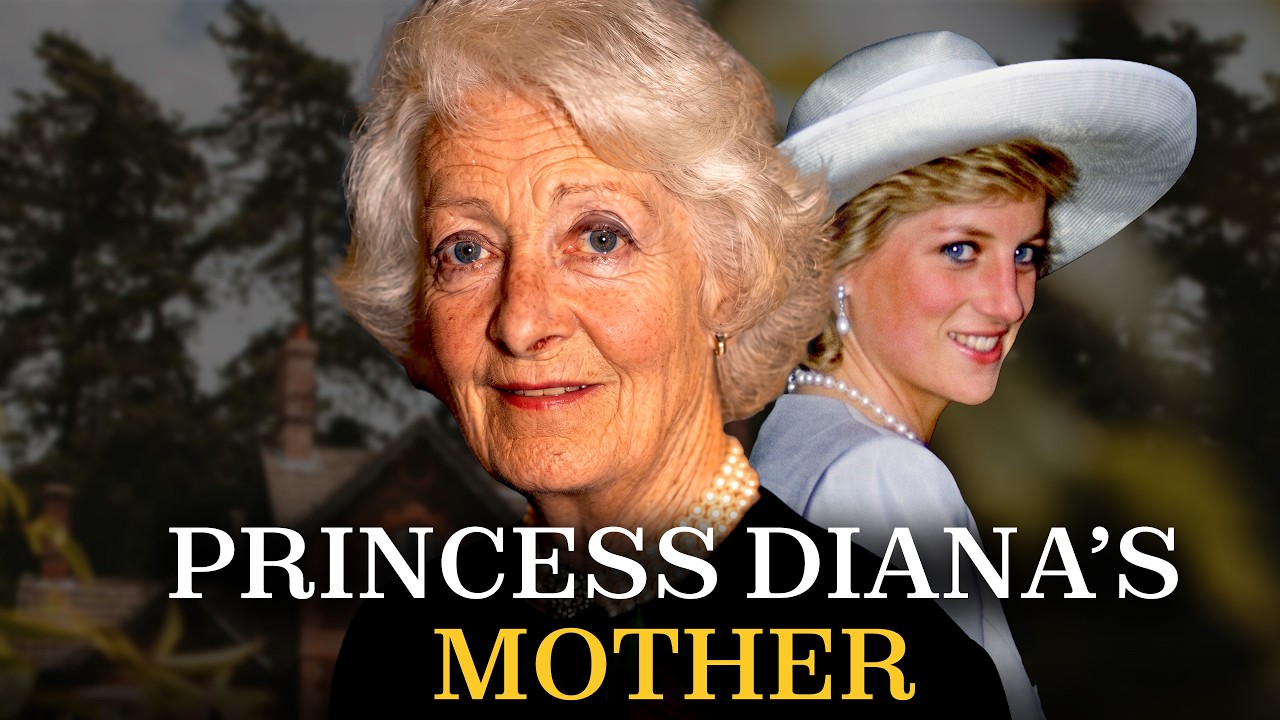
Frances Ruth Burke Roche was born on January 20, 1936, at Park House on the Sandringham estate, a few minutes’ walk from where the King of England lived. Her father, Maurice Roche, was the fourth Baron Fermoy, a Conservative MP with an Irish barony. Her mother, Ruth Gill, was a pianist who would later serve as a confidante and woman of the bedchamber to Queen Elizabeth, the Queen Mother, for 37 years.
The family had deep aristocratic roots in County Cork, and American money on the other side. Frances’s great-grandmother was an American heiress named Frances Ellen Work, whose father, a New York stockbroker, so distrusted British aristocrats that he wrote into his will that any descendant accepting a British title would forfeit their inheritance. They took the title anyway.
Frances grew up playing with the future Queen Elizabeth II and Princess Margaret. Her childhood was standard upper-class British: ponies, nannies, governesses, boarding school, and a finishing school in Paris. By the time she returned home at 17, she was tall, blonde, and strikingly pretty, ready for the 1953 London season.
That year was a particularly big deal. It was the coronation year of Queen Elizabeth II, and Frances was presented at court during the most high-profile season in a generation. Into that circus walked Edward John Spencer, Viscount Althorp, heir to the Earldom of Spencer and one of the most eligible bachelors in Britain. He was 30. She was 18.
Their engagement happened fast. On June 1, 1954, they married at Westminster Abbey, with Queen Elizabeth II, Prince Philip, and the Queen Mother in attendance. The newspapers called it the society wedding of the year.
As Viscountess Althorp, Frances moved into the Spencer family properties and got to work doing what 1950s aristocratic wives were expected to do: produce children, preferably male. Her first child, Sarah, arrived on February 19, 1955. Jane followed on February 11, 1957. Both girls were healthy, but the family needed an heir.
On January 12, 1960, a son, John, was born. He lived 10 hours. Frances woke up from anesthesia to the news. Her husband’s response was to send her to Harley Street for medical evaluations to determine why she hadn’t produced a healthy male heir.
On July 1, 1961, she gave birth to another daughter, Diana Frances Spencer. The arrival was greeted with open disappointment in the delivery room. Finally, on May 20, 1964, Frances delivered the longed-for son, Charles Edward Maurice Spencer, the future ninth Earl Spencer.
By then, something had already broken in the marriage. The miscarriages, the grief, the treatment, all of it had taken a toll. The family moved back into Park House, Frances’s childhood home, after her father died in 1955. It became the scene of the marriage’s slow-motion disintegration.
In 1966, Frances fell for Peter Shand Kydd, an Australian-born heir to a wallpaper business. He was 41, married with three kids, and by every account warm, relaxed, and fun, the opposite of Johnny Spencer’s stiff aristocratic energy. Their affair began sometime in 1966.
In late 1967, Frances left. She packed up the two youngest children, Diana and Charles, and moved to a house in Belgravia, London, intending it as a trial separation. Johnny Spencer had other ideas. After Christmas, he refused to send the children back. He lawyered up and filed for custody.
The custody battle was brutal. British wardship proceedings in the 1960s were sealed, so no public transcript exists. What leaked out over the decades is that Frances’s own mother, Lady Ruth Fermoy, stepped up for her son-in-law and sided against her daughter. Frances lost. All four children went to Johnny, with limited visitation.
The divorce was finalized in April 1969. She was 33 years old. The British press savaged her with one word: bolter. A woman who had abandoned her children for another man. Guest lists pruned her out. Her mother stopped speaking to her for years.
On May 2, 1969, Frances married Peter Shand Kydd. The wedding was small and private, nothing like the first. They moved to a farmhouse on the Isle of Seil, a small island off the west coast of Scotland connected to the mainland by a single stone bridge. The population was a few hundred people.
Frances loved it. She fished for salmon, walked the moors, drank in the local pub with farmers. She opened a gift shop in Oban selling tweed scarves and shortbread and little woolen sheep. She ran it herself, standing behind the counter, chatting with tourists who had no idea they were being rung up by the mother of the future Princess of Wales.
Her children visited when they could. Diana, in particular, would make the trip to Scotland as a teenager. The visits were precious to Frances, who tried her best to rebuild relationships severed in that 1968 courtroom.

Then, in the late 1970s, Diana started dating the Prince of Wales. In November 1977, Diana, then 16, met Prince Charles at a shoot at Althorp, where Charles was dating Diana’s older sister Sarah. By 1980, Charles and Diana were an item. In February 1981, they were engaged.
On July 29, 1981, the royal wedding happened at St. Paul’s Cathedral, watched by 750 million people worldwide. Frances attended. The organizers split Diana’s mother and father onto opposite sides of the cathedral. Johnny walked Diana down the aisle, having suffered a severe stroke that left his health fragile.
Throughout the 1980s, Frances occupied a strange position as the mother of the most photographed woman alive. She didn’t do interviews. She didn’t give quotes. From Scotland, she watched. Diana’s marriage was falling apart in slow motion, echoing patterns Frances herself had lived through a generation earlier.
Frances was genuinely supportive during the worst years of Diana’s marriage. But she was not, by temperament, a warm and nurturing type. Diana needed someone to hold her. Frances was better at telling her to buck up and go for a long walk.
Meanwhile, the Kydd marriage was cracking up. By 1988, Peter had moved out and eventually married another woman. The divorce was finalized in 1990. Frances, at 54, was divorced for the second time.
In 1994, Frances officially converted to Roman Catholicism. For a woman of her background, raised Church of England and closely tied to the royal family, this was a significant move. She took it seriously. Her Catholicism channeled into a charity called the HCPT, the Pilgrimage Trust, which organizes pilgrimages to Lourdes for sick and disabled children.
Year after year, Frances went to Lourdes, pushing the wheelchairs of disabled children through the narrow streets of the town. Every volunteer who worked with her tells the same story: she refused special treatment.
Frances was not a saint. In 1996, she pleaded guilty to drink-driving in Scotland, earned a 14-month driving ban, and paid a substantial fine. She took the punishment without complaint.

Diana’s marriage to Prince Charles had been officially over since August 1996. The divorce settlement stripped her of the HRH style. Frances gave an interview to Hello! magazine, saying she thought it was absolutely wonderful that Diana had lost the HRH, framing the loss as liberating.
Diana did not see it that way. She felt publicly demeaned by her own mother. Their relationship, already fragile since 1968, finally shattered. They stopped speaking.
Then came August 31, 1997. Princess Diana died in a car crash in the Pont de l’Alma tunnel in Paris at 36 years old. Frances and Diana had not spoken in months. They would never speak again.
Charles Spencer gave the eulogy at Diana’s funeral at Westminster Abbey, the same cathedral where his mother had been married 43 years earlier. Frances attended, stone-faced.
In October 2002, Frances testified at the theft trial of Paul Burrell, Diana’s former butler. Under cross-examination, she was forced to discuss the breakdown of her relationship with Diana, confirming under oath that they had not spoken for months before Diana’s death. The trial collapsed in November 2002 when the Queen suddenly recalled a conversation that exonerated Burrell.
Frances was sick for longer than the public knew. Parkinson’s disease came first, then a brain tumor. She continued to live at her home in Callanish on the Isle of Seil, continued to participate in parish life at the Catholic church in Oban, and continued to refuse interview requests.
On June 3, 2004, Frances Shand Kydd died at home. She was 68. Her funeral was held at the Cathedral Church of Saint Columba in Oban. Princes William and Harry attended. Charles Spencer came with his sisters Sarah and Jane. Prince Charles did not come.
Frances was buried at Pennyfuir Cemetery on the outskirts of Oban. Her grave is simple: a stone, a name, dates. No Westminster Abbey funeral, no royal carriage, just a Scottish burial in the town where she’d run her gift shop for 30 years.
In her last months, Frances was too sick to travel to Lourdes. Her friends from HCPT sent her a little container of water from Lourdes. She kept it by her bed until she died.
Frances Shand Kydd was not a saint, not a victim, not a villain. She was a complicated woman who lived through an amount of loss that would break most people and kept going anyway, mostly quietly, mostly on her own terms. She raised, partly at a distance, the most famous woman of the late 20th century. She buried a son who lived 10 hours. She lost three more children to a sealed courtroom in 1968. She outlived her second daughter in the worst possible way a parent can.
Through all of it, she found a gift shop in Oban, a grotto at Lourdes, a salmon river in the Highlands, and a faith she had not been born into. She built a life on the rubble of the one that was taken from her.