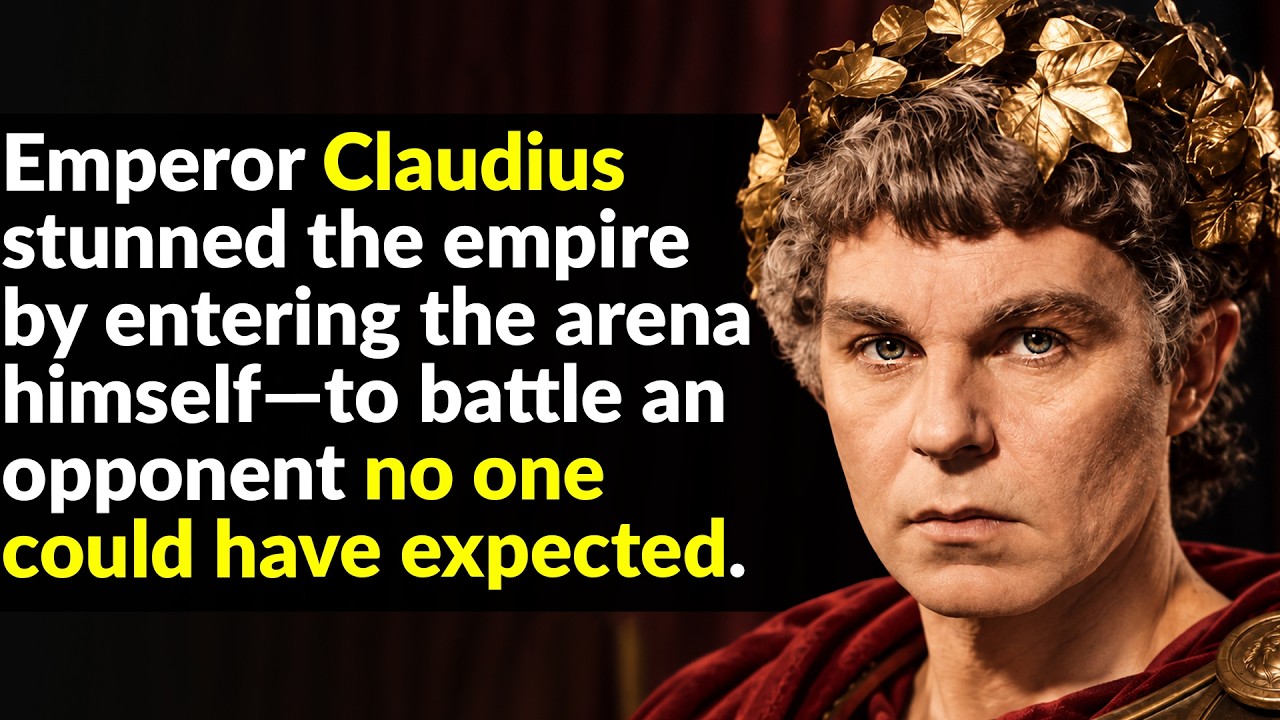
The ancient Romans loved their blood-soaked games, but during his reign, Emperor Claudius astonished the empire by stepping into the arena himself to face a truly strange opponent. Born on August 1, 10 BC, Claudius was a member of the great Julio-Claudian dynasty, a family that expected greatness from every child. His father, Drusus, was a distinguished military commander stationed in Roman Gaul, present-day France, when Claudius was born. That made him unique among Roman emperors: he was the first born outside Italy.
But birth into a wealthy family did not grant him every advantage. At a young age, Claudius fell ill with a mysterious disease that left lasting consequences. Though he eventually recovered, the boy was never the same, burdened with a permanent limp and slight deafness. His condition reportedly caused lifelong physical difficulties.
One Roman historian described the illness as producing weak knees that buckled under his weight, a shaking head, halting speech, and a runny nose whenever he became excited. Modern assessments have offered possible explanations. Historians, aided by contemporary medical practice, have proposed various causes for his symptoms. Before World War II, polio was the prevailing theory, so widely accepted that fictional portrayals of the emperor used that presumed diagnosis.
But polio does not explain all his symptoms, and more recent theories have suggested cerebral palsy or Tourette’s syndrome as the source of his physical suffering. Whatever the disease was, it also caused social suffering. Claudius’s visible weakness was a source of great shame to his family, and they rejected him as a child. His mother was especially harsh, repeatedly calling the young boy a monster and using him as a standard of stupidity.
The future emperor likely felt relief when she finally found a way to be rid of him. After his father died in battle, his mother could not bear the burden of her son alone. Records indicate she sent the young boy to live with his paternal grandmother, Livia, for a few years. His grandmother seemed kinder to him, though not significantly.
She appeared to share her daughter-in-law’s low opinion of the boy. Excluded from political affairs, Claudius turned his attention to scholarly pursuits instead. By his teenage years, his symptoms receded somewhat, and his family took renewed interest in him. They noticed his intellectual inclination and decided to do what they had never done before: encourage him.
In 7 AD, his family hired a history tutor to refine the young man’s talents. After that, Claudius spent most of his time among academics and philosophers. One well-known philosopher, Augustus, noticed Claudius’s excellent and obvious skills as an orator. Along with his new skills, he developed a measure of courage; he was not afraid to speak the truth.
Claudius proved himself a talented historian with a bent for honesty. In his work on the civil wars, he did not hesitate to offer sincere and truthful criticism of the Emperor Caesar Augustus, a member of his own dynasty. But that integrity harmed him further. His refusal to follow the party line and erase his dynasty’s history damaged his chances for public office.
Emperor Augustus died in 14 AD and was succeeded by Tiberius, who was Claudius’s uncle. Seeing an opportunity, Claudius appealed directly to his powerful relative for a post. Tiberius granted his nephew the honors reserved for consuls, but did not actually appoint him to any official position. Humiliated again, Claudius gave up and returned to his studies.
His family may have missed a political opportunity, for though they always held him in contempt, the Roman people seemed to respect him. Upon Augustus’s death, a delegation of equestrians, the wealthy class below senators, elected Claudius to lead them. When his house burned down, the Senate requested funds to rebuild it and asked that Claudius be allowed to participate in debates, showing positive feeling toward the young historian. Tiberius refused both proposals, but his successor may have seen Claudius’s political value.
In 37 AD, Tiberius’s life and reign ended, and Caligula became the new ruler. He happened to be Claudius’s nephew. The young emperor saw use for Claudius, perhaps because of his popularity, and finally granted what he had long awaited. Shortly after taking power, Caligula appointed Claudius as his co-consul, giving him considerable authority.
But that association carried serious downsides. As Caligula’s reign continued, the young emperor grew more cruel and sadistic, and according to some accounts, lost his mind. Claudius became a target of much of that cruelty. His nephew constantly mocked him, stripped him of vast sums as co-consul, and insulted him before the Senate.
This mistreatment began to take a toll. His weakness from childhood disability and his nephew’s harassment made Claudius seem no real threat to enemies of the imperial family. That perception ultimately saved his life. On January 24, 41 AD, a conspiracy against Caligula culminated in his assassination, along with many of his closest allies and advisers.
Claudius’s affliction saved him from the purge, and he later claimed he had been exaggerating it precisely for that purpose. Given what happened next, his claim may have had some truth. With his nephew dead, Claudius found himself the only remaining adult male in the imperial family. In one day, he went from the emperor’s laughingstock to the most likely candidate for succession.
If that seemed suspicious, it may have been deliberately arranged. Shortly after his nephew’s death, the Praetorian Guard found Claudius and led him to their camp under their protection. There they proclaimed him the new emperor of Rome. After arguing with the Senate over guarantees of his safety, Claudius returned to court, where the Senate confirmed his position.
He promptly cleansed the court of the conspirators, executing all involved. It was an extraordinary rise, but he still needed to win hearts and minds. As the first emperor proclaimed by the Praetorian Guard rather than the Senate, Claudius had to convince the legislative body he was a worthy ruler. He chose to sit among them during regular sessions, waiting his turn to speak and rarely imposing his imperial authority.
Roman custom held that new rulers adopt the titles of their ancestors, but Claudius refused them, assuring the Senate he would earn them over time. That political acumen marked his reign. After all those years his family prevented him from holding public office, Claudius proved them wrong. Despite relative inexperience, he was a competent and effective administrator, gaining popularity with the common people.
One progressive reform was empowering freedmen. Previously, freed slaves were not allowed any political authority. Claudius expanded the imperial bureaucracy by appointing freedmen to administrative posts. They remained fiercely loyal to him in return, strengthening his position.
He also had to set the household in order. Caligula had been known for extreme rule and spending vast sums of public money. Claudius proved his ability as a ruler, helping to reform imperial finances throughout his reign. But that did not mean he feared spending.
He had a practical and compassionate approach to governance, shown in many building projects. For example, he built a new harbor north of the Roman city of Ostia to combat grain shortages in winter. He also corrected his predecessor’s errors: he abolished the taxes on food Caligula had imposed and went further by lowering taxes on communities suffering drought or famine. His ambition to expand the food supply did not stop there.
Claudius’s greatest aim was to eliminate famine in Italy entirely. He hoped to do this by greatly increasing the amount of fertile land, embarking on an unprecedented project. He intended to drain Lake Fucine, hoping to make the nearby river accessible year-round and allow resources to move more easily. But the project went completely wrong.
His plan involved digging a tunnel under the lake, but it proved harder than expected, ending up grotesquely crooked and too small to accommodate the water flow. Still, Claudius proceeded with a grand opening ceremony, staging a massive gladiatorial show to celebrate. When the tunnel was opened, its small size caused the water to surge back, flooding the local area. The show was drowned, forcing Claudius and other spectators to flee for their lives.
His project failed, but it was a rare blemish on a record of achievements. Claudius also achieved considerable military success. His reign saw the first major territorial expansion since Augustus. This clever emperor annexed the provinces of Judea, Lycia, Mauretania, Noricum, and Thrace.
He also looked beyond mainland Europe toward a western island. In 43 AD, Claudius sent a commander and legions to the island of Britannia, the first step in the ultimately successful conquest of Britain. Though begun in his reign, it remained incomplete beyond it; still, he controlled enough of the island to reward himself with a short holiday. After the initial successes in Britain, Claudius traveled there himself to inspect his new land, bringing reinforcements, including a procession of war elephants.
A great temple was dedicated in his honor in modern-day Essex during his visit. It was remarkable he found time for rest at all. Throughout his life, Claudius wrote an astonishing amount of literature. He was a talented and diligent historian, as well as a skilled linguist.
He composed a full dictionary of the Etruscan language and even added three new letters to the Latin alphabet. As if that were not enough, Claudius also published a book on dice games. But one passion stood above the rest. Claudius took great personal interest in law throughout his life, studying it in books and legislative documents, and practically by observing the Senate and the various trials of his era.
As emperor, he elevated that passion to the next level. After taking power, he immersed himself in his legal interest, chairing many public trials, regularly attending Roman courts, and enjoying creating laws as much as enforcing them. During his reign, he issued daily decrees ranging from moral judgments to medical advice. A disturbing practice was common among slave owners at the time: if a slave fell ill, the owner would abandon him rather than provide medical care.
If the slave survived, many owners simply took him back into service. Claudius banned this practice, ruling that slaves abandoned and then recovered became free. He even made owners who ended the lives of their sick slaves subject to legal liability. It was a remarkably progressive position.
Claudius held strong views on the administration of the Roman state religion and introduced many reforms reflecting them. He practiced what he preached. When Alexandrian Greeks proposed dedicating a temple to his deification, Claudius refused, insisting the gods alone choose new gods. Ancient historians described his behavior as gentle and modest.
As ruler, he was popular among the masses, and the affection was mutual. He was said to occasionally dine with the common citizens. Yet for all his joviality, there was another side to the emperor. Claudius was as famous for his hot temper as for his approachability.
He was incredibly quick to anger, often exploding in public. To his credit, he acknowledged this flaw and publicly apologized for his temper on at least one occasion. He often directed that fury toward his favorite non-academic hobby: an irresistible passion for games and gladiators. He was constantly seen watching fights in the arenas of Rome, often publicly praising his favorite fighters.
He founded and presided over many new and innovative events, holding annual games celebrating his ascension. Some were absurd. He fought a killer whale, though not hand-to-hand. Claudius often staged naval battles in lakes as entertainment.
Once, a killer whale became trapped in the harbor at Ostia, and Claudius seized the opportunity. After gathering a crowd of spectators, Claudius and a guard of Praetorians hunted the whale for entertainment using javelins thrown from a ship. Despite all the fun, his reign was not always safe or stable. Though popular with the masses, Claudius never enjoyed the same trust from his noble peers and other politicians.
His position remained in danger throughout his reign, with numerous conspiracies against his life and attempts to overthrow his regime. Claudius had no choice but to strengthen his position. This involved responding to those who tried to assassinate him, resulting in the elimination of many senators. That only further deteriorated his reputation with the Senate.
They began exploiting what they considered flaws in his character. His emotional life was troubled. After breaking off his first engagement to a distant relative, Aemilia Lepida, for political reasons, Claudius married Livia Camilla. His second marriage lasted only a few hours; Livia died suddenly on their wedding day.
His third marriage to Plautia Urgulanilla allegedly involved frequent infidelity, and his fifth marriage to Valeria Messalina was clouded by rumors of betrayals. She eventually left Claudius to marry her lover. Perhaps the next time would bring better fortune. Unfortunately, the streak continued.
His sixth marriage was political, to his niece Agrippina the Younger. But Agrippina felt no familial or marital loyalty to her new husband. Once they were married, she began gradually trying to wrench power from Claudius, scheming to eliminate rivals to her son Nero to prepare him to become the next emperor. This would prove his undoing.
In the months before his death, Claudius and his wife reportedly quarreled constantly. Their relationship became increasingly hostile, and the emperor openly complained about his marital situation. He was not wrong. In the early hours of October 31, 54 AD, Emperor Claudius died at the age of 63.
All evidence pointed to poison. Many historians agree his wife was the instigator of his death, responsible for the plot, if not directly responsible for administering the poison. Agrippina got exactly what she wanted. Claudius’s successor was his stepson and legally adopted son, Nero.
Her conspiracy had paid off, and her son was now ruler of the Roman Empire. Nero quickly went to work erasing his predecessor’s legacy, revoking many of his official decrees on the grounds that Claudius had been too stupid and senile to mean them. This stance reflected a broader trend. Partly due to Nero’s rewriting of history and partly due to the hostility of his political contemporaries, Claudius’s reputation among ancient writers was terrible.
Many criticized his reign. Modern historians, however, have sought to correct that reputation, and Claudius is now regarded as one of the best and most progressive emperors of the ancient world.