In the summer of 1943, a German corporal stood at the railing of a transport ship moving slowly through morning fog toward the coast of the United States. He was one of hundreds of prisoners, captured in Tunisia that May when the last German and Italian forces in North Africa surrendered. He had spent weeks in a wire cage in the desert, then more weeks in a crowded hold crossing the ocean in convoy, packed in narrow bunks. Now, for the first time, the Americans had allowed the prisoners on deck.
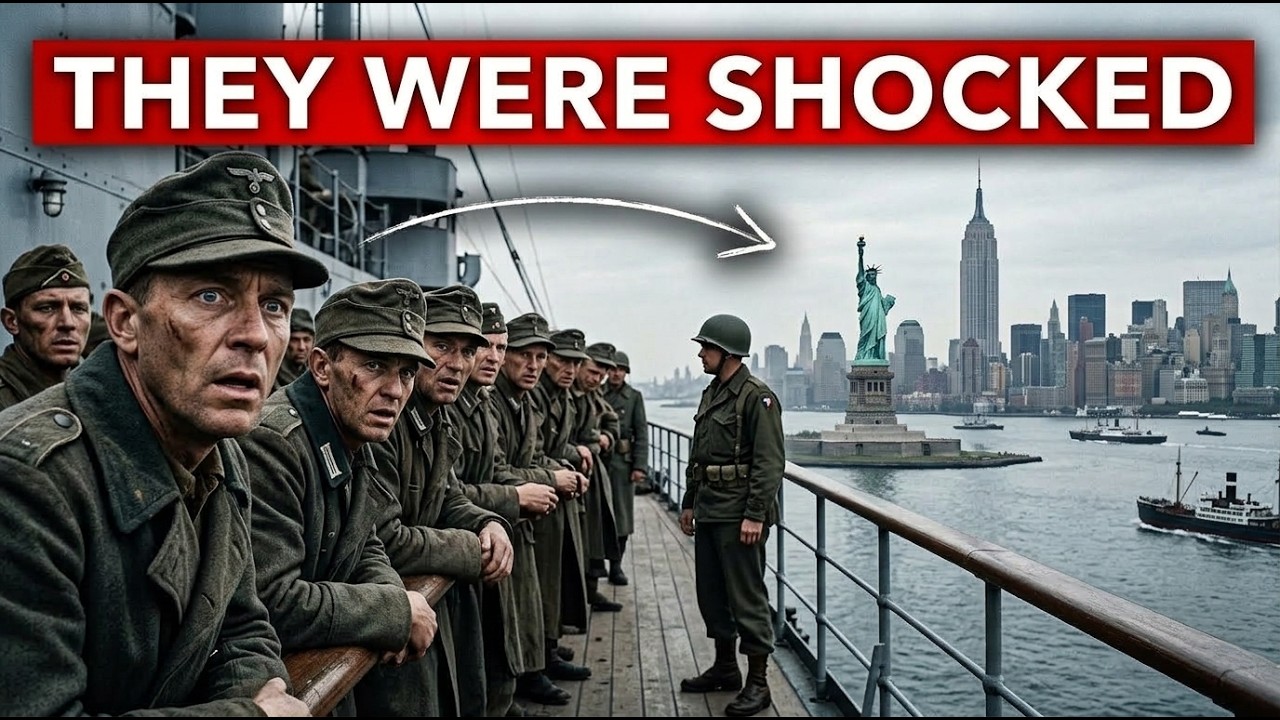
He thought he knew what he was about to see. He had been a soldier for four years, and throughout that time he had heard the same story about the United States: that it was weak, divided, and decadent, that its people had no will for war, that its cities were paralyzed by strikes and shortages. He had heard it repeated by men who swore they had seen it in newsreels or heard it on the radio, that German bombers had hit New York and that the great American city lay in ruins. It made sense to him.
His own country’s cities were being bombed. Why would the enemy be any different? When the fog lifted, what emerged on the port side was a green copper statue of a woman holding a torch above her head, standing on an island in the middle of the harbor. Behind it, in the morning sunlight, rose a wall of towers, dozens of them, hundreds of feet high, made of stone and steel and glass, standing so close together they looked like a single cliff.
None of them were damaged. Ferries crossed the harbor. There were tugs, barges, freighters, and warships. On the shore, he saw roads, and on those roads, an unbroken stream of cars.
A man beside him said quietly in German that it must be a trick. It was not a trick. To understand what that harbor did to those men, you must understand what was in their heads when they arrived. Germany in the 1930s and 1940s was a country where nearly all information came from the government.
Newspapers, radio, and the newsreels shown in every cinema were controlled by the Propaganda Ministry under Joseph Goebbels. Listening to foreign broadcasts was a punishable crime. A young German soldier in 1943 had grown up hearing only one version of the world. In that version, the United States was not a military power to be taken seriously.
It was portrayed as a land of gangsters, jazz, and bread lines, a hybrid nation lacking the discipline and sacrifice that war required. Its government was said to be controlled by financiers. Its factories might produce cars and refrigerators, but the regime insisted it could not produce armies, and its soldiers, if they appeared, would be amateurs. Beyond the official line, there were rumors.
Soldiers traded stories in barracks and trenches, as soldiers always do. Some stories concerned the war reaching America: U-boats sinking ships off American shores, which had been true in 1942, saboteurs landed on the American coast, which was also true although the mission had failed completely, and German aircraft bombing New York or about to bomb it. That last tale rested on a grain of reality. German aircraft designers were working on a long-range bomber meant to reach the United States, and the idea of striking New York had been discussed at high levels.
Prototypes had flown. But the project never approached operational production, and no German bomb ever fell on the American mainland. A soldier in the desert had no way of knowing that. Many prisoners later told American investigators and camp officials they had believed New York had been damaged or destroyed.
Some had been told so directly. Others simply assumed it, because every other great city in the war was being bombed, and they could not imagine enemy soil going untouched. It would be wrong to say the German picture of America was pure fantasy. It began with something real.
In early 1942, shortly after Germany declared war on the United States, a small number of U-boats crossed the Atlantic and began attacking ships along the American East Coast. What they found astonished them. American coastal cities were still fully lit at night. Ships sailed alone and unescorted, silhouetted against the glow of the shore.
There were almost no patrols. For several months, the U-boats sank ships almost at will. Tankers burned within sight of the beaches. People on the shores of New Jersey, Virginia, the Carolinas, and Florida watched ships explode on the horizon.
Oil and wreckage washed ashore. U-boat crews called it the “happy time. ” For a few months, war really had come to America’s doorstep, and America had looked utterly unprepared. A German soldier in North Africa heard about that.
What he did not hear about was what happened next. By mid-1942, the Americans had organized coastal convoys, air patrols, and escorts, and the U-boats were driven away from the shores. By the spring of 1943, the Battle of the Atlantic had turned against Germany, with submarines being sunk faster than they could be replaced. And beyond that coast, which U-boat men had seen glowing in the dark, an industrial mobilization was underway on a scale German leaders refused to believe possible.
The prisoners crossing the Atlantic in 1943 were sailing straight into that reality. The voyage itself was the first lesson, though most did not realize it at the time. After the surrender in Tunisia, the Allies found themselves with a quarter of a million prisoners. There was not enough food, water, or shelter in North Africa to hold them.
Britain was already overcrowded and short of food. The solution was to ship them to the United States, where there was space, food, and a severe labor shortage. There was also a convenient practical side. Freighters arrived in North Africa and the Mediterranean loaded with supplies for the Allied armies and returned to America empty.
Now they returned full of prisoners. Many of those ships were Liberty ships, simple, slow freighters produced in vast numbers, launched from American shipyards several a day. The German prisoner climbing aboard did not know the ship beneath his feet had been built in weeks by workers few of whom had been shipbuilders two years earlier. All he knew was that it was just a ship.
The voyage took about two weeks in convoy. Prisoners were kept below deck in crowded quarters, and for most, the greatest fear of the journey was that their ship would be torpedoed by their own navy’s submarines. That almost never happened. By 1943, the convoys carrying them were well protected.
There was also the food. Prisoners who had spent recent months in Africa on meager rations found themselves receiving regular meals, the same basic food eaten by the American crew and guards: white bread, meat, and real coffee. More than one prisoner later recalled thinking the Americans were putting on an act, feeding them well for a few days before the real treatment began. They did not yet realize this was simply what Americans ate.
Not all prisoners arrived in New York. Many entered through the large navy and army port in Virginia, others through Boston, but large numbers sailed into New York harbor. For those who arrived, the approach was something they described for the rest of their lives. The ship passed through the narrow channel between Brooklyn and Staten Island into the upper bay.
To the left stood the Statue of Liberty, which everyone had seen in pictures and none expected to see still standing. Ahead, at the tip of Manhattan, the towers of the financial district rose straight from the water. Behind them, farther up the island, were more towers, the tallest rising over a thousand feet. The harbor was crowded.
In 1943, New York was the busiest port in the world. Troopships, freighters, tankers, and warships loaded and departed in a continuous stream. Ships lined the piers along the rivers. Ferries crossed between the boroughs.
Tugs pushed barges loaded with railroad cars. Nothing was broken. There were no ruined buildings, no wreckage, no columns of smoke. The windows of the towers were intact.
On the highways along the waterfront, cars moved by the thousands, private cars in the middle of a war. A prisoner whose last memory was of Hamburg, Cologne, or Berlin knew what a city under bombing looked like. He knew the blacked-out windows, the sandbags, the craters, the burned-out blocks. He looked for those things in New York and found none of them.
For those who arrived in the evening, there was something else. New York had dimmed its lights in 1942 after the U-boat attacks, so that ships would not appear as silhouettes against the glow, but a dimmed New York was still brighter than anything in darkened Europe. Prisoners arriving at dusk saw lights in windows, lights on bridges, lights moving along the roads. In Germany, showing a light at night could get you arrested.
The men standing at those railings were soldiers of a regime responsible for terrible crimes, and many still believed in it. But they were also young men far from home, seeing something that matched nothing they had been told. What happened after the ship docked was a continuation of the lesson. The prisoners were led off, searched, deloused, and registered.
Each man was photographed, fingerprinted, and given a serial number. Their rights under the Geneva Convention were explained to them in German. The processing was fast, organized, and impersonal, carried out by an army that had clearly done it many times before and had the staff, forms, and facilities for it. Then they were put on trains.
German soldiers knew how prisoners were transported in Europe. They knew freight cars. Many had seen or helped guard trains loaded with prisoners and deportees packed into cattle cars. What they were led to was passenger cars, with upholstered seats and windows, and in some cases sleeper cars.
Meals were served during the journey. The guards were few and often relaxed, and the trip was long. The camps were inland, in Texas, Oklahoma, Kansas, Nebraska, and across the South and Midwest, because that was where space was available and where farms needed labor. The trains took days to get there.
For days, the prisoners watched America pass beyond the windows. They saw cities, one after another, all intact, all lit at night. They saw factories with full parking lots, thousands of cars belonging to ordinary workers. They saw freight trains that seemed endless, carrying tanks, trucks, and aircraft parts.
They saw farms with tractors and electric lights. They saw fields of wheat and corn stretching to the horizon, and cattle in numbers they could not count. And they saw the vast size of it. A German soldier’s sense of distance had been shaped in a country you could cross by train in a day.
Here the train ran for two days, three days, and the country went on. Many of them later said it was not the city skyline that convinced them. It was the train. A skyline could have been a show front.
But three days of continuous, undamaged, bustling country could not be. Not every prisoner accepted what he saw. Among the men captured in North Africa were some of Germany’s most committed soldiers, the old Africa Corps fighters, captured at a time when Germany still seemed to be winning the war in the East. Many were convinced Nazis, and they did not stop being convinced when they reached America.
Some insisted it was all staged. There are accounts of prisoners arguing that the Americans had deliberately routed the ships and trains to show them only the country’s best, or even that the trains were running in circles past the same cities and factories again and again to make the country seem larger than it was. Others accepted that America was rich but drew the opposite conclusion: that a people blessed with so much comfort would never have the will to fight a real war. Inside the camps, hardline prisoners mostly exercised control.
They dominated camp life, intimidated men who expressed doubts, and punished those they suspected of disloyalty. In the worst cases, prisoners were beaten or even killed by their fellow prisoners for saying the war was lost. For a long time, a prisoner who privately concluded that everything he had been told was a lie had good reason to keep quiet about it. So for most, the change was slow and internal.
It happened in a man’s own mind over months, as he worked on an American farm, ate American food, read American newspapers, and received letters from a family back home being bombed night after night. But for many, the first crack appeared on a ship deck in the fog, when the towers rose on the horizon, still standing. What the harbor actually destroyed was not merely a false report of an air raid. It was the assumption underneath the report: the assumption that the war was hurting the enemy as much as it was hurting Germany.
Every soldier needs to believe his suffering is shared by the other side. The German prisoners had seen their own cities burn. They suffered shortages of fuel, food, and ammunition. They had been told the enemy was in the same condition, or worse.
That belief made their suffering bearable and made victory seem possible. New York harbor told them in a single glance that it was not true. The enemy’s greatest city stood intact and untouched. Its harbor was crowded with ships.
Its roads were full of cars. Its lights were burning, and everything that followed confirmed it: the trains, the farms, the factories, the food. The United States was not being worn down by the war. It was being built by it.
It is worth being careful about what this means. The prisoners shaken by what they saw did not suddenly become democrats, and what they saw did not justify or erase what their army and government had done. Many clung to their beliefs for a long time. Some never gave them up.
But hundreds of thousands of German soldiers spent years in the United States, and when they finally returned to their ruined homeland, they carried with them a picture of America that no propaganda could have given them, because they had seen it with their own eyes. The German corporal at the railing is a composite figure, as is the man beside him. But the image of America in German propaganda, the 1942 U-boat campaign off the American coast, the abandoned German projects for a bomber that could reach New York, the shipping of prisoners to the United States on returning freighters after the surrender in Tunisia, their arrival at ports including New York, the dimmed lights still visible, the processing procedures, the journey inland in passenger cars, the astonishment of some prisoners, and the intimidation of hardliners inside the camps, all of this is documented in camp records and in the recollections of the prisoners themselves.