Cynthia Spencer stood a pace behind the Queen Mother for thirty-five years, admired across a kingdom for her grace, and almost no one guessed what that grace had cost her. To the world she was the saint of Althorp, the beautiful countess of one of the grandest houses in England, the trusted friend of a queen. Behind those walls she lived a marriage without warmth, tied to a man who loved his paintings more easily than he loved his own family, and she carried it the way her kind were taught to carry everything, in silence, with a smile. Two generations later, a girl with her blood and her name would be handed the same lesson in front of the whole world.
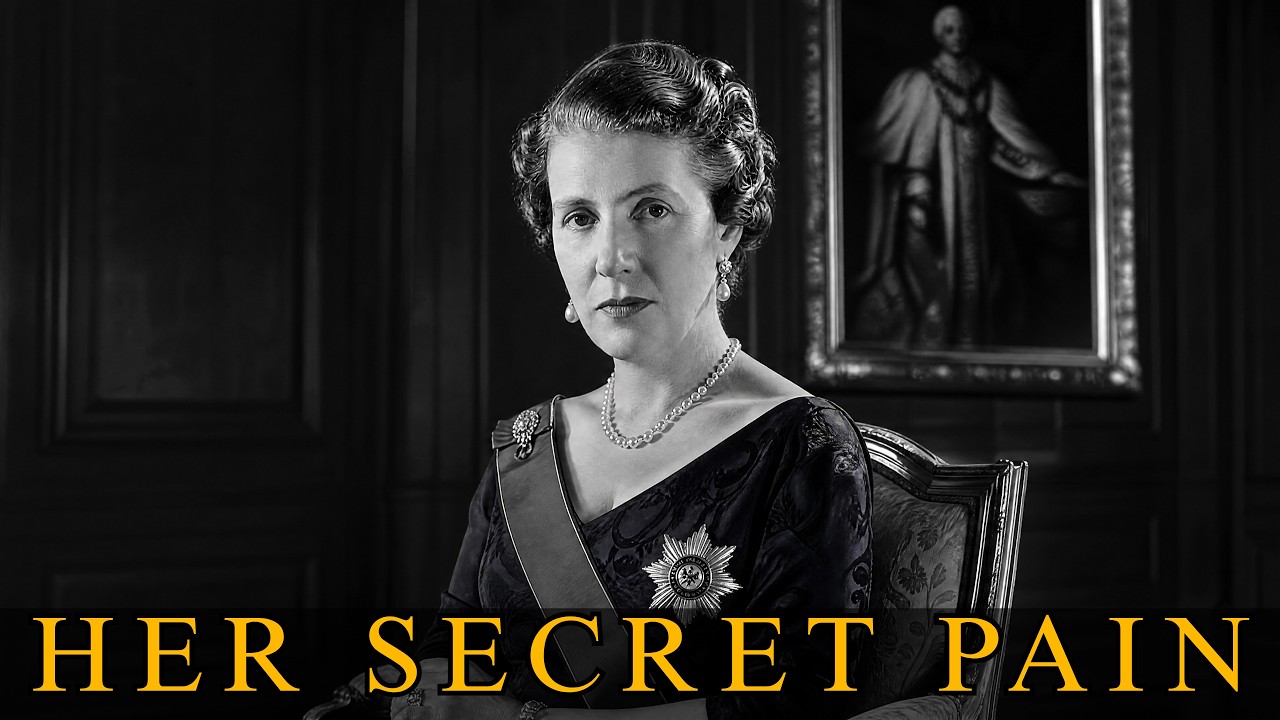
Her granddaughter was Diana. She was born into that world at its very summit on the 16th of August 1897. Lady Cynthia Hamilton came from a family that stood as high as any subject could stand, a daughter of the Duke of Abercorn, raised among nurseries and footmen and the vast quiet certainties of the Edwardian aristocracy. She was presented at the court of George V just as the old world was about to be torn apart by war.
By every account that survives, she was lovely and gentle and selfless, the words a class reserves for a woman who never causes trouble, and Cynthia never did. She had been raised on a single unspoken commandment that governed every girl of her rank: marry well, serve the family and the crown, and bear whatever there is to bear without letting it show. On the 26th of February 1919, she married Albert Spencer, Viscount Althorp, heir to the sixth Earl Spencer and one of the oldest fortunes in England. To everyone watching, it looked exactly like what a great marriage was supposed to be, a duke’s daughter joined to an earl’s heir, the right blood flowing into the right house.
Albert was a serious, cultivated man with a genuine scholarly love of art. He would become a trustee of the Wallace Collection and chairman of the advisory council of the Victoria and Albert Museum. But the tenderness he showed his canvases stopped at the frames. He was cold in the rooms where warmth was wanted, and the marriage, by the settled account of those who have written about the family, was a union of duty rather than love, correct in every outward particular and starved in every inward one.
For a woman raised as Cynthia had been raised, that was not at first a catastrophe. She had been taught that affection was a bonus and duty was the substance. So she became the perfect wife of a difficult man, smoothing what he made rough, gracious where he was stiff, carrying the social weight of the family so that his awkwardness never showed. There is no scene in the record, no quarrel, no slammed door, and that absence is the point.
The friction is the silence itself, a young woman of real feeling discovering month by month that the grand life she had been promised would be lived largely alone beside a man who reached more naturally for a painting than for her. In 1922, Albert succeeded as the seventh Earl Spencer, and Cynthia, not yet twenty-five, became Countess Spencer and mistress of Althorp. It was a house of some ninety rooms, with a park running to the horizon, stables and farms, walls hung with pictures by Van Dyck and Rubens and Reynolds, a library of rare books, and a household of servants arranged around the family whose name was on the gates. She took charge of it all and wore it lightly, becoming one of the most admired countesses in England.
But the grander the house, the more perfect the performance had to be, and the colder the marriage grew, the warmer and steadier the countess appeared. The performance and the pain rose together. Beneath the surface, the ground was shifting. The Spencer fortune was under a strain the great families all felt in those years.
Death duties, falling agricultural rents, and the cost of keeping Althorp alive pressed on the accounts. In the 1930s, Albert sold a small portrait of Henry VIII by Hans Holbein, one of the treasures of the collection, for ten thousand pounds, by one account to help pay for his son’s education. The picture ended its journey in a great museum in Madrid. One small masterpiece gone to prop up a family that from the outside looked as though it could never run short of anything.
The Spencers were selling their treasures to keep up the appearance of a wealth that was quietly draining away, and Cynthia lived at the center of a performance on two fronts at once. She gave the family two children. A daughter, Lady Anne, born in 1920, and a son, Edward John, always known as Johnny, born in 1924, the heir who would grow up to be Diana’s father. A boy raised in that house learned certain lessons early.
He learned that a Spencer man kept his feelings to himself, that warmth was not something the head of the family handed out freely, because he had grown up watching his own father hand out so little of it. Johnny absorbed his father’s remoteness the way a child absorbs an accent, and he carried it into his own marriage decades later with results that would break a family apart in front of the whole country. The coldness was not an accident that struck the Spencers once. It was a thing they handed down parent to child like the pictures and the plate.
In 1937, a door opened that she could never have expected. When King Edward VIII gave up his throne and his younger brother came to the crown as George VI, the new queen, Elizabeth, assembled the ladies of her household and chose Cynthia Spencer. To be made a lady of the bedchamber was one of the highest honors a peeress could receive, placing her among the small circle of women who attended the queen in person at state banquets, on royal tours, at the private weekends that shaped the real life of the court. But the appointment was more than an honor.
For a woman who had spent nearly twenty years in a marriage without warmth, the household of Queen Elizabeth offered something Althorp never had. It offered friendship. The queen was not a cold employer but a warm and loyal one who kept the women she trusted close for decades. Cynthia found in her forties a place where her gifts were valued and her presence wanted for its own sake.
The warmth that a marriage is supposed to provide, she found instead in service to a queen. When the Second World War came in 1939, Cynthia was among the women who held their posts through the long gray years, the tours of bombed cities, the visits to hospitals and factories, the quiet labor of keeping up morale. The patient endurance that had been the private tragedy of her marriage became in wartime a public virtue, and in June 1943 she was appointed an officer of the Order of the British Empire. The war also brought a bright thread into the family story when her daughter Anne married a Royal Navy captain at Westminster Abbey in 1944, a marriage that seems to have held the warmth Cynthia’s own had lacked.
After the war came the great tours, including the long journey to southern Africa in 1947, and the private weekends at Royal Lodge and Balmoral where the queen kept her circle close. Cynthia held her place for thirty-five years, longer than most marriages, and it was the clearest measure anyone has of where her heart had made its home. In 1954, her son Johnny married Francis Ruth Roche at Westminster Abbey, attended by the Queen and the Queen Mother themselves. Francis was young, not yet nineteen, and beautiful, and she came from a family that stood almost as close to the monarchy as the Spencers did.
Her mother, Ruth, Lady Fermoy, was herself a close friend and a lady in waiting to the Queen Mother. Diana, when she was born, would have two grandmothers who served the same royal mistress. The couple set up their home at Park House on the Sandringham estate in Norfolk, leased from the crown, almost in the shadow of the royal residence. But Johnny carried his father’s coldness into the marriage, and the same cold thread that had run through Cynthia’s marriage was running through her son’s.
Before Diana came a daughter, Sarah, born in 1955, and another, Jane, in 1957. In 1960 a boy was born, christened John, and he lived only a few hours. The loss fell on the marriage like a weight, and it fell hardest on Francis, who was made to feel that the failure to produce a living heir was somehow hers to answer for. She was even sent to be examined, as though the fault must lie in her.
On the 1st of July 1961 came another daughter, and they named her Diana Frances, a small disappointment to a family still desperate for a boy. A son, Charles, finally came in 1964, but by then the marriage was coming apart, and the four surviving children were growing up inside a house where the temperature was dropping year by year. In the autumn of 1967, Francis left Park House. Diana was six years old and would remember for the rest of her life the sound of her mother’s car on the gravel.
What followed was one of the most bitter aristocratic divorces of the decade. When the question of the children came to court, Francis’s own mother, Ruth, Lady Fermoy, chose the side of the Spencer earldom over the side of her own child and gave evidence that helped ensure Francis lost. The divorce was granted in 1969, custody of the four children was awarded to Johnny, and Diana lost her mother a second time, by law, partly because her own grandmother had spoken against her mother in a courtroom. In the years after the divorce, Cynthia was the closest thing the Spencer children had to a fixed point.
For Diana in particular, her grandmother seems to have been a figure of real comfort, a still presence in a childhood full of upheaval. Then her body failed her. In her final years Cynthia developed a brain tumor and bore it with the same self-command she had shown across half a century. On the 4th of December 1972, at the age of seventy-five, she died at Althorp, and the newspapers marked her passing in the flat, respectful language of the court circular that told the world almost nothing of what her life had actually been.
Diana was eleven. Twenty years later, the granddaughter pulled the forgotten countess back into the light. Diana had married the Prince of Wales in 1981 in a wedding watched by an estimated three-quarters of a billion people, and she had discovered the same thing her grandmother had discovered sixty years before, that the grandest marriages could be the coldest. Where Cynthia had endured in silence for fifty years, Diana refused the silence.
She cooperated with Andrew Morton, whose book in 1992 tore the mask off the royal marriage, and in 1995 she sat before a television camera and told a national audience that there had been three people in her marriage. But even as she broke the silence, she reached back for the woman who had kept it. Diana believed, the book recorded, that her grandmother looked after her in the spirit world. The most watched woman on earth, frightened and alone in a palace, turned in her fear to the memory of the gentle countess she had lost as a child.
Diana was buried on an island in the lake at Althorp, the house her grandmother had run for fifty years, in the very grounds where Cynthia had lived and endured and died. The two women came to rest in the same place under the same trees. The Spencers passed down houses and pictures and titles and something else no will could ever list. It taught that duty came before feeling, that a marriage was an alliance to be maintained rather than a love to be enjoyed, that suffering was private and grace meant hiding the wound.
Cynthia learned it so completely that she made a kind of saintliness out of it and was loved for it. Diana was handed the same lesson and could not make it hold in the glare of the whole watching world. Three generations, one recurring wound, the quiet countess almost no one remembers and the princess almost no one has forgotten. Cynthia had given her whole life to looking after other people and asking for nothing.
In the end, in her granddaughter’s imagination, she was doing it still from the other side of the grave, the eternal caretaker of a family that never quite learned to care for its own.