Pamela Beryl Digby was born on March 20, 1920, in Farnborough, Hampshire. She was the eldest daughter of the 11th Baron Digby, master of Minterne, a handsome house in Dorset that had belonged to the family for centuries. The name was ancient, but the money was thin, a gap between title and finances that shaped her from childhood.
She was presented at court in 1938 as a debutante, taking her place in the marriage market like generations of girls before her. There was a problem, though. She was not beautiful by the standards of her age. She was auburn-haired, round of face, and inclined to plumpness. Pretty in a healthy English way, but never the woman who stopped a room.
What she had was a single gift. She made every man believe he was the only one who mattered. She listened as though the man in front of her were the most fascinating person alive. She remembered details of his work, his worries, and his small vanities, and fed them back with a warmth that felt entirely genuine.
In the summer of 1939, she came up to London, hungry for a life larger than the one she had been born to. Within a fortnight of Britain declaring war, she sat down to dinner beside a man whose surname was the most famous in Britain.
Randolph Churchill was the only son of Winston Churchill. He was 28, handsome in a heavy way, brilliant in flashes, and already marked by the drinking and recklessness that would ruin him. He was seized by the urgent thought that he might be killed and ought to father a son to carry the Churchill line. He had proposed to as many as eight women that autumn. Pamela said yes.
They were married on October 4, 1939, at the Church of St. John in Smith Square, Westminster. She was 19. He was 28. The marriage gave her the name and entry into the most powerful family in the country at the very moment it was about to lead the nation through its greatest trial.
The marriage itself began to disappoint almost at once. Randolph drank heavily, gambled with pathological recklessness, and had a talent for alienating everyone around him. But the name was doing its work. When Winston Churchill became Prime Minister in May 1940, Pamela was already installed within his orbit.
She had a genius for being agreeable to powerful men. She dined at Downing Street and spent weekends at Chequers while the fate of the war was decided in the rooms around her.
On October 10, 1940, she gave birth to a son. They named him Winston after his grandfather. The birth of a male Churchill heir secured her place in the family beyond any question.
The early war years saw her living a curious double life. On the surface, she was the dutiful young wife and mother. Underneath, the marriage was disintegrating. Randolph, sent abroad on service, ran up gambling debts on the voyage out and wrote home to instruct Pamela to settle the accounts. One demand was for around $12,000, a fortune in those years.
Rather than expose her husband's recklessness, she protected the family name. She took a paid job at the Ministry of Supply earning about 12 pounds a week. She quietly sold the wedding presents and a good deal of her jewelry. She moved the baby out of London for safety and economized wherever she could.
In March 1941, a tall, grave, immensely rich American stepped off a plane into wartime London. His name was William Averell Harriman, and he had arrived as the personal envoy of President Franklin Roosevelt to oversee Lend-Lease. He controlled the vast flow of weapons, ships, aircraft, food, and raw materials that Britain could not survive without.
Harriman was 49 years old, the son of a railroad baron who had built one of the largest transport empires in American history. He was reserved, serious, a touch cold. He was also married to his second wife, who was 3,000 miles away.
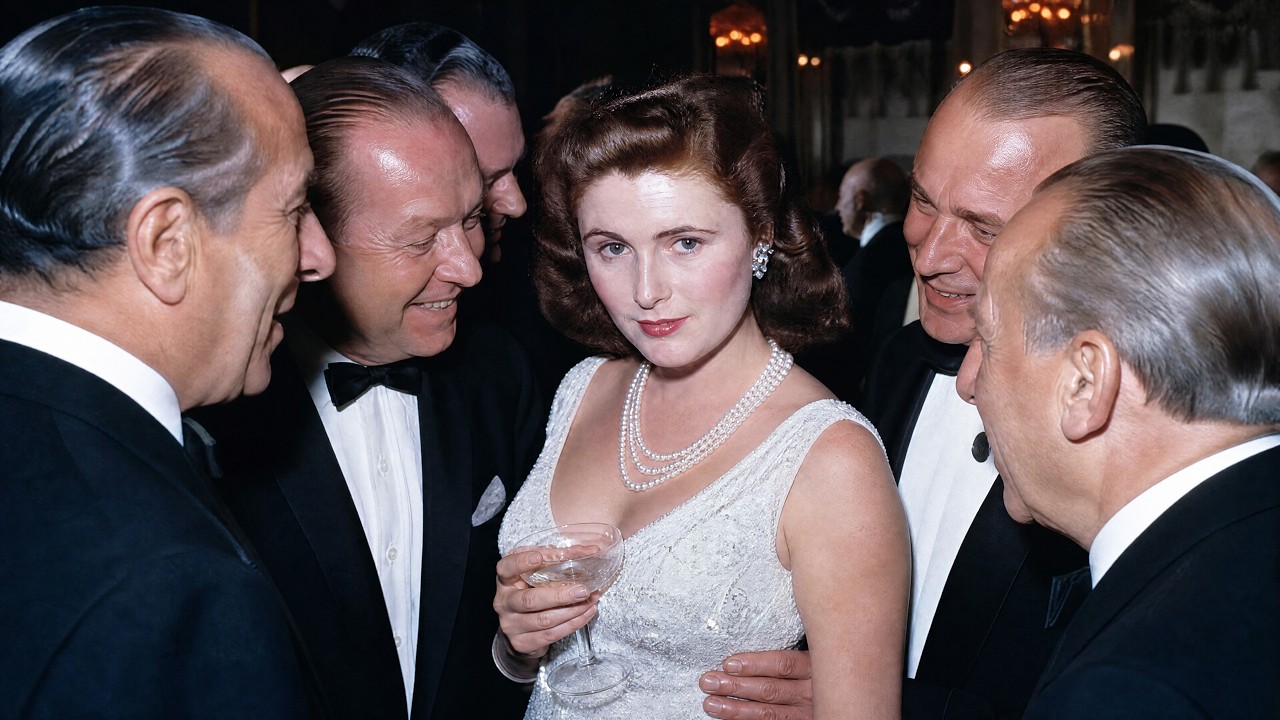
Churchill flattered Harriman, dined him, took him to Chequers, and brought him inside the family circle. To keep Harriman happy was a matter of national survival. It was in this atmosphere that Harriman was introduced to Pamela Churchill.
The introduction came at the Dorchester Hotel during an air raid. Here was the most attentive young woman in London, schooled in the art of making a great man feel he was the only one, seated beside the most important American in the country. Within weeks, they were lovers.
The affair was extraordinary not because it was secret, but because it was not. They were seen together. They were known to be together. And the Churchills said nothing and allowed it to continue.
Randolph was away on active service, risking his life, and his wife was openly involved with another man under the noses of his own parents. Yet there is no record of Winston confronting Pamela, no record of Clementine casting her out. The silence was deliberate. The Prime Minister had decided that the comfort and goodwill of the American envoy mattered more than the propriety of his daughter-in-law's behavior.
Pamela navigated the situation with poise. She remained the perfect daughter-in-law to Winston, attentive and warm. For a time, Harriman's own grown daughter Kathleen came to London and became Pamela's close friend and flatmate, even as Pamela carried on her relationship with Kathleen's father.
Some who knew her well came to believe that Pamela was not only Harriman's lover, but Churchill's most useful private channel to the Americans. She spent her nights with the man who controlled the flow of American supply and her days inside the Churchill family. She was perfectly positioned to carry what she learned from the American at night to the Englishman at breakfast.
Whether Churchill formally directed it cannot be proven. But the circumstances are suggestive. Pamela was an extraordinary listener, the kind of woman to whom men talked freely. She was learning in the most direct way possible that intimacy with powerful men was itself a form of power.
When Harriman's duties carried him away from London, the war brought a steady parade of powerful Americans to Pamela's door. She became the great hostess of the Anglo-American alliance and a good deal more besides.
The most famous of these attachments was to Edward Murrow, the celebrated American broadcaster whose nightly reports brought the courage of the bombed city into millions of American homes. The affair shook his marriage to its foundations. By some accounts, he came close to leaving his wife for her.
Then there was William Paley, the founder and chairman of the Columbia Broadcasting System, one of the architects of American mass media. He fell within Pamela's circle as well.
And there was John Hay Whitney, known as Jock, heir to one of the largest fortunes in the United States, descended from the Whitney and Payne families. He was the third.
These three men, Harriman, Paley, and Whitney, are the figures the story gathers under the banner of the three American billionaires. In the money of the 1940s, they were not billionaires in the literal sense, but ultra-rich men of the first rank. Pamela attached herself in a single span of wartime years to three of the richest and most powerful Americans alive.
The cost of all this was her marriage. Randolph, returning periodically from his service, learned of his wife's affairs. There were furious scenes and bitter recriminations. The union that had given Pamela the Churchill name was finished in all but the legal sense.

The divorce came in 1945. Pamela kept two things from the marriage that would matter for the rest of her life. She kept her son, young Winston. And she kept the name Churchill.
Randolph's own story moved swiftly toward tragedy. The drinking deepened. The quarrels multiplied. He died in 1968 at the age of 57, remembered chiefly as the difficult son of a great father and the discarded first husband of a woman who went on to eclipse them both.
Pamela, by contrast, was only beginning. In the late 1940s, she left England and moved to Paris. The choice was shrewd. Post-war Paris was reviving as the capital of European pleasure and style, a city where a beautiful manner mattered more than a fat inheritance.
She arrived with very little money and a great deal of nerve. She set herself up modestly and began to attach herself to the very richest men she could find. She refined her taste, learned about art, wine, furniture, and food. She converted to the Roman Catholic faith, a change some attributed to genuine conviction and others to the practical hope of marrying into the great Catholic families of the continent.
For roughly five years, through the early 1950s, Pamela was the companion of Gianni Agnelli, the grandson and heir of the founder of Fiat. He was handsome, charming, fabulously rich, and recklessly alive. Pamela would later call these the happiest years she ever knew.
She wanted to marry him. And Agnelli, for all his devotion, would not marry her. The reasons were a tangle of family pressure, religion, and social expectation. In 1953, he married Marella Caracciolo, a beautiful Italian princess of impeccable lineage. Pamela was left with nothing but the memory.
After Agnelli came a Rothschild. Baron Elie de Rothschild was a member of the French branch of the most famous banking family in the world, a partner in the family bank, and a master of the great vineyard of Chateau Lafite. He was immensely rich and crucially, married.
Pamela pressed the point of marriage. She is said to have issued something close to an ultimatum. The answer was the one she had heard before. He would not leave his wife.
It was the repetition that taught the lesson. She had now given years of her life to two of the richest men in Europe, and both had been content to keep her and unwilling to wed her. She resolved in effect never to be refused a third time.
In New York, she found at last a man who would marry her. His name was Leland Hayward, one of the most successful theatrical and film producers of his era. He was married to his wife Slim, a famous beauty in her own right.
Pamela set her sights on Hayward and did not let go. He divorced Slim, an episode that earned Pamela a fresh wave of hostility. In 1960, he married her.
After two great refusals, Pamela Churchill had finally won the thing she had wanted since Agnelli. She was now Pamela Hayward, and she had crossed the Atlantic to become an American wife. She reinvented herself as the devoted wife of a leading American producer and as a hostess at the heart of New York's theatrical world.
For 11 years, she was Leland Hayward's wife. Then, in 1971, he died. Pamela, at the age of 51, found herself a widow in a foreign country.

Six months after she buried one husband, she married the man she had taken as a lover 30 years before. Averell Harriman had gone on to a towering public career. He had served as ambassador to the Soviet Union and to Britain, as secretary of commerce, as governor of New York, and as an elder statesman of the Democratic Party. His wife, Marie, had died.
They met again at a dinner in Washington. Within a matter of weeks, they had decided to marry. The wedding took place in 1971.
Through Averell, Pamela gained two things she had pursued her whole life. She gained American citizenship. And she gained access to one of the great American fortunes, with all the houses and the standing it conferred.
She devoted herself to Averell with the same completeness she had brought to every important man in her life. He was an old man and growing older, and Pamela nursed him and kept him at the center of things. Through him, she was drawn ever deeper into the world of Democratic politics.
Averell Harriman died in 1986 at the age of 94. His death left Pamela a very rich widow and plunged her into one of the bitterest battles of her life. The Harriman fortune became the object of a long and savage legal war between Pamela and Averell's children and grandchildren. They accused her of mismanaging and draining the family money that should have passed to them. The litigation dragged on for years.
Even as the inheritance battle raged, Pamela was building something the Harriman heirs could never take from her. In 1981, she founded a political action committee, formally called Democrats for the '80s, and known to everyone as Pam PAC. From her estate at Middleburg, Virginia, she set out to raise money and rebuild the party's fortunes.
She turned out to be magnificent at it. The same gifts that had drawn wartime envoys and Italian heirs now drew donors, politicians, and operatives to her dinners. In its first 20 months alone, her committee raised more than a million dollars. Over its life, it is credited with raising on the order of 10 million.
The crowning achievement of this final career came with the rise of Bill Clinton. Pamela was an early and important backer of the young governor of Arkansas. A single fundraiser at her Middleburg estate in 1992 is said to have gathered more than 3 million dollars for his campaign in one day.
When Clinton won the presidency in 1992, Pamela Harriman had backed the winner. In 1993, President Clinton appointed her the United States Ambassador to France. The Baron's daughter from Dorset returned to the city of her great love affairs, not as a kept companion, but as the official representative of the most powerful nation on Earth.
She died on a day in early February 1997, at the age of 76, swimming alone in the calm blue water of a pool at the Hotel Ritz in Paris. She suffered a sudden cerebral hemorrhage. She was pulled from the pool and rushed to the American Hospital at Neuilly, where she died the following day.
The president of France, Jacques Chirac, came in person to honor her and laid upon her flag-draped coffin the Grand Cross of the Legion of Honor, the highest order France can bestow. It was said to be the first time the honor had been given to a woman serving as a foreign diplomat.
President Bill Clinton sent the presidential aircraft, Air Force One itself, across the Atlantic to bring her body home. Her funeral was held at the National Cathedral in Washington, and Clinton himself spoke in her praise.
To her detractors, Pamela Harriman was the courtesan of the century, a woman who had slept her way from a Dorset barony to a Washington Cathedral. To her admirers, she was the cleverest political operator of her generation, a self-made woman who had risen through the only door history left open to her.
She had no money, no great beauty, and no power the world would recognize. She had only attention and the will to spend it. And with those two things alone, she rewrote the whole of her own ending.