Archduke Ludwig Viktor of Austria was born on May 15, 1842, the youngest son of Archduke Franz Karl and Princess Sophie of Bavaria, and the younger brother of Emperor Franz Joseph I. His parents had hoped for a girl after losing their only daughter, but instead they received a lively, mischievous boy who filled the palace with laughter. The family called him Hetzy, a nickname that captured his playful nature. His mother adored him and dressed him in elaborate costumes for the popular parlor game known as Tableau Vivant, in which noble families recreated scenes from art and history.
Ludwig loved it, and it was his first taste of performance, one he never lost. Unlike his older brothers, who were raised for responsibility, Ludwig grew up pampered and indulged. He spent most of his early life surrounded by women, his mother’s ladies-in-waiting, tutors, musicians, and servants. By the age of six, it was clear he was no ordinary Habsburg.
Where his brothers followed rules, Ludwig invented his own. In 1848, revolution swept the empire, and the imperial family fled Vienna for Innsbruck and then Olmütz. The boy who had danced through palace corridors watched the empire tremble as his brother Franz Joseph was crowned emperor at just eighteen. Like every Habsburg prince, Ludwig was expected to serve the army.
He began his military training as a teenager and rose through the ranks, becoming titular head of the 65th Infantry Regiment in 1860 and eventually holding the rank of General of Infantry. But behind the medals, he remained uninterested in war. He preferred art to arms, and officers whispered that his mind wandered during drills. To keep him occupied, the emperor sent him to Salzburg in 1861 as imperial representative.
It was both an honor and a subtle exile. Ludwig adored Salzburg. The city’s charm and pace suited him perfectly. He spent his summers at Schloss Klessheim, a grand estate surrounded by woods and gardens, where he hosted guests and staged small performances.
He was polite, generous, and flamboyant, and the local elite adored him. But when he returned to Vienna, the city was in the middle of a cultural awakening, and Ludwig decided to make his mark not through politics or the military, but through beauty itself. In 1863, he commissioned a grand residence at Schwarzenbergplatz, a palace designed by Heinrich von Ferstel in the opulent neo-Renaissance style. It featured a massive ballroom glittering with chandeliers, a lavish dining hall, and a winter garden filled with exotic plants and statues.
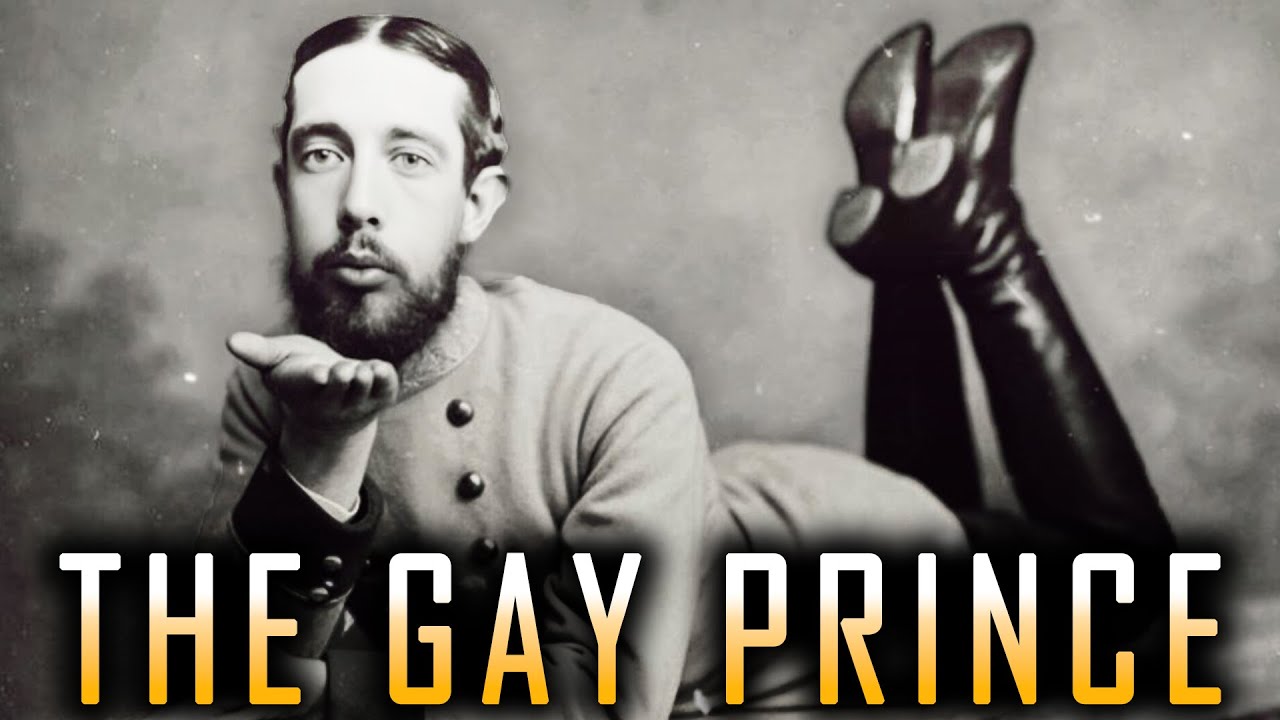
Inside, he hosted dazzling dinners, masquerade balls, and musical evenings that drew the cream of Viennese high society. Even the emperor and Empress Elisabeth occasionally attended. Ludwig collected art obsessively, and his opinion could make or break reputations in the salons of Vienna. He also developed a fascination with photography, posing for portraits that raised eyebrows.
In one famous image, he appeared dressed as a woman, bouquet in hand and a playful smirk on his face. The photograph only fueled the growing rumors about his private life. Ludwig Viktor was known to be attracted to men, in an age when such a thing was forbidden by both law and religion. Within the Habsburg court, everyone knew it, and no one said it.
His family treated it with nervous humor. The emperor is said to have joked that Ludwig should be assigned a ballerina as his adjutant so nothing scandalous could happen. The childhood nickname Luzy-Woozy took on a sharper edge, a way to diminish him and turn his flamboyance into mockery. But Ludwig refused to hide.
He strolled through Vienna in elegant English suits, frequented the opera and the cafés, and surrounded himself with beautiful young men. His sharp tongue and disregard for protocol were creating enemies. His wit was famous throughout Vienna, clever, sharp, and often cruel. For decades, he enjoyed what the court called Narrenfreiheit, the fool’s freedom, and people laughed instead of taking offense.
But as he grew older, the laughter faded. One of those who came to despise him was Empress Elisabeth herself. The two had once been close, but the friendship soured. Ludwig remained deeply attached to his domineering mother, Archduchess Sophie, while Elisabeth grew resentful of her.
Worse, Ludwig began repeating gossip about the Empress, describing her as vain and temperamental. Elisabeth wrote mocking verses about him, describing him as frail, deceitful, and ridiculous, a monkey in a weakly body whose pastime is lies and whose trade is slander. Ludwig’s meddling went beyond words. Rumor had it that he had revealed the affair of Princess Louise of Belgium with the officer Gáza von Mattachich.
When news of the affair reached the emperor, it exploded into scandal, and Louise was declared insane and confined to an asylum. No one could prove Ludwig was responsible, but the suspicion stuck. Even his nephew Archduke Franz Ferdinand, once friendly, grew to despise him. Ludwig openly mocked Franz Ferdinand’s marriage to Countess Sophie Chotek, calling it a misalliance.
By the early 1900s, Ludwig Viktor had alienated nearly everyone at court. Then, in 1904, he fell from grace in the most humiliating way imaginable. According to multiple accounts, he was at the Kaiserbründl, a luxurious bathhouse in the heart of Vienna that was quietly known as a meeting place for men seeking company Vienna refused to acknowledge. He made an advance toward another man who responded by slapping him across the face.
In Vienna, a slap was more than an insult. It was humiliation, and when that humiliation involved the emperor’s brother, it could not be ignored. Within days, the rumor spread through the city. Some claimed the encounter had been staged to bring him down.
Among those suspected of orchestrating the scandal was Franz Ferdinand, who had never forgiven Ludwig for mocking his marriage. His allies made sure the story was repeated in all the right places. Officially, the Austrian newspapers said nothing, but behind palace walls, the message was clear. The emperor could not allow a public scandal to tarnish the dynasty.
A story was invented that Ludwig was leaving Vienna for his health. On February 1, 1904, Archduke Ludwig Viktor departed quietly from the city. No crowds gathered to see him off, no orchestra played. He was condemned to disappear alive but erased.
He settled at Schloss Klessheim, the grand estate just outside Salzburg where he had once spent happy summers. The palace became his gilded prison. He was allowed to maintain a small household, but his circle of visitors was sharply limited. Still, he refused to live like a man defeated.
He dressed impeccably, trading his military uniform for fine English suits and a white hat that became his signature look. Locals in Salzburg often saw him driving through town in a carriage, waving politely as if nothing had changed. He supported local charities, funded the Salzburg Art Association, and became a quiet patron of museums and artists. He received visits from his nieces, the Archduchesses Gisela and Marie Valerie, who adored their uncle.
Their visits were the highlight of his quiet existence. But even in Salzburg, his past cast a long shadow. Letters from Vienna stopped coming, invitations to family events ceased. The emperor, though still fond of him, kept his distance.
Ludwig was tolerated, not forgiven. By 1910, visitors noticed changes. He would lose track of conversations, forget faces, drift between moments of sharp wit and confusion. In 1915, the emperor ordered that he be placed under legal guardianship, and his world shrank even further.
He was moved into a small section of Klessheim, confined to just three rooms. The windows were barred, the doors locked. The man who had once dazzled Vienna now lived like a secret, hidden from view. The war changed everything outside those walls.
The Austro-Hungarian Empire was collapsing under the weight of loss and revolution. Franz Joseph died in 1916, leaving behind a broken dynasty. Ludwig Viktor, the last surviving son of Archduke Franz Karl, outlived his brother by only a few years. In January 1919, two months after the Habsburg monarchy officially ended, Archduke Ludwig Viktor passed away at the age of seventy-six.
There was no royal procession, no grand funeral, no fanfare. He was buried quietly in the cemetery of Siezenheim beside the small parish church near Salzburg. The scandal that had destroyed his name faded into history, while the empire that silenced him vanished entirely.
The man they once called Luzy-Woozy had outlived them all.