The widow of Pablo Escobar, Victoria Eugenia Henao Vallejo, was cleared in 2026 of money-laundering charges in Argentina when a federal judge declared the case against her null and void. The ruling, issued on March 26, 2026, by Judge Marcelo Martínez de Giorgi, came after the court found that prosecutors had improperly gathered a key witness statement in the United States without following international legal cooperation rules. It is not the first time the case has collapsed. The same widow had been arrested, imprisoned, and cleared once before, in 2000 and 2001, after Argentine authorities accused her of laundering drug money and using false documents.
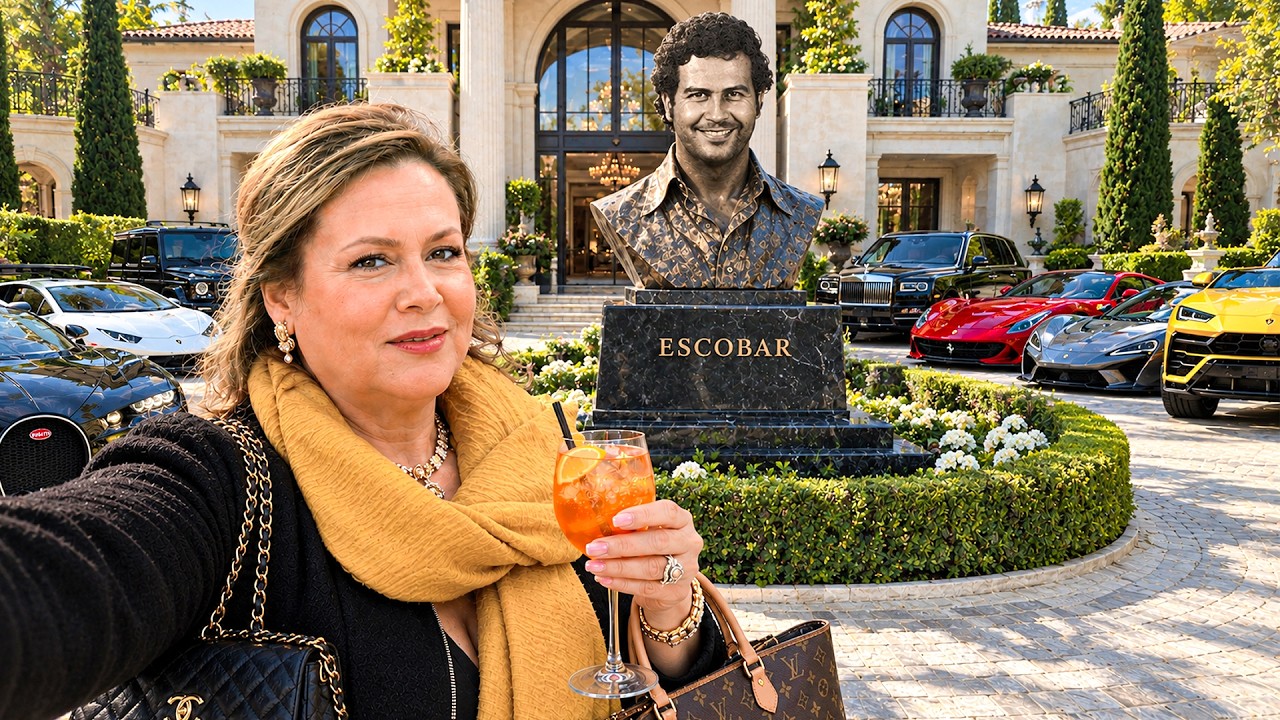
The pattern has repeated across more than 25 years: criminal accusations linked to her late husband’s empire, followed by acquittal or dismissal. Still, many headlines in recent months claimed Henao had inherited $200 million from Escobar’s fortune. There is no public record supporting that. Her own accounts, and those of her son, describe the opposite: assets seized by the state, destroyed during the war, or surrendered to the Cali cartel in exchange for the family’s survival.
The real story involves a woman who met Escobar at 12, married him at 15, and spent her life inside the orbit of the most dangerous drug trafficker in history. Born and raised in Envigado, a working-class town outside Medellín, she crossed paths with Escobar in 1972 when she was a child and he was a 23-year-old small-time criminal. His early offenses reportedly included stealing tombstones, sanding the names off, and reselling them. Her family disapproved deeply.
They saw what he was, but by the time Henao was 15, she had run off with the 26-year-old Escobar and married him. She has since acknowledged, in interviews, the power imbalance that defined the relationship. She described being raised in a culture where women were expected to follow their husbands without question, and she has spoken publicly about an abortion she underwent at 14, saying she felt violated by the man who would become her husband. By the late 1970s, Escobar had moved from petty crime into cocaine, building smuggling routes through the Bahamas to Miami.
The money arrived so fast that the family’s circumstances changed beyond recognition. They lived on Hacienda Nápoles, the estate with its own airstrip, private zoo, and the hippos that still roam Colombia today. In Medellín, they occupied the Monaco building, a luxury apartment tower that was targeted by a car bomb in 1988, in an attack widely attributed to the Cali cartel. The wealth came with a constant price.
During the late 1980s and early 1990s, Escobar went to war with the Colombian state, fighting to avoid extradition to the United States. His stated preference was to be buried in Colombia rather than locked up in America. The conflict saw judges murdered, journalists killed, a presidential candidate assassinated, bombs placed in shopping centers, and hundreds of police officers slain. Meanwhile, Henao raised two children while moving between safe houses, living with raids on doors and the persistent fear that someone might come for her children to get at her husband.
In 1991, Escobar turned himself in under an agreement that kept him in Colombia. He built his own luxury prison, La Catedral, complete with a soccer field, a bar, and a jacuzzi, and he continued running his empire from it. When the government tried to move him to a regular prison in 1992, he escaped and vanished. The final chapter unfolded quickly.
A dedicated police unit, the Search Bloc, pursued him with U. S. backing, while a shadowy group known as Los Pepes, formed from his enemies, began killing his associates and burning his properties. In November 1993, Escobar tried to move his family abroad.
Henao, their son Juan Pablo, and daughter Manuela flew to Frankfurt, Germany, where they were sent back. They were placed in a hotel in Bogotá under state protection, a measure that also served as a means of watching them. Escobar kept calling, speaking repeatedly to his son, and each call gave the Search Bloc another chance to trace him. On December 2, 1993, one day after his 44th birthday, Escobar was on the phone with Juan Pablo when the call ran too long.
Police triangulated the signal to a house in a middle-class Medellín neighborhood and stormed it. Escobar attempted to escape across the rooftops and was killed. That was the beginning, not the end, of Henao’s ordeal. At 32, with a 16-year-old son and a 9-year-old daughter, she was summoned to a meeting with Helmer “Pacho” Herrera, one of the most feared figures in the Cali cartel.
The subject was Escobar’s assets. In the cartel’s view, Escobar owed them for years of war and lost members, and with him dead, the bill fell to his widow. The family has said they surrendered a large portion of what Escobar left behind, properties, assets, and cash, to buy their lives. The Rodríguez Orejuela brothers, leaders of the Cali cartel, also imposed a condition on Juan Pablo: live a life without violence, without revenge, and without taking over his father’s business.
A 16-year-old boy was effectively forced to sign a peace treaty with a cartel to survive. The family still had to leave Colombia, but no country would take them. Spain refused. Germany had already refused.
In total, 17 countries turned them away. The only place that accepted them was Mozambique, a nation in southeastern Africa emerging from a brutal civil war. Henao described the experience as a horror, with poor living conditions, no real schooling for her children, and no future. Eventually, her son told her flatly that either they left the place or he would kill himself.
With help from Colombia’s attorney general, Gustavo de Greiff, the family received entirely new legal identities and flew to Buenos Aires. Victoria Eugenia Henao Vallejo ceased to exist. She became María Isabel Santos Caballero. Her son became Juan Sebastián Marroquín Santos.
Her daughter became Manuela. For the first time in years, they were anonymous. That anonymity did not last. An accountant who discovered the family’s identity began extorting her, threatening to expose who she was.
The extortion lasted 11 months. Eventually, she walked into a judge’s office and told the truth: she was Pablo Escobar’s widow and she was being blackmailed. The result was immediate public exposure. In November 1999, Argentine police arrested her and her son in their apartment in the Nuñez neighborhood on charges of money laundering, criminal association, and falsifying documents.
The irony was stark. She had gone to the justice system for help and left in handcuffs. She spent about 18 months behind bars before being released for lack of evidence. In 2005, a federal court cleared her and her son of the laundering and criminal association charges, and the following year the country’s top criminal appeals court confirmed the decision.
More than a decade later, the case resurfaced. In 2016, the DEA’s representative in Argentina sent a note to Argentine prosecutors referencing an organization being investigated in Colombia for drug trafficking and money laundering with connections to companies in Argentina. That tip led to a Colombian man named José Bayron Piedrahíta Ceballos, described by prosecutors as a major trafficker with ties to the Cali cartel and the criminal network in Envigado. They alleged that he had injected drug money into the Argentine economy through real estate projects, including a luxury gated community and even a famous tango café in Buenos Aires called Café de los Angelitos.
The prosecutors alleged that María Isabel Santos Caballero and her son Sebastián Marroquín introduced Piedrahíta to a developer who needed investors. In return, they allegedly received a commission of about 4. 5 percent of the money invested, roughly $100,000. In 2018, federal judge Néstor Barral formally charged the widow and her son, along with former Colombian soccer player Mauricio “Chicho” Serna.
The judge wrote that the widow and her son had made an “essential contribution” to the trafficker’s criminal goals. One detail struck observers as nearly impossible to invent: according to Piedrahíta’s own statement, Pablo Escobar had killed or ordered the killing of Piedrahíta’s brothers. The widow and her son reportedly had no idea. If the case was accurate, they had allegedly done business with a man whose family had been destroyed by Escobar.
Piedrahíta ultimately ended up in a prison cell in Florida and became a cooperating defendant, giving a statement to Argentine prosecutors who traveled to the United States to take it. That testimony became the foundation of the entire case against the widow. In 2020, the case was sent to trial. Henao, now in her late 50s, faced the possibility of returning to prison for an offense tied once again to her husband’s world.
The case sat unresolved for years until March 2026, when Judge Martínez de Giorgi ruled it null and void. His reasoning centered on the way Piedrahíta’s statement had been taken in the United States. The judge found that prosecutors had lacked the proper authority to take that kind of testimony abroad, and since the case rested on that evidence, the entire structure collapsed under the concept of “fruit of the poisonous tree. ”
The acquittal drew immediate opposition.
In April 2026, prosecutors appealed, arguing that the judge had ignored financial evidence and applied the wrong standard. The fight may not be over, but for now, the widow and her son have walked away. That brings the question of the $200 million back into focus. No public record shows that Victoria Eugenia Henao inherited that sum.
The family’s consistent account, repeated by both the widow and her son, is that most of Escobar’s wealth was seized, destroyed, or surrendered to the Cali cartel to keep them alive. The only time her name was linked to millions of dollars in recent years was inside a money-laundering accusation that has now been thrown out. Henao, now in her 60s, still lives in Argentina and still uses her identity as María Isabel Santos Caballero. In court papers, she described herself as an organizational coach and a writer.
She has spent years working with psychologists to process the marriage, the war, the exile, and the prison cells. She now speaks to other women about her experiences and calls herself a specialist in ontological coaching. After 25 years of silence, she published a memoir. In English, it is called “Mrs.
Escobar: My Life with Pablo. ” In Spanish, the title translates to “My Life and My Prison with Pablo Escobar. ” The framing is deliberate: she describes the marriage not as a love story, but as a prison. She took the book on international tour, including signings in Budapest, Hungary.
In 2023, she gave a major radio interview in Colombia and apologized, asking for forgiveness for decisions she made when she was young. She also insisted she was never an accomplice in her husband’s business and said she confronted Escobar repeatedly about what he was doing. She has publicly pushed back against claims made by Virginia Vallejo, the television journalist who had an affair with Escobar, about why the family changed their names, saying the name change was simply the only way out of Colombia when no country would take them. Not everyone accepts her account.
A critic in the London Review of Books argued that her memoir revealed little new information about Escobar and appeared written primarily to settle scores and clean up her own name. Whatever one believes, the scope of what she survived is undeniable. Her son, Juan Sebastián Marroquín, never picked up a gun. He became an architect, designer, author, and public speaker who travels the world warning about the consequences of drug trafficking.
He has said he has been in contact with at least 150 families of victims of his father’s violence and has written several books, including “Pablo Escobar: My Father. ”
Her daughter, Manuela, chose the opposite path. She maintains total silence, with no social media, no interviews, and no public life. She was nine when her father died and reportedly struggled with depression for years.
When her mother and brother were arrested in 1999, she had to leave her regular school and be taught at home. Her brother has said that even though she does not have their father’s fortune, she is richer now than she ever was, because she finally has peace. The observation carries weight. Escobar controlled more money than almost anyone on Earth, with houses, planes, and warehouses of cash, and it bought his family a dead father on a rooftop, a widow held hostage by his enemies, 17 countries closing their doors, a son threatening suicide in a foreign land, and two criminal cases that followed her for more than a quarter of a century.
The fortune did not protect the family. The fortune was the curse. Victoria Eugenia Henao did not inherit $200 million.
What she inherited was the Escobar name, and she has spent the last three decades trying to give it back.