When King Henry III of England died in 1272, he left behind a dynasty that had survived rebellion and near civil war. But his most enduring legacy was not the throne he held for 56 years—it was the five children who carried the Plantagenet bloodline across medieval Europe. From the warrior heir who conquered Wales to a daughter whose marriage briefly promised to unite England and Scotland, their lives shaped kingdoms for centuries. Henry III ruled from 1216 to 1272, known for his piety, his architectural ambitions at Westminster Abbey, and his struggles with rebellious barons.
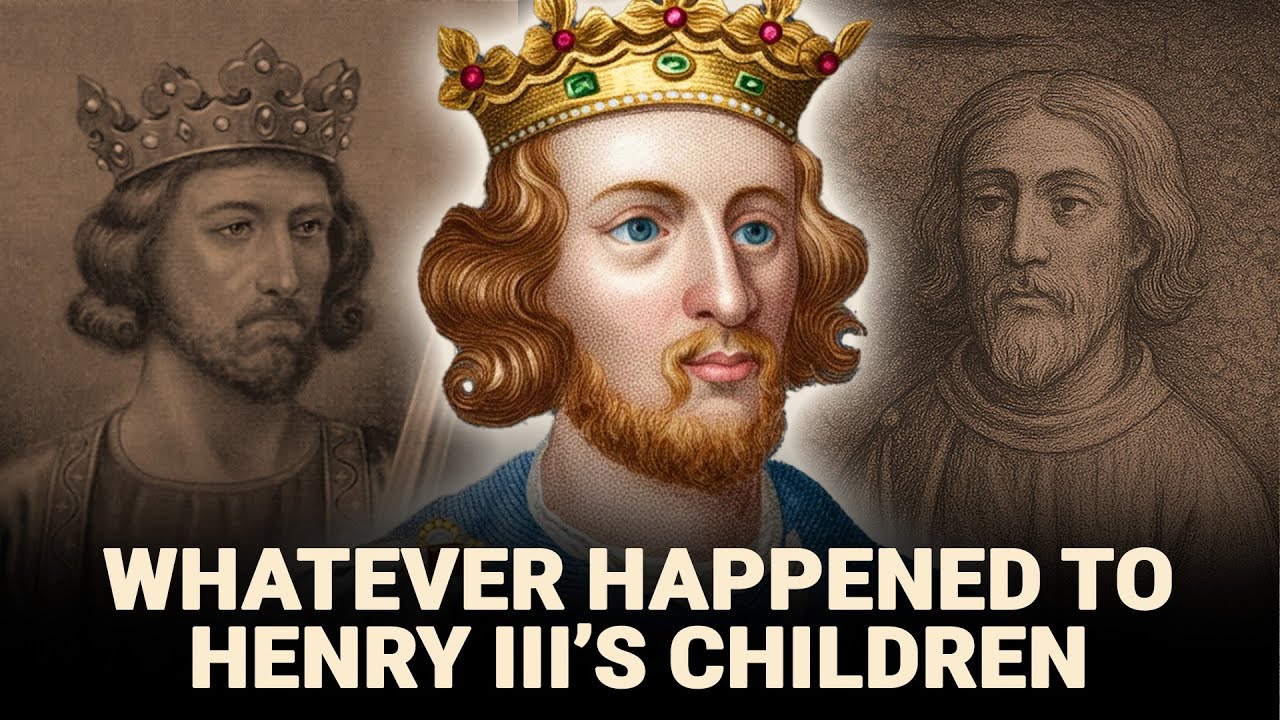
His marriage to Eleanor of Provence in 1236 produced five children who grew up amid the turbulence of the Barons’ War, when Simon de Montfort and other nobles challenged royal authority and even captured the king. Yet the children emerged as instruments of a sophisticated diplomatic strategy that would extend English influence far beyond the island kingdom. The eldest, Edward, was born at Westminster Palace on June 17, 1239. Groomed for kingship from birth, his real education came through the harsh realities of political conflict.
In 1258, the Barons’ War erupted, and at the Battle of Lewes in 1264, Edward’s impetuous cavalry charge left the main royal army exposed. Both he and his father were captured and spent over a year in the custody of Simon de Montfort. The captivity transformed him, teaching patience and strategic thinking. After his escape in 1265, he led the royalist forces to victory at the Battle of Evesham, where de Montfort was killed.
In 1270, Edward embarked on the Ninth Crusade to the Holy Land. Though militarily unsuccessful, it established his reputation in European politics. Word of his father’s death reached him in Sicily in 1272, yet remarkably there was no succession crisis—his claim was universally accepted, and he took two years to return for his coronation. Edward I’s reign transformed England from a struggling kingdom into the dominant power in the British Isles.
Between 1277 and 1283, he systematically conquered Wales, building an iron ring of castles at Conway, Caernarfon, and Harlech that permanently incorporated the country into the English kingdom. The Statute of Rhuddlan in 1284 formally annexed Wales, creating new shires and extending English law. Scotland proved more challenging. When the succession crisis erupted in 1290 following the death of the child queen Margaret, his own great-niece, Edward positioned himself as overlord.
His initial success in installing John Balliol as a puppet king ultimately backfired, leading to the Wars of Scottish Independence. Edward reformed English law and administration with the same systematic approach he applied to conquest. The Statutes of Westminster codified legal procedures, while his expulsion of the Jews in 1290 reflected both religious prejudice and fiscal desperation. He died in 1307 while campaigning in Scotland, leaving a transformed kingdom with the most sophisticated administrative machinery in medieval Europe.
His descendants carried the Plantagenet claim through the houses of Lancaster and York, fueling the Wars of the Roses, and eventually through the Tudor dynasty to the modern Windsor line. Every British monarch since 1272 traces their ancestry back to him. Henry III’s eldest daughter, Margaret, was born at Windsor Castle in September 1240. As a royal daughter, she was groomed as a diplomatic instrument.
On December 26, 1251, the 11-year-old Margaret married 10-year-old Alexander III of Scotland at York Minster in one of the most magnificent royal celebrations of the 13th century. The marriage represented Henry III’s diplomatic masterpiece—achieving through kinship what English armies had failed to accomplish through conquest. When Margaret took up residence in Scotland around 1260, she adapted well to a kingdom very different from her father’s England. By contemporary accounts, her marriage was genuinely affectionate, a fortunate outcome in an age when royal marriages were purely political arrangements.
She gave birth to three children: Margaret in 1261, Alexander in 1264, and David in 1272. She also served as a crucial communication channel between the English and Scottish courts. Tragedy struck in the 1280s when both her sons died, followed by Alexander III himself in 1286. Margaret had died in 1275, spared witnessing the collapse of everything her marriage had been designed to achieve.
Her granddaughter, the Maid of Norway, was just six years old when she inherited the Scottish throne. An arrangement for the child queen to marry Edward of Caernarfon, later Edward II, would have united England and Scotland under a single crown. But she died in 1290 during her voyage from Norway to Scotland, ending the direct line from Margaret’s marriage. That crisis precipitated the succession dispute that led Edward I to claim overlordship and ultimately to the wars of Scottish independence—the military conflict her marriage had been designed to prevent.
Beatrice was born in Bordeaux in June 1242, during one of her father’s expeditions to secure his French territories. Her birth in Gascony symbolized the continental connections that would define her life. In 1260, the 18-year-old Beatrice married John II, Duke of Brittany, in a ceremony celebrating the alliance between England and one of France’s most strategically important duchies. Brittany controlled crucial ports and commanded significant military resources, making it a valuable ally for English interests in France.
As Duchess of Brittany, Beatrice adapted successfully to Breton culture while maintaining her English connections, serving as an effective diplomatic bridge. She and John II had six children, including their son Arthur II, who would become Duke of Brittany. Through this line, her bloodline reached the pinnacle of European power with Anne of Brittany, who became Queen of France through marriages to Charles VIII and Louis XII. Through Anne, Beatrice’s bloodline entered the French royal family directly, carried by later Bourbon kings who ruled France until the Revolution.
Beatrice died in 1275, the same year as her sister Margaret. The Breton alliance she embodied proved valuable during the subsequent Anglo-French wars, with Breton ports providing crucial support for English military operations. The cultural exchange she initiated enriched both English and Breton civilization, and her marriage became a model for later English diplomacy—royal daughters achieving through statecraft what armies often could not accomplish through conquest. Edmund, nicknamed Crouchback, was born at Westminster Palace on January 16, 1245, the second surviving son.
The nickname’s origin remains disputed—some suggest it referred to a physical deformity, while others argue it derived from “cross-back,” indicating his participation in crusading activities. As second son, he was destined for a supporting role, but Henry III understood the importance of providing adequately for younger sons, determined to ensure Edmund’s loyalty through generous endowments. In 1267, Edmund received the Earldom of Leicester, deliberately granted as a symbol of the complete defeat of Simon de Montfort’s rebellion. His promotion to Earl of Lancaster the same year provided vast estates across northern England, making him one of the wealthiest nobles in the kingdom.
His participation in the crusade to the Holy Land from 1270 to 1272 established his reputation as a serious military commander. Edmund’s marriage to Blanche of Artois in 1276 was one of the most significant diplomatic achievements of Edward I’s early reign. The widow of Henry I of Navarre, Blanche brought both wealth and strategic connections. Through her, Edmund gained claims to territory in France and connections to the highest levels of continental nobility, transforming him from an English earl into a European magnate.
Edmund’s political style differed markedly from his brother’s. Where Edward relied on force, Edmund preferred negotiation and compromise, making him valuable as a diplomatic intermediary. He served as Edward’s representative in negotiations with French and papal authorities and acted as guardian of the realm during Edward’s absences. His descendants established one of the most important noble dynasties in English history.
His grandson Henry of Grosmont became one of the most powerful nobles of the 14th century. Through Henry’s daughter Blanche, the Lancastrian inheritance passed to John of Gaunt, third son of Edward III. This merger of Lancastrian wealth with royal blood created the power base that enabled Henry Bolingbroke to seize the throne as Henry IV. Edmund’s descendants ruled England as the Lancastrian kings from 1399 to 1461, and the claim they established provided the legal foundation for one side in the Wars of the Roses.
Katherine was born at Westminster Palace in the summer of 1253, the youngest child. Her birth completed Henry III’s family after 13 years of marriage, and at 56, Henry was an elderly father by medieval standards. The king’s joy at her birth was recorded by contemporary chroniclers. But her life was tragically brief.
Royal records provide few details about her childhood, suggesting she may have been sickly from birth. Contemporary sources mention only that she was weak and never thrived. Katherine died on May 3, 1257, just short of her fourth birthday. Henry III ordered elaborate funeral arrangements, and she was buried in Westminster Abbey, positioned near the high altar.
The monument Henry commissioned was unusually elaborate for such a young child, featuring carved angels and religious imagery. The inscription composed by Henry himself revealed the depth of his grief. Contemporary accounts describe the king visiting her tomb regularly, particularly on the anniversary of her death—a public display of grief unusual for medieval kings. Eleanor of Provence was later buried nearby, creating a Plantagenet family mausoleum centered around Katherine’s resting place.
Though Katherine lived only four years, her memory influenced Henry’s later years. She symbolized the fragility of medieval childhood, reminding observers that royal power offered no protection against life’s fundamental uncertainties. Her death deepened the king’s religious devotion and commitment to building lasting monuments. The tomb where she rests continues to attract visitors nearly eight centuries after her death.
The children of Henry III carried the Plantagenet bloodline far beyond England’s shores, each fulfilling a different aspect of their father’s royal vision. Edward transformed his inheritance into an empire. Margaret carried English royal blood to Scotland, and through the Stuart dynasty it eventually returned to the English throne. Beatrice established English influence in Brittany that endured through the Hundred Years War and beyond.
Edmund founded the House of Lancaster, whose wealth and power eventually challenged the crown itself. Even Katherine, who lived only four years, left her mark through the grief and devotion she inspired. Henry III, often dismissed by historians as weak or ineffective, achieved through his children what many more aggressive rulers could not accomplish through force alone. The diplomatic investments he made in his children’s futures paid dividends for generations, demonstrating the enduring value of patient, careful statecraft over immediate military solutions.
Through their marriages, alliances, and descendants, his children shaped the Wars of the Roses, the Hundred Years War, and the Union of England and Scotland. The Plantagenet dynasty that began with Henry II continued through his descendants for over three centuries, and the bloodlines established through Henry’s careful marriage diplomacy continue today in the British royal family.