To most Americans, Richard Nixon remains the haunted face on television in August 1974, the president who resigned in disgrace after Watergate. But behind that public collapse stood a much smaller world: a family of four, with two daughters who lived their formative years inside a home that was both a sanctuary and the epicenter of a constitutional crisis. Richard and Pat Nixon married in 1940 and after years of struggle had two daughters. Patricia, known as Trisha, was born in 1946, and Julie in 1948.
By the time the girls were in grade school, their father had already served as a congressman, a senator, and vice president of the United States. Their childhood unfolded in the crossfire between their parents’ fierce privacy and their father’s relentless drive for political redemption. While other children learned family stories at the dinner table, Trisha and Julie learned theirs from campaign buses, motorcades, and foreign trips. They grew up in a house where television news sometimes spoke their father’s name with admiration and sometimes with contempt, and where their mother tried to build normal routines while the world judged every expression on her face.
When Nixon reached the presidency in 1969, his daughters were no longer children. One was newly married into the Eisenhower dynasty, and the other was approaching a White House wedding that would become a televised symbol of the normal American family Nixon wanted the country to see. Then Watergate arrived. For the nation it was a political scandal; for the Nixon daughters it was siege warfare inside their own lives.
They watched enemies close in, allies peel away, and their mother absorb humiliation with clenched dignity. One daughter stepped forward as her father’s most visible defender, facing cameras and hostile questions with composure beyond her years. The other retreated further into the protective privacy her parents had always maintained. Trisha Nixon Cox, the elder daughter, was born in 1946 into a life already shaped by ambition, discipline, and quiet tension.
From her earliest years she learned to live behind walls, both the emotional ones her parents built and the literal ones of political life. While Julie was more outspoken and instinctively public-minded, Trisha moved through the world with a practiced reserve that became her shield. As a child she lived through campaign after campaign, learning to smile for cameras, stand still beside her mother at rallies, and read the unspoken moods of her father as he returned from political combat. Her teenage years were spent navigating the surreal rhythms of state dinners, foreign trips, and daily proximity to power, combined with a constant sense of being watched and measured.
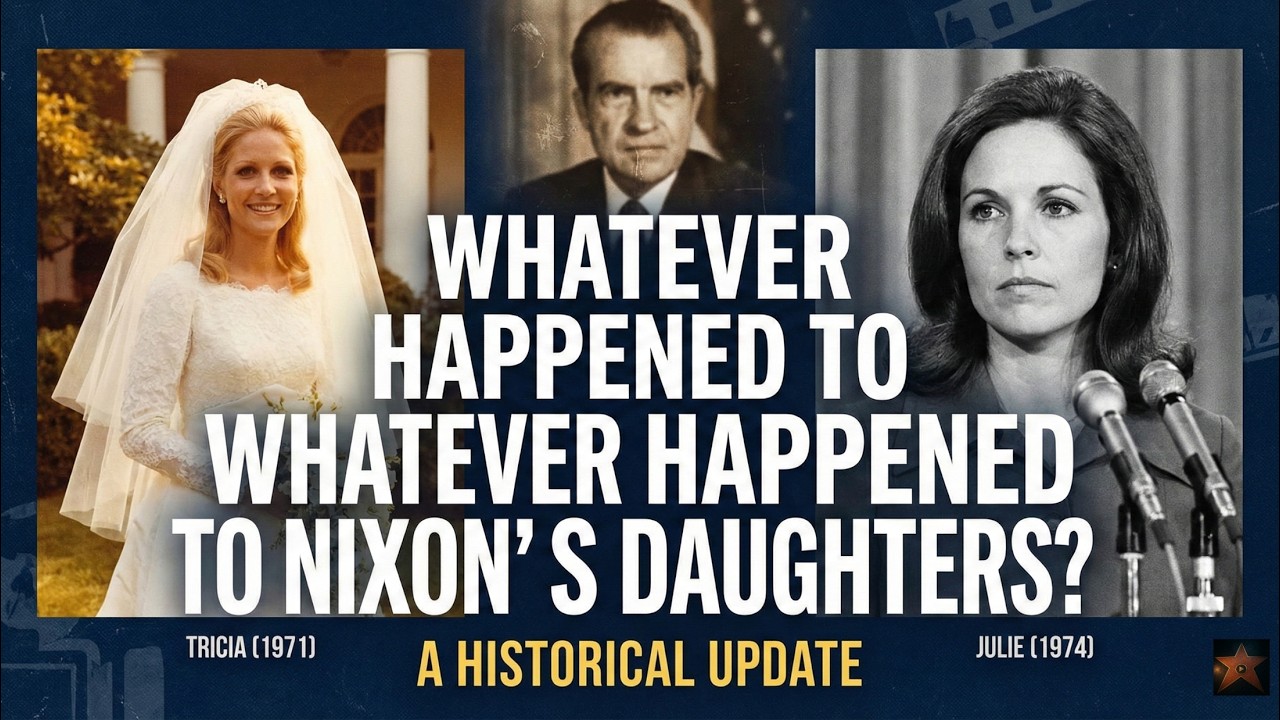
The turning point of her life arrived in 1971, when she became the first presidential daughter to be married in the White House Rose Garden. The event was broadcast to millions, a moment engineered to project stability and tradition at a time when America was divided over Vietnam and social change. Her marriage to Edward Cox became one of the most iconic images of the Nixon years. Yet behind the glamour, Trisha remained the most private member of the family, enduring public spectacle with polite distance but refusing to become part of the political theater.
During Watergate, while her younger sister spoke out passionately, Trisha’s reaction was more inward. She stayed close to her mother, helping Pat Nixon face the humiliation that consumed the final years of the presidency. She watched her father deteriorate under pressure as the West Wing darkened with fear and paranoia. When Nixon resigned in August 1974, Trisha stood with her family on the South Lawn, her expression a mixture of heartbreak and unwavering loyalty.
In the decades that followed, she intentionally retreated from public life. She raised her son Christopher, supported charitable and educational causes, and avoided the spotlight except on rare occasions tied to her father’s memory. Her silence became its own statement, a refusal to let her family’s wounds become public spectacle. Her legacy is one of restraint, quiet endurance, and the chosen privacy of a woman who had already endured more scrutiny than anyone should bear.
Julie Nixon Eisenhower was born in 1948, the younger daughter and the child who would become the most vocal and devoted defender of her father during the darkest years of his presidency. If Trisha represented reserve, Julie represented resolve. From a young age she had an instinct for engagement, sharpened curiosity, and the confidence that placed her naturally in the center of events. She grew up attuned to the emotional undercurrents of her family, sensing her father’s insecurities as deeply as his ambitions.
She watched his political exile after losing the 1960 presidential race and the 1962 California governorship, and felt the shift in her home when he rose again to claim the White House in 1968. While Trisha kept a formal distance from politics, Julie stepped into it, learning campaign mechanics and press relations with the same determination her father brought to debate preparation. Her marriage in 1968 to David Eisenhower, grandson of President Dwight D. Eisenhower, merged two of the most significant political families of the 20th century.
The union was symbolic, historic, and deeply scrutinized. Beyond the symbolism, Julie embraced her role with maturity far beyond her years, becoming a poised public figure at a moment when the Nixon administration desperately needed stability. Her defining chapter came when Watergate exploded. As the scandal engulfed the presidency, Julie became her father’s staunchest public defender.
She appeared frequently on national television, confronted skeptical reporters, and articulated arguments that presidents and senior advisers struggled to express. She spoke not as a political operative but as a daughter convinced of her father’s fundamental decency. During the agonizing months before resignation, she served as an intermediary between her parents, helped shield her mother from the cruelty of headlines, and encouraged her father when his confidence faltered. When Nixon resigned in 1974, Julie’s devastation was visible, but so was her resolve.
In the years after, she became an unofficial historian of her father’s life, co-authoring books, granting interviews, and working to present a fuller picture of the man behind the scandal. She balanced loyalty with intellect, acknowledging her father’s failings without allowing them to erase his accomplishments or humanity. Her steady presence at the Nixon Library and at national commemorations made her the enduring voice of the Nixon legacy. Together, the Nixon daughters reveal the private cost of public downfall.
They show how a presidency’s collapse reverberates through a household, how children absorb the emotional shock history books overlook, and how the burden of legacy can shape a lifetime. Their lives demonstrate that political tragedy is never just political; it is familial and personal. Through them, the Nixon story becomes not merely political history but a deeply human saga of loyalty under pressure. Trisha chose preservation over performance, and Julie refused to let her father’s worst chapter define his entire life.
Even in the rubble of scandal, their endurance restores humanity to a man often remembered only for his worst hour.