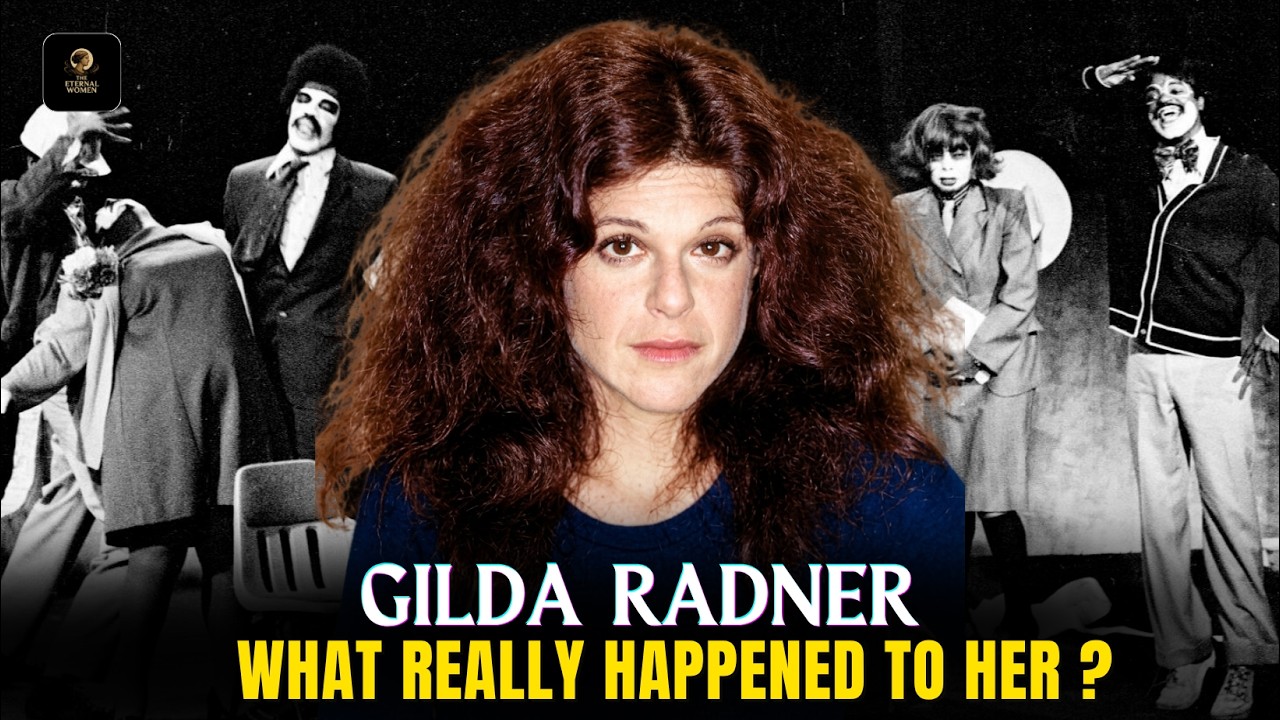
Gilda Radner, one of the original stars of “Saturday Night Live,” died on May 20, 1989, at Cedars-Sinai Medical Center in Los Angeles. She was 42 years old. Her husband, Gene Wilder, was at her side and later described her face as peaceful in a way he had not seen in years. The Emmy-winning comedian had spent nearly ten months visiting doctors with symptoms that were repeatedly dismissed as stress, anxiety, and the ordinary complaints of a woman who needed rest.
By the time the correct tests were finally run in October 1986, she was diagnosed with Stage IV ovarian cancer that had already spread to her liver and lungs. Radner was born Gilda Susan Radner on June 28, 1946, in Detroit, Michigan. Her father, Herman Radner, ran the Hotel Tuller, one of the city’s finest hotels, and was the defining influence in her life. He took her to Broadway shows in New York and encouraged her creative instincts from an early age.
His favorite expression, a shrug of philosophical humor in the face of difficulty, was “always something. ” She carried that phrase with her for the rest of her life and eventually used it as the title of her memoir. When Radner was 14, her father was diagnosed with a brain tumor. He died when she was 15.
The loss was devastating, and she spoke about it for the rest of her life with an honesty suggesting she never fully healed. She turned to food for comfort and developed an eating disorder she struggled with for years, a detail that would take on deeper significance when she later tried to report physical symptoms to doctors. She attended the University of Michigan, planning to become a teacher for children with developmental disabilities. That ambition reflected a core part of her character, a genuine pull toward people in need.
But theater found her there, and she left one semester short of graduation to join the Second City comedy troupe in Toronto. In that creative environment alongside Dan Aykroyd, John Belushi, and Bill Murray, she found her voice as a performer. When Lorne Michaels launched “Saturday Night Live” on NBC in 1975, Radner was 29 years old and part of the original cast. She quickly became the heart of the show.
Her characters became cultural landmarks: Roseanne Roseannadanna, the brash commentator built on her father’s phrase; Emily Litella, the elderly woman who argued passionately about misunderstood topics before being gently corrected; and Lisa Loopner, the studious teenager. In 1978, she won an Emmy for Outstanding Continuing or Single Performance by a Supporting Actress in Variety or Music. In 1979, Radner brought her characters to Broadway in her one-woman show “Gilda Radner: Live from New York” at the Winter Garden Theatre. She left “Saturday Night Live” after the fifth season in 1980.
She met Gene Wilder on the set of the film “Hanky Panky” in 1982. He later wrote that approaching her felt like meeting an old friend. They married on September 18, 1984, in a small private ceremony in southern France and built a life together in Connecticut. In the years before her cancer diagnosis, Radner and Wilder were trying to have children.
Fertility treatments were unsuccessful, and the hormonal interventions produced physical symptoms including bloating, fatigue, and pelvic discomfort, symptoms that closely resembled what she would later report as the cancer developed. This overlap made it easier for some doctors to close the case without further investigation. In early 1986, Radner began experiencing symptoms. She reported fatigue that did not respond to rest, pelvic pain, and abdominal bloating.
She went to multiple doctors and described her symptoms with the precision of someone who paid close attention to her body. She was repeatedly told nothing was seriously wrong. She was told it was stress. She was told it was anxiety.
At least one doctor diagnosed her with irritable bowel syndrome. Her history of fertility treatment provided a convenient alternative explanation. She did not receive a CA125 blood test, a screening tool for ovarian cancer markers. She did not receive a transvaginal ultrasound.
The tests that could have revealed what was growing inside her were not ordered. For approximately ten months, the cancer that would kill her was allowed to advance unchecked. On October 21, 1986, after about ten months of undiagnosed symptoms, Radner finally received the correct tests. The diagnosis was Stage IV ovarian cancer.
It had already spread to her liver and lungs. A disease that was likely treatable, and possibly curable, when her symptoms first appeared had progressed to its most advanced and resistant stage. Radner faced the diagnosis with courage and humor. She began treatment immediately, undergoing surgery followed by intensive chemotherapy.
She lost her hair and experienced severe side effects. She found her way to the Wellness Community in Santa Monica, California, a cancer support group that provided emotional and social support alongside medical treatment. She credited the group with giving her something the medical establishment had not consistently provided, the feeling of being heard by people who understood her experience. She spoke publicly about her cancer at a time when ovarian cancer was barely discussed in public culture.
She called herself, with self-aware humor, “the hidden cancer woman. ” In early 1988, the cancer appeared to go into remission. She began writing her memoir during this period and held a vision for cancer support groups to be available everywhere for anyone who needed them. She said there should be a thousand of them.
The cancer returned. It was not defeated but had merely rested briefly before returning more advanced and more resistant. She recorded the audiobook version of “It’s Always Something” about a month before her death. She knew she was dying as she sat in that studio.
The recording won a posthumous Grammy in 1990. Radner died at 6:20 a. m. on May 20, 1989.
The public grief was genuine, and her characters were mourned alongside her as if they had been real people who also passed away. Wilder’s grief was different. It was the grief of a man who believed, based on everything he knew about what had happened, that the outcome could have been different. If the diagnosis had come earlier, if her symptoms had been taken seriously from the start instead of dismissed for ten months, she might still be alive.
He turned that belief into action. He founded the Gilda Radner Genetic Cancer Program at Cedars-Sinai Medical Center, a research program dedicated to women’s cancers and hereditary ovarian cancer. He testified before Congress about his experiences and the medical failures that cost Radner her life. He pushed legislators to allocate federal funding for ovarian cancer research.
He co-authored the book “Gilda’s Disease” in 1998 with oncologist Dr. Stephen Piver, designed to educate women about ovarian cancer symptoms and the importance of early detection. When Wilder was diagnosed with non-Hodgkin’s lymphoma in 1999, he chose not to announce it. He did not want his illness to overshadow Radner’s cause or shift public discussion away from ovarian cancer awareness.
He died on August 29, 2016, at age 83. His family later revealed he had Alzheimer’s disease in his final three years and had kept it private out of concern for others. He loved Radner for the rest of his life and said so clearly and without shame until the end. The medical details of what happened to Radner deserve attention.
The documented timeline is clear: about ten months of reported symptoms, ten months of seeking medical care, ten months without a correct diagnosis, and progression of disease from an early treatable stage to one of its most advanced forms. Ovarian cancer symptoms, especially in early stages, are nonspecific. Bloating, pelvic or abdominal pain, feeling full quickly, urinary urgency, and fatigue each have dozens of common explanations. The diagnostic challenge is real and should be honestly acknowledged.
But it does not fully explain what happened to Radner, because her symptoms were consistently attributed to psychological causes without adequate testing for physiological causes. This pattern has been confirmed by research repeatedly. Women experiencing pain and fatigue are statistically more likely than men with similar symptoms to have those symptoms attributed to stress, anxiety, or emotional distress, and are less likely to receive the necessary tests to rule out serious physiological disease. A 2021 study published in the Journal of Women’s Health found that women with chronic pain conditions were still significantly more likely than men to have their pain dismissed or undertreated.
What has improved tangibly and meaningfully in part as a direct result of the advocacy following Radner’s death is awareness and research infrastructure around ovarian cancer. The Gilda Radner Familial Ovarian Cancer Registry at Roswell Park Cancer Institute has recorded more than 7,000 families and contributed to identifying genetic risk factors that allow women with family histories of ovarian or breast cancer to be screened and followed more carefully. The five-year survival rate for Stage I ovarian cancer now exceeds 90 percent. The difference between that figure and the under-30 percent survival rate for Stage IV is not primarily biological but about the timing of detection.
Those who knew Radner consistently described extraordinary personal warmth. She remembered things about people. She followed up. She cared about individuals in a way many celebrities simply do not.
She also struggled significantly and privately with things many women of her generation struggled with. The eating disorder that developed after her father’s death was not a passing teenage phase but something she managed throughout her adult life. She wrote about it in her memoir with the same honesty she brought to everything, not to invite pity but because she believed honesty about personal suffering was more useful to others than pretending to overcome it easily. Her relationship with her body was complicated, shaped by grief, cultural pressures on women in public life in the 1970s and 1980s, the experience of unsuccessful fertility treatments, and then the experience of reporting symptoms to doctors who sent her home.
Her persistence in continuing to see doctors, continuing to describe her symptoms, and continuing to insist something was wrong even as the system repeatedly told her nothing serious was happening was itself an act of determination. Many women stop insisting. Radner did not. Her humor was not a shield or a defense mechanism but her primary language, the way she experienced and communicated life.
When diagnosed with Stage IV cancer, she did not give up. She said she did not want to be the victim of a tragedy. She wanted to stay what she was, a comedienne, a clown. If she was going to have it, she said, she would try to discover what might be funny about it.
She titled her memoir after her father’s favorite expression, “It’s Always Something. ” It is a funny phrase, and it is also true. There is something quietly devastating in the fact that the daughter who inherited it from her father used it as the title for a book about dying from a disease that could have been caught in time. The medical landscape for ovarian cancer has improved notably since 1989, through genetic screening for hereditary risk factors, improved treatment protocols, and increased awareness among doctors and the public about symptoms and the importance of taking them seriously.
Research programs and registries bearing Radner’s name have contributed to tangible progress. Women with family histories of ovarian or breast cancer can now undergo screening and follow-up in ways that were not available in 1986. But the progress is not complete. Ovarian cancer remains one of the deadliest women’s cancers, not because it is inherently untreatable but because it is often diagnosed at late stages.
The gap between early-stage and late-stage survival rates is filled by women who reported symptoms and did not receive adequate testing. Women told it was just stress or anxiety. Women sent home with reassurances they had not earned through sufficient testing. Gene Wilder made sure Radner’s story was not just a celebrity death filed away and forgotten.
He insisted systematically and publicly that it was a preventable death and that prevention required change. The tangible things that changed because of her story are not abstract. Wilder spent 27 years insisting on the truth that it did not have to happen when it did. He was right.
She was 42 years old and was supposed to live for decades more. The world is smaller without her.