Joan Bennett Kennedy played her assigned part for nearly twenty-five years: the blonde, soft-spoken pianist who looked exactly like the wife the Kennedy operation wanted the public to see. Behind that composed face ran a colder story—three pregnancies lost almost as soon as they began, a drowning that reached her through a bedroom wall, and a disease that unspooled her in public while the nation traded her name as a punchline. What actually happened to Joan ran harder and stranger than the tabloid shorthand, and the strangest part lay in how much of the damage arrived wearing the face of family loyalty. She met him at a gymnasium.
In October 1957, Edward Moore Kennedy, the youngest of the clan and the one everybody underestimated, turned up to dedicate a new gym building at Manhattanville College of the Sacred Heart. A senior named Joan Bennett caught his eye between the speeches and the ribbon. A Bronxville girl raised Catholic and comfortable, she could sit down at a keyboard and silence a room. Music belonged to Joan the way politics belonged to the Kennedys—a first language learned in childhood—and for the rest of her life it stayed the one country where nobody outranked her.
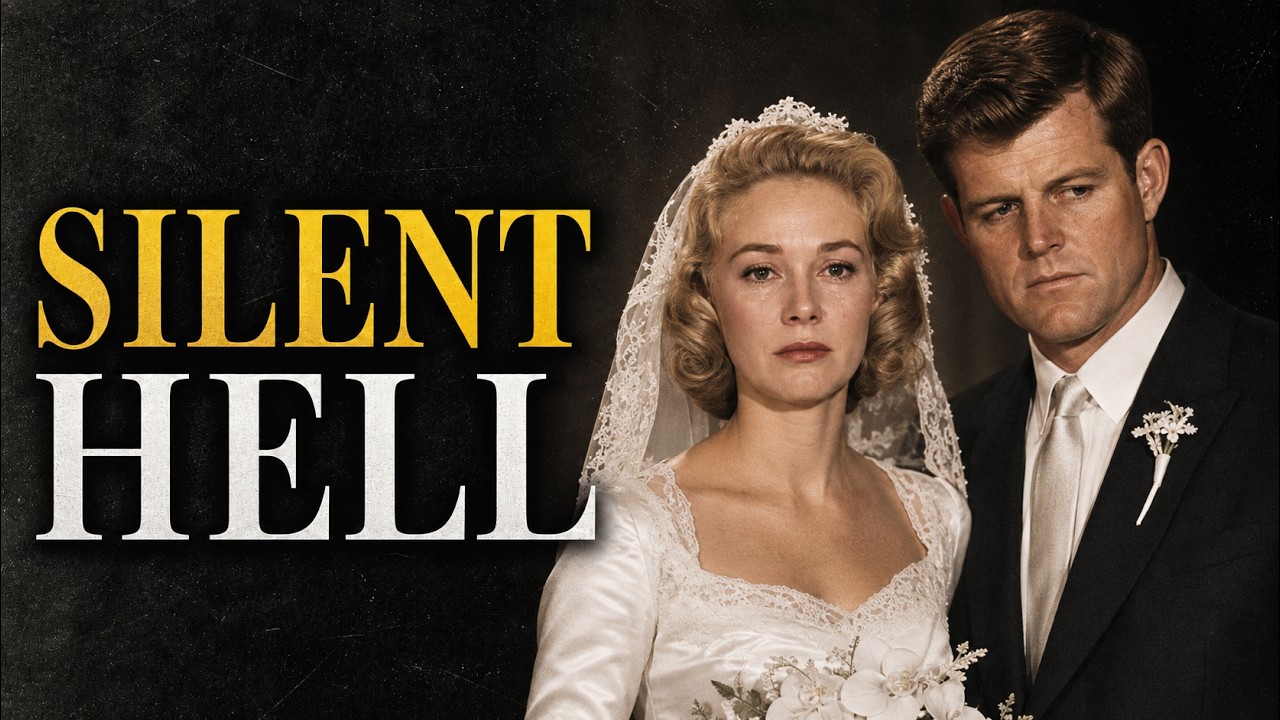
They married on November 29, 1958, inside St. Joseph’s Church in Bronxville. To the guests it looked like a straightforward society wedding between a handsome heir and a lovely young pianist. The photographs came out beautifully.
Some biographers have argued the courtship ran on a schedule set by the family patriarch, Joseph P. Kennedy Sr. , who wanted his sons paired off and respectable before John Kennedy’s 1958 Senate re-election. A pretty wife on Ted’s arm rounded out the family portrait at exactly the right moment for the cameras.
Other historians push back, noting a courtship of roughly a year was ordinary for wealthy Catholic families of the era, and that reading the whole thing as a corporate merger flattens two young people who genuinely liked each other. Both things could sit in the same room. Joan could have loved him and still walked into a marriage whose terms strangers drafted before she ever arrived. She married into a firm, not a husband.
The Kennedys ran on a family logic older than any of the children, engineered by a father who treated public life as a business with heirs, and every marriage inside it functioned as a merger with expectations attached. Joan brought a music degree and a gentle temperament to a household that valued neither. She would spend two decades discovering exactly how little room that household kept for a woman who could not turn grief into a campaign asset. Her first child, Kara, arrived on February 27, 1960.
Weeks after giving birth, Joan pulled herself out of the recovery bed and onto the campaign trail for her brother-in-law’s run at the presidency, shaking hands in church basements while her body still healed. The photographs from that period sold a fantasy of a golden family and a woman born for the flashbulbs. The private version ran a different direction entirely. Joan came into the family from outside its bloodline and outside its temperature, and the Kennedy household ran hot, competitive, and merciless in a way no upbringing prepared her to survive.
She measured herself against Jacqueline, who could disarm a French president in his own language, and against Ethel, who produced children and campaign energy at an athletic clip. Against those two, Joan came away convinced she ranked as the weak link—the soft one, the sister-in-law who could play Chopin but could not play the family. Marcia Chellis, who later worked closely with her and wrote about those years, described a woman drowning in a private conviction that she did not belong, that the family had cast her in a role she could never grow into. Then the family started to die.
An assassin killed John Kennedy in Dallas in 1963. Five years later, another gunman killed Robert in the kitchen of a Los Angeles hotel. The youngest, the one nobody ever planned to lean on, inherited the entire weight of the name. Ted became the surrogate father to thirteen fatherless children, and the family expected his wife to steady the whole trembling structure from beside him.
While the country mourned in public, Joan lost children in private. She miscarried in 1963 and again in 1964—two griefs the Kennedy publicity apparatus found no use for and never mentioned. After Robert’s death in 1968, the family’s political engine began treating Ted as the presumptive next president and Joan as the presumptive next first lady, demanding a flawless performance from a woman quietly coming apart under the load. A role she never applied for, measured against the memory of Jacqueline in the same breath, and left to absorb the fear that she would fail on the largest stage the country owned.
Every marriage owns a night it never recovers from. On July 18, 1969, Ted Kennedy drove a car off a narrow bridge on Chappaquiddick Island. His passenger, Mary Jo Kopechne, twenty-eight years old, had given years of her young life to Robert Kennedy’s cause and survived him only to drown in the back of his brother’s car. The vehicle flipped into the water, and Ted climbed out.
Mary Jo did not. He left the scene and never called the police for roughly ten hours, walking in mid-morning to tell his story—by which time a diver had already pulled the young woman’s body from the submerged wreck. Somewhere in Virginia, a pregnant woman on doctor-ordered bed rest watched the man she married become the most notorious name in America overnight. Her doctors had ordered the bed rest precisely because two earlier pregnancies ended in loss.
On July 22, Joan attended Mary Jo Kopechne’s funeral, a pregnant woman under medical orders to stay in bed, sent instead to a graveside to help her husband resemble a grieving friend rather than a man under investigation. Three days later, she appeared at his side in court while Ted pleaded guilty to leaving the scene of an accident and collected a suspended sentence. In August 1969, within weeks of the funeral and the courtroom and the humiliation broadcast into every American home, Joan lost the pregnancy. Biographers who disagree about almost everything else agree about this sequence: the drowning, the forced performances, and the collapse that followed marked the point where both the marriage and the woman inside it broke past repair.
A later version of Ted Kennedy sands him down into the lion of the Senate. That version leaves out the man Joan actually married. His infidelity was less a rumor than a fixed feature of the Washington weather, an open secret traded among reporters and staffers who mostly agreed not to print it. The tabloid press speculated about specific women endlessly, and loyal Senate staff spent years shielding the details, so most name claims about particular individuals remain unverified to this day.
No serious account disputes the pattern itself. By the early 1970s, Joan’s drinking stopped hiding. On October 9, 1974, police arrested her for drunk driving after a minor collision in McLean, Virginia. The lazy story claims Ted drove her to drink; that version runs both too simple and too flattering to everyone except Joan.
His behavior and the constant terror of what people called the Kennedy curse worked as accelerants, but Joan also carried a genetic loading for the disease down a family line where her own mother fought alcoholism before her. Reducing her illness to a husband’s sins erases the medical condition she actually fought. She seized ownership of her life in the most unexpected way available. In 1978, instead of hiding, Joan sat down with McCall’s magazine and named her alcoholism out loud on the record under her own name.
No political wife of that era spoke like that. A political spouse admitting to alcoholism in a national magazine took a kind of nerve the Kennedy men, with all their trained bravery, never once demonstrated about their own failures. That same year, the couple formally separated, and Joan abandoned Hyannisport for a rented Boston apartment, alone, so she could get sober on her own terms. Then she returned to school.
During the separation, Joan enrolled in graduate study and in 1981 earned a master’s degree in education from Lesley College—an accomplishment no press office arranged and no campaign required. It carried no political value whatsoever, which is precisely why it stayed hers. The machine came calling one more time. When Ted mounted his 1980 Democratic primary challenge against President Jimmy Carter, the estranged couple reunited for the cameras across 1979 and 1980, standing shoulder-to-shoulder in the old familiar pose so voters would see a marriage instead of wreckage.
Joan, sober now and rebuilding, delivered one last performance before she finished performing for good. The ending came quietly. In 1981, the Kennedys announced their intention to divorce, and a court dissolved the marriage in 1982. A myth attached itself to the split almost immediately: people love to call this the first divorce in the senior generation of the Kennedy clan.
That claim misses the record—Ted’s sister Patricia Kennedy Lawford had already divorced back in February 1966. Joan’s divorce broke a narrower record: it was the first among the Kennedy brothers themselves, the men who carried the political name into elections. The terms vanished into a vault; a court in Barnstable County, Massachusetts, sealed the settlement permanently. Press accounts have long claimed Joan walked away with around four million dollars, her Boston apartment, and a house in Hyannisport, but newspapers reported those figures widely and confirmed them not at all, guessing at documents no reporter ever actually read.
She built a real life anyway. In 1992 she published a book called The Joy of Classical Music and performed again as a pianist, returning to the identity she carried into that gymnasium back in 1957 before the name swallowed it whole. The disease, though, never fully released her. In July 2004 and again in April 2005, her three children—Kara, Ted Jr.
, and Patrick—stepped in and assumed temporary legal guardianship to force her into treatment after doctors hospitalized her with a concussion following a collapse alone on a Boston sidewalk. The children who survived those years grew up and carried her standing in a probate court to rescue the mother the family once dragged from a sick bed to rescue their father’s reputation. Joan Bennett Kennedy died on October 8, 2025, at the age of 89, from complications of dementia, having outlasted the husband, the myth, and most of the people who ever tried to tell her who she could be. The family cast her as scenery, the pretty accessory to a great man’s ascent, and for a long time the country happily left her there—first as an ornament, later as a joke.
The record shows something the frame never could. She grieved three lost children while a nation watched a scandal instead. She stood in a courtroom and at a graveside while her own body broke. A husband whose sins the whole capital agreed to bury betrayed her in public and let her take the laughter for it.
And then, without a campaign strategist or a press release or a single person telling her she could, she named her disease out loud when the culture forbade naming it, left the most powerful family in America and rented an apartment where nobody watched, earned a degree carrying her own name, and returned to the piano bench they pulled her away from before any of them ever heard of her. The one they called the weak link outlived the marriage, the scandal, and the man.