The most dangerous men in the Third Reich rarely raised their voices or fired a weapon. Bruno Streckenbach had an ordinary face, the kind you would forget an instant after passing him on the street. Yet he was directly responsible for designing the most efficient and ruthless mobile killing machinery the world has ever seen. His name rarely appears in standard history books, but he was the dark architect who took the scattered, chaotic hatred of the Nazi regime and organized it into the devastatingly precise death squads known as the Einsatzgruppen.
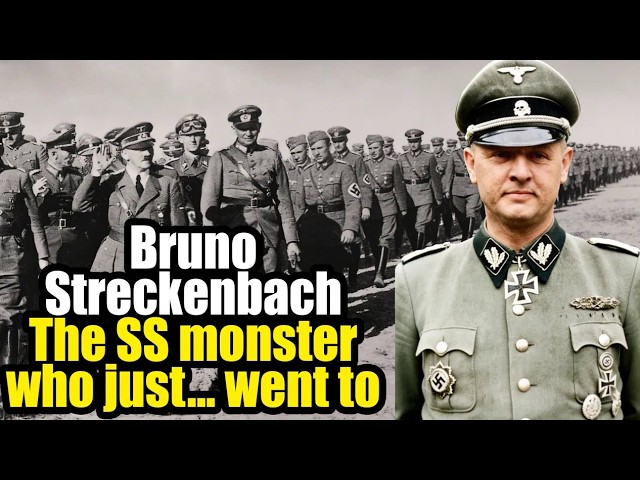
To understand how a seemingly normal person becomes an administrator of mass death, you have to look back at Germany after the First World War. The country was humiliated, economically ruined, and violently divided. In that shattered society, a young, highly intelligent man like Streckenbach found himself drawn not to building a peaceful future, but to the bloody street fighting of the Weimar Republic. He joined the Freikorps, the rogue paramilitary groups of angry veterans, and quickly discovered a unique combination of absolute ruthlessness on the streets and a cold, calculating, analytical mind in the office.
He realized early on that unorganized violence achieves nothing. True power, he understood, lies in the ability to organize, categorize, and systematically eliminate enemies with bureaucratic precision. This terrifying talent for combining street-level brutality with corporate-level efficiency made him invaluable when the newly formed Gestapo began looking for men to crush communist opposition in the port city of Hamburg. When Streckenbach took charge of the local political police, he did not rely on chaotic raids or random terror.
Instead, he built a meticulous filing system, turning political suppression into a smooth-running assembly line. He mapped out the entire opposition network, identified key leaders with chilling accuracy, and systematically dismantled the resistance until Hamburg was firmly under the grip of the secret police. That flawless performance caught the attention of Reinhard Heydrich, the chief of the Reich Main Security Office, who was searching for capable, emotionless men to help expand his empire of terror across Europe. Heydrich recognized a kindred spirit in Streckenbach, a man who viewed human beings not as living individuals with families and hopes, but as logistical problems to be solved and erased on paper.
He promoted Streckenbach and brought him to Berlin, placing him in a position of immense, unseen power as head of the personnel department for the entire security apparatus. From a comfortable office in the capital, Streckenbach acted as the ultimate human resources manager of the Third Reich, carefully selecting the exact men who would be sent out to drown Europe in tragedy. He looked for educated, highly organized individuals, intentionally recruiting lawyers, doctors, economists, and even former ministers, because he believed mass extermination required intelligent management rather than mindless savagery. When the German military crossed into Poland in the autumn of 1939, Streckenbach was given his first major opportunity to test his theories on population control on a countrywide scale.
He was one of the primary organizers of Operation Tannenberg, a highly classified campaign designed to decapitate Polish society by hunting down teachers, priests, intellectuals, and political leaders. He sent specialized task forces behind the advancing army with detailed lists of names and addresses, systematically removing anyone with the education or influence to organize resistance against the German occupation. During this brutal campaign, Streckenbach made a chilling observation that would forever alter the course of the war. He noticed that regular army soldiers and initial police battalions were struggling psychologically with the intimate, horrific reality of executing unarmed civilians, women, and children day after day in the forests and ravines of Eastern Europe.
He analyzed this psychological breakdown not as a moral failing or human tragedy, but purely as a logistical inefficiency that needed correction before the regime embarked on its ultimate ideological crusade. In the spring of 1941, Hitler made the decision to break the non-aggression pact and launch a catastrophic invasion of the Soviet Union, demanding a war of absolute annihilation that ignored all conventional rules of military engagement. Heydrich summoned Streckenbach and tasked him with an administrative nightmare: create a highly mobile, heavily armed extermination force that could follow the army into Russia and instantly liquidate entire communities. Streckenbach did not hesitate or question the moral weight of the order.
He retreated to his office and systematically designed the architecture of the Einsatzgruppen, carefully calculating everything from ammunition requirements to fuel for transport trucks. He gathered approximately 3,000 carefully chosen men in the quiet training town of Pretzsch, far from public view, and personally oversaw their preparation for the mission ahead. In that peaceful little town, Streckenbach stood before a crowd of highly educated professionals and calmly instructed them that their sole duty was to step onto Soviet soil and systematically murder millions of innocent Jewish families, communist officials, and local partisans. He organized them into four lethal, highly mobile death squads, ensuring they were integrated into the supply lines of the regular army so their grizzly work would never be delayed by a lack of resources.
The reality of his planning became clear the moment the invasion began. His Einsatzgruppen swept across Eastern Europe, leaving a trail of devastation and shattered communities. Because of the flawless administrative framework designed in Berlin, these four relatively small units murdered well over a million men, women, and children in just the first few agonizing months of the Soviet campaign. Every bullet fired in those dark forests was paid for, tracked, and organized by a quiet man sitting behind a polished wooden desk hundreds of miles away.
He had proven to the highest levels of Nazi leadership that industrial-scale genocide was possible, laying the organizational groundwork for the extermination camps that would soon follow. Life inside the upper echelons of the Nazi security apparatus, however, was a vicious, paranoid game of survival. When Heydrich was assassinated by Czech commandos on the streets of Prague in 1942, Streckenbach lost his political shield and found himself exposed to the toxic rivalries tearing through the secret police headquarters. The new chief of the security service, Ernst Kaltenbrunner, resented Streckenbach’s immense influence and maneuvered to strip him of his power.
Facing the destruction of his carefully built career, Streckenbach made a surprising decision that shocked his rivals: he formally requested transfer out of the comfortable offices of Berlin and directly into the brutal, freezing meat grinder of the Waffen SS on the Eastern Front. It was rare for a desk murderer to willingly trade a tailored uniform for the mud and blood of combat. But Streckenbach proved adaptable, taking command of the 8th SS Cavalry Division Florian Geyer despite having almost no frontline tactical experience. He applied the same cold, analytical ruthlessness to military command that he had applied to human extermination, fighting through the collapsing front lines with a terrifying calmness that earned him the highest military decorations from the crumbling regime.
As the war turned into an apocalyptic nightmare for the Germans, he was given command of the 19th Waffen Grenadier Division, a unit composed largely of Latvian conscripts fighting a desperate, losing battle against the overwhelming Red Army. Streckenbach led these exhausted, freezing men into the Courland Pocket, a hopeless entrapment on the Baltic Coast where they were completely surrounded and cut off from the rest of the retreating German military. He held his ground until the last days of the war, fighting with the frantic energy of a man who knew exactly what vengeance the Soviets would unleash if they discovered his true identity. When Nazi Germany surrendered in the spring of 1945, the architect of the death squads was swept up by the victorious Red Army alongside thousands of his starving Latvian soldiers.
He was transported under heavy guard to Lubyanka prison in Moscow, where Soviet interrogators eventually pieced together the horrifying truth that they were holding the man who had directly engineered the slaughter of their people. Logic dictated that the notoriously brutal Soviet justice system would execute him without a second thought. But for deeply complex political reasons, they kept him alive. Instead of facing a firing squad, Streckenbach was put through the Soviet legal system and sentenced to 25 years of backbreaking hard labor in the freezing Gulag.
For ten long, silent years, the man who meticulously calculated the logistics of the Holocaust faded into the snowy obscurity of the Soviet prison system. People assumed he would die there, forgotten. But geopolitical landscapes shift in strange ways. In 1955, West German Chancellor Konrad Adenauer traveled to Moscow and negotiated a diplomatic agreement to bring the last remaining German prisoners of war home.
Bruno Streckenbach, the man who had built the mobile killing machinery of the Third Reich, was quietly placed on a train heading west, stepping back onto German soil as a free man. One would expect the new democratic West German government to arrest him and put him on trial for his documented crimes against humanity. But the post-war German justice system was tragically flawed, heavily populated by former Nazi officials willing to look the other way. Streckenbach did not have to flee to South America or live under an assumed identity.
He simply returned to his hometown of Hamburg, bought a nice suit, and secured a comfortable job as a manager in a shoe manufacturing company. The man who ordered the executions of thousands of children spent the 1950s and 1960s living a peaceful, prosperous life, blending perfectly into the economic miracle of post-war Germany. It was not until the late 1960s, a full two decades after the war, that a new generation of German prosecutors finally found the courage and legal evidence to indict him. They built a massive case, intending to expose the quiet shoe company manager and deliver long-overdue justice.
But Streckenbach, a man who had manipulated his way through Weimar street brawls, Gestapo politics, the Eastern Front, and the Soviet Gulag, still had one final trick. When the trial was set to begin, his defense lawyers produced a stack of medical documents signed by sympathetic doctors, claiming he suffered from a severe, life-threatening heart condition and was too fragile to withstand the stress of a courtroom. He played the role of a frail, deteriorating old man with chilling perfection. The German courts accepted the deception and suspended the proceedings indefinitely, declaring it inhumane to prosecute a dying man.
The architect of the Einsatzgruppen returned to his comfortable home in Hamburg, untouched by the justice system he had so easily outsmarted. He did not die quickly, as his doctors had warned. Instead, he lived for several more years in total peace, enjoying a quiet retirement stolen from millions of innocent people across the European continent.
When Bruno Streckenbach finally took his last breath in the autumn of 1977 at the age of 75, he died peacefully in his own warm bed, a chilling reminder that sometimes the true architects of hell never face justice on Earth.