Marilyn Monroe was married three times, and each marriage followed a pattern that became clearer only in hindsight: the men in her life wanted a version of her they could manage, while she kept refusing to stay small. Photographs capture her laughing freely at parties while her husband watched her with something closer to surveillance, an image that has haunted observers for decades because of what it quietly suggests about the gap between her public radiance and her private reality. Before she became Marilyn Monroe, she was Norma Jeane Mortenson, born in Los Angeles on June 1, 1926. Her mother, Gladys Pearl Baker, struggled with severe mental illness and was institutionalized when Norma Jeane was very young.
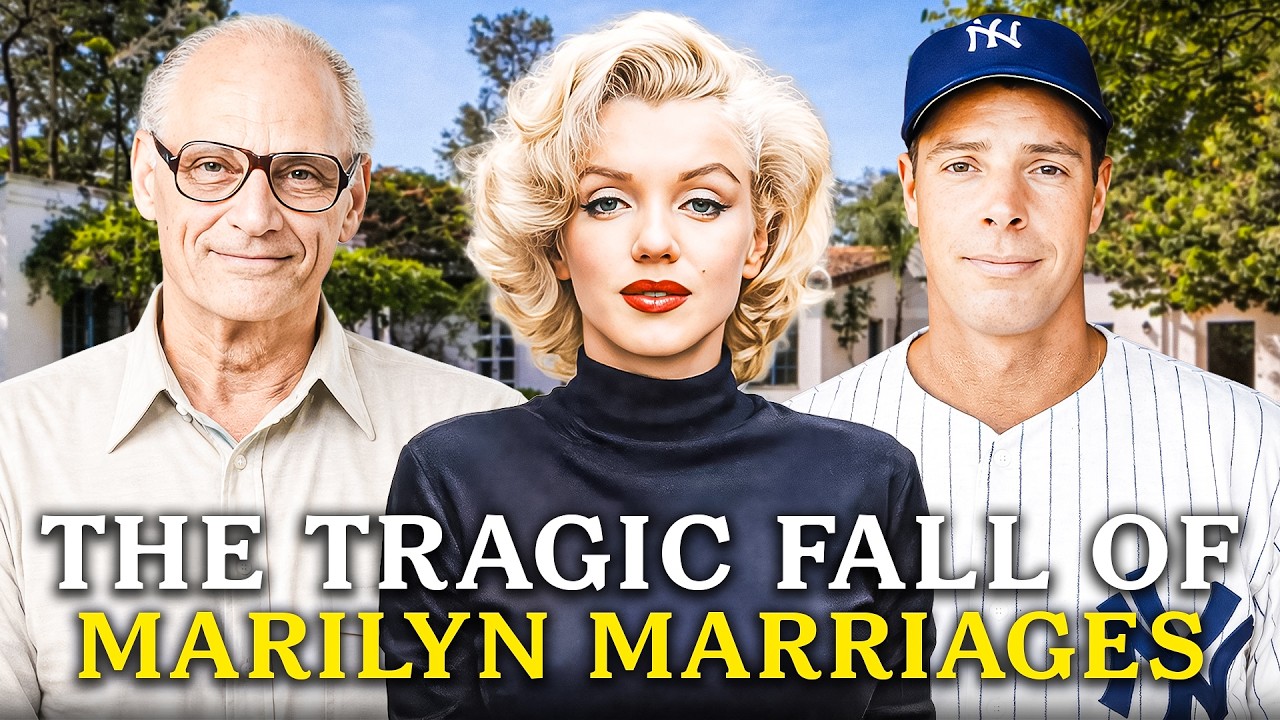
Her father was never a real presence in her life, and she spent years moving between foster homes and a brief stay in an orphanage, always on the margins, always temporary. She later described feeling invisible growing up, and she spoke in later years about childhood experiences in foster homes and in the care of people who should have protected her, moments that left marks no one could see. That early lesson, that security was fragile and belonging was conditional, shaped every relationship she would go on to have. In 1942, when she was just 16, she married for the first time.
Her name was James Dougherty, 21 years old. The marriage was born out of practicality, not romance. Her guardian, Grace McKee Goddard, was relocating to the East Coast and could no longer care for her, and the alternative was returning to the orphanage. When Dougherty, a neighbor and family acquaintance who worked at Lockheed Aircraft, showed romantic interest, the adults in her life encouraged the match.
The wedding took place on June 19, 1942, just 18 days after her 16th birthday, and she wore a white gown borrowed from a neighbor. She later described the marriage as something that simply happened to her, not something she chose. She was fond of Dougherty in the way you might be fond of someone who kept you from a worse fate, but fondness is not love, and she knew the difference even then. Dougherty had specific ideas about what a wife should be, and those ideas did not include ambition, independence, or a career.
He wanted a homemaker, while she was becoming something else entirely. During the war years, while Dougherty served with the merchant marine in the Pacific, Norma Jeane went to work at a munitions factory in Burbank, where she inspected parachutes and sprayed fuselages. In 1945, an Army photographer named David Conover arrived to document women contributing to the war effort, and the camera responded to her in a way he later said was simply not teachable. He encouraged her to pursue modeling professionally.
She began working with Emiline Snively at the Blue Book modeling agency, dyed her hair from brunette to blonde, and started appearing on the covers of small magazines. Dougherty did not support any of it. In 1946, she signed her first contract with 20th Century Fox, a standard six-month contract paying $75 a week, and took the name Marilyn Monroe. That same year, she filed for divorce from James Dougherty, who was at sea when he received the news.
Dougherty would spend the rest of his life speaking about her with warmth mixed with something unresolved, maintaining until his death in 2005 that she had been a wonderful wife and that Hollywood had taken her away from him. What he never quite reckoned with was that she had already been leaving long before Hollywood arrived. By 1952, Marilyn Monroe was a phenomenon. Joe DiMaggio had been watching from a distance.
DiMaggio had retired from baseball in 1951 after 13 seasons with the New York Yankees, during which he was named an All-Star every single year he played, and he still holds a 56-game hitting streak. He was quiet, dignified, and deeply private, almost the photographic negative of everything Marilyn represented publicly. When a mutual friend arranged a dinner date in March 1952, he reportedly had been asking about her for some time before that. The date was set for a small Italian restaurant.
DiMaggio arrived on time, and what he thought would be a quiet dinner became a four-hour conversation in which he reportedly did most of the listening. He called her the following day, and again after that. The relationship that developed was by all accounts genuinely tender at the start. DiMaggio was courtly and attentive in ways Marilyn was not used to.
He sent flowers. He called when he said he would. For a woman who had spent her formative years being temporarily housed and moved on from, that kind of constancy was not a small thing. But there was a problem that announced itself fairly early on.
Joe DiMaggio was in love with Marilyn Monroe, but he could not stand what being Marilyn Monroe actually meant. He hated the publicity, hated the way men looked at her, and hated with a specific burning intensity the fact that she seemed entirely unbothered by all of it. She liked being Marilyn. He wanted her to stop.
Just days after they married at San Francisco City Hall on January 14, 1954, Marilyn flew to Korea to perform for American troops stationed there. Tens of thousands of soldiers gathered to watch her perform in an open field in freezing cold, and she wore a tight sequined dress in sub-zero temperatures and sang until her voice gave out. She came back to DiMaggio describing it as the most real moment of her career. He was angry she had gone.
The marriage lasted exactly nine months. The visible breaking point came in September 1954 during the filming of a scene for The Seven Year Itch on a street in New York City, in which Marilyn stood over a subway grate while her white dress billowed upward. DiMaggio watched from the sidelines, and what he saw shattered something in him. Not because of the scene itself necessarily, but because she looked free.
That night, witnesses at the hotel reported raised voices, and Marilyn appeared the following morning visibly distressed. The details of what happened that night have never been confirmed with any specificity, but something was broken and it did not mend. She filed for divorce on October 4, 1954, citing mental cruelty. At the press conference following the filing, she wept.
She had loved him, and she had wanted it to work. DiMaggio never truly recovered from losing her, arranging fresh flowers to be placed at her grave three times a week for 20 years after her death. He reportedly said near the end of his own life that not marrying her was the biggest mistake he ever made, though they had been married. Arthur Miller was in the mid-1950s one of the most celebrated playwrights in America.
Death of a Salesman had won the Pulitzer Prize for Drama, and The Crucible had used the Salem Witch Trials as an allegory for McCarthyism. When his path first crossed meaningfully with Marilyn Monroe at a party in Hollywood in 1951, the pairing struck most observers as almost absurdly unlikely. He was the intellectual, she was the blonde. Those were the categories, and the culture of that era was not particularly interested in complicating them.
Marilyn had no patience for that framing. She had been quietly and persistently educating herself for years, reading voraciously, attending acting classes at the Actors Studio in New York under Lee Strasberg, and engaging with ideas with genuine hunger. She had been reading Dostoevsky, Whitman, and Freud at a time when the studio was handing her scripts they didn’t believe required much from her mentally. The power dynamics between them were complicated from the beginning.
Miller was married when they met to his first wife, Mary Slattery, with whom he had two children. The relationship developed slowly through correspondence and occasional meetings over several years, a long, slow burn that he later acknowledged had never been entirely resolved in his mind even while he remained married. When the decision finally came, Miller divorced Slattery, converted to Judaism, and married Monroe in a civil ceremony on June 29, 1956, followed by a Jewish ceremony on July 1. The cultural moment surrounding the marriage was enormous.
It was called, with the particular breathlessness of 1950s tabloid writing, the union of the egghead and the hourglass. For a time, though, the marriage appeared to be genuinely good for both of them. Miller provided intellectual companionship, someone who engaged with her thoughts as well as her presence. She took his surname professionally for a period.
When Miller was subpoenaed by the House Un-American Activities Committee in 1956, called to account for his alleged associations with communist organizations, Marilyn stood beside him publicly and without hesitation. Miller was ultimately cited for contempt of Congress for refusing to name names, a charge later overturned on appeal in 1958. The cracks formed early. In 1958, during the filming of Some Like It Hot, Marilyn’s behavior on set became a source of significant strain.
She was perpetually late and struggled to complete takes, requiring scenes with dozens of takes for a single line. What was less visible at the time was that she was also dealing with a pregnancy that would end in miscarriage. It was her second. She had also lost a pregnancy in 1957.
Each loss hollowed her out a little more. She had wanted to be a mother with a sincerity that sometimes surprised people who assumed Marilyn Monroe must have other ambitions. Miller’s response to her suffering during this period was not what she needed. In early 1960, while Marilyn was in Nevada filming The Misfits, a film Miller had written specifically for her and which was supposed to be a gift, she discovered his personal journal.
In it he had written about her in terms that made clear he sometimes found her exhausting and erratic, that he sometimes doubted whether the marriage had been the right choice. He had written about her not as a partner but as a subject, with the clinical distance of a writer observing material. She read it. According to people close to her at the time, she did not confront him with it immediately.
Instead, she carried it. The Misfits was grueling in every sense. The Nevada desert in the summer of 1960 was punishing, with temperatures reaching over 100 degrees during shooting. The cast included Clark Gable, who was 60 and in declining health, and Montgomery Clift, who had survived a near-fatal car accident years earlier.
Everyone on that set was in some way fragile. Marilyn was frequently unwell during production, dealing with an increasing dependence on prescription medication that had been building for years. There were days she could not come to set, and days she arrived hours late. She and Miller barely spoke during filming except when the scene required it.
The marriage officially ended in January 1961, finalized in a Mexican court. Miller announced the divorce the day after principal photography wrapped on The Misfits, a timing that struck many observers as peculiar, even callous. Clark Gable died of a heart attack on November 16, 1960, just 11 days after filming ended. His wife made comments to the press suggesting that the stress of working with Marilyn had contributed to the strain on his heart.
It was a public accusation made during the earliest days of grief, and it landed on Marilyn with crushing weight. She had admired Gable enormously. She carried the grief and the blame together. Miller would go on to marry again within months of the divorce, a photographer named Inge Morath who had been on the set of The Misfits.
He acknowledged eventually that he had not been able to give Marilyn what she needed. By 1961, Marilyn Monroe had been through three marriages, two miscarriages, and a lifetime’s worth of being wanted for the wrong reasons. She checked herself into Payne Whitney Psychiatric Clinic in New York in February 1961, shortly after the divorce. What is documented is that she found the experience deeply distressing, feeling she had been placed somewhere she did not belong, confined behind locked doors in a way that felt punitive rather than restorative.
She managed to reach Joe DiMaggio by phone, and he flew to New York almost immediately and arranged for her transfer and release. She described the stay as one of the most frightening experiences of her life. She was transferred to Columbia Presbyterian Medical Center, where she spent several weeks recovering. DiMaggio visited every day without fail during that stay.
After her discharge, she returned to California and resumed therapy with Dr. Ralph Greenson, a psychiatrist who became increasingly central to her daily life, with boundaries between professional treatment and emotional dependency becoming increasingly difficult to define. She worked when she could. She filmed scenes for Something’s Got to Give at 20th Century Fox beginning in April 1962, a romantic comedy that was supposed to signal a fresh chapter.
Instead, the production became a monument to everything that wasn’t working. She was frequently absent dealing with a severe sinus infection among other health issues, and the studio had very little patience left. On May 19, 1962, she performed at Madison Square Garden at a Democratic fundraiser in honor of President John F. Kennedy’s upcoming birthday.
It became one of the most talked about moments of the year, and one of her last major public appearances. Fox dismissed her from Something’s Got to Give on June 8, 1962, citing breach of contract. There were negotiations in the weeks that followed about reinstating her, and a new contract was reportedly being drawn up. On August 4, 1962, a Saturday, Marilyn Monroe was at her home on Fifth Helena Drive in Brentwood, a modest Spanish-style house she had bought earlier that year, the first property she had ever purchased entirely in her own name.
That night she took a lethal amount of barbiturates. She was found the following morning by her housekeeper. She was 36 years old. The official ruling was a probable overdose with the possibility that it was self-inflicted.
The circumstances have been debated ever since. What the record cannot dispute is the simple fact of her age and of all the years she still had ahead of her. Each of her three husbands, in his own way, wanted a version of Marilyn that was manageable. Dougherty wanted her domestic and contained.
DiMaggio wanted her private and away from other men’s eyes. Miller wanted her to be the muse, inspiring at a distance, not too demanding up close. None of them quite wanted the actual woman. The narrative of Marilyn Monroe as a helpless, beautiful woman swept along by forces beyond her control has always been more comfortable than the alternative, which is a woman who knew exactly what she was doing professionally.
In 1955, she walked away from her Fox contract and formed her own production company, Marilyn Monroe Productions, a genuinely radical act for a female performer of that era. It eventually resulted in a new contract with Fox in 1956 that gave her script approval on certain projects, director approval, and a salary increase to $100,000 per film. She was also by most accounts a person of real generosity. She remembered the names of crew members when stars above her in the billing rarely bothered.
She advocated for Ella Fitzgerald to be booked at the Macambo nightclub in West Hollywood, a venue resistant to booking a Black headliner. Marilyn reportedly called the owner personally and promised to take a front table every night Fitzgerald performed. Fitzgerald later said publicly that Marilyn had done something genuinely meaningful for her career. What her three marriages show, looked at honestly across the span of years, is a woman who kept trying.
She kept reaching for connection, for stability, for love. She was 36 when she died, which means there were likely decades more of her story left to be written. A version of Marilyn Monroe at 60 or 70, thoughtful, still funny, no longer young enough to be dismissed as merely decorative, exists only as imagination. But the full arc of a life is not always visible in the moments that get photographed.
Sometimes it lives in the reaching.