At 1:44 in the morning on June 6, 1968, surgeons at the Ambassador Hotel in Los Angeles stopped trying. Robert F. Kennedy, struck down in the kitchen pantry by a 22-caliber revolver just moments after winning the California Democratic primary, was dead at 42. His wife Ethel knelt on the concrete as a busboy named Juan Romero pressed rosary beads into the dying man’s palm.
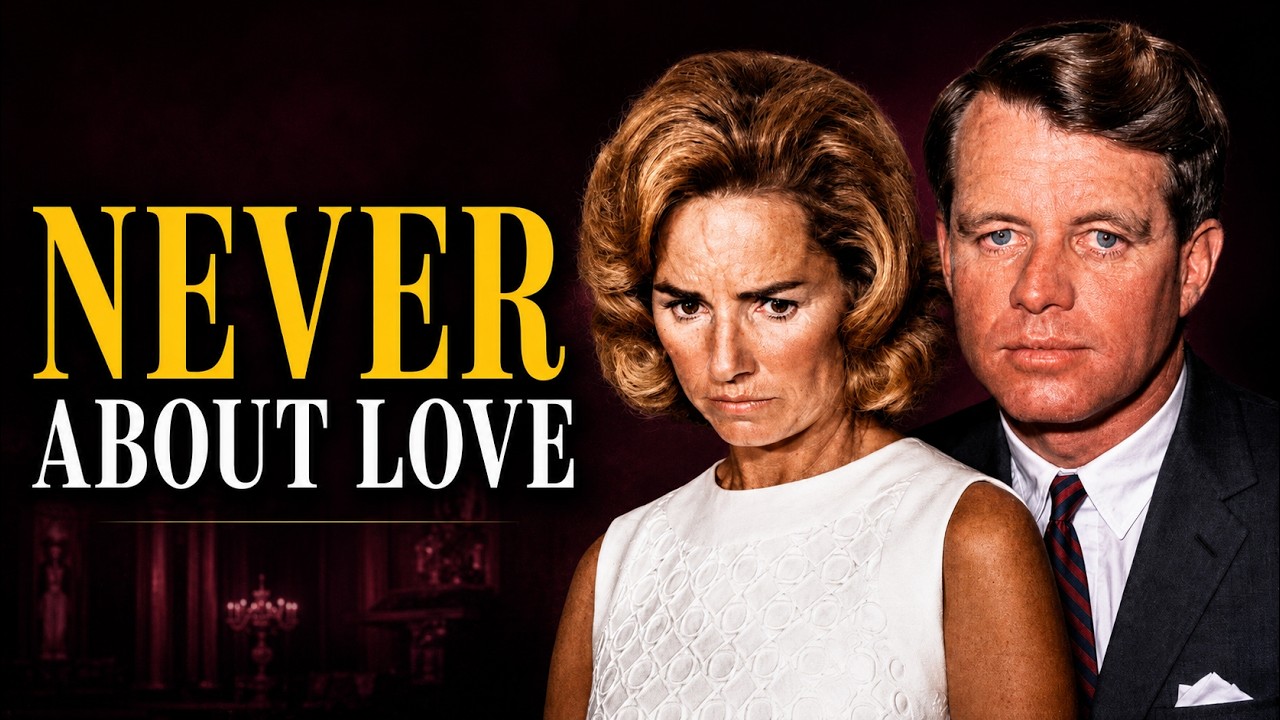
She was 40 years old and pregnant with their 11th child. She buried him at Arlington National Cemetery beside his brother, and on December 12 of that year delivered a daughter, Rory, who would spend her entire life meeting strangers eager to describe a father she never saw. Ethel Skakel Kennedy then spent another fifty-six years as a widow. She never remarried, never divorced, and never permitted so much as a photograph hinting at a second act.
When asked in 1991 why a woman widowed at 40 had never taken a second husband, she answered without hesitation: “How could I possibly do that with Bobby looking down from heaven? That would be adultery. ” The sentence was not a figure of speech. Adultery requires, as a plain matter of grammar, a first marriage still in force.
Ethel Kennedy considered herself married to a man twenty-three years in the ground. The lazy explanation for her choice involves money, and that explanation collapses on contact. Ethel Skakel walked into the marriage carrying a coal and coke fortune of her own. Her father, George Skakel, had built the Great Lakes Carbon Corporation out of nothing, assembling a fortune by understanding that America would burn whatever anyone sold it.
Growing up in a thirty-one-room house in Greenwich, Connecticut, Ethel absorbed a Catholicism that predated the Second Vatican Council, a faith in which hell functioned less as a metaphor and more as a street address. Mass every morning. Confession as routine maintenance. Sin tallied in an itemized ledger.
Every rule she followed for the rest of her life traced straight back to that dining room in Greenwich and to the woman at the head of the table, her mother Anne, who poured Catholic doctrine into her children at a pressure that left permanent grooves in every one of them. She met Bobby in December 1945 while skiing at Mont-Tremblant, Quebec. A seventeen-year-old Ethel collided with the Kennedy family in the person of a twenty-year-old Bobby, who possessed all the charm of a clenched fist and none of his older brother’s polish. He liked her sister Pat first, and for a while that arrangement looked settled to everyone watching.
The romance collapsed. Ethel waited, then moved, and by 1949 the two were courting seriously enough that both families began the slow arithmetic of a merger between two enormous Catholic fortunes. They married on June 17, 1950, at St. Mary’s Catholic Church in Greenwich, in front of a congregation that understood precisely what a Catholic sacrament costs and precisely how permanent it intends to remain.
Everything in her story hangs on that last sentence. A Catholic marriage of 1950 performed properly in front of God and Greenwich did not function as a contract either party could renegotiate once the terms turned unpleasant. It functioned as a metaphysical fact, and metaphysical facts survive bad behavior. In Ethel’s theology, the marriage existed independently of whether either party behaved well inside it.
The vow bound her to God rather than to her husband’s behavior, and a promise to the Almighty included no escape clause triggered by a Hollywood actress. Within a few years of buying Hickory Hill from Jack and Jackie Kennedy in 1956, the estate acquired a reputation for glorious chaos. Children everywhere, dogs, horses, ponies, and a swimming pool functioning as the estate’s primary instrument of social policy. Ethel once shoved the historian Arthur Schlesinger Jr.
into that pool fully clothed, and Schlesinger, a Pulitzer winner and a gentleman, climbed out dripping and rejoined the party without complaint. She spent almost the entire marriage pregnant, eleven children between 1951 and 1968, while simultaneously working the campaign trail like a field general. Jack’s run in 1960, Bobby’s Senate race, the presidential campaign of 1968, she attacked each one with the energy of someone who resented sleep. By 1963, the Kennedy operation counted her as an asset rather than an ornament, holding her up against the introverted stillness of Jackie Kennedy, whom the family loved the way one loves a painting, while they loved Ethel the way one loves a sister who will drive you to the airport at four in the morning.
The rumors about Bobby began while he still lived, and they metastasized the instant he stopped breathing. Marilyn Monroe occupies the center of nearly all of them. Larry Tye and Anthony Summers argue some version of yes, while Donald Spoto argues no, bringing flight logs and documents proving that a sustained physical affair between Bobby and Monroe would have required the man to occupy two places at once repeatedly across a span of months. Tye’s careful version permits a single night, one encounter rather than a sustained affair.
The remainder of the Monroe material rests on FBI wiretap summaries nobody ever verified and on anecdotes from Peter Lawford, whose relationship with the factual record could charitably qualify as recreational. The tabloid economy of the 1970s paid him handsomely for both, because a dead Kennedy cannot sue and a dead actress cannot correct the transcript. Further claims reached into Candace Bergen and Lee Radziwill, Jackie’s own sister, but their promoter, David Heymann, fabricated quotes, invented sources, and constructed interviews with people who never spoke to him. His book sold beautifully anyway.
The mechanism matters more than any individual allegation. Dead men cannot sue. A murdered Kennedy generates demand for new material forever, and publishers pay for material. Each new book cites the last one, and repetition manufactures a kind of counterfeit consensus.
Even the biographers who defend Bobby most vigorously concede one point: the man possessed a roving eye. Whether that eye ever translated into sustained betrayal of his wife remains, after six decades of digging by people motivated to find otherwise, unresolved. November 1963 broke Bobby Kennedy in a way the public never fully saw. He stopped eating, wore his dead brother’s overcoat, and disappeared into grief the way other men disappear into liquor.
The only person on the planet occupying the same crater of grief answered to the name of his brother’s widow. Jackie and Bobby found each other down in that hole and stayed there for years. Evan Thomas reads the relationship as a trauma bond and nothing else, with Bobby stepping into the role of surrogate father to John and Caroline. Ethel noticed.
According to one account, she walked up to Jacqueline Kennedy and delivered a sentence with no wasted words: “Look, people are whispering about you and Bobby. ” No scene, no lawyers, no cold silence stretching across a decade of Thanksgivings. She confronted her and then swallowed the whole thing whole. Theology explains why Ethel would not leave, and the Kennedy family explains why she never expected to want to.
No tradition of monogamy existed in the Kennedy clan, and Joseph P. Kennedy Sr. conducted his affairs with a brazenness bordering on performance art. Rose absorbed it, prayed, traveled, and held the entire operation upright while her husband did as he pleased, sitting beside him anyway after his 1961 stroke.
That model landed in front of Ethel Skakel in 1950, fully assembled, instructions included. Wives of mid-century political elites operated under a standing instruction: tolerate it quietly, protect the campaign, protect the children, and above all protect the man. Widowhood opened somewhere in that summer of 1968. Ethel would ultimately spend more years as Bobby’s widow than she ever spent knowing him alive.
Canon law poses no obstacle whatsoever to remarriage; death dissolves the marriage bond, and the church permits remarriage explicitly. Within five months of that funeral, Jacqueline Kennedy married Aristotle Onassis. Ethel declined the identical permission for the next fifty-six years. Andy Williams escorted her to events across much of that period; both parties denied any romance flatly, consistently, and until the end of their lives, calling the friendship a companionship born of mutual grief.
She described herself, not as unwilling or heartbroken or loyal, but as married to a dead man. She would wake in the morning and picture Bobby happy in heaven, reunited with Jack, the two brothers together up there in exactly the way they lived together down here. That belief carried her through the first year, then through the next fifty-five. She founded the Robert F.
Kennedy Memorial within months of the funeral, an organization surviving today under the name Robert F. Kennedy Human Rights, pouring five decades of unspent energy into it. The work functioned as ballast, and she needed the ballast, because the next fifty years arrived carrying a bill that no amount of faith fully covers. In 1984, her fourth child, David, died of a drug overdose at 28.
Thirteen years later, Michael, her sixth, died in a skiing accident at 39. Her daughter-in-law Mary Richardson Kennedy died by suicide in 2012, and seven years after that her twenty-two-year-old granddaughter Sasha died of an accidental overdose. Ethel, then 91, walked behind another coffin. Faith stayed.
She attended mass, prayed for all of them, and continued speaking about Bobby in the present tense, as though the man occupied the next room rather than a plot of Virginia grass. On November 24, 2014, Barack Obama hung the Presidential Medal of Freedom around her neck in the East Room. She stood at 86, surrounded by surviving children, accepting the country’s highest civilian honor for human rights work that began the week her husband died. Ethel Skakel Kennedy died on October 10, 2024, at the age of 96, fifty-six years and four months after the pantry at the Ambassador.
Strip the story down to its frame: a woman married a man in 1950 under a theology treating the vow as permanent, discovered her husband attracted rumors the way a lightning rod attracts lightning, and declined to leave because leaving never appeared anywhere on the list of things a person in her position could do. Then somebody shot him. She stayed married anyway for fifty-six years to a husband she believed watched her from somewhere above Virginia, and she stayed married with such conviction that the mere question of remarriage struck her as a question about adultery. She outlasted the rumors, outlasted the biographers who profited from them, outlasted the fabricator who invented the worst of them, and outlasted nearly everybody who ever worked up the nerve to ask her the question directly.
Bobby lived 42 years. Ethel spent longer as his widow than he spent alive, and she never once described that arrangement as a sacrifice, because in her understanding of the universe, nothing about it required one. Eighteen years of marriage, fifty-six years of widowhood, and not one of them spent looking for a replacement.