In 1934, walking into a Midwestern bank meant facing more than a note-passing thief. Tellers looked up to see men armed with Thompson submachine guns, wearing bulletproof vests, with accomplices waiting outside. This was the public enemy era, and the men behind these robberies were far from amateurs.
These were the heavy hitters of the Great Depression. They hit two banks in a single day. One escaped an "escape-proof" jail with a carved piece of wood. Another turned a South Dakota city into a shooting gallery. Their stories defined an era of desperation and defiance.
The story begins in Oklahoma on November 1, 1932. Pretty Boy Floyd, a name he despised, walked into a bank in his hometown of Tulsa. He wasn't wearing a mask. He greeted people on the sidewalk by name. When he left with $2,530 in cash, no one called the police. Many locals were silently rooting for him.
Floyd was known as the Robin Hood of Cookson Hills. Rumors spread that he would tear up mortgage papers during his robberies, burning the debts of struggling farmers. While historians debate the truth of these claims, the people of Oklahoma believed it. In 1931 and 1932, he robbed so many banks that insurance rates for financial institutions literally doubled.
On December 12, 1931, Floyd pulled off one of the most efficient robbery days of the Depression. He robbed a bank in Paden, Oklahoma, then drove down the road and robbed another in Castle. Two banks, one afternoon, and the same Tommy gun. He was so unconcerned about identification that he often introduced himself by name during the heists.
The FBI eventually tied Floyd to the Kansas City Massacre, a June 1933 ambush outside Union Station that killed four lawmen and a federal prisoner. Floyd denied involvement until his death, and historians still debate it. But the event gave J. Edgar Hoover the political cover to pursue these outlaws with full force, putting Special Agent Melvin Purvis at the center of the hunt.
Jumping forward to March 6, 1934, the scene shifts to Sioux Falls, South Dakota. The Security National Bank and Trust was hit by John Dillinger and his associates, including a 5-foot-4 dynamo of violence named Baby Face Nelson. They entered armed with submachine guns.
While the gang cleaned out cash drawers, the alarm was tripped. Motorcycle officer Hale Keefe arrived on the scene. Baby Face Nelson, standing at a second-floor window, cut him down before he could even dismount. The newspaper described Nelson as gloating. Miraculously, Keefe survived.
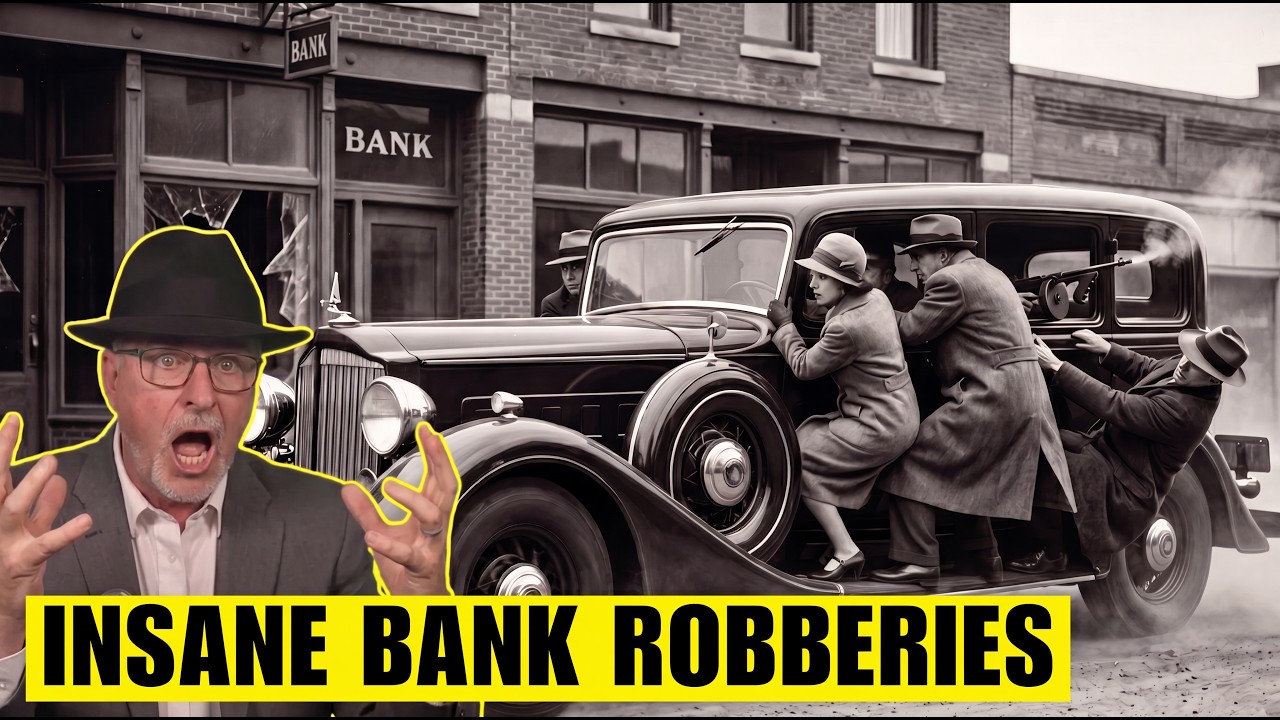
With the police converging, the gang needed an exit strategy. They grabbed five employees and forced them onto the running boards of their getaway Packard. These hostages clung to the sides of the car, serving as human shields against police fire. The gang escaped with $46,000, eventually dumping the hostages on a cold roadside.
Two weeks earlier, the same crew had been involved in a disastrous FBI raid at the Little Bohemian Lodge in Wisconsin. Agents accidentally shot three innocent civilians in the dark while Dillinger and Nelson slipped away. The embarrassment made the manhunt personal for Hoover.

A week after Sioux Falls, on March 13, 1934, the crew hit the First National Bank in Mason City, Iowa. They expected to walk out with $240,000. They left with only $52,000, thanks to a quick-thinking teller named Harry Fisher.
When the gang stormed in, Fisher locked himself inside the vault. When ordered to hand over the money, he passed out stacks of one-dollar bills, keeping the larger denominations hidden. The lobby filled with smoke from gunfire and a tear gas grenade fired by a bank guard in a bulletproof booth. The guard hit one robber square in the back with the gas canister.
The gang grabbed bystanders on their way out, forcing them onto the sides of their Buick. Some accounts put the hostage count at 24 people. As they fled, they threw roofing tacks out the windows to flatten the tires of pursuing police. The bullet-pocked glass and the tacks are still preserved in the Mason City Public Library today.
The gang realized their mistake when they counted the money on the side of the road. The $52,000 haul was a far cry from their expected quarter-million. Harry Fisher, the teller who saved the bank's big bills, deserved a statue.
Dillinger himself is perhaps best known for the wooden gun escape. In January 1934, he was held in the Lake County Jail in Crown Point, Indiana, which authorities bragged was escape-proof. On March 3, he walked out the front door.

He had carved a block of wood into the shape of a pistol, blackened it with shoe polish, and pressed it into a guard's ribs. He locked the guards in cells, grabbed two real machine guns from the armory, and stole the sheriff's personal Ford V8 from the driveway. Witnesses said he was singing "I'm Heading for the Last Roundup" as he drove away.
Historians later suggested the wooden gun story may have been fabricated. Dillinger's lawyer implied the escape was likely bought with robbery money. But Dillinger didn't care about the truth. The wooden gun story made every lawman in America look like a fool, and that was worth more to him than the facts.
Months earlier, in East Chicago, Dillinger had worn a bulletproof vest during a robbery. A patrolman named William O'Malley shot him four times in the chest, but the rounds didn't penetrate. Dillinger then machine-gunned the officer dead. His getaway car featured steel plating and bulletproof glass.
These robberies weren't just about the money. They were about showmanship. In a country where one in four working adults had no job, and banks were foreclosing on everything, these men became folk heroes. They were a giant middle finger to the institutions that had let everyone else's life burn down.
When Pretty Boy Floyd told a teller his real name, when Baby Face Nelson cracked jokes through gunfire, when Dillinger sang cowboy songs in a stolen sheriff's car, it was theater. The people who lived through it weren't always sure who the real villains were.
That's why a teller wouldn't always sound the alarm. That's why a town like Sallisaw never gave Pretty Boy up. And that's why 20,000 people showed up at his funeral when Melvin Purvis and the FBI finally shot him down in a cornfield in Ohio in October 1934.
Three months later, in July 1934, Purvis was outside the Biograph Theater in Chicago when Dillinger walked out of a movie and into a trap. The public enemy era didn't end with a dramatic last stand. It ended on a sidewalk under a marquee's light. The era of the outlaw was over, but the stories of their audacity lived on.