The wedding took place on a boat. April 15th, 1994. A research vessel on the Hudson River, the same river Robert F. Kennedy Jr. had built his environmental reputation defending.
There was no cathedral, no crowd of senators, no motorcade of cousins. Mary Richardson was six months pregnant. The groom’s divorce from his first wife, Emily Black, had been finalized only weeks before.
For a woman marrying into the most photographed family in American politics, it was a strangely quiet way to become a Kennedy.
Mary would have known exactly how quiet it was. She had spent more than 20 years watching how Kennedy weddings were supposed to look. She had watched from the inside.
Mary Richardson didn’t meet Bobby Kennedy Jr. at a fundraiser or a gala. She met him as a teenager because his sister Kerry was her roommate at the Putney School in Vermont. The two girls became the kind of friends who merge lives.
Mary spent school vacations at Hickory Hill, Ethel Kennedy’s sprawling Virginia estate. She was in the family’s photographs)Skip and inside their rituals from roughly the age of 15.
Several accounts describe her carrying a crush on Bobby from those boarding school years. A crush that lasted, in one form or another, for two decades before he ever proposed.
So when people ask why a smart, talented woman would marry a man weeks out of his first marriage while pregnant, the honest answer is that Mary wasn’t marrying a man she had just met. She was marrying a family she had half belonged to since childhood.
The wedding formalized the membership she had been paying dues on since 1974.
Mary came from a large Irish Catholic family, one of seven children. She lost her father when she was young, a loss that friends later identified as a wound that never fully closed. At Putney, she struggled with anorexia severe enough to alarm those around her.
The pattern that emerges is a young woman of enormous ability, gifted and artistic, who attached herself early to a family that offered structure, glamour, and a kind of borrowed permanence.
She built a real life of her own in the meantime. Mary became an accomplished designer working at Parish-Hadley, the legendary New York decorating firm that had done the Kennedy White House rooms. She shared an apartment with Kerry Kennedy in New York as an adult.
Her professional world, her social world, and her emotional world all ran through the same family.
Bobby arrived at 1993 as a man in mid-reinvention. His first act had nearly killed him. A heroin addiction ended in a 1983 arrest. His court-ordered community service took him to the Hudson River, where he transformed himself into an environmental litigator.
By the early ’90s, he was arguably the most publicly promising of his generation of Kennedys. He was also married to Emily Black, with two young children.
That marriage was failing as Bobby and Mary drew together in 1993. The arithmetic of the calendar is not disputed. Mary became pregnant while Bobby was still legally married to Emily.
The divorce came through in March 1994. The boat wedding came in April. Their son Conor was born that July.
There is another piece of Catholic machinery that almost nobody remembers. Bobby pursued an annulment of his first marriage, the church process that declares a marriage essentially void.
For a family whose public identity was welded to American Catholicism, it was not a scandal. It was a procedure. Mary, a genuinely devout Catholic, watched her own wedding become possible partly because the church could be persuaded to treat a 12-year marriage with two children as something that could be administratively undone.
She presumably didn’t dwell on what that precedent could one day mean for her.
What is beyond dispute is the shape of the arrangement Mary walked into. She was the second wife, arriving pregnant, married on a boat with minimal ceremony.
She had traded 20 years as the family’s beloved insider for a formal position with far less protection. A best friend can leave. A wife who has crossed her best friend’s brother cannot, not without losing everything at once.
For a while, none of that seemed to matter. The first years produced momentum. Four children in 7 years: Connor in 1994, Kyra in 1995, Finn in 1997, Aiden in 2001.
Summers at Hyannis Port, where the family operates less like relatives and more like a standing institution with its unspoken rule that the family’s collective image outranks any individual member’s private complaint. Mary had watched that system as a guest. Now she lived inside it.
Her job became the house. The family settled in Bedford, New York, in wealthy Westchester horse country. Over the years, Mary poured her professional identity into transforming the property into a green-built showcase engineered around her husband’s public brand.
She co-founded the Food Allergy Initiative. Connor had severe allergies. Through her architectural training, she worked on plans for a home meant to demonstrate that luxury and environmental responsibility could coexist.
The project drew admiring press. The couple appeared as a matched set. He fought polluters in court, she built the future in timber and geothermal systems.
Look at what she actually constructed. Her career, which had once belonged to her, had been converted into an unpaid extension of her husband’s public mission. She had no salary, no independent income of any consequence, no separate territory.
The house was the marriage. That’s not a metaphor. When the marriage ended, the house is where it ended.
Here is where the public story and the private record split apart, with a piece of evidence that doesn’t come from a bitter friend or an anonymous source. It comes from Robert F. Kennedy Jr. himself, in his own handwriting.
In 2001, Bobby was keeping a meticulous journal. In the back of it, according to the New York Post, which obtained and published portions in May 2013, he kept a running ledger of women. 37 of them in that single year, entered with numeric codes beside their names to categorize what had happened with each one.
While America saw the crusader and the architect building their greenhouse, the crusader was keeping books.
Alongside the coded ledger, Bobby wrote about wrestling with what he called his “lust demons,” his phrase, and described his infidelities in the language of addiction and moral struggle.
Kennedy has never authenticated the journal. Treat the specifics with appropriate care. But no serious challenge to the document ever materialized.
Several of the women came from within the couple’s own social world. That matters more than the number. 37 strangers is a betrayal. A betrayal drawn from your shared circle means your dinner parties and weekends are all seated with people who know something you don’t.
The record shows what the decade did to Mary. Friends describe a long deterioration through the 2000s. Deepening depression, drinking that escalated from social to medicinal, cycles of treatment and relapse. A woman increasingly isolated inside a marriage that looked, from the outside, like a partnership.
The couple went through marriage counseling, reportedly multiple rounds. Nothing held.
The surviving record does not describe a simple villain and a simple victim. People close to the family described Mary, in her worst periods, as volatile and frightening. People close to Mary described a woman being slowly hollowed out by a husband who was chronically absent, chronically unfaithful, and constitutionally incapable of being alone.
Both sets of accounts can be true at once. A person can be genuinely ill and genuinely wronged.
What is beyond argument is the direction of dependence. Bobby had a public career, an income, and the most famous family in America. Mary had the house.
The house was reaching its final form during exactly these years. Around 2008 and 2009, the Bedford Green Home project drew its warmest press coverage. The geothermal wells, the reclaimed materials, the solar arrays.
Mary gave the tours. The marriage was in counseling, the drinking was escalating, and the couple’s public product was a monument to their shared values, photographed for design press while its architect was coming apart inside it.
The rupture came fast and in public. On May 12th, 2010, Robert F. Kennedy Jr. filed for divorce.
Three days later, Mary was arrested in Bedford, charged with driving while intoxicated. That August, she was arrested again, charged with driving under the influence of drugs.
Two arrests in one summer. Each police report a headline. Each headline another exhibit in a custody war that was now fully underway.
The order of events is the story. Mary didn’t spiral and then get served with divorce papers. She was served and then she spiraled.
Friends described her as blindsided by the filing, still convinced through much of the process that the marriage could be saved, still referring to Bobby as the love of her life.
The practical machinery tightened around her. According to Newsweek’s reporting, sourced to Mary’s friends and family, her credit cards were cut off during the litigation. The money available to run the household shrank to the point that a woman living in a multi-million dollar showcase estate was functionally broke.
She had no career income. She’d given the career to the house. Even her social support ran through the Kennedys. Her best friend since boarding school was her husband’s sister.
When the marriage went to war, the war was fought entirely on his terrain. With his family, his money, his lawyers.

Why didn’t she just leave? Four children were at stake, and Bobby was seeking custody. Her faith made divorce itself a kind of defeat. And she was ill, publicly and provably ill, with two arrests on the record.
There were moments through 2010 and 2011 when it looked like the temperature might drop. Mary entered treatment. There were stretches of stability, attempts at reconciliation.
Her friends later described her as hopeful in these windows, focused on the children. The relief was real enough that people believed in it.
Then, in September 2011, Bobby’s lawyers filed a document in the custody case. It was an affidavit, roughly 60 pages long, sworn by Robert F. Kennedy Jr., and it was sealed.
In it, he portrayed his wife as violent, unstable, and dangerous to their children. He described alleged incidents of rage and physical attack. He recounted in detail her lowest and most desperate moments across years of psychiatric crisis.
Every breakdown she’d had inside that marriage, every episode her husband had seen because he was the person she was closest to on Earth, had been converted into a weapon. The only thing she had left was her children.
The man kept ledgers. In 2001, the ledger was women. In 2011, the ledger was her.
Was any of it true? Some of it may have been. Her own family never claimed Mary was well. What her family disputed was the framing. A one-sided sworn narrative written by an adversary in litigation, presenting a sick woman at her worst moments as the whole of who she was.
An affidavit is not a diagnosis. It’s an argument with a notary stamp.
There was one more pressure building in the same window. Bobby had become involved with the actress Cheryl Hines. When exactly that relationship began is disputed.
What’s undisputed is that Mary knew of the relationship in the last period of her life. The marriage she was still, by her friends’ accounts, hoping to repair had visibly moved on without her.
By the spring of 2012, Mary’s situation had contracted to a single set of walls. She was living in the Bedford house, the green showcase she’d built, but living there almost alone. The children were increasingly with their father. The money was throttled. The custody fight was grinding on with that sealed affidavit in the file.
Friends who saw her that spring described her as gaunt and frightened. Her siblings were mobilized around her, alarmed and increasingly angry.
She had by then started keeping her own record. Emails to friends, conversations with her family, fragments that would surface later when the two families went to war over her memory.
On the morning of May 16th, 2012, a housekeeper found Mary Richardson Kennedy in the barn behind the Bedford house. She was 52 years old.
The medical examiner ruled her death a suicide. The toxicology report found antidepressants in her system and no alcohol. A detail her family would cite with bitter precision. The woman portrayed in that sealed affidavit as an out-of-control addict died sober, on her prescribed medication, alone.
The funeral was a Kennedy production. It was held at St. Patrick’s Church in Bedford. The family turned out in force.
Bobby delivered a eulogy. He spoke lovingly of Mary, of her gifts and her struggles, and told the mourners he’d wondered if he could have done more to save her.
Then, within days of Mary’s death, that sealed 60-page affidavit from the custody case appeared in the press, published through Newsweek and The Daily Beast.
The document a court had locked away was suddenly public, in full, at the precise moment Mary could no longer answer a single line of it.
Court-sealed filings do not walk into newsrooms on their own. Someone with access made a decision that the public’s final picture of Mary Richardson Kennedy should be the picture her legal adversary had drawn of her.
No one has ever been formally identified as the source of the leak.
The Richardson family denounced the leaked affidavit as a vicious, one-sided assassination of a dead woman’s character. Their sister recast as the dangerous madwoman of her husband’s court papers.
Two grieving families, two sworn narratives, one press cycle. The Kennedys had been winning press cycles since 1960.
Mary was buried at Saint Francis Xavier Cemetery in Centerville, Massachusetts, near the Kennedy compound at Hyannisport. Placed in death inside the family geography she had orbited since she was 15.

Then, a few weeks later, the grave moved.
That summer, Mary’s body was exhumed and reburied roughly 700 feet away in a different section of the same cemetery. A newly purchased plot isolated from other graves, bought on the authority of her husband.
The Richardson family said they were not consulted and not informed. They learned their sister had been dug up and relocated after it was done.
The stated logic involved future family burial arrangements. The effect, as the Richardsons experienced it, was that the Kennedys had unilaterally repositioned Mary’s body without a phone call to the seven siblings who had buried her weeks before.
For 18 years, the marriage had been a system in which Bobby controlled the income, the family, the lawyers, and eventually the sworn narrative of who Mary was. The exhumation extended that control past the boundary where control is supposed to end.
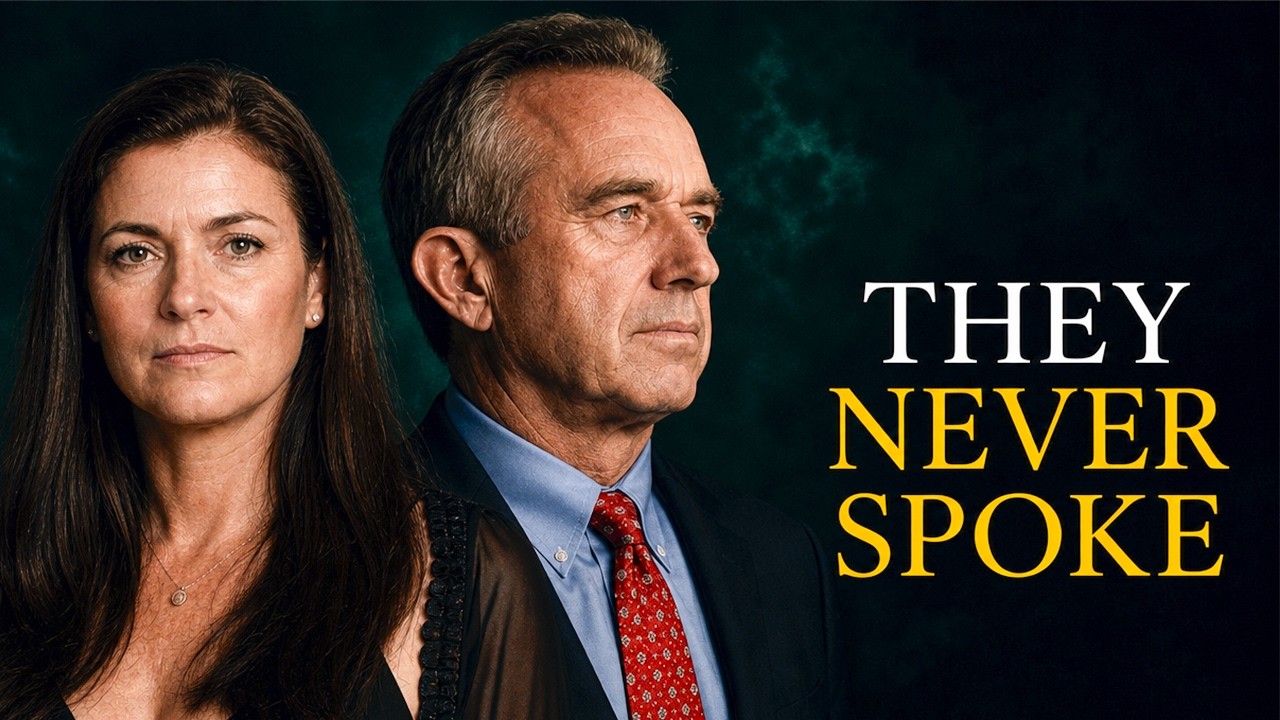
The two families never reconciled. The Richardsons and the Kennedys simply stopped speaking. Permanently.
Bobby’s life resumed its trajectory. In August 2014, two years after Mary’s death, he married Cheryl Hines in a ceremony at the Kennedy compound in Hyannisport.
In 2015, Jerry Oppenheimer published a critical biography of Bobby that revisited the marriage and its end. The counter evidence existed. But counter evidence in a book is a whisper against the 60-page affidavit that ran in a national magazine during a funeral.
The first story told is the story that sets.
Then the balance shifted for a reason nobody in 2012 could have predicted. Bobby ran for president. His 2023 and 2024 campaigns dragged every corner of his biography back under the lights.
In 2024, the journalist Maureen Callahan published *Ask Not*, a book about the women damaged across generations of Kennedy men. Callahan’s account reframed the affidavit not as evidence about Mary, but as evidence about how the family fights. The pattern of inconvenient women recast as unstable the moment they became liabilities.
Its effect was concrete. 12 years after a sealed document defined Mary in death, a best-selling counter archive existed. Every profile of the candidate now had to reckon with the barn in Bedford.
The machinery that had protected the story for a decade was the same machinery that eventually broke it open. Fame kept the affidavit’s version alive. Fame is what finally drew enough scrutiny to challenge it.
And the fragments Mary left became the sourcing. The woman who had no lawyers to match his, no press office, turned out to have done the one thing available to her. She told people. She wrote it down. She made witnesses.
It took over a decade for that quiet, outgunned record to find a publisher. But it did.
As of now, when Mary Richardson Kennedy’s name appears in print, it is more likely to appear as the woman the system broke than as the madwoman of the court file.
That is not justice. It’s something smaller and stranger. A correction, arriving late, carried by the very celebrity that once buried it.
The record won’t settle everything. Whether Bobby loved her, in whatever compromised way he was capable of, whether the affidavit’s incidents happened as sworn, whether Mary could have been saved by different choices, the surviving evidence can’t close those questions.
What the record establishes is the architecture. A woman gave a family 38 years, a marriage 18, four children, and her entire professional life. When the marriage ended, every institution surrounding it answered to one side.
She lost the fight while alive. The fight over what she meant is the one still moving.
Go back to where America came in. The beautiful greenhouse in Bedford, the magazine spreads, the geothermal wells, the crusader and his architect wife modeling a sustainable future.
That house was real. Mary really built it with real talent. It was also the most complete piece of evidence she ever created.
It’s the physical record of a woman who converted everything she had into the stage set of another person’s public life. Until there was nothing left of her that stood on independent ground.
She died 100 feet behind it, sober, mid-litigation, seven weeks before her body was moved to a plot she never chose.
The wedding was on his river. The house was for his brand. The affidavit was his sworn story. The funeral was his eulogy. And the grave, twice, was his decision.
For 18 years of marriage and 13 years since, one side has held every microphone. Which is the plainest way to say what the title says. They never spoke. Because only one of them was ever allowed to.