In the garden of a palazzo on the Grand Canal in Venice, a woman is buried beside her dogs. Their names are carved into small stones near the wall. Hers is there, too, on a simple plaque: Peggy Guggenheim, 1898 to 1979.
A few steps through a doorway hang paintings by Picasso, Pollock, Kandinsky, Mondrian, and Ernst. Roughly 400,000 people walk through that collection every year. Most of them never visit the garden.
The paintings are what people come for. The woman who gathered them, fought for them, and smuggled them across a continent collapsing into war tends to be an afterthought.
The Guggenheim name is everywhere. It sits on a Frank Lloyd Wright spiral in Manhattan and a titanium wave in Bilbao. But the person who did more than anyone to make that name mean art instead of copper and silver was, for most of her life, considered the lesser Guggenheim.
Her father was the brother the family did not quite trust with the business. He walked away from the operation that made the Guggenheims rich, started his own venture, and lost most of what he had. When he died, he left his daughters a fraction of what their cousins inherited.
Peggy took that fraction and built something her grandfather, for all his hundreds of millions, never could have imagined.
This is not really a wealth story. The Guggenheims had wealth, enough to influence governments and reshape entire economies. This is about what happened when that wealth passed through tragedy, grief, and a woman who refused to fit the mold her family had poured for her.
It starts in a village in the Swiss countryside where a boy sold whatever he could carry to keep his family from starving. It ends in an unfinished palazzo on the Grand Canal where that boy’s granddaughter rests in a garden beside the animals she loved most.
Around 1881, Meyer Guggenheim traveled to Leadville, Colorado, to inspect a pair of claims he did not want. He had accepted a stake in two operations as settlement for a debt. When he arrived, the main shaft was completely flooded.
Pumping it out would cost an estimated $20,000. One of his partners decided the situation was hopeless and sold his share. Meyer kept his.
Over the next six years, roughly 9 million ounces of silver and 86,000 tons of lead came out of the two operations. They held some of the richest ore deposits in the state.
Meyer, who had spent 30 years scraping together a living selling stove polish and Swiss lace, grasped something that separated him from almost every other prospector in the Colorado mountains. Pulling metal from the ground was profitable. Processing that metal was far more profitable.
He built a smelter in Pueblo, Colorado, in 1888. Three years later, he consolidated a dozen operations under a single company. In 1901, his sons seized control of the American Smelting and Refining Company, known as ASARCO, the largest metal processing operation in the country.
Meyer was born on February 1, 1828, in Lengnau, a small village in Switzerland. His family was Jewish, and Swiss law dictated where Jews could settle, whom they could marry, and what work they were permitted to do.
His father, Simon, fell into poverty when his wife fell ill. She died when Meyer was six. The children were split up among different households. Meyer, still a boy, went door-to-door after school selling whatever small items he could carry. Not for pocket money, to eat.
In the late 1840s, the Guggenheims and the Weils boarded a ship at Le Havre and crossed the Atlantic. During the voyage, Meyer fell for Rachel Weil’s daughter Barbara. They married a few years later. His step-sister became his wife.
In Philadelphia, he tried everything. Stove polish, lye, imported Swiss lace and embroidery. Every venture did a little better than the last. He was not a visionary. He was a grinder.
When the Leadville opportunity arrived, decades of incremental work had prepared him to recognize what it was. After the claims delivered, Meyer brought his sons into the business. There were seven of them.
The principal Meyer drilled into every one of them was cohesion. Stay together. The family is the enterprise, the enterprise is the family.
Daniel, the second son, emerged as the driving force. After Meyer died in Palm Beach, Florida, in March 1905, Daniel assumed full control and pushed the operation into territory his father had never imagined.
Through ASARCO, through Kennecott Copper, and through a web of partnerships, the Guggenheims extracted copper in Alaska, Utah, and Chile, tin in Bolivia, and diamonds and rubber in the Belgian Congo. One biographer wrote that Daniel could make or break a government with a single telegram.
By 1918, the fortune was estimated at 250 to 300 million dollars. That placed the Guggenheims alongside the Rockefellers and the Vanderbilts at the very peak of American wealth.
The fortune came at a cost that Meyer’s generation never discussed publicly. Workers at a Guggenheim facility in Perth Amboy went on strike in 1912, and four of them were shot by men brought in to replace them. In Alaska, striking laborers were reportedly expelled from their bunkhouses in freezing temperatures.
Then the brothers turned on each other. William, the youngest, accused the older siblings of shutting him out of a profitable Chilean copper operation. In 1922, an internal revolt at ASARCO went further. Board members accused the Guggenheim brothers of diverting company resources for their private benefit.
Daniel was forced out. He stepped away from the business the following year at 67 and retreated to his estate on Long Island.
The machinery Meyer had spent his life constructing was pulling itself apart. His sons would devote their remaining years not to extracting more wealth from the earth, but to giving it away. Fellowships, hospitals, aeronautical research, art museums.
The name Guggenheim, which for half a century had meant silver and copper and brute industrial force, was about to mean something very different. But the person who would change that meaning most dramatically was not Daniel, not Solomon, not any of the seven sons. It was a granddaughter.
Of Meyer Guggenheim’s seven sons, Benjamin was the one who should have been something else entirely. He was the fifth son, born in 1865, and he occupied an awkward position from the start.
He enrolled at Columbia College in 1882, the first Guggenheim to attend a university. He dropped out after two years. He handled some of the silver processing work and earned a nickname, the silver prince, though the title carried more irony than anyone acknowledged.
Daniel ran the empire. Benjamin orbited it.
In 1894, he married Florette Seligman, a member of one of New York’s most prominent Jewish banking families. The marriage deteriorated within a few years. Benjamin spent increasing amounts of time in Paris, eventually keeping a separate apartment there.
The stated reason was business. The actual reason was a woman named Leontine Aubart, a French singer roughly 20 years his junior.
In 1910, Benjamin walked away from the family partnership entirely. The decision baffled Daniel and angered the older brothers. It also proved disastrous. Benjamin lacked the instincts that had guided his father’s generation.
Two years later, he boarded a ship in Cherbourg, France. The Titanic.
He traveled with a small entourage: Leontine and her maid, his valet, and his chauffeur. On April 10, 1912, they set out for New York. Four days later, just before midnight, the ship struck an iceberg.
Benjamin and his valet slept through the initial collision. A bedroom steward woke them, helped Benjamin into a life preserver and a heavy sweater, and sent the group to the boat deck.
Leontine and her maid were placed in lifeboat nine. Benjamin spoke to the maid in German just before the boat was lowered. He told her they would see each other again soon. It was just a repair. The Titanic would sail on tomorrow.
He did not believe this. There were not enough lifeboats. Women and children would go first. The men who remained would not be rescued.
Benjamin and his valet went back to their cabin. They removed the life preservers and the sweaters. They changed into formal evening wear, white ties, tails.
When the steward encountered them again and asked why they had changed, Benjamin reportedly answered that they had dressed in their best and were prepared to go down like gentlemen. He asked the steward to deliver a message to Florette: “Tell my wife I have done my best in doing my duty.”
According to one account, they were last seen on deck, seated in chairs with brandy and cigars. The ship went down at approximately 2:20 in the morning on April 15. Benjamin was 46.
His body was never recovered. The manner of his death instantly became one of the most repeated stories of the disaster.
What the story leaves out is what happened next. What it meant for a wife in New York and three daughters who were about to learn that the Guggenheim name, by itself, would not be enough to protect them from anything.
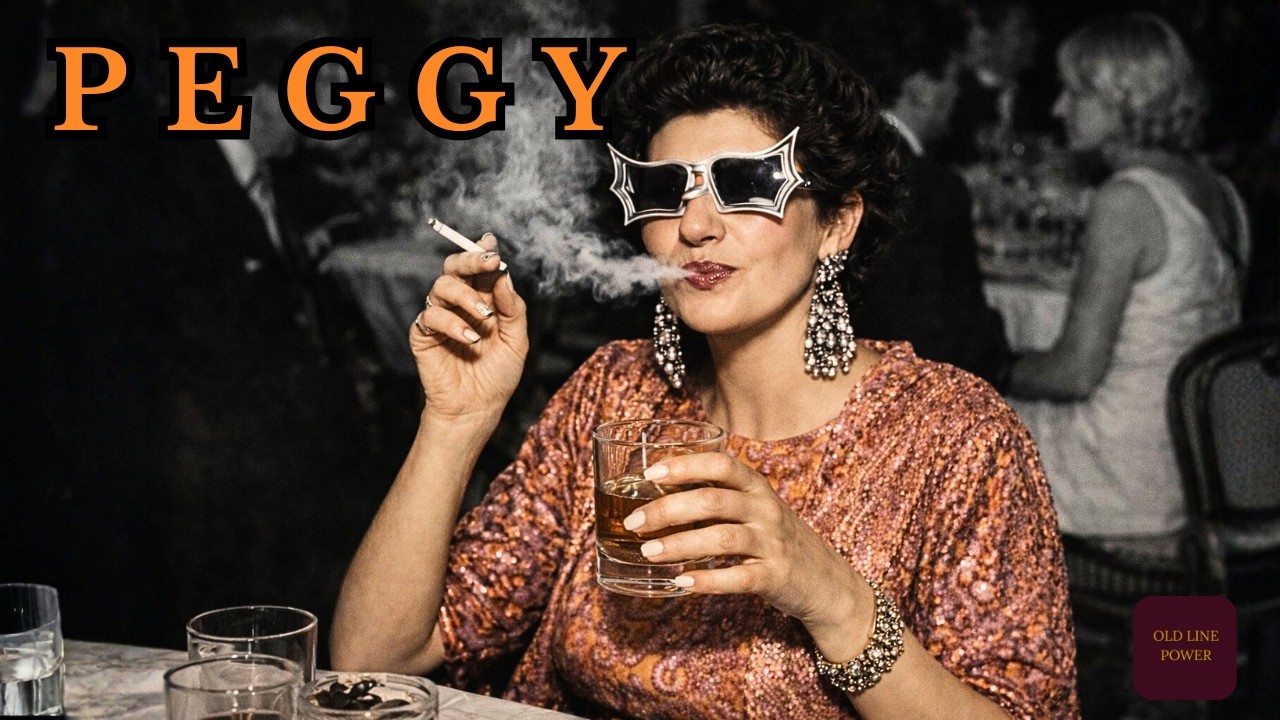
$450,000. That was the trust Benjamin Guggenheim left behind. In most families, that would have been a comfortable inheritance. Inside the Guggenheim world, it was practically an apology.
Peggy’s cousins on Daniel’s side stood to inherit tens of millions. Benjamin’s widow had three young daughters and not nearly enough to raise them the way the family expected.
Florette did what she could. She kept the household together. She stayed in the right social circles. But Peggy sensed the gap early. They were Guggenheims who could not keep up with the other Guggenheims.
Peggy was 13 when the Titanic went down. She barely knew her father. When she turned 21 in 1919, she came into her inheritance. Sources differ on the precise amount. The trust Benjamin left was $450,000. By the time Peggy received her full share, it may have grown to as much as $2.5 million.
Before she left, she took a job at the Sunwise Turn, a radical bookshop in Midtown Manhattan. Then, with her money secured, she booked passage to Europe. She arrived in Paris in 1921, 23 years old, with no plan and no particular reason to come back.
She did not yet know what was about to happen to her sisters.
Benita, the eldest, had married and was trying to start a family. After several painful attempts, she died in childbirth in 1927. She was 32. Peggy, already living in France by then, later wrote that the loss felt as though she had been cut in two.
Then came something no one could have prepared for. Hazel, the youngest, had married a journalist in 1923. They had two sons.
On October 19, 1928, Hazel took both boys to the rooftop of the Surrey, a 16-story apartment hotel on East 76th Street. She was visiting a cousin who lived in the penthouse. Both children fell from the roof.
The New York Times reported the deaths the following day. The medical examiner concluded it was an accident. Two separate police investigations reached the same finding.
Hazel was unable to give a coherent story of what had happened. Within the Guggenheim social circle, other explanations circulated quietly. Her marriage was failing. Her emotional state had been fragile for months.
Hazel spent time in a sanitarium afterward. She divorced in 1930 and spent the rest of her life moving between countries and marriages. She died in 1995 at 92.
Three sisters: one dead in childbirth, one destroyed by a loss no parent should have to carry, and one in Paris watching from across an ocean.
Peggy Guggenheim was 30 when the Surrey Hotel tragedy reached her. Within 16 years, she had lost her father to the Atlantic, her eldest sister to childbirth, and her youngest sister to a grief that would never fully release its grip.
The Guggenheim name had given her just enough money to build a life. It had given her nothing that could protect her from this.
Laurence Vail was the kind of man who entered a room and rearranged the energy in it. Tall, born in Paris to American parents, he wrote plays and sculpted and painted bottles with intricate collages. The expatriate community in Paris had given him a title: the king of Bohemia.
Peggy met him shortly after arriving in Europe. She was 23. He was around 30. They married in March 1922. Her mother disapproved. That may have been part of the appeal.
For a brief stretch, the marriage worked. They settled in the south of France and built a social circle that would have horrified Florette Guggenheim. The anarchist Emma Goldman stayed in a cottage Peggy provided and used it to work on her autobiography.
Vail had a temper that went beyond colorful. He threw things. He screamed. According to one account, he knocked a dish into her lap so violently during a fight that it triggered the labor that brought their daughter into the world.
Their son, Sinbad, had been born in London in 1923. Peggy arrived in Switzerland in 1925. Both children would spend much of their youth being shuttled between countries and relatives.
By 1928, the marriage was over in all but paperwork. Peggy had fallen for John Holmes, a war veteran and writer. She left Vail for him. The divorce came through in 1930.
Holmes died suddenly in 1934, reportedly from complications during a routine surgery. Peggy was devastated. She spent several years in a relationship with the writer Douglas Garman, but it never gave her what she was searching for.
By the mid-1930s, she was approaching 40, living in London, wealthy enough to be comfortable, but not rich enough to sit still.
Then, during Christmas of 1937, she met Samuel Beckett. He was decades away from the Nobel Prize and not yet famous, thin, intense, deeply private. They began an affair that lasted through the winter and into the spring.
When it ended, Beckett had given her something more durable than the relationship itself: a direction. “Stop looking backward,” he told her. “Contemporary art was a living thing. She should dedicate herself to that.”
She listened. On January 24, 1938, she opened a gallery on Cork Street in London. She called it Guggenheim Jeune.
Marcel Duchamp helped select the first exhibitions. The opening show featured Jean Cocteau. The second was the first solo exhibition of Wassily Kandinsky’s work in England. Yves Tanguy followed.
The gallery attracted attention and earned real respect from critics and collectors. It also lost 600 pounds in its first year.
She looked at the numbers and made a calculation that would define the rest of her life. A gallery was too small. What she needed was a museum.
Before the war started, there was a list. Herbert Read, one of the most respected art critics in England, had helped Peggy plan the museum she wanted to build in London. What he produced was essentially a blueprint: every major modern artist who should be represented, with notes on what kind of work to acquire for each.
Peggy closed Guggenheim Jeune with a farewell party on June 22, 1939. She had the list. She had the money. She sailed for Paris in August to begin approaching artists and dealers.
On September 1, Germany invaded Poland. Two days later, Britain and France declared war. The museum project collapsed overnight.
Peggy decided to use the funds to buy the art directly. Work by work, she would acquire what Herbert Read had outlined on paper.
Her own account of what followed became famous. “My motto was ‘Buy a picture a day,’” she later wrote, “and I lived up to it.”
The timing was devastating and, for a collector with resources, extraordinary. Artists were selling at prices that would have been unthinkable two years earlier. Some needed the money to eat. Others needed it to fund their escape from occupied territory.
On April 9, 1940, the day German forces invaded Norway, she walked into Fernand Léger’s studio and bought his 1919 canvas Men in the City for $1,000. Léger reportedly said he was astonished by her composure.
She kept buying. Braque, Dalí, Miró, Picasso, Mondrian, Kandinsky. She acquired a Brancusi sculpture, Bird in Space, as German troops closed in on Paris.
By the time she stopped, she had assembled what historians would later recognize as the foundation of a major modern art collection. The total cost was under $40,000.
Then the question became how to save it. The Louvre refused to store the works. According to Peggy’s account, the museum did not consider them important enough to justify the space.
She arranged for everything to be shipped to a friend’s property near Vichy, then to the museum at Grenoble, whose director accepted the crates reluctantly.
In June of 1940, the Germans entered Paris. Peggy had already left for the south. She spent the next year in Vichy territory, a Jewish-American woman with a famous surname in a region where neither fact offered protection.
She made contact with Varian Fry, an American journalist running the Emergency Rescue Committee out of Marseille. Through his network, Peggy arranged exit documents for herself and her growing entourage: her children, her ex-husband Laurence Vail, his second wife Kay Boyle, and their children, and Max Ernst.
Ernst was a German surrealist painter who had been interned twice by the French authorities as an enemy alien. By the spring of 1941, he was also romantically involved with Peggy. She had helped secure his release and his travel documents.

The group flew from Lisbon to New York on a Pan American Clipper in July of 1941. The collection followed separately, packed in crates and declared as household goods. It arrived in New York intact.
That a private individual managed to assemble, transport, and preserve a collection of this scale while war consumed the countries around her is an episode without many parallels.
The paintings hung from ropes and pulleys, suspended at angles that let viewers tilt them forward and back. The walls curved. The lights flickered on and off at timed intervals. Nothing in the space sat still.
Frederick Kiesler, the Austrian architect Peggy hired to design the gallery, had built something closer to an installation than a room. Critics called it a real experience. Nobody who walked in forgot it.
Art of This Century opened on West 57th Street in New York in October of 1942. Three of the four galleries were dedicated to movements: Cubism and abstraction in one, Surrealism in another, kinetic art in a third. Only the front room functioned as a commercial space where work could actually be sold.
On opening night, Peggy wore one earring designed by Alexander Calder and another by Yves Tanguy. When someone asked why, she said it showed her equal commitment to both sides of modern art.
She had married Max Ernst in December of 1941, a few months after arriving in New York. The marriage was troubled almost immediately. Ernst was proud, private, and uninterested in being known as the husband of his patron. The marriage lasted five years on paper. In practice, it was over long before that.
But the gallery was alive. European refugees and young American painters crowded into the space on 57th Street and found themselves looking at the same walls. Surrealism from Paris next to new work from Brooklyn and downtown Manhattan.
Peggy had created the one place in the city where those two traditions could meet.
That meeting produced Jackson Pollock. Howard Putzel, her assistant and advisor, had been urging her to look at Pollock’s work for months. She was skeptical.
Then Piet Mondrian, the most disciplined geometric painter alive, stood in front of one of Pollock’s canvases for what witnesses described as an uncomfortably long time. Peggy walked over and dismissed the work. Mondrian did not move.
Eventually, he told her that it might be the most exciting painting he had seen in a very long time. Here or in Europe.
Peggy reversed herself on the spot. She gave Pollock a monthly stipend. She gave him his first solo exhibition in November of 1943.
That same year, she commissioned him to paint a mural for the entrance hall of her townhouse. What he delivered was the largest canvas of his career and one of the works that announced abstract expressionism to the world.
Between 1943 and 1947, Pollock had four solo shows at Art of This Century. Rothko showed there. Motherwell and Hofmann, too.
Peggy also staged an exhibition by 31 women in January of 1943, the first documented all-women art show in America. Frida Kahlo, Leonora Carrington, Louise Nevelson, and her own daughter Pegeen were among the artists featured.
The critic Clement Greenberg, reviewing the final season, noted that Peggy had given first exhibitions to more serious new artists than anyone else in the country. He predicted her place in American art history would only grow with time.
In 1946, she published her memoir, Out of This Century. It was candid about her romantic life in a way that scandalized even her friends. That same year, she divorced Ernst.
By 1947, she was done with New York. The gallery closed. She packed the collection and booked passage to Europe. Venice, she had decided, would be her future home.
She had arrived in New York with crates of European paintings that no museum wanted to store. She was leaving with a collection that had helped launch an entire American art movement.
There were two Guggenheim museums in the 20th century, and the people who built them could not stand each other.
Solomon Robert Guggenheim was Meyer’s fourth son, born in 1861 in Philadelphia. He had worked the family business like his brothers and retired early with a fortune large enough that he never needed to think about money again.
For the first six decades of his life, Solomon was the quietest of the brothers. Dutiful, conventional, unremarkable by the standards of a family that measured itself in millions.
Then he met Hilla Rebay. Rebay was a German artist, a baroness by birth, and a believer in non-objective art with the fervor of someone who had found religion. She was introduced to Solomon around 1926, and within months, she had redirected the entire trajectory of his life.
Before Rebay, Solomon collected old masters in the way wealthy men of his generation tended to. Safe purchases, decorative value. After Rebay, he sold most of them and began buying Kandinsky. He eventually owned over 150 of the painter’s works.
In 1937, Solomon established a foundation in his name to promote non-objective art. Two years later, Rebay opened the Museum of Non-Objective Painting in a former automobile showroom on East 54th Street. Bach played through speakers. The lighting was reverential. Visitors were expected to contemplate the work in silence.
Rebay ran the institution with an authority that bordered on autocratic. She also decided who was not welcome. Rebay’s opinion of Peggy was not subtle. She considered her a dilettante who promoted mediocrity and damaged the family name.
When Pollock, desperate for income in 1943, wrote to Rebay asking for a job at Solomon’s Museum, she hired him to make frames and operate the freight elevator. The most important painter of his generation, the man Peggy had just given his first solo show, was building frames in the basement of the rival institution.
Solomon had ambitions beyond the showroom. In 1943, he and Rebay commissioned Frank Lloyd Wright to design a permanent building. Wright, then in his mid-70s, proposed something no one had seen before: a continuous spiral ramp that wound upward from the ground floor to a glass dome.
The design was radical and immediately controversial. Other architects attacked it. Some artists worried the curving walls would distort their work. Wright did not care. Neither did Solomon.
But Solomon never saw it finished. He died on November 3, 1949, at 88. The building took another decade to complete. When the museum finally opened on 5th Avenue on October 21, 1959, Wright himself had been dead for six months.
Rebay had been forced out years earlier, pushed aside by trustees who found her impossible to work with. The temple of pure abstraction she had spent two decades building toward opened without her.
The spiral became one of the most recognizable buildings in America. And in 1969, when Peggy loaned her collection for a major exhibition in New York, the two legacies appeared under the same roof for the first time.
One uncle had believed that art should transcend the material world. His niece believed art should be covered in the fingerprints of the people who made it. He wanted silence. She wanted noise.
The Venetians had a nickname for it: the palace that was never finished. It had been sitting on the Grand Canal since 1749, when the Venier family commissioned the architect Lorenzo Boschetti to build something that would rival the Palazzo Corner directly across the water.
The plan called for five stories, a classical facade in Istrian stone, triple arches rising through two noble floors. Only the ground level was ever completed.
Whether the money ran out or a rival family intervened to prevent the Veniers from overshadowing their own property depends on which story you believe. Either way, the result was a building one story tall on a canal lined with palaces four and five stories high.
Carved lion heads decorated the waterline facade, which is likely where the name came from. Palazzo Venier dei Leoni, the palace of the lions.
For almost two centuries, it sat there. Occasionally occupied, never completed. In 1910, the Marchesa Luisa Casati moved in. Casati was among the most extravagant figures in early 20th century Italy. She walked across St. Mark’s Square with a pet cheetah on a leash and threw masked parties that became legend in Venetian society.
She ran out of money by 1924 and was forced to sell. The palazzo changed hands several more times, declining with each transfer, until it came back onto the market after the Second World War.
Europe was broken. Venice had no tourist economy. Nobody wanted a one-story ruin on the Grand Canal.
Peggy did. She bought it in 1949.
The building was damaged, neglected, and precisely what she needed. Low and wide, with a garden facing the water. Space for her art, space for her dogs, and enough room to live exactly the way she wanted.

The timing was fortunate. The year before, the Venice Biennale had resumed after a six-year wartime pause. Many countries could not afford to participate. The Greek pavilion sat empty because Greece was in the middle of a civil war.
Peggy was invited to exhibit her collection in the vacant space. She filled half the building with European surrealist works and half with American abstract expressionists. For most European visitors, this was their first encounter with Pollock, Rothko, or Motherwell.
Peggy had carried an American art movement across the Atlantic and set it down inside one of the oldest cultural institutions in Europe.
From 1951 onward, she opened the palazzo to the public several afternoons a week, Easter through November. No admission charge. Visitors walked through the rooms where she actually lived. The art hung on the walls of her home because it was her home.
A Picasso in the hallway. A Calder mobile turning slowly above a doorway. A Marino Marini sculpture on the terrace facing the canal.
She owned what was said to be the last private gondola in Venice. In the evenings, she would take it out onto the canal. Sometimes alone. Sometimes with whichever guests had turned up that week.
Truman Capote visited several times during the 1950s. The palazzo attracted writers, artists, collectors, and curious tourists who had heard that an American woman lived in a building full of paintings and dogs.
By the early 1960s, she had mostly stopped acquiring new work. She focused on lending it to institutions across Europe. Amsterdam, Zurich, London, Stockholm.
In 1974, the Louvre exhibited it in Paris. The same institution that had refused to store her paintings in 1940 now displayed them as a major cultural event.
She was in her mid-70s. Her health was beginning to fade. The palazzo grew quieter. But she still opened it on schedule. She still walked through the rooms. She still had the dogs.
The paintings look cheerful at first: bright colors, simple figures, scenes of daily life rendered in a style that sits somewhere between folk art and surrealism. Women in gardens, families at tables, couples standing together.
Then you look at the faces. The eyes are empty. Not stylized. Empty. Every figure in every scene stares out with the same hollow expression, as though the person painting them knew what happiness was supposed to look like, but could not feel it from the inside.
Pegeen Vail Guggenheim painted her whole life. She grew up surrounded by surrealists: Tanguy, Ernst, Breton, Duchamp. They moved through her mother’s homes in France and later in New York, and Pegeen absorbed their influence early.
By the time Peggy opened Art of This Century, Pegeen was a young woman with her own practice already developing. What she made was entirely her own. Critics who noticed the work admired it. But they tended to mention her mother in the same sentence, and that was a shadow Pegeen never stepped out of.
She was born near Lake Geneva in the summer of 1925. Her parents separated when she was three. The custody arrangement sent her to Peggy, while her brother Sinbad went to their father. In practice, neither child stayed in one place for long.
By her teenage years, she was already struggling with depression.
She and her mother loved each other badly. That is the most honest way to put it. Peggy admired Pegeen’s beauty and her art, but could not express affection in ways her daughter could receive.
One biographer reported that Peggy once said she would rather own a Picasso than have a daughter. Whether she said it exactly that way or in what context is disputed. What is not disputed is that the remark entered the family record and stayed there.
Pegeen married the French painter Jean Hélion in 1946. They had three children and settled in Paris. The marriage lasted roughly a decade before ending in divorce.
Shortly after, she met Ralph Rumney, an English painter connected to the Situationist movement. Peggy detested him from the start. Rumney later said that this hostility was relentless and that it compounded the pressure Pegeen was already under.
They married and had a son, Sandro. Her mental health worsened throughout the 1950s and 60s. She drank heavily. She relied on medication.
On March 1, 1967, Rumney found Pegeen in the bathroom of their Paris apartment. She had overdosed on her medication. She was 41. She left behind four sons, the youngest still a small child.
Peggy received the news by telegram while traveling in Mexico. In her memoir, she called Pegeen the love of her life, a mother, a friend, a sister.
What followed was not grief alone. It was war. Peggy refused to accept that the death was self-inflicted. She pressed the French authorities to investigate Rumney. He was questioned, but never charged.
She then used her influence to separate Rumney from Sandro. The boy was raised apart from his father.
In the palazzo, Peggy dedicated a room to Pegeen’s paintings. They hang there still, the bright colors, the hollow eyes. Visitors pass through on their way to the Picassos and the Pollocks, and most of them do not stop.
The name on the wall is Guggenheim, same as every other room. But the work in this one was made by a woman who spent her life trying to be seen as something other than her mother’s daughter, and never quite managed it.
Peggy lived 12 more years. She continued to open the palazzo on schedule. She continued to walk the rooms. She did not collect any more. She did not travel much.
The woman who had once bought a painting a day while an army advanced on Paris now moved through her own collection like a visitor in someone else’s museum.
Peggy Guggenheim died on December 23, 1979, near Padua, Italy, following a stroke. She was 81.
She was cremated. Her ashes were placed in the garden of the Palazzo Venier dei Leoni beside the stones marking her dogs. No grand monument, no family mausoleum, just a plaque, a patch of ground, and the animals she had loved most.
Three years earlier, in 1976, she had signed over the palazzo and the entire collection to the Solomon R. Guggenheim Foundation.
The decision carried a weight that neither institution fully acknowledged at the time. The foundation had been built by her uncle Solomon and shaped by Hilla Rebay, a woman who considered Peggy’s taste in art beneath contempt. Now that foundation would be responsible for preserving every painting, every sculpture, every object Peggy had carried out of a collapsing Europe and championed in a New York gallery that the art establishment had initially dismissed.
The woman Rebay had called a promoter of mediocrity had just handed over what would become one of the most visited collections in Italy.
The Peggy Guggenheim Collection opened to the public in 1980 under the foundation’s management. Within a few years, it had become the second most visited attraction in Venice, behind only the Doge’s Palace.
As of recent estimates, roughly 400,000 people walk through the palazzo annually. The collection itself has been valued at over $3 billion.
$40,000 worth of art purchased in studios and apartments while the German army closed in now sits in climate-controlled rooms overlooking the Grand Canal.
In 2017, Karole Vail, Peggy’s granddaughter, was appointed director of the collection. A Guggenheim is still running the palazzo. Not a mining Guggenheim. Not a smelting Guggenheim. An art Guggenheim.
The transformation Meyer could never have predicted when he stood at the mouth of a flooded mine in Colorado is now complete.
The garden is easy to walk past. Most visitors do. The paintings inside are famous. The names on the walls are names that changed what art could be in the 20th century.
But the woman who put them there is in the garden beside her dogs, in a palazzo that was never finished, in a city built on water that is slowly reclaiming everything around it.
Meyer Guggenheim arrived in America with nothing and built a fortune in silver and copper. His granddaughter took what was left of that fortune after it had passed through tragedy and grief and loss. And she turned it into something that will outlast every mine the family ever dug.
The copper is gone. The silver is gone. The paintings remain.