Ike Clanton was not the man who fired the opening shots at the OK Corral, nor was he the one who fell in the dusty lot on Fremont Street. He was the man who helped make the gunfight inevitable. Hotheaded, ambitious, and rarely without a grudge, Clanton spent 1881 pushing the Earp brothers and Doc Holliday to the edge of violence in the lawless mining town of Tombstone, Arizona Territory. When the shooting finally came, he ran.
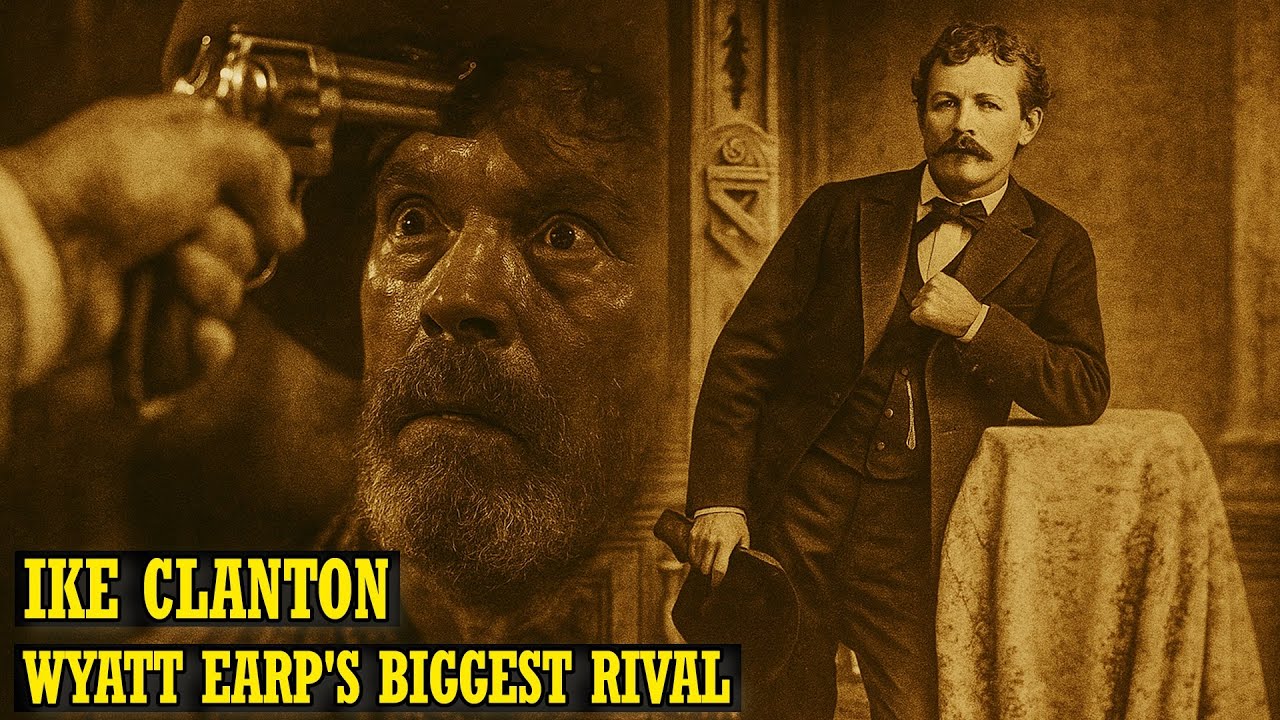
But his role in the conflict would define the most famous gunfight in Old West history, and his life afterward would end the way many feared it would, with a fatal shot in the Arizona brush. Clanton was born Joseph Isaac Clanton in Callaway County, Missouri, one of seven children of Newman Haynes Clanton and Mariah Kelso Clanton. His father worked as a miner during the gold rush, took up farming, and eventually moved the family into the cattle business as they pushed westward. After Mariah passed away in 1866, the family remained close.
By 1877, the Clantons had settled in southeastern Arizona Territory, near the future site of Tombstone, long before the silver boom turned the region into a thriving frontier town. Old man Clanton lived with his sons Phin, Ike, and young Billy. By 1878, Ike ran a modest food stand near the Tombstone Mill site on the San Pedro River. By 1881, he helped manage the family cattle operation at Lewis Springs, about twelve miles west of Tombstone.
The Clantons and their hired hands were part of a loose network of ranchers and outlaws known as the Cowboys. They were rowdy, often violent, and widely suspected of driving cattle across the U. S. -Mexico border under questionable circumstances.
Many accusations were never proven in court, but their reputation for theft and lawlessness followed them. Newman Clanton’s ranch near the border became a hub for moving cattle and goods through the region, much of it outside legal channels. The Mexican government had imposed steep taxes on goods moving north, making unauthorized trade far more profitable than legitimate commerce. Figures such as Curly Bill Brocius and the McLaury brothers regularly traded in these cattle, selling them to men like old man Clanton.
The Clanton family’s conflict with the Earps did not begin with a single dramatic event. It grew from political allegiances, personal grudges, and the pressures of a frontier town divided over law and order. During the November 1880 election for Pima County Sheriff, the Cowboys backed the sitting sheriff, Charles Shibell, while the Earps supported his challenger, Bob Paul. The divide deepened after Wyatt Earp’s horse went missing in late 1879.
More than a year later, Earp received word the animal was near Charleston. He and Holliday traveled to the Clanton ranch to reclaim it. According to Wyatt’s later testimony, eighteen-year-old Billy Clanton sarcastically asked if Earp had any more horses to lose, but returned the animal without demanding proof of ownership. Wyatt read the gesture as a clear sign the Clintons knew the horse belonged to him, and the distrust between the families hardened.
By the spring of 1881, Wyatt Earp was considering a run for sheriff of Cochise County. He believed that solving high-profile crimes would boost his standing with voters. After the deadly March 15 stagecoach robbery near Benson, in which the driver and a passenger were killed, Earp saw an opportunity. According to his later statements, on June 2, 1881, he approached Ike Clanton with a proposition: financial compensation, including the reward posted by Wells Fargo and possibly more, in exchange for information leading to the arrest of the robbers.
The plan collapsed when the three main suspects, Bill Leonard, Harry Head, and Jim Crane, died in separate unrelated confrontations before they could be captured. Clanton’s usefulness to Earp ended, and the rivalry between the men continued to simmer. That simmer became a boil on the evening of October 25, 1881. Ike Clanton had reportedly told several people that Doc Holliday and the Earp brothers had privately admitted to participating in the Benson stagecoach robbery.
The claims were never supported by evidence and were strongly denied. That night, while Clanton was in Tombstone and heavily intoxicated, Doc Holliday confronted him and openly accused him of spreading falsehoods. Their heated exchange drew the attention of Tombstone City Marshal Virgil Earp, who warned both men he would arrest them if they did not settle down. Holliday left for his room.
Virgil stayed out and joined a card game that lasted through the night. The players included Ike Clanton, Tom McLaury, Cochise County Sheriff Johnny Behan, and another man. They played until nearly dawn on October 26. By around 8:00 a.
m. , Clanton was still on the streets, having drunk through the night. Bartender E. F.
Boyle found him in front of the telegraph office and advised him to get some sleep. Clanton said he was not ready to turn in. Boyle later testified that Clanton was carrying a firearm, that he helped cover it to avoid attention, and that Clanton made a troubling statement: as soon as the Earps and Doc Holliday appeared on the street, there would be a confrontation. Boyle went directly to Wyatt Earp’s house to report the threat.
Clanton later denied making any such statement and said he did not recall speaking to Boyle that morning at all. Later that morning, Clanton retrieved his rifle and single-action revolver from the West End corral, resumed drinking, and told people around town that he was looking for Doc Holliday or one of the Earp brothers. Around 1:00 p. m.
, Virgil and Morgan Earp encountered him on Fourth Street. Virgil approached from behind and struck him to subdue him. The brothers disarmed Clanton and escorted him to Judge Wallace for violating Tombstone’s ordinance against carrying firearms within city limits. Clanton later claimed that while waiting for the judge, Wyatt, Virgil, and Morgan offered to return his rifle and fight him on the spot inside the courthouse, an offer he said he refused.
He was fined twenty-five dollars plus court costs. Virgil told him the confiscated weapons would be left at the Grand Hotel. Around 1:30 to 2:00 p. m.
, the situation escalated further. Frank McLaury and Billy Clanton rode into Tombstone from Antelope Springs, about thirteen miles east, where they had been rounding up cattle. They had heard from a neighbor that Ike and Tom had been involved in confrontations the night before. Both men arrived on horseback, carrying rifles and revolvers, which was customary for travel through rural areas outside town.
Given recent attacks by Apache warriors on U. S. Army forces near Tombstone, carrying weapons in the countryside was considered normal and often necessary. On arriving, they stopped at the Grand Hotel on Allen Street, where they encountered Doc Holliday.
Learning that their brothers had each been in physical altercations with the Earps that day, Frank McLaury reportedly refused to have a drink and left with Billy to find Tom. City ordinance allowed visitors to retain their weapons temporarily after entering town, and the law did not clearly define what constituted a reasonable time to surrender them. That ambiguity let Frank and Billy remain armed. Around this time, a man named Coleman informed Virgil Earp that the cowboys had been seen leaving the Dunbar and Dexter livery stable near the OK Corral, still visibly armed.
Virgil decided to intervene and disarm them. He retrieved a short double-barreled shotgun from the Wells Fargo office, concealed it beneath a long overcoat, and walked to Hafford Saloon, where he handed the shotgun to Doc Holliday and took Holliday’s walking stick in exchange, allowing them to switch weapons discreetly. Sheriff Johnny Behan, who had long-standing ties to the Cowboys, later said he did not hear about the developing conflict until after 1:30 p. m.
, when he was at the barber shop. Around 2:30, he spotted both Clanton brothers and both McLaury brothers gathered in a narrow vacant lot off Fremont Street, about fifteen to twenty feet wide, next to C. S. Fly’s boarding house and photography studio.
Several members of the local vigilance committee offered to accompany Virgil, but he declined their help, choosing to rely only on official deputies. He had already deputized Morgan and Wyatt, and brought Holliday on as a temporary deputy earlier that morning. When the confrontation on Fremont Street escalated into gunfire, Ike Clanton did not join the fight. He rushed toward Wyatt Earp, insisting he was unarmed and had no intention of engaging in violence.
Wyatt later recalled telling him something to the effect of: “Then get to fighting or move out of the way. ” Clanton ran into the front entrance of Fly’s boarding house and escaped without injury. By the end of the gunfight, Tom McLaury, Frank McLaury, and Billy Clanton lay dead. Billy was nineteen years old.
Ike Clanton filed murder charges against the Earp brothers and Doc Holliday. All were arrested and released on bail pending a preliminary hearing before Justice Wells Spicer that lasted about a month. Clanton testified that the Earps and Holliday had mistreated him the night before the shootout, that he never threatened them, and that when Virgil ordered the Cowboys to disarm, they complied, raising their hands with Tom McLaury even opening his coat to show he carried no weapon. He alleged Wyatt had pushed a revolver into his abdomen and declared a fight was inevitable.
He supported Sheriff Behan’s claim that Holliday and Morgan fired first. But under further questioning, Clanton’s story unraveled. He accused the Earps and Holliday of staging the Benson stagecoach robbery, claimed each had privately confessed involvement, and even alleged Holliday took money from the stage before it departed. Records showed no money was ever reported missing, and the robbery had not been fully carried out.
Given the severity of the claims and the tense relationship between Clanton and Holliday, the accusations were seen as highly improbable. Spicer ultimately cleared the Earps and Holliday. He noted that Clanton, while unarmed the evening before the gunfight, had openly expressed hostility toward them and said that once armed, he intended to confront them. On the morning of the incident, Virgil had detained Clanton for unlawfully carrying a revolver.
At the time of the confrontation, Clanton carried no weapons. Spicer emphasized that Clanton, being closest and most exposed to the Earps, could have easily been harmed, but was not. He walked away from the gunfight without injury. Clanton’s name surfaced again in connection to the ambush that seriously wounded Virgil Earp on December 30, 1881, leaving him with a permanently disabled left arm.
Though Clanton’s hat was found near the ambush site, supporters claimed he had been in Contention City at the time. Without solid evidence, the case was dropped. On March 18, 1882, Morgan Earp was fatally shot while playing billiards at Hatch’s Saloon. Wyatt was also targeted but not hit.
Believing the legal system would not deliver justice, Wyatt organized an escort to move Virgil and his wife to a train bound for Colton, California. At the Tucson rail station, Frank Stilwell, believed to be lying in wait, was fatally shot. In the days that followed, Wyatt assembled a group of allies commonly called the Earp Vendetta Ride to track down those responsible for the attacks on his family. They never located Ike Clanton, but several cowboy associates lost their lives.
By late April 1882, the Earps and Holliday left Arizona Territory, none of them returning to face legal consequences. The Clanton family moved on, settling near their sister’s property east of Springerville, close to the New Mexico border. By 1885, Ike and Phin each established 160-acre ranches roughly ten miles east of Springerville. Around them formed a loosely organized band of associates, including Lee Renfro, G.
W. “Kid” Swingle, “Long-Hair” Sprague, Billy Evans, and their brother-in-law Evan Stanley, operating from a ranch near Springerville in Apache County. On November 6, 1885, local cattleman Isaac Ellinger shared a meal with the Clantons and Renfro. After dinner, Ike, Renfro, and Ellinger entered a nearby cabin, and an incident occurred in which Ellinger was critically wounded.
He survived several days before dying, reportedly describing the event as unjust and deliberate. Isaac’s brother William, a prominent cattleman and member of the Apache County Stock Association, held significant economic and political influence. Over the following year, tensions mounted. On December 25, 1886, Billy Evans allegedly committed a reckless act resulting in the death of a local man named Jim Hale.
By the mid-1880s, the Clantons and their associates were already under suspicion for cattle theft, with livestock reportedly moved south through remote corridors along the Blue River and Eagle Creek to markets in Clifton. In April 1887, the Apache County Stock Association hired a Pinkerton detective and appointed constable Jonas “Jake” V. Brighton, a known range detective, as a Secret Service officer. Phin Clanton was arrested on cattle rustling charges and held in St.
Johns. Grand juries issued indictments against the Clantons and several associates, including charges of cattle theft and allegations of involvement in Isaac Ellinger’s death. Brighton was tasked with locating Ike Clanton. After a three-day search, Brighton stayed overnight on May 31, 1887, at Jim P.
Wilson’s ranch along Eagle Creek, south of Springerville. The following morning, Clanton appeared. Brighton recognized him immediately. As Clanton began to leave, he retrieved his rifle.
Brighton fired twice. One shot passed through Clanton’s torso, the second struck the saddle and grazed his leg. Clanton fell from his horse and was found lifeless. A newspaper account offered Brighton’s version: Clanton turned toward brush for cover while preparing to use his firearm, ignored calls to stop, and Brighton fired.
Alternative accounts exist. One version claims Clanton’s body remained untouched for several days before being quietly buried in an unmarked grave by Mormon settlers in a cemetery southeast of Eager, Arizona. Modern historians have questioned whether his death resulted from personal motives rather than law enforcement. In June 1996, Clanton descendant Terry Ike Clanton and historian James A.
Browning searched for his final resting place. Near Eagle Creek, they located a shallow grave beneath a large tree they believed held Clanton’s remains. Terry Clanton has since advocated for the remains to be exhumed and reinterred in Tombstone’s Boot Hill Cemetery, but his efforts have not received support from Tombstone officials. Ike Clanton was never the fastest gun in the West.
His weapon was influence, manipulation, and a talent for stirring conflict in a lawless land. While Wyatt Earp carved his legend into frontier justice, Clanton embodied the chaos that made Tombstone famous. He did not fire a shot in the gunfight that bears the town’s name, but he was the spark that helped ignite it, and his life shaped the mythos of the Old West long after the smoke cleared.