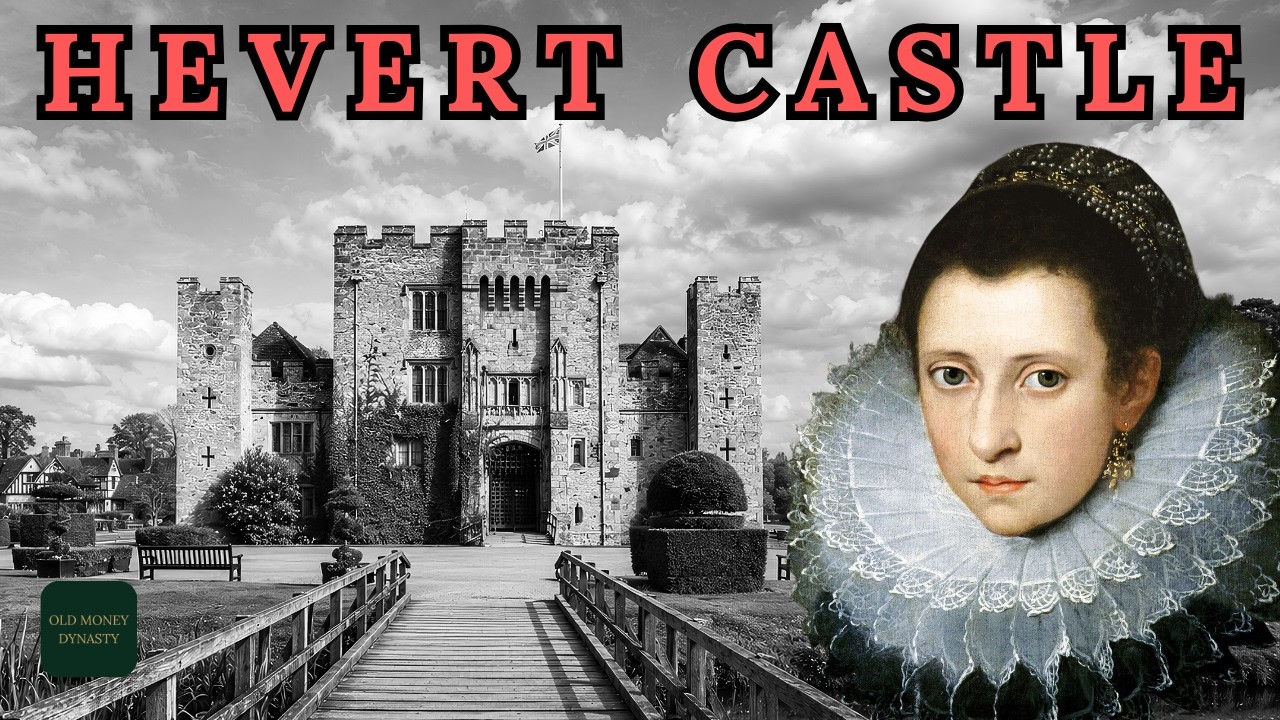
In July 1903, William Waldorf Astor, an American who had left the United States over a decade earlier declaring it no longer had room for gentlemen, purchased Hever Castle in Kent. The 600-acre property, a working farm with tenant farmers, had been owned by the Meade Waldo family since 1749 but had been let out for years. The stone building with a moat and a working portcullis was known to most educated English people as the childhood home of Anne Boleyn, where Henry VIII had courted her. Astor had already spent years acquiring English property and a genuine title.
The purchase came after a tenant, Captain Guy Sebright, had spent eight years and his own money restoring the castle on the understanding that he would eventually be allowed to buy it. The freehold was sold over his head to a man who could pay more and pay faster. Sebright was furious, but no record survives of what passed between the two men. One of them kept records.
The other did not. Before buying a genuine 16th-century house, Astor had commissioned a cathedral architect to build him a false one. The office on the Victoria Embankment in London, completed in 1895, looked like a small fortified house from the 1500s in Portland stone. Astor used it to run his profitable New York property holdings.
He had entered politics in New York, served in the state assembly and senate, then lost two congressional races. After the second defeat, he gave it up entirely. President Arthur appointed him minister to Italy in 1882, where he began buying antiquities. He also wrote two historical novels set in the Italian Renaissance, neither of which is considered good but both reflect a man who would rather have been living in that era.
His father died in February 1890, and Astor inherited a fortune that placed him second in America only to Rockefeller. A family quarrel followed, and in 1891 he sailed for England. Two summers later, New York papers reported he had died of pneumonia. He had not.
The cable that caused the report was later cataloged by the New York Historical Society as a probable forgery, and who sent it was never settled. He read his obituaries and observed that the press had treated him more kindly dead than in years. He never returned to America, taking British nationality in 1899, but he continued drawing money out of the country. His American property alone was assessed at $60 million at his death.
Astor had wanted a title for years. The English system required that a barony be attached to a real place owned by the recipient. He had money, and an office that looked like a castle. What he lacked was an actual castle.
Hever, ringed by water on all four sides, solved that problem. He had earlier bought an English country house from the Duke of Westminster, so this was not about want of a house. It was about the name. Hever had been acquired by Sir Geoffrey Boleyn, a London cloth merchant who became Lord Mayor, in 1462.
He died the following year, but his descendants climbed the social ladder rapidly through strategic marriages. Thomas Boleyn inherited in 1505 and moved the family from Norfolk to Kent, placing them 30 miles from the capital to advance his career at court. His children included Mary, Anne, and George. Contrary to common belief, Anne Boleyn was almost certainly not born at Hever.
The family was still in Norfolk when she arrived, making Blickling the likely birthplace. Even that is an inference. Historians have debated Anne’s birth year for a century. Eric Ives argued for around 1501; Retha Warnicke argued for around 1507.
The strongest evidence on the earlier side is a letter Anne wrote in French to her father soon after reaching the continent. In 1981, art historian Hugh Paget pointed out that no child of six writes that way, but a girl of twelve might. The six-year margin changes how old she was when her father sent her abroad. No household accounts survive from Hever for those years.
What is known is that she was sent in 1513 to the household of Margaret of Austria in Mechelen, then to France, where she remained for about seven years. She lived at Hever for roughly eight years as a child. Three books survive in the world carrying Anne Boleyn’s handwriting, and two are now at Hever. In a library in Rome are 17 letters written by Henry VIII to a woman who was not his wife.
They carry no dates, and every one is in his own hand. Several were sent to Hever. Her side of the exchange does not survive. Anne had returned from France around 1521 and entered the household of Catherine of Aragon as a maid of honor.
She attached herself to Henry Percy, heir to the Earldom of Northumberland. Cardinal Wolsey broke the understanding between them on the king’s instructions, and Anne was sent home to Hever. By about 1526, Henry was asking her to become his mistress. She declined.
That refusal is the hinge of the entire story. It may have been a tactic, or it may have been a woman who had watched what became of royal mistresses and understood the risk. Both readings are available. The consequence is documented.
She went back to Kent repeatedly for months at a time, and he wrote. Henry disliked writing letters and kept secretaries for that purpose. Seventeen surviving letters in his own hand to one person has no parallel elsewhere in his life. Twice he complains he cannot make out her meaning.
In at least one, he drew her initials inside a heart. England was ruled by a man who wrote letters to Kent and then waited for the post. In January 1527, while Anne was at Hever, she appears to have accepted him. No document records the moment.
It is an inference drawn from what happens next, and the reasoning matters more than the conclusion. The tone of the letters changes. The following summer brought the sweating sickness. Anne left London and then caught the disease.
Henry sent his own physician, William Butts, down into Kent to attend her. She recovered. After Anne Boleyn’s execution on May 19, 1536, men went through the royal palaces with chisels. Her arms were cut off the stonework, her initials carved beside the king’s were removed or recut, her falcon badge went too.
The name came out of the paperwork wherever it could be altered. The purge was not entirely successful. At Hampton Court, a workman missed a section of ceiling, and her initial is still entwined with his five centuries later. Seventeen days elapsed from her arrest to her death.
Five men were accused alongside her, including her brother George. Her marriage was annulled two days before she died. The king’s daughter Elizabeth was declared illegitimate. The paperwork was not consistent.
It did not need to be. Thomas Boleyn was not executed. He lost his offices but lived on at Hever, dying there in 1539. His tomb brass shows him in garter robes.
Above one shoulder, cut into the metal, is a falcon, his executed daughter’s badge, placed three years after the chisels had gone around. Anne owned books of hours, the commonest sort of private religious book of the time. One was a small manuscript made in Bruges around 1450. Beneath a picture of the Last Judgment, she wrote a line asking whoever held it to remember her in their prayers and signed her name.
The book left her hands and went missing from the record for a very long time. Possessing an object signed by a woman convicted of treason carried a risk anybody would have understood. In 2021, Kate McCaffrey, a young woman working at Hever and studying for a master’s degree, borrowed an industrial ultraviolet lamp and turned it on the pages. Writing came up out of the paper that nobody had seen for centuries.
The book carried other people’s names as well: Gage, West, Shirley, arranged around a fourth family, Guilford. Every one was Kentish, and everyone was tied to the others by marriage. The group was overwhelmingly female. Her conclusion was that the book traveled along a chain of women, daughter to mother, sister to niece.
Each woman added something of her own next to Anne’s line before passing it on. Somebody had later rubbed the names out, most likely in the 19th century when cleaning marginalia out of old books became fashionable. Under the lamp, they came back. The long gallery at Hever, the castle’s most photographed room, was long thought to date from about 1506, placing its construction in Thomas Boleyn’s hands.
The castle commissioned architectural historian Simon Thurley to examine the fabric. His dating puts the room after 1540. Thomas Boleyn was dead by then. So was Anne.
The person holding Hever that year was Anne of Cleves, who had been queen of England for six months. Almost nobody connects Anne of Cleves with this house, which is strange because she held it for the rest of her life. The marriage ran from January to July 1540. The popular version is a story about a painting by Holbein.
The insult usually attached to that episode, the remark about a Flanders mare, appears nowhere until a bishop wrote it down more than a century later. No contemporary source records it. What actually happened does her considerably more credit. The king wanted out.
She agreed without argument, then negotiated. The ground given for the annulment was a prior engagement from her girlhood, a legal fiction both sides knew. What she took in exchange was not. She received a large settlement in land and income, precedence above every woman in England apart from the king’s daughters and his next wife, and formal standing as the king’s sister.
She kept all of it, outliving Henry and both wives who came after him. In 1553, she rode in Mary Tudor’s coronation procession sharing a carriage with Elizabeth. She died in July 1557 and was buried in Westminster Abbey. Hever came to Anne of Cleves through Henry VIII.
On the last day of 1540, Sir James Boleyn sold the freehold to the king for £200. James was Thomas Boleyn’s brother, Anne Boleyn’s uncle, and had served as chancellor of her household while she was queen. Four years after the chisels, her uncle sold her childhood home to the man who had ordered them. Thurley’s other finding is that Anne of Cleves was at Hever far more than anyone had assumed and put work and money into the fabric while she was there.
If the dating holds, the long gallery was built by a woman who had been discarded at 24 and handed set of houses to be quiet in. Nothing was taken from her, not her money, not her standing, not her nerve. Of the six outcomes available to Henry’s wives, it is the least dramatic and the most successful. Hever reverted to the crown on her death.
She held the house 34 times longer than she held the crown of England. Hever then spent the next two centuries in the hands of people who kept choosing the losing side of English history, and a house owned by losers stops being spent on. Edward Waldegrave, who held it from 1557, was among the men who had let Mary Tudor continue hearing mass against council orders. Under Mary it made his career.
Elizabeth stripped him of his offices within months. He kept his religion, which was the problem. A chapel was built into the wall thickness at Hever, concealed behind paneling. In 1561, a customs officer at Gravesend stopped a traveler and worked out that the man was Waldegrave’s priest.
Waldegrave and his wife were arrested and taken to the Tower. He died in his cell that September, four years after taking possession. The family kept the house, kept the faith, and paid for the combination in the most literal way available. A statute of 1581 set the fine for refusing to attend church at £20 a month, a figure that could swallow a gentry family’s entire annual income, levied month after month on people who saw no way to comply.
English Catholic families were quietly bankrupted by that arithmetic across three reigns. Then came the civil war, and the family backed the king who lost. Royalist estates were sequestered, and the owners had to buy their own land back from Parliament at Parliament’s price. By the early 1700s, they were finished with it.
Almost nothing in this stretch involved violence. Nothing was burnt or besieged. Hever was only ever underfunded. A stone house left alone for two centuries does not stay the same.
Nearly every seat of that rank in Kent was rebuilt at least once between 1560 and 1750. At Hever, almost none of that happened because nobody who owned it could afford to improve it. The Tudor work survived by default. In 1715, the Waldegraves sold.
The buyer was Sir William Humfreys, a baronet and former Lord Mayor of London. From him it passed by marriage to the family that would still hold the freehold when Astor’s visitor found it leaking in 1901. Astor’s restoration was carried out by Frank Loughborough Pearson, whose father had built the embankment office. Thomas of Peterborough took the contract.
At its height, the workforce on the castle came to 748 men. A temporary village was built to house them. Astor had a small cottage built for himself among the works and was on the ground most days. The first thing done was to undo Sebright’s Victorian restoration.
Doors he had hung came off, locks he had fitted were removed, glass he had set was replaced with glass made the old way. None of it was bad work. It was 19th-century work, and the brief was 16th. That distinction cost an enormous amount of money and is the whole logic of the project.
No modern plane was allowed on the site. Men worked the timber with adze and chisel, the slow method that leaves a surface catching light unevenly, so the new work would not announce itself. Nathan Hitch did the carving, William Silverfirth did the modeled plaster ceilings. The first winter brought the valley’s usual problem: water got into the foundations.
Pearson engineered a tiled cellar underneath, sealed to carry the water away from the fabric. That is the moment the project stops being restoration. Central heating went in throughout the house, a private water supply, a firefighting system in a building that had spent 400 years with neither. There was also a power station, since rural Kent had no electricity supply in 1905.
The castle itself was small, holding perhaps 20 usable rooms, and a man in Astor’s position was expected to host shooting parties and weekend guests. So he built a village. The Astor Wing went up between 1904 and 1907 on the far side of the moat. Brick and stone below, timber framing above, arranged to read as a cluster of cottages that had accumulated next to a castle over generations.
Inside, it is one building containing more than 100 rooms. A covered bridge links it to the house. Breaking the mass into apparent cottages hides the scale completely. The deception is complete and in its way honest, because every joint was cut the way a Tudor joint was cut.
It was made new correctly, 400 years late. In October 1906, just over three years after signing for the freehold, William Waldorf Astor slept in the house for the first time. The contract to create a lake was signed in December 1904. It contained a clause about Sundays.
Eight hundred men would work the ground at Hever by day and through the night on every day of the week but that one. The whole thing was to be finished inside two years. They were paid to make a lake where low meadow ran down toward a stream. Astor wanted about 38 acres of open water.
The obstacle was that a river was already using the site. So the river was moved. The River Eden came out of its course and went roughly 50 yards further north into a new channel dug to receive it, and it has run there ever since. Then the public road was shifted west because its old line would have crossed the water.
To make a view from a house, a private individual relocated a river and a public highway. Moving a highway required formal consent, and somebody had to be persuaded. Astor was extremely good at persuading people who could be persuaded with money. Steam navvies did the heavy cutting.
A temporary railway was laid across the site to carry spoil off the excavation. Eight hundred men dug by artificial light in winter in a wet field. No list of names survives, no record of injuries, no account by anyone who swung a shovel. The workforce exists in the archive as a number in a contract.
Weir and lock gates went in to hold the level once the basin was cut. The basin filled in July 1906. Controlling where the Eden ran and how high it sat meant controlling the thing that had been quietly destroying the building. In 1905, Roman marble began arriving in Kent.
Astor had been buying this material since his years as minister in Rome. The collection of classical antiquity was substantial. Some pieces can be traced to the dealer Stefano Bardini in Florence. The difficulty was that Astor had a collection and nowhere to put it.
There is no natural place in a Kentish manor house for a Roman sarcophagus. So rather than fit the marble into the estate, he built an estate around the marble. Joseph Cheal, the landscape contractor, went to Italy in 1903 to see what his client had been describing, going in particular to the Villa d’Este at Tivoli. What came back to Kent was a scheme.
The Italian Garden runs over 200 yards along the north side of the new lake, enclosed by sandstone walls about 13 feet high. One entire side is given over to alcoves and niches cut into the stonework, each built to hold a particular object. The wall was not decorated with sculpture afterwards. It is a container designed after the collection existed, to the measurements of the pieces going into it.
Around a thousand men worked on the gardens across the four years to 1908. A walled Tudor garden was also laid out, planted to a 16th-century scheme and named after Anne Boleyn. Then Rome said no. Astor had bought a balustrade from the Villa Borghese.
Standing on it were antique statues. He tried to buy those as well. The Italian authorities refused to let them leave the country. The balustrade came to Kent.
Its statues stayed in Rome. That is the only moment in this entire story where a person tells William Waldorf Astor no and it sticks. Italy passed its first national law protecting antiquities in 1902 and a considerably stronger one seven years after that. Astor was buying across exactly those years, in the closing window while the rules were being written around him.
The Borghese statues were an early application of a principle that would shortly cover almost everything else he owned. The garden was finished without the pieces he had wanted, and unless you know the story, you cannot see the gap. The gardens were finished in 1908, five years after the purchase. Then in 1916, Astor got the rest of what he was after.
The barony came first, Astor of Hever in 1916, and twelve months after that, a viscountcy. The house’s name became his name. That was the one asset on the property which had never lost its value, and he put it on. Not everybody approved.
Honors were being distributed during a war in ways many people found hard to defend. To a good number of people, it looked like a purchase rather than a recognition. That reading followed him into his obituaries. He died on October 18, 1919, in Brighton, of heart failure.
Hever went to his younger son, John Jacob, who had served on the Western Front and come home without his right leg. The family held the castle for 64 years. What finished them was water, which had been the problem at Hever since the 1200s. Floods went through the estate in 1968.
Holding ground like that against a river it had been fighting for seven centuries stopped making financial sense. In 1983, the castle went on the market with more than 3,000 acres attached and a price of £13. 5 million. Broadland Properties bought it.
The figure paid was never published. It has stayed in private hands since and has stayed open to visitors. Something near 400,000 people walk through it every year. Most of them are there for one woman who left at about the age of 12.
The small manuscript bearing Anne Boleyn’s handwriting surfaced around 1903 after four centuries in which nobody recorded where it had been. Astor bought it, acquiring Boleyn material wherever he could find it. He understood precisely what he had paid for in Kent, and it was not the brickwork. The book went into a case.
Underneath her line, invisible, were the names of the four families who had passed the book between them in the years when passing it was dangerous. Astor never knew they were there. Neither did his son or his grandson. The findings were published in 2021.
The manuscript sits at Hever still, in a case doing what it has always done. What has changed is that the label beside it can now tell you who kept it alive.