Trevor Rees-Jones was 29 years old in the summer of 1997. A former paratrooper, he worked in security for the family of Mohamed Al Fayed. The world’s press would describe him as Princess Diana’s bodyguard. His own account was more precise: he was hired to protect Dodi Al Fayed, and Diana came under his protection because she was with Dodi.
That distinction mattered on the night of August 30-31, 1997. The man giving the orders was Dodi, and Dodi did not take his advice.
The final day began in Sardinia. On August 30, Rees-Jones, a second bodyguard named Kees Wingfield, Dodi, and Diana flew from Sardinia to Le Bourget airport outside Paris on a private Harrods jet. They were ending a 10-day trip. When the plane landed, photographers were already waiting. Rees-Jones said it was clear someone had tipped them off.
The photographers followed them through Paris on scooters and motorcycles. Rees-Jones described them as more aggressive than anything his team had faced all summer. By late evening, around 9:30 or 10:00, the group had returned to the Ritz hotel, which was owned by Al Fayed.
No one had told the security team in advance where the couple planned to eat. Rees-Jones said this was typical of Dodi, and it made access harder than it should have been. While Diana and Dodi went upstairs to the Imperial Suite for dinner, Rees-Jones was on the phone with London, arranging a plan to move crowds and photographers away from the front doors.
He heard that Diana had been crying by the time the couple went upstairs. He did not see it himself. The news reached him secondhand, and he said it was the first time anything like that had happened during the trip.
At some point that evening, Henri Paul came and sat with the two bodyguards. Paul was the acting head of security at the Ritz. He had driven the support car from the airport that morning, with Wingfield beside him, and Rees-Jones said he drove well. Now he was holding a drink. Rees-Jones described it as a yellow liquid and said he did not look closely. He noticed nothing suspicious in Paul’s speech or behavior.
There is a rule in the work that forbids drinking while on duty. The two bodyguards assumed Paul was still working. Blood tests after the crash showed his alcohol level was about three times the French legal limit. Rees-Jones accepted the French results when they came out and said the finding shocked him because Paul had acted like a man in full control of his senses.
Wingfield offered one possible explanation. Paul was smoking a cigar. Neither bodyguard smoked, and the strong tobacco smell may have masked any scent of alcohol. Wingfield called it just an observation, not an excuse.
Then came the plan. While the couple dined, Paul told the bodyguards that Dodi wanted to leave from the back of the hotel in a single car with no protection. Rees-Jones objected. His advice, and Wingfield’s, was to leave from the front in the usual two vehicles after moving the crowds away. Rees-Jones told Dodi that if he insisted on using the back door, he would be in the car with him.
Neither bodyguard had a problem with Paul behind the wheel. Rees-Jones later told British investigators that Dodi did not listen to his arguments and did not want any of them.
The plan was a decoy. Two vehicles would wait in front of the Ritz where the photographers were, with Wingfield among them. In the back, on Rue Cambon, a Mercedes S280 would be brought around with Paul driving, Dodi and Diana behind him, and Rees-Jones in the front passenger seat. Rees-Jones said he was not happy about it because it split his team in half, but he agreed to the plan.
Ritz security cameras recorded much of this. In the inquest, the jury watched footage of Paul consulting with the Ritz head of security, the bodyguards, and the night manager as arrangements were made. While they waited at the back door, Rees-Jones was on the phone again, this time with the apartment the couple were heading to, asking staff to wait for their arrival.
He says Diana and Dodi came down in a cheerful mood, better than the one they had arrived in. He does not think they were frightened. Rees-Jones sat in the front passenger seat. As the car pulled away, he noticed a light-colored small hatchback and two motorcycles with photographers following.
Here his memory stops.
He cannot tell you how fast the car was going because he does not remember. He said that if the speed had become dangerous, he would like to think he would have asked Paul to slow down. Whether he did or not is one of the things the injury took.
Meanwhile, Wingfield was stuck in traffic on the way to the apartment. There had been an accident. He did not yet know whose accident it was. Calls to Rees-Jones’s mobile phone and pages to his pager went unanswered. Wingfield assumed his colleague had slipped into a nightclub, and that was his biggest worry that night because the team was badly short of men.
Then the phone rang. A driver ran to the crash site and reported that Dodi was dead and the princess had injuries to her legs. Wingfield learned Rees-Jones was alive early that morning after meeting the Al Fayed helicopter at Le Bourget and heading to the hospital. On the steps outside, a man in a white coat asked if he was from the security team and told him his friend had survived. Wingfield’s first fear was that Rees-Jones had lost a limb. The doctor told him it was only his face.
Rees-Jones’s next memory is of a hospital room in Paris 10 or 12 days later. His mother was telling him there had been an accident and that he would be fine. He could not answer her. There was a tube in his throat. His jaw was wired shut, and a brace held a broken bone in his neck. His mother wrote the alphabet on a piece of cardboard, and he pointed at letters to ask what had happened to the other people in the car. She told him enough for one day. The next day she told him the rest.
Dodi Al Fayed and Henri Paul died at the scene. Diana died in the same hospital where Rees-Jones was lying. He was the only survivor, and he had to absorb that without being able to speak a single word.
His face had been shattered. French surgeons rebuilt it with about 150 pieces of titanium, using old family photographs as a reference. One operation on his jaw alone took 10 hours. He has since seen pictures of the wrecked Mercedes. He has always said that looking at the car fills him with amazement, because he cannot imagine how anyone survived it, let alone the man in the front seat.
Years later, a court in London showed him security footage of the group leaving the Ritz that night and asked if it brought back any memories. It did not. When he stood on the witness stand in January 2008, the scars of the crash were still visible on his face and head. A psychiatrist who assessed him told the court that the chance of his memory returning was slim.
What came instead was pressure. Within months, the man who paid his wages, a grieving father who believed his son had been killed, was asking whether Rees-Jones remembered a flash of light in the tunnel. Mohamed Al Fayed’s theory was that Dodi and Diana had been killed in a conspiracy and that Rees-Jones held the proof in a memory he was refusing or unable to retrieve.
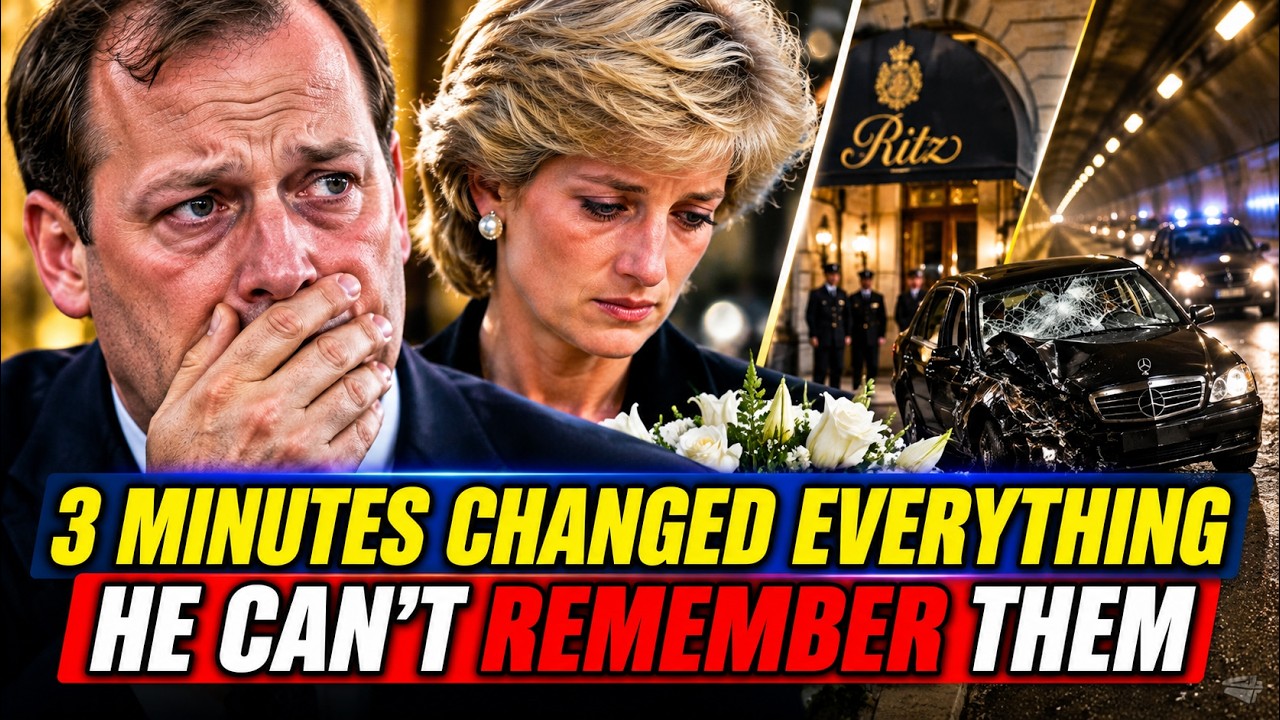
In a 2006 letter to the police officer investigating the crash, Al Fayed wrote that Rees-Jones knew details the security services were anxious to cover up. He listed some: why Paul took the route through the Alma tunnel, a motorcycle blocking the car’s exit, a flashlight blinding the driver. Rees-Jones told the inquest he was not lying about his memory loss.
In early March 1998, six months after the crash, a British newspaper published what was then his most detailed public account of that night. Rees-Jones described flashes of a woman’s voice in the back of the car. First a moan, then Dodi’s name. The Sunday Telegraph reported that Al Fayed had arranged the interview. Two years later, Rees-Jones said on CNN that he no longer accepted those flashes as real memories. He had wanted so badly to remember that things he had read and seen had crept into what he thought he remembered.
One detail complicates this. The French investigation file on the crash scene, which Rees-Jones said he had read, records that Diana was making a sound at the scene, a moan. Perhaps the sound in his flashes matched something real. Yet the recorded sound is very different from the remembered one, and his psychiatrist told him the flashes were false memories.
Even the first fact the world knew about his survival faded. In the early weeks, newspapers reported that he lived because he was wearing a seatbelt. Later technical investigations found that no one in that car was wearing a seatbelt at the moment of impact.
When a CNN anchor asked him in 2000 whether he had any “what ifs,” he said he had gone over that whole night in his mind more than anyone might realize. It is one of the few places in the public record where he describes what that night left in him.
Rees was born in March 1968 in Rinteln, a military garrison town in West Germany, the middle of three sons. His father was a surgeon in the British Army and his mother a nurse. When he was 10, the family settled in Oswestry in Shropshire near the Welsh border. At Fitzalan High School, he joined the Combined Cadet Force, and in 1987 he enlisted in the 1st Battalion of the Parachute Regiment. He served one tour in Northern Ireland and received the General Service Medal.
In 1995, he began working for Mohamed Al Fayed, the Egyptian-born owner of Harrods and the Ritz in Paris. By the summer of 1997, he had spent about 12 months as Dodi’s bodyguard, driving him around London and traveling with him. He had formed a clear picture of the work. Dodi hated being stuck in traffic. If he felt the pace was slow, he would ask the driver to speed up. Rees-Jones said the speed decision was the driver’s, and he never drove faster than he considered safe.
The harder problem was information. Dodi did not tell the security team where he was going until he was already on the way. Rees-Jones said this lack of advance notice made it difficult for him and Wingfield to do their jobs properly throughout that final trip.
The summer began as a routine assignment. In July, the Al Fayed family spent a holiday in the south of France, and Diana came as a guest with her two sons. Rees-Jones joined the security team two days into the trip. He said she was spontaneous, as natural as anyone could be. Wingfield described the same thing in his own words. What struck him most was how simple and modest she was. She also knew who they were. Rees-Jones said that after just one introduction, she remembered the name and used it, and from then on she called the people looking after her by their first names.
At the end of that first holiday, every member of the team received a printed letter signed by Diana and her sons. Many of the letters carried a personal line at the bottom. When asked in 2000 what memory he would keep from that summer, Rees-Jones chose an amusement park. One evening during the first holiday, on the way back from a restaurant, the group stopped at a funfair. He said he would like to think the security team did their job well enough that the Al Fayeds, the princes, and the princess could enjoy themselves like anyone else.
Wallace, a 60 Minutes correspondent, summarized the frustration he heard from Rees-Jones this way: Dodi did not tell anyone where he was going until the last minute, making it hard for the bodyguard to secure the place. Rees-Jones had put up with that for a year.
Then the summer changed. Diana and Dodi went on trips together without the bodyguards. Rees-Jones said he was completely stunned when he learned about them. He had interpreted their earlier friendship as just pleasant conversation between two people of similar age at family events. The picture of the couple kissing was taken when his team was not there, and it shocked him.
Dodi was not the man the newspapers described, according to Wingfield. He considered Dodi quiet and reserved, more a listener than a talker, certainly not a playboy. A guest host on Larry King Live asked Rees-Jones about reports that Dodi was planning to marry an American woman, Kelly Fisher, in August of that year. He said he knew her as an old friend of Dodi’s who had visited them many times. He would have described her as his girlfriend during the previous year. Whether she was there in August, he could not confirm. There was a rumor she was, but no one on the security team ever saw her.
Their final trip was a 10-day cruise on the Al Fayed yacht Jonikal in the Mediterranean, with Rees-Jones and Wingfield on the protection team. Photographers followed them the whole time, occasionally getting close to the couple.
A larger dispute arose over a ring. Mohamed Al Fayed insisted that Dodi bought an engagement ring for Diana in the last days of her life. Rees-Jones and Wingfield were with the couple on a tour of Monte Carlo about a week before the crash, and both confirmed the couple did not stop at any jewelry store. Rees-Jones repeated this before the inquest. When asked whether the alleged Monte Carlo visit happened, he said no.
He does know of one jewelry store visit. On the final day in Paris, he accompanied Dodi to Repossi on Place Vendôme in front of the Ritz. Dodi went in and stayed for between five and ten minutes. Rees-Jones waited at the front door, then accompanied him back to the hotel. Because he did not enter the store, he cannot say what Dodi did there.
As for how serious the relationship was, Rees-Jones told CNN he could not comment on its depth. “You cannot force two people to connect, and clearly something had happened between them,” he said.
Everything that happened between the back door of the Ritz and the hospital bed rests on the testimony of others. Investigators reconstructed the scene from the car, the road, the photographers’ own pictures, and the statements of people who arrived at the crash site.
The Mercedes left Rue Cambon at about 12:20 a.m. Photographers followed on motorcycles and in cars. The inquest jury later concluded that the speed and driving style of those pursuing vehicles contributed to the crash. Paul was driving very fast. Investigators estimated the car’s speed approaching the tunnel at between 60 and 70 miles per hour, more than double the 50 kilometers per hour limit there.
Near the entrance, the Mercedes struck the rear left of a white Fiat Uno. Then it entered the tunnel. The coroner later told the jury there was no evidence of defects in the Mercedes. The Fiat was never found, although investigators believed it was likely involved. Seconds later, the car hit the 13th concrete pillar inside the tunnel at about 12:23 a.m.
Dodi Al Fayed and Henri Paul died at the scene. Diana was alive. Doctors reached the car within about 10 minutes. They gave her first aid at the scene and again on the way, stopping once to deal with her dropping blood pressure. The ambulance arrived at Pitié-Salpêtrière hospital at about 2 a.m. She died there a few hours later. At the close of the inquest, the coroner told the jury he saw no evidence that any doctor or ambulance crew had failed to do their best, with very little evidence that a different course of treatment would have changed the outcome.
Rees-Jones was taken to the same hospital. He was among the last to learn of Diana’s death because he was fighting for his life in the same building where doctors tried to save hers. His injuries were concentrated in his lower jaw, the base of his skull, and his lungs. He also suffered a broken bone in his neck and a fracture to his left wrist. When he was well enough to answer questions, he defended the French health care system. He said in a CNN statement that the care he received was excellent and beyond reproach.
Here, on the subject of the driver, Rees-Jones’s account meets the physical evidence. French police announced the day after the crash that Paul’s blood contained alcohol at three times the French driving limit, roughly double the British limit. Rees-Jones had sat a few feet from Paul that evening, and so had Wingfield. Neither smelled alcohol or heard any slurring.

The coroner, Lord Justice Scott Baker, offered the jury a possible reason. He reminded them that experts who testified on the subject agreed that some people tolerate alcohol to the point where they appear sober to any ordinary observer, even when their blood alcohol is more than double the legal limit. That sentence carries weight in Rees-Jones’s case because it is the closest explanation in the records for why two trained bodyguards noticed nothing unusual. It does not prove the bodyguards made the right decision. But it explains how a former paratrooper, who knew drinking on duty was against the rules, could sit next to the man who would drive him without any suspicion.
On October 3, 1997, just over a month after the crash, Rees-Jones flew back to Britain. He was still communicating only through whispers and written answers. Al Fayed had moved Rees-Jones’s parents to Paris, housed them in an apartment with a car and driver at their disposal, and also moved his brothers there. Rees-Jones said on CNN in 2000, years after a bitter dispute, that he was very grateful for that. While he lay in the hospital, his parents also wrote to Prince Charles, and a reply came from his private secretary.
On the day he left Paris, he was not taken to a London hospital but to Park Lane apartments where Al Fayed was staying. Rees-Jones wanted to go there. He was exhausted and remembered few details, but he remembered Al Fayed crying in a state of great distress.
His memory was another matter. The injury had taken everything from that moment until he woke up in the hospital, and no rest brought back what was lost. In his 1998 newspaper interview, he mentioned that doctors were not confident he would ever regain his memory. His physical recovery was long. Within about a year, his face had returned almost completely to normal. Two and a half years after the crash, he told CNN he felt completely fine. His back stiffened from time to time. His left wrist needed three operations, and part of the left side of his face remained numb.
Rees-Jones set himself a goal of returning to work within six months of the crash, and he achieved it. By early 1998, he was doing light duties in the Al Fayed organization. It was the job he knew, and Al Fayed was generous with his family. It also kept him close to a father who could not accept that his son had died because of drunk driving.
Mohamed Al Fayed was convinced the crash was a murder orchestrated by the British establishment, and he accused Prince Philip of being behind it. He claimed Diana was pregnant and that she and Dodi were about to announce their engagement. He alleged Henri Paul was a paid informant for French and British intelligence, that he was not drunk, that the blood tests were faked, and that he was deliberately directed onto the road leading to the tunnel. The investigations found no evidence Paul worked for any security service, and the coroner asked the jury to set conspiracy theories aside.
Rees-Jones, as the only person who had been inside the car, was the obvious source to search for evidence. He described those meetings later before the inquest. They took place in early 1998 while he was back on light duties, and he said he felt pressure to recover what had happened. Al Fayed would put possibilities to him, including a mysterious flash inside the tunnel, which made Rees-Jones uncomfortable.
Wallace described Al Fayed as a hands-on boss who liked to know everything in detail. Rees-Jones also told Wallace he did not hate the man, that he was grateful for what Al Fayed had done for his parents, and that he pitied a father who had lost his son, but he believed the man was completely wrong.
The newspaper interview came in that period. Rees-Jones explained in 2000 how it was requested. The request was for one interview with the Daily Mirror, centered on whether he could help his boss. Rees-Jones said you would have to be very hard-hearted not to feel sympathy for this man, and he felt sympathy for him then and still did. He was told the article would not be published until after the French investigating judge interviewed him again. In the interview, he quoted his psychiatrist’s name for those memories, describing them as windows of memory, small and short-lived. The chase he described, two cars and a motorcycle pursuing the Mercedes, resembles the one he described on CNN two years later: a small car and a few motorcycles. The interview also quoted him saying that if Paul had shown any sign of drunkenness, he would never have allowed him near the car.
Then the arrangements began to fall apart. A series of events made Rees-Jones feel his trust in his employer was fading, and his lawyers warned him that if he stayed in his job, they could not represent him because he was being used as a mouthpiece for whatever theory was current. He resigned in the spring of 1998. It was reported at the time that Al Fayed said the job would be available if he wanted to return.
Wingfield followed a similar path in his departure. In April 1998, Al Fayed took part in a television program called Secrets of the Crash, and Wingfield was working at one of his properties in Scotland when he was summoned to a meeting in a tent. He says he was told that if he did not participate, he would have to look for another job, and that he should not worry about the questions because they would be provided to him in advance. Wingfield knew his appearance would be interpreted as support for the conspiracy theory, and he did not believe it. He called it an ethical decision, and then he left.
Blame followed. Al Fayed publicly accused both men of a lack of professionalism that contributed to the deaths. They replied that they had advised against using the back exit but were not listened to. He also said he paid all of Rees-Jones’s medical bills. Rees-Jones asked his lawyers to check that and was told it was not true. He said most of the costs were covered by the British National Health Service under an agreement with France. Al Fayed covered limited care in Paris, a few visits to a private hospital after Rees-Jones returned home, and at most three or four physiotherapy sessions. Rees-Jones felt let down by those attacks. He did not see in himself anything that deserved that treatment.
By August 1998, Rees-Jones had left Al Fayed’s employment and was working in a sports shop in a small town in northwest England. As the first anniversary of the crash approached, he gave his first television interview since it happened. Most of what he said was a request. He said August would be hard for him, his family, and all the families involved, and he asked the press to respect their privacy and allow them to mark the anniversary in their own way. He told the interviewer he had cooperated fully with the French investigating judge and given him everything he knew.
His French lawyer took a harder line. He asked judges to examine whether the Ritz management bore any responsibility, citing questions about security, what the hotel knew about the driver’s drinking, and possible pressures. The Ritz was owned by Al Fayed. The man who was once his bodyguard was now, through his lawyer, raising questions about his hotel.
In March 2000, Rees-Jones published his book, The Bodyguard’s Story, written with the help of ghostwriter Moira Johnston. He explained his reasons in a CNN interview. People had urged him for a long time to tell his account, but he had held out. His former employer had accused him and Wingfield of a lack of professionalism that allegedly caused the crash, and Rees-Jones believed everyone had the right to respond. He also had two years of legal bills, which he said he fully deserved to have paid. Then there was the gap. He said the silence he kept was being filled by others with whatever they wanted, and people would keep asking what he remembered and what he knew. The book gave him more control over what was said.
Wallace said Rees-Jones was offered a million dollars by the National Enquirer and similar sums by British tabloids, but he turned them all down. Press reports estimated his earnings from the book at about a million pounds, most of which went to legal fees in the lawsuits Al Fayed brought. Al Fayed tried to block publication of the book in England. The injunction was refused.
Al Fayed’s argument was that the bodyguards had violated confidentiality agreements. Rees-Jones replied that confidentiality about that holiday had already been broken when he and Wingfield were asked, through their work, to speak to the media. He had given an interview to the Mirror, and Wingfield had appeared on two or three television programs. Wingfield put the point more bluntly: “You cannot have it both ways, asking people to say what you want when you want, then asking them to be silent once they stop working for you.”
The 60 Minutes interview aired on Sunday, March 12, 2000. CBS summarized the book that week as not quite the love story the tabloids and Dodi’s father portrayed. Rees-Jones had seen two people enjoying a holiday. He kept saying how far the relationship had developed was beyond his knowledge. Nine days later, Rees-Jones spent an hour on Larry King Live with Greta Van Susteren substituting for the host, joined by Wingfield for part of the program.
Wallace offered his own explanation for why Rees-Jones was speaking now. He was angry at Al Fayed, who was effectively holding him responsible for the crash, and he wanted to set the record straight regarding his and Wingfield’s responsibility. The book deliberately left some things out. Rees-Jones told CNN that anything personal and very private had stayed in the drawers. He would not comment on that. He said all that remained was what actually happened, told with the help of other people.
He was cautious about emotions. When asked about graves, he said visiting them was not a great flood of emotion. He said he was not that kind of person and that he simply wanted to say he had been there to pay his last respects. The Irish Times, in a profile of him the same month the book came out, quoted a more direct version of the same meaning: he was not that kind of man. He had managed to visit Dodi’s grave at the Al Fayed estate in Surrey. He had not visited Diana’s grave, and he said he had refrained for a reason. If anyone found out, it would turn into a media circus. He said if he went, it would be in private and only he would know.
When asked what he would say if he met Diana’s close family, he said he would express his sincere sympathy for what they had been through. He would also tell them that he and Wingfield had done as much as anyone could that night to look after the princess. On the question of blame, his answers were measured. He said the tragic mistake was Paul’s for not declaring he was unfit to drive. Dodi’s idea to leave the hotel through the back door was another possible mistake because Dodi did not take the bodyguards’ advice. Beyond that, he said he and Wingfield did everything they could in those circumstances, and he stood by that. He added that if he felt any guilt, he would not have returned to the field, which he was doing at the time.
The seatbelt story began within three weeks of the crash. On September 21, 1997, French investigators told journalists that photographs taken by paparazzi that night showed Rees-Jones without a seatbelt when the Mercedes left the Ritz, but later images showed him wearing it shortly before the crash. Police believed that last-minute decision had saved his life. They said none of the other passengers were wearing seatbelts. It was a tidy explanation and widely accepted.
The later technical examination, conducted for Operation Paget, reached a different conclusion. None of the four people in the car were wearing seatbelts at the moment of impact, including Rees-Jones. French investigators had by then concluded there was at least slight evidence he was trying to reach for the belt in the final moments. The two findings can coexist: someone trying to reach for a belt in the last second is not someone wearing it. What he did in that final second is known only to him, and he has no memory of it.
His own account changed with the evidence. On 60 Minutes, Wallace asked whether he had worn a seatbelt. Rees-Jones said he did not know and remembered nothing about the ride. He added that the later report, which said he was not wearing it, proved to others that he had not made anything up. Nine days later, on CNN, he said he had been told he was not wearing it, assumed the early reports were wrong, and believed the airbag had saved him in the first impact, after which his face and chest hit the dashboard as the car was pushed.
He explained the habit behind it. In his line of work, he said, bodyguards often do not wear seatbelts because they need freedom of movement inside the vehicle. He and Dodi did not wear belts inside London. When the car left the city at speed, they wore them. He was careful to add that he could not speak for what happened in that Mercedes and could only describe his personal practice.
Wallace pressed the point that critics raised. If Rees-Jones had worn a seatbelt and had not made sure the others wore theirs, that was a professional failure. Wallace also asked why he did not realize Paul was under the influence. Rees-Jones answered both the same way. He had no memory of seatbelts, and he saw no sign of drinking. He agreed with the French court’s finding that Paul was drunk and said the news had shocked him.
On Larry King Live, a caller from New Mexico asked why, as Diana’s bodyguard, he did not insist she wear a seatbelt. Rees-Jones corrected the assumption. He was Dodi’s bodyguard. Dodi was a 42-year-old man, and Rees-Jones could not force him to do things. He said that if he had seen the car going at a dangerous speed, he would have ordered the driver to slow down and asked the passengers to fasten their seatbelts. He could not confirm whether that happened because he had no memory of it.
Lord Stevens, after his 2006 investigation report, stated that Diana, Dodi, and Paul might not have died if they had worn seatbelts, according to The Guardian. The inquest jury listed the absence of seatbelts among the factors contributing to the deaths of Diana and Dodi.
Behind the seatbelts lies a larger fact about that night. Diana was in the care of a private employee of her boyfriend’s family, not under the protection of Scotland Yard. That arrangement dated back to 1993. Her senior royal protection officer, Ken Wharfe, resigned in November of that year. A few weeks later, Diana announced her withdrawal from public life, and in December she gave up the round-the-clock police protection. From then on, she relied on private security. Police protection was mostly limited to times when she traveled with William and Harry.
Wharfe, who published his memoirs in 2002, said he believed the loss of royal protection led to the Paris crash. From his point of view, the private security she relied on lacked the planning, coordination, and communication that proper protection provides. Rees-Jones never claimed to be that kind of officer. He was a paratrooper turned soldier working for a billionaire’s family, and he spent the summer protecting the billionaire’s son.
The French investigation concluded that Paul was drunk and driving too fast, and that finding held for years while Al Fayed pressed his case in courts and newspapers. In 2004, the Metropolitan Police opened its own investigation. Operation Paget, led by Lord Stevens, the former commissioner of the force, issued its report in December 2006 in a document of more than 800 pages. It stated that the crash was a tragedy and found no evidence of a conspiracy.
One chapter dealt with the bodyguards: Rees-Jones, Wingfield, and a third man named Robin Murrell. Operation Paget treated Rees-Jones’s memory as something to be tested. Psychiatrist Maurice Lipsedge, consulted during the investigation, said Rees-Jones remembered getting into the Mercedes and leaving the Ritz, and after that he remembered nothing. When the inquest heard the evidence, Lipsedge told the court that the chances of memory recovery were slim. Coverage published by Yahoo on the 29th anniversary of the crash said the Paget investigation found no evidence that Rees-Jones remembered more than he said.
The inquest began in October 2007 at the High Court in London with a jury of 11 members. Over nearly six months, the court heard from more than 240 witnesses. A week after it began, the jurors went to Paris and walked through the Ritz, including the tiled lobby inside the back service door where the group waited that night. They also saw the tunnel.
Rees-Jones, who was working in Iraq at the time according to Yahoo News, gave his testimony in late January 2008. Two fragments emerged in his testimony. In the first, he was at a traffic light and saw a motorcycle on the right side of the car. He said he remembered that motorcycle very clearly. In the second, he heard someone moaning and heard Dodi’s name without knowing who said it. He reasoned that if there was no one else, it must have been Diana because the voice was a woman’s. He told the coroner the memories were vague, that he doubted them himself, and that he mentioned them because they kept coming back to him. He said his psychiatrist told him they might be false memories. He described no flash of light.
A lawyer asked about the phone calls and anonymous messages that followed the crash. Rees-Jones said the caller ordered him to stay silent and made clear he knew where he lived. He did not take any of it seriously. The lawyer then put to him a story about a remark he was said to have made to a woman, that if he remembered, they would kill him. The court heard that he did not recall any such conversation, and it was considered unlikely he ever said it. That threat, if it was a threat, presupposes a memory he does not have.
He also did not accept the suggestion that British security services paid him to change his story. He told the court he was not part of any conspiracy to hide the truth. All he did was tell the truth as he saw it.
The verdict came on April 7, 2008, after days of deliberation. The jury had five options, from an open verdict to unlawful killing. Manslaughter was not among them. They chose the most serious option available. The coroner told the jurors that unlawful killing is a form of manslaughter. Nine of the 11 jurors agreed the cause was grossly reckless driving by the pursuing vehicles and the Mercedes. All 11 jurors agreed on the absence of seatbelts and the collision with the pillar.
The foreman listed the contributing factors: the speed and driving style of the Mercedes and the vehicles behind it, Paul’s impaired judgment due to alcohol, the absence of seatbelts, and the fact that the Mercedes hit a pillar in the tunnel rather than colliding with something else. Princes William and Harry thanked the jury. They said they agreed with its findings. Mohamed Al Fayed expressed disappointment and held to his belief in a conspiracy.
The verdict mentioned the drivers, the alcohol, the missing seatbelts, and the pillar. It did not mention the bodyguards. Rees-Jones had already expressed his feelings about the official outcome. In remarks carried by Hello magazine, he said he was happy with the inquest results, happy with what he did that night, and that he had moved on.
Rees-Jones returned to his own life, and he had been working on that for years. In September 2000, The Times reported that he had signed a one-year contract as deputy head of security for the United Nations in Suai, East Timor, which the paper described as one of the most dangerous conflict zones in the world, working alongside peacekeepers from Australia, New Zealand, Fiji, and Pakistan. The paper noted that he avoided publicity seriously and refused to discuss his job.
The same report said he had spent two hours at Diana’s grave on the island at Althorp, the Spencer family estate in Northamptonshire. He had told CNN six months earlier that any visit would be private. The visit stayed private for as long as possible.
Later coverage linked him to senior corporate security roles, including the oil services company Halliburton and the pharmaceutical manufacturer AstraZeneca. A profile described him as living in Shropshire and staying out of the public eye. In 2008, the year of the inquest, he was working in Iraq protecting foreign workers. He is 58 now and uses the name Trevor Rees. A Yahoo report on the 29th anniversary said he rarely spoke publicly about the crash in the decade that followed.
Every August, the same facts repeat. The only person who was inside the Mercedes and survived remains unable to provide the one thing people ask of him: the memory of what happened in the tunnel.
The title of this article says the bodyguard broke his silence and that what he saw in Paris still haunts him. The first half of the record holds together. Rees-Jones spoke in 1998, 2000, and again in 2008. The second half rests on very little. In the interviews and testimony reviewed here, he never described himself that way. He told CNN in 2000 that he had to look at himself every day and be satisfied with what happened, that the hypothetical questions were countless, and then he declined to say more.
What he saw in Paris is simple and can be contained. A back door at the Ritz. A driver who had a drink but showed no signs of it. A plan he opposed and then agreed to. A faded hatchback and a few motorcycles behind the car as it pulled away. Since then, two police investigations and a jury have filled in the details of the physical story. The final minutes of his memory remain empty, and he has refused to fill them with anything he cannot verify.
He was 29 when his memory stopped at that door. The last thing he remembers has not changed in all the years since.