In the annals of ancient history, few punishments were designed with such chilling precision as those of Sparta. For most societies, the ultimate penalty was death, the final forfeit of life itself. But the Spartans perceived the matter differently. For a man deemed a coward, they reasoned, death was a mercy—a swift end to suffering.
The true punishment was to make the coward wish for that end, and then to keep him alive, burdened with his shame, unable to escape it. This was the core principle of Spartan justice: a system of civil death, a sentence of living torment. This philosophy was rooted in the very nature of the Spartan state. Sparta was not a city with a formidable army; it was an army with a city.
The entire society—its laws, its customs, and the upbringing of its boys—was organized around a single, overriding purpose: to produce men who would stand firm in the phalanx and never break. A man’s worth, his status, his very identity as a full member of the community, hinged on one question: would he hold his ground, or would he flee? When a man fled, he lost not just a battle, but everything that made him Spartan. The official designation for such a man was tresas, meaning “trembler.
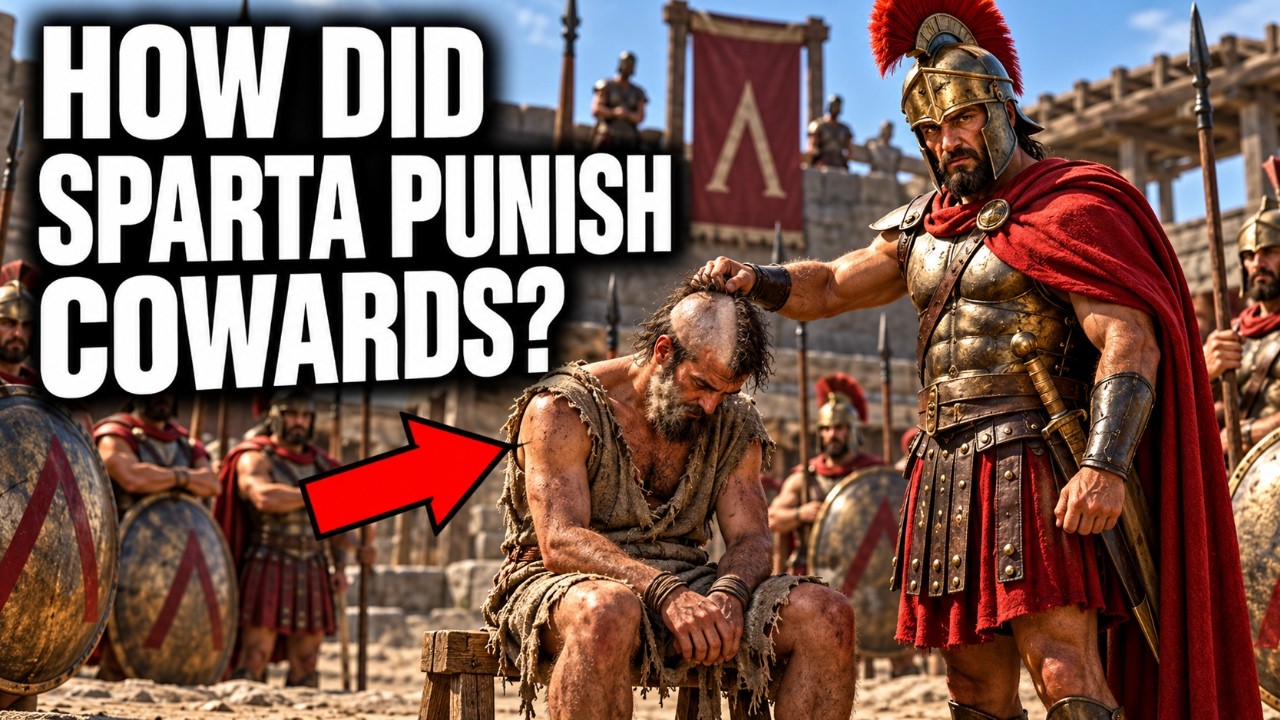
” It was not a passing insult but a permanent, formal classification carried to the grave. It was, in the words of the Spartans themselves, a form of civil death—a state of being where a man still breathed and walked the streets, but had, in every way that mattered, ceased to exist as a person. The systems of punishment were meticulously designed to make this dishonor public, constant, and inescapable. One such punishment was inscribed on the man’s own face.
Spartan men were known for their long hair and full beards, a mark of their identity. The coward, however, was required to shave off half his beard, leaving the other half to grow. This deliberate asymmetry turned his face into a walking announcement of his disgrace. For weeks, he would walk the streets, a visible mark of shame that everyone recognized, and he could do nothing to hide it.
Even his clothing was turned into an instrument of mockery. While Spartans were renowned for their austere and uniform appearance, the coward was forced to wear a cloak patched with bright, clashing colors. This was not a mark of poverty but a badge of ridicule. In a society that prized dignity above all, he was transformed into a walking joke, a figure of laughter rather than pity.
His own identity, so carefully cultivated by his uniform society, was weaponized against him, and he was trapped in his own shame, wearing it on his body, unable to remove it. The disgrace extended to the future, severing his bloodline. In Sparta, marriage was a civic duty directly tied to producing the next generation of soldiers. But no one would marry a man bearing such a stigma, and no family would allow its daughters to marry into such dishonor.
The coward found himself trapped between contradictory expectations: the state required him to marry, yet his shame made it socially impossible. In a society obsessed with producing soldiers, he was forbidden from fathering any… his lineage ended with him. The shame did not merely disfigure his life; it obliterated his descendants before they were born. Daily life became a relentless performance of submission.
The coward was expected to yield his seat, step aside in the streets, and defer to everyone, even his social inferiors. If struck or insulted, he was expected to endure it without resistance. The historian Plutarch records that trembling men were public property, subject to being hit by anyone, and forbidden from fighting back. Every interaction was a fresh humiliation, a constant reminder that he had forfeited the right to defend his honor because he had shown in battle that he had none.
This brutal system was designed to ensure there were as few cowards as possible. The process began at age seven, when Spartan boys entered the agoge—a brutal state-sponsored training system that would shape the next thirteen years of their lives. It was a machine designed to remove fear and replace it with something far more powerful: terror of shame. Boys were deprived of food to learn to withstand hunger, given minimal clothing even in winter, and forced to endure constant hardship, competition, and surveillance.
The goal was to produce men who found the battlefield less terrifying than the disgrace of returning home. Through years of deliberately administered hardship, the Spartans sought to instill in their boys a fear of shame so profound that it would outweigh the fear of pain or death itself. Among all the equipment of the Spartan warrior, the shield was paramount. It was not just a personal defense but a crucial element of the phalanx formation, protecting not only the bearer but also the man to his left.
Throwing away his shield meant endangering the entire line, and so the shield became the ultimate symbol of a man’s commitment. A soldier who lost his helmet or breastplate had suffered a misfortune; a soldier who lost his shield had committed a crime, proving he had cast it aside in flight. The famous proverb, delivered by Spartan mothers to their sons, captured this ethos: “Return with your shield or on it. ” Come back victorious, or come back dead.
The only unacceptable option was to return alive without it, a visible declaration of cowardice. These uncompromising values were enforced by an unexpected group: the mothers of Sparta. Their role in reinforcing military ideals was a defining feature of the society. Ancient sources record mothers urging their sons to return with or on their shields, and even expressing satisfaction at the news of a son’s heroic death.
The most chilling accounts describe mothers who, far from pitying their cowardly sons, were enraged and disowned them, with at least one story claiming a mother killed her own son for his disgrace. Whether such stories are literally true, the fact that they form part of Spartan self-identity reveals a society that leveraged the deepest human bond—a mother’s love—to enforce its martial code. This web of discipline rested on a dark foundation. The Spartan warrior elite was a tiny minority, ruling over a vast population of enslaved people known as helots, who worked the land and made the Spartan way of life possible.
Fearing a helot revolt, the state instituted the crypteia. Each year, the Spartan authorities formally declared war on the helots, so that killing them would not be a religious transgression. Then, elite young Spartan men were sent into the countryside with daggers, operating at night to ambush and kill the strongest and most capable helots, those most likely to lead a rebellion. This was a systematic program of state terror, designed to keep a subjugated population in line through the regular, unpredictable murder of its most formidable members.
The famous Spartan courage at the top of society was made possible by the systematic terror at its base. The entire system comes into sharp focus in the story of one man: Aristodemos, a figure from the most famous battle in Spartan history. At the pass of Thermopylae, a small Greek force held off a massive Persian army for days, and the three hundred Spartans who died there became immortal legends. But Aristodemos was not among them.
According to the historian Herodotus, Aristodemos and another Spartan had been absent from the final battle due to a severe eye infection. While his comrade chose to be led back to the fight and to his death, Aristodemos returned home. His fate in Sparta was a living nightmare. Designated a tresas, he was shunned by all.
No one would speak to him, share fire, or light a lamp for him. He was mocked and ostracized wherever he went. He endured the full weight of the Spartan penal code, a life of unending, daily disgrace, knowing his comrades had become legends while he was the most despised man in Sparta. He got one chance at redemption.
The following year, at the Battle of Plataea, Aristodemos fought with a desperate, reckless fury, leaving the ranks to seek death and reclaim his name. He died, fighting with exceptional bravery in the front lines. Yet even this final sacrifice was denied its intended meaning. The Spartans acknowledged that Aristodemos had fought more bravely than anyone else, but they refused to honor him with the title of the best warrior of the day.
Their reasoning was clear: he had fought not out of courage, but because he wanted to die, to escape his shame. A true Spartan, they said, fights bravely while wanting to live. The system was so total that it offered no exit, not even through a glorious death. Aristodemos had thrown away his life, and even in his pursuit of redemption, he had failed to be a true Spartan.
His story reveals the ultimate purpose of the Spartan system of punishment. It was not about revenge or the display of power. It was a brutal calculus designed to ensure that men would never even consider fleeing the battlefield. The Spartans understood that for some, the weight of public shame was a far heavier sentence than death itself.
And in their relentless pursuit of the perfect warrior, they created a society where a man’s life could become a punishment worse than any mortal execution.