When King Edward VII was buried in May 1910, the woman who had been his companion for twelve years was admitted to the service through a side door. Her name was Alice Keppel, and for more than a decade she had been one of the most influential women in England. Ministers sought her ear. Hostesses competed for her presence. The king himself, it was said, could not be at ease for long without her.
On the day of his funeral, she was let in quietly, apart from the family, apart from the grief the world was permitted to see. It was a small thing, a door. But it marked the end of a life built entirely on the favor of one man.
Alice Frederica Edmonstone was born in 1868 in a gray-walled castle in the west of Scotland. Her father was Admiral Sir William Edmonstone, a baronet with a good name but not a great fortune. The family stood close to grandeur without quite owning any of it. Alice grew up in comfort on the edge of a world that measured everything in money she did not have.
What she had instead was a rare gift. She could make the person in front of her feel like the only person in the world. She listened, she remembered names and worries and small vanities, and she made powerful men feel understood. She did it so smoothly that they rarely noticed how carefully it was done.
In 1891, at 22, she married George Keppel, the third son of the Earl of Albemarle. He was charming, kind, and by most accounts had little fortune and little imagination. He would prove in time remarkably willing to look away. The marriage held a real affection, but the shape of Alice’s life was set early. She had married into a world of grand names while owning almost nothing within it.
Late Victorian and Edwardian high society ran on appearances. A beautiful, clever, discreet young woman could rise very far if she never made the single unforgivable mistake of being indiscreet. Alice learned that lesson better than anyone of her generation. Discretion was not a virtue tacked on afterward. It was the foundation of everything.
By the late 1890s, the Honorable Mrs. George Keppel was one of the most sought-after women in London. She had the looks, the wit, and the gift of making the great feel greater for having been near her. There was only one thing she did not yet have. The one man whose attention could change a clever woman’s entire life.
In early 1898, she met Albert Edward, Prince of Wales. He was 56, heir to the throne of the largest empire the world had ever known, and he had been heir for a very long time. She was 29. Within weeks, the thing was understood. Alice Keppel had become the favorite of the Prince of Wales.
There had been other women before her. But Alice was different. She did not flaunt the position. She made herself not a diversion but a necessity. Everyone who mattered knew, but the world was permitted to know everything and required to acknowledge nothing.
The arrangement had a shape. She lived at 30 Portman Square. The prince came to her in the late afternoons with a regularity the household learned to anticipate. When his carriage drew up at the door, her husband would already have found somewhere else to be. George Keppel did not make scenes. Asked about his wife, he is said to have answered that he did not mind what she did, so long as she came back to him in the end.
In the Portman Square nursery, there were two small girls who knew the heavy bearded gentleman only by the name they had given him themselves. They called him Kingy. He would lower himself onto the floor for them, this enormous heir to the British Empire, and play games with bread and butter slices on his trouser leg. To the children, the most powerful man in England was the funny old friend who played on the carpet.
The gifts came. Edward gave generously, and Alice received gracefully. The king saw to it that the woman he loved would not want for money. He could not hand her funds from the public purse, so it was done through friends and financiers and quiet arrangements. A good position was found for George Keppel, comfortable and well-paid. The king paid the husband to be elsewhere.
The whole apparatus of Alice Keppel’s golden life flowed directly or indirectly from one man’s favor. She was wealthier than she had ever dreamed of being, and not one pound of it was finally, securely hers. It was all a gift, and a gift by its nature can be given back.
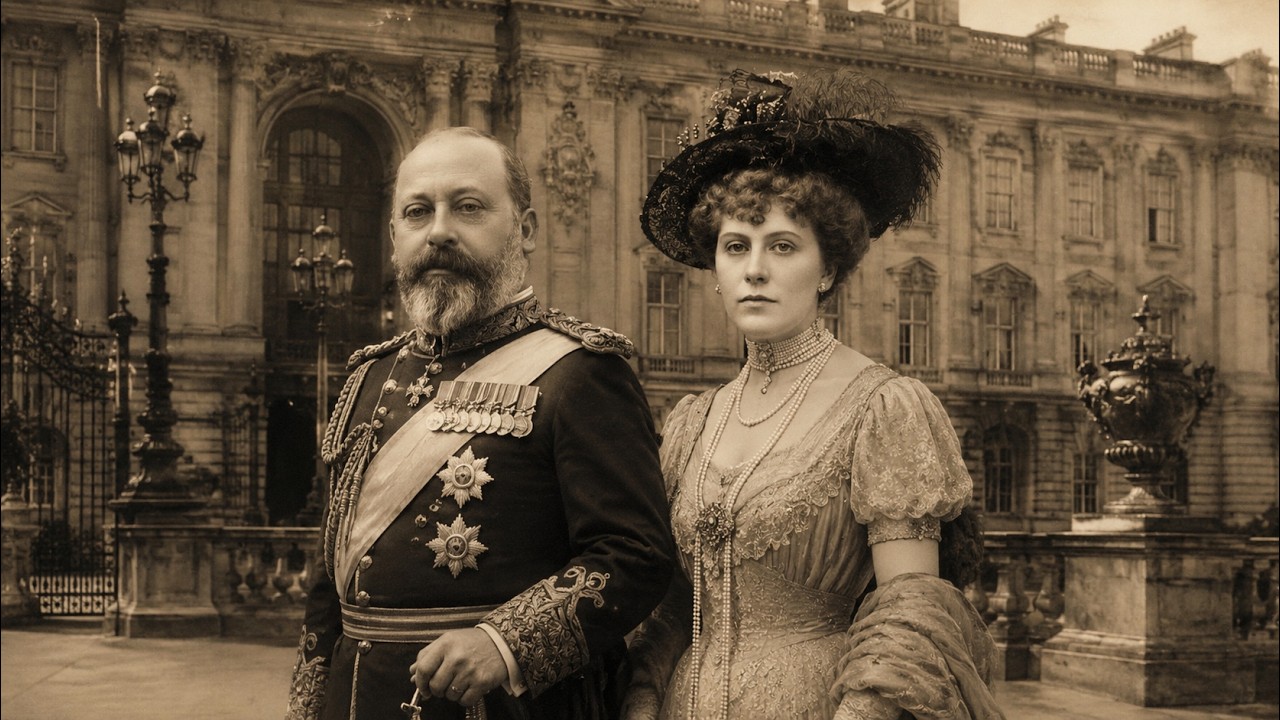
In January 1901, Queen Victoria died. The bored old prince was king now. For the next nine years, Alice Keppel was the most powerful woman in England who held no office, no title, and no claim to anything at all.
The court had a name for her position, borrowed from the French. La favorite. What that meant in practice was power. It was exercised in drawing rooms, over bridge tables, in the long hours after dinner. Ministers learned quickly that the path to the king ran through her.
The king was clever but impatient, warm but volatile. There was exactly one person who could reliably manage him. She knew when to press and when to let it lie. She knew how to make him feel that a concession had been his own idea all along.
Sir Charles Hardinge, one of the most senior officials of the age, wrote of it plainly. There were occasions when the king was at odds with his own Foreign Office, and Hardinge was able through her to advise the king so that the government’s policy might be accepted in the end. The foreign policy of the British Empire, on more than one occasion, was steered through a mistress in a drawing room.
Around 1909, the king arranged the most telling gift of all. Through his friend Sir Ernest Cassel, he saw to it that she was given shares in a rubber company. The shares climbed. By the accounts of her biographers, that single arrangement was eventually worth something in the order of fifty thousand pounds. In the money of our own time, that is several million.
She had everything now. The houses, the jewels, the ear of the king, the deference of ministers. She had taken the only road her world left open to a woman, and she had traveled it to a height almost no one of her station ever reached.
And every single piece of it rested on the health of one man. There were no settlements in her name that the crown could not unmake. No title that would outlive him. No legal claim, no pension, no protection. The power was real, but it was held entirely at the pleasure of a heavy, breathless man in his late sixties who smoked thirty cigarettes and a dozen cigars a day.
In the spring of 1910, the king and his favorite traveled together to Biarritz, as they did every year. But the king arrived already unwell. A chill had settled into his chest and would not lift. Alice wrote a hurried note to a friend, the worry breaking through her careful brightness. She was, she admitted, quite worried, and had already sent for the nurse.
The king came home to England at the end of April, and he did not get better. He should have rested. Everyone around him said so. But Edward VII had waited the better part of sixty years for his crown, and he would not be told to lie down now. He kept his appointments. He received his ministers. He would work to the very end.
On the 2nd of May, he went out to dine in public for the last time. Alice was there. By one account, she looked at him across the table, saw how ill he truly was, and quietly sent him home to the palace. It was very nearly the last thing she would ever be able to do for him.
By the first days of May, there was no more pretending. The queen, Alexandra, had been away, and she came hurrying home, arriving on the 5th. By then, her husband was dying.
Near the end, the king asked for Alice Keppel. The queen, who had borne this woman’s presence in her marriage for twelve years, permitted her to come. Alexandra could be extraordinarily generous. Of her wandering husband, she would say simply, “He loved me the most.”
What happened next, the sources cannot agree upon. In the gentler version, the two women wept together, and the queen was kind. In the other version, the one most of her biographers have come to accept, the scene went very differently. As the king sank toward unconsciousness, Alice became distraught and then inconsolable. The household had to lead the weeping mistress from the room. Some accounts put a sharp command in the queen’s mouth. To get that woman away.

Just after 11 that night, the king died. He was 68. An entire age went into the grave with him. And in that same dark hour, the whole magnificent structure of Alice Keppel’s life began quietly to fall.
Eleven days later, they buried him. She was not refused a place at the funeral. That would have been a scandal. She was granted one. But by the account of her biographers, she was admitted to the service through a side door. Apart from the family, apart from the mourning the world was allowed to see.
For twelve years, this had been a woman who mastered the front door. And now, on the single day it mattered most, she was let in at the side, quietly, when no one would be troubled by the sight of her grief. It told her exactly what she had always been to them. Not family. A guest whose welcome had that week run out.
The new king, George V, had no use whatever for his father’s favorite. The court closed to her. The invitations thinned and then stopped. The power that had run through her for a decade now ran elsewhere. She had not been left poor. The shares were still hers. But money was never what had made her life extraordinary. The world that had given it all its meaning had simply withdrawn.
In November of 1910, only months after the king was buried, the Keppels closed up their English life and left. The reason they gave the world was the education of their daughters. There was simply nothing left for her in England.
The Keppels came back to England in time for the war. By the time the world had finished tearing itself apart, the two small girls were small girls no longer. The younger, Sonia, had grown into exactly the daughter her mother might have ordered. Quiet, beautiful, conventional. She married well and gave her mother no trouble at all.
The elder, Violet, was a different matter entirely. Violet was in love, helplessly, furiously, all-consumingly in love. And not with a man. Her name was Vita Sackville-West. They had known each other since childhood. Now they were grown women, and what had begun as a schoolroom friendship had become the central fact of Violet’s existence.
They ran away together to France openly, recklessly. Violet did not want to be discreet. Violet wanted to be free. And that was the one thing her mother could not allow.
Here was Alice Keppel, the woman who had spent her whole life outside the rules of marriage. The mistress of a king. And here was her daughter asking for the same freedom in her own way. Her mother set out to destroy it.
She used everything. Charm, manipulation, determination, money. The whole arsenal that had conquered a king was now turned at full force on a daughter. Violet was steered into a marriage with a young officer named Denys Trefusis. A marriage that was from the start very nearly a fiction. It did not hold her.
And so her mother reached for the last weapon. Money. She cut off her daughter’s allowance. It was a calculated cruelty from a woman who knew precisely what money meant, because money was the very thing that had made her own freedom possible. Take it away, and a woman of Violet’s class had nothing.
When Violet talked of divorce, of escape, of poverty if that was the price of love, her mother is said to have cut her down with a single line. She would be a laughingstock, Alice told her, reduced once more to plain Miss Keppel, a nobody, an object of pity and gossip.
Read the fear underneath the cruelty. Alice Keppel was not protecting some abstract idea of respectability. She was protecting the only thing that had ever protected her. Her entire glittering life had rested on one single unbreakable rule. You may do anything. You must never be caught doing it.

Discretion was not her hypocrisy. It was her religion. It was the thin membrane that separated a respected society hostess from a ruined woman. And now her own child was tearing that membrane to shreds in public.
What Alice could not say, perhaps could not even let herself think, was the cruelest truth of all. She was demanding that her daughter live a lie because a lie was the thing that had saved her own life. She was punishing Violet for wanting honestly what Alice had only ever been allowed to have in secret.
In the end, the mother won. Of course, she won. She had broken kings to her will. A heartbroken daughter was no match for her at all. The affair was slowly, methodically crushed. Vita went back to her husband and her sons. Violet was the one left broken.
She did not die of it. People rarely do. She lived a long time. But by her biographer’s account, something in her went quiet after that. In her later years, she became a parody of her own mother. Living in grand houses, giving lavish parties, flirting with princes, telling beautiful and flamboyant lies. She built around the ruin of the one true thing she had ever wanted an imitation of the very woman who had taken it from her.
The discretion that had carried the mother to the side of a throne became the cage that held the daughter for the rest of her days. To the end of her life, Alice Keppel believed she had done the right thing. She had played the world by its rules and won. She had never once learned how to let someone she loved be free.
In 1925, Alice and George Keppel bought a villa on a hill above Florence. It was called the Villa dell’Ombrellino. Galileo himself was said to have lived there once. And here, in the long Italian light, the last great Edwardian mistress made herself a kingdom in miniature.
She gave perfect parties. To the terrace gardens came the exiled kings and queens of half of Europe. The dethroned, the displaced, the leftover royalty of a world the great war had swept away. A young Winston Churchill came to paint. Alice presided over it all exactly as she once had over Edwardian London. An uncrowned queen reigning over a court of other people’s lost thrones.
She never lost the old certainties. In December 1936, news reached the world that the king’s own grandson, Edward VIII, had given up the throne of England to marry a divorced woman he loved. The old mistress of his grandfather was overheard delivering her verdict in a single dry sentence. Things, she said, were done much better in my day.
Underneath the wit is the whole of her creed. In her day, a king kept his throne and his love both, and the world looked politely away. In her day, you did not blow up your life for passion. You arranged it. You kept the surface bright. She had built her life on that principle and crushed her own daughter’s heart to defend it.
The end came in Florence in September 1947. Alice died of a failing liver at 79. She had been married to George for 56 years. He did not last without her. Just over two months later, George Keppel died too. After 56 years of making way for her, it seems he could not find the way to go once she was gone.
They were buried together in the same foreign soil beneath the cypresses of a city that had never been theirs. And there for a long time, the story of Alice Keppel was allowed to rest. Quietly in the margins. The side door of history.
But history keeps strange accounts. The throne that Alice Keppel could never touch was not finished with her bloodline. She had two daughters. The wild one, Violet, had no children. Her grief ended with her. But the quiet one, Sonia, had a daughter of her own. And that daughter had a daughter, a girl born in the very year Alice Keppel died.
That girl would grow up to fall in love in her turn with a Prince of Wales. She would wait through decades of scandal and exile of her own. And she would at last, against every prediction, marry her king. A century after the side door, Alice Keppel’s own great-granddaughter would stand in Westminster Abbey and be crowned Queen of England.
The position the mistress could never have. The dignity she was denied at a funeral. The place at the very center, in the full light, with nothing hidden and no side door at all. History gave it in the end to the blood of the woman it had cast out. And gave it openly. And gave it a crown.
Alice Keppel never knew. She had been in her grave for two years before the child was even born. She died believing she had played a brilliant game and won everything a woman of her world could win. She was wrong about her daughter. She was wrong about the cost. But about her own strange, borrowed, brilliant life, perhaps in the end she was not so wrong. She had reached for a crown she could never hold. And a hundred years later, in a way she could never have dreamed, the reaching came true.