On the night of July 22, 1934, the air outside the Biograph Theater in Chicago was thick with summer heat. John Dillinger stepped through the lobby doors after watching Clark Gable die on screen in *Manhattan Melodrama*. He wore a straw hat tilted low, wire-rimmed glasses, and carried a loaded automatic in his right pocket.
He walked about 20 feet down the sidewalk before FBI agent Melvin Purvis lit a cigar. That was the signal. Agents stepped out of the shadows. Dillinger reached for his pistol but never cleared the pocket. Five shots cracked through the night. Three bullets found him. Two tore through his body, and one struck the back of his neck, exiting just under his right eye.
He pitched forward onto the pavement. Minutes later, in a back room at a nearby hospital, the most hunted man in America was pronounced dead at 31 years old.
Dillinger was not just a bank robber. He was the man who humiliated J. Edgar Hoover, broke out of an escape-proof jail with a wooden gun he carved himself, and hit bank after bank across the Midwest. Newspapers called him Public Enemy Number One. Farmers in Indiana called him a hero. The FBI called him the reason their entire agency had to be reinvented.
Hollywood never told the full story. That night, Dillinger thought he had vanished. He had no idea the woman walking beside him in the orange skirt had already sold him out for $5,000 and a chance to stay in the country.
John Herbert Dillinger was born June 22, 1903, in Indianapolis, Indiana. His father owned a small grocery store and a handful of rental properties. The family was working-class, not rich, not poor. John’s mother died when he was 3. That changed him. His father remarried six years later, but the boy never connected.
He started shoplifting young, stealing coal from rail yards as a teenager, and picking fights. His father moved the family to Mooresville, Indiana, when John was 16, hoping the country air would settle him down. It didn’t. He dropped out of school, joined the Navy in 1923, and deserted a few months later because he hated taking orders. He came home, married 16-year-old Beryl Hovious, and tried to live straight for about a year.
In September 1924, Dillinger made the decision that defined his life. He was 21, broke, and angry. A friend from the local pool hall named Ed Singleton told him he had a plan. A grocer named Frank Morgan walked home every Saturday night with the day’s cash. They would jump him on the street. Quick money, no witnesses.
They botched it. Morgan fought back. Dillinger hit him with a bolt wrapped in a handkerchief. The grocer survived. The cops arrested Dillinger that same week. His father told him to plead guilty. The judge gave him 10 to 20 years. Singleton, who fought the charge, got two.
That sentence built Dillinger. At the Indiana State Reformatory in Pendleton, he met Harry Pierpont, a cold, careful planner, and Homer Van Meter, a fast, reckless gunman. When they were transferred to the tougher Indiana State Prison at Michigan City, Dillinger requested a transfer to join them.
At Michigan City, the crew came together. Charles Makley, the smooth talker, a former cigar salesman turned career thief. Russell Clark, the muscle. John Hamilton, a steady Canadian hand. They studied bank floor plans the way other prisoners studied scripture. They told Dillinger one thing over and over: when you get out, don’t waste time on grocery stores. Banks have money. Banks have insurance. Nobody dies, and the cops barely chase you.
Dillinger sat behind bars for roughly nine years. He walked out on May 22, 1933. His father had begged for parole, gathering signatures from more than a hundred neighbors, and even the prosecutor who put him away.
The country was different now. The Great Depression had gutted America. Banks had failed by the thousands. Families were starving. Farmers were losing land to the same banks that took their savings. Dillinger walked back into that world with a head full of plans and a heart full of rage.
He hit his first bank just 19 days later. June 10, 1933, the National Bank in New Carlisle, Ohio. Dillinger and a couple of accomplices walked out with $10,600 in cash. He worked it like a script. No yelling, no panic. The local paper said the robber was polite.
That word followed him for the rest of his life. Polite, charming, almost gentle. People who watched him work said he tipped his hat to women on his way out the door.
But Dillinger wasn’t just robbing banks. He was running a project. Every score went into a war chest with one purpose: break Pierpont, Makley, Clark, and the rest of his prison brothers out of Michigan City.
He hit bank after bank that summer. Montpelier, Indiana. Bluffton, Ohio. Indianapolis, where the state bank job alone paid out $25,000. He used the money to bribe guards and smuggled three pistols into the prison hidden inside a barrel of thread delivered to the shirt shop where inmates worked.
On September 26, 1933, Pierpont, Makley, Clark, and seven other convicts pulled those guns, took the deputy warden hostage, and walked out of Michigan City. Ten of the most dangerous men in the Midwest were free because of John Dillinger.
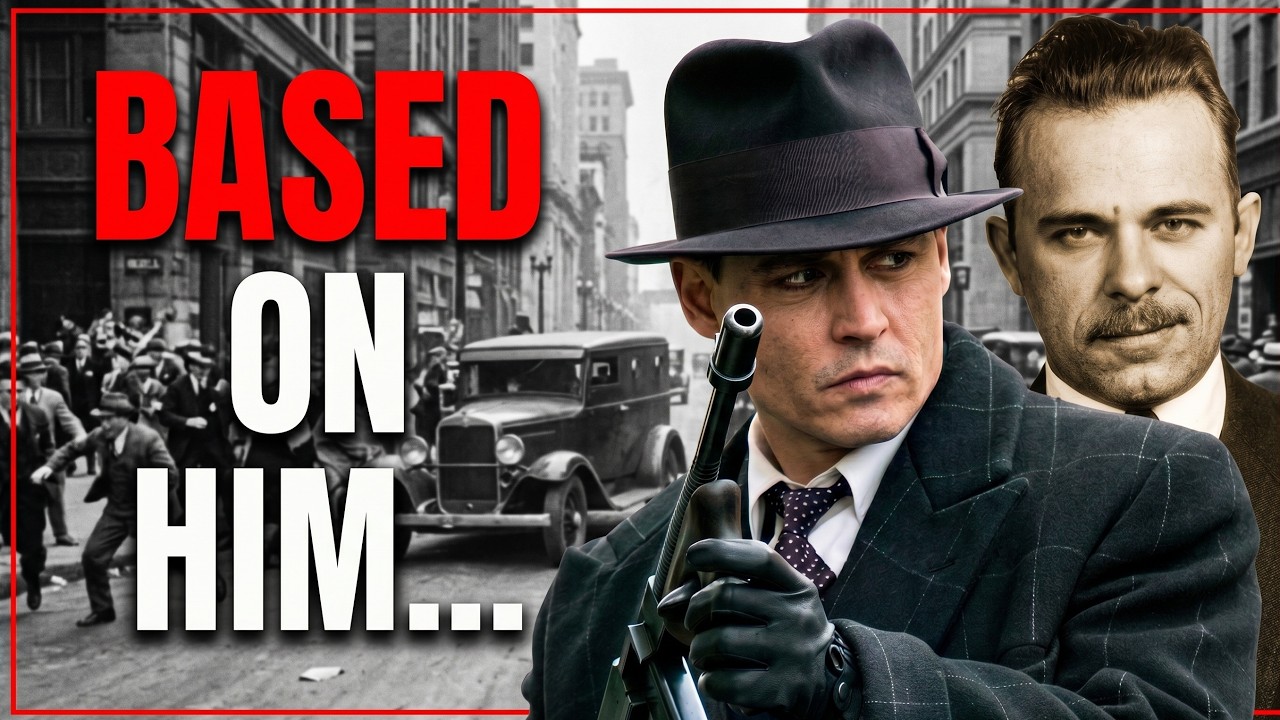
The irony? Dillinger himself had been arrested four days earlier in Dayton, Ohio. He was sitting in a jail cell when his crew broke free. So Pierpont returned the favor. On October 12, 1933, Pierpont and three others walked into the Lima, Ohio jail, told the sheriff they were there to transfer Dillinger, and when Sheriff Jess Sarber asked to see their credentials, they shot him. Sarber died that evening. Dillinger walked out a free man.
The first Dillinger gang was born. Between October 1933 and January 1934, the gang hit banks across the Midwest. Greencastle, Indiana, $75,000, one of the biggest single hauls of his career. Racine, Wisconsin, $27,000. East Chicago, Indiana, $20,000.
They moved like a military unit. Dillinger handled the floor and the customers. Pierpont covered the door. Makley worked the vault. They wore bulletproof vests stolen from police arsenals. They carried Thompson submachine guns. They knew the back roads of three states by heart. They switched cars on every getaway, hiding stashes in barns owned by farmers paid in cash who asked no questions.
The American public ate it up. You have to understand the moment. 1933. One in four men out of work. Banks foreclosing on family farms. Children starving in cities that had been booming five years before. And here came this charming, smiling bandit knocking over the same banks that had ruined so many lives.
Newspapers ran his picture on the front page. Women sent him love letters. Songs were written about him. He wasn’t just a criminal anymore. He was a symbol.
J. Edgar Hoover saw it differently. Hoover was running an agency most Americans had never heard of, the Bureau of Investigation. No power to cross state lines. No authority to make arrests in most jurisdictions. His agents weren’t even allowed to carry guns without special permission.
Hoover needed a war. A villain big enough to justify expanding his Bureau into the kind of federal police force he’d been demanding for years. When Dillinger started crossing state lines after every robbery, Hoover finally had his ticket. He put a young, sharp-dressed agent named Melvin Purvis in charge of the Chicago field office and told him one thing: get Dillinger by any means, whatever it costs.
Before Purvis could close in, Dillinger walked into the biggest disaster of his career. East Chicago, Indiana. January 15, 1934. The First National Bank. The gang took $20,000. But on the way out, police officer William Patrick O’Malley stepped in front of Dillinger with his revolver drawn. He fired. The bullet struck Dillinger’s bulletproof vest. Dillinger raised his Thompson submachine gun and cut O’Malley down.
The officer died on the bank steps. He left behind a wife and children. That was the murder charge that would follow Dillinger to the grave. It was the only homicide ever formally charged against him, though the gang’s body count by then was much higher.
Eight days later, the gang made another mistake. They drove to Tucson, Arizona, for a winter break. A fire broke out at the hotel where some of them were hiding. Firefighters helped carry their luggage down. The luggage was suspicious, heavy, clinking. The firefighters recognized faces from a detective magazine.
Within 72 hours, the entire core of the gang was in custody. Pierpont, Makley, Clark, Dillinger. All four arrested without a shot fired. Dillinger was extradited back to Indiana to stand trial for the murder of Officer O’Malley.
They put him in the Lake County Jail at Crown Point, Indiana. Sheriff Lillian Holley told reporters her facility was escape-proof. Guardsmen surrounded the building. Reporters lined up to photograph the famous prisoner. Dillinger smiled for the cameras, even put his arm around the prosecutor for a now-famous photograph.
A few weeks later, on March 3, 1934, he walked out the front door.
Here’s how it happened. Dillinger carved a piece of wood into the shape of a pistol. He blackened it with shoe polish. On the morning of March 3, he held that wooden gun on a guard during routine breakfast service. He locked guard after guard and trustee after trustee in cells, one by one. He walked into the warden’s office, took two real Thompson submachine guns from the rack, grabbed a hostage, and walked out the front door.
He stole Sheriff Holley’s brand new Ford V8 and drove away. Free again. The humiliation was complete. Sheriff Holley resigned in disgrace within weeks.
Dillinger made one critical mistake. He drove that stolen sheriff’s car across the state line from Indiana into Illinois. That was federal. Driving a stolen car across state lines violated federal law, and that gave Hoover his opening. The Bureau finally had jurisdiction, and the manhunt went national.
Purvis got the green light to use any tactic necessary. Wiretaps. Informants. Lethal force. The rules were off.
Months later, on his 31st birthday in June 1934, John Dillinger was officially branded the FBI’s first Public Enemy Number One with a $10,000 reward on his head.

But for now, Dillinger was already gone. He drove to Chicago and reunited with his girlfriend, a quiet half-French, half-Menominee woman named Evelyn Frechette, called Billie by everyone who knew her. She was dark-eyed, soft-spoken, and absolutely loyal. She’d been working as a hat check girl when she met Dillinger in the fall of 1933. She knew exactly what he did for a living. She didn’t care.
Dillinger built a new crew that spring. Homer Van Meter was still loose, so was John Hamilton. He brought in a vicious gunman from Chicago named Lester Gillis, better known as Baby Face Nelson. Barely in his mid-20s, 5 feet 4 inches tall, and one of the most violent men in American organized crime. Nelson loved killing lawmen. Dillinger didn’t trust him, but he needed gunmen.
The second Dillinger gang hit the Security National Bank of Sioux Falls, South Dakota, on March 6, 1934. Nearly $50,000. They hit the First National Bank of Mason City, Iowa, on March 13. $52,000. Dillinger took a bullet in the shoulder during the Mason City job. He kept running.
In late May, he paid underworld doctors to remake his face in a back room procedure and to burn off his fingerprints with acid. He nearly died on the table from the anesthetic. He thought he was disappearing. He wasn’t.
On April 9, 1934, federal agents grabbed Billie Frechette outside a Chicago tavern. Dillinger had been waiting in the car at the curb. He saw the agents move. He could have driven straight at them. He drove away. He’d never see her again. She got two years in federal prison for harboring a fugitive.
Two weeks later came the Little Bohemia disaster. April 22, 1934. The gang was hiding at a rural Wisconsin lodge called Little Bohemia in Manitowish Waters. A tip came in. Purvis loaded his agents into cars and rushed up from Chicago.
They arrived in the evening. They didn’t surround the building. They didn’t wait. Three local men walked out of the lodge getting into a car to leave. The agents thought they were the gang. They opened fire, killed one civilian, wounded two others.
The shooting alerted Dillinger and the gang inside. They slipped out the back into the dark Wisconsin woods. Baby Face Nelson killed Special Agent W. Carter Baum at point-blank range during the chaos. The entire gang got away, every single one.
The newspapers crucified Hoover. Congress threatened to dissolve the Bureau. Purvis offered to resign. Hoover refused. He wanted Dillinger alive or dead, but mostly dead.
That’s when the trap finally started to close.
In the summer of 1934, Dillinger was hiding in plain sight on the north side of Chicago, living under the name Jimmy Lawrence. He had a new girlfriend, a waitress named Polly Hamilton. Polly lived with her landlady, a Romanian immigrant named Anna Campanas, who went by the American name Anna Sage.
Sage ran a brothel on the side. She was facing deportation as an alien of low moral character. She was desperate.
In July, Sage figured out who Jimmy Lawrence really was. Dillinger had let his guard down. He’d been going to movies, drinking at neighborhood bars, even strolling past police stations, laughing too loud at his own anonymity.
Sage made one phone call. She sat down with Melvin Purvis and told him everything. She wanted money. She wanted her deportation case dropped. Purvis promised a cut of the reward. He said he’d do what he could about the deportation but couldn’t guarantee it. Sage agreed anyway.
She told him Dillinger was planning to take her and Polly to a movie soon. She’d wear a white blouse and an orange skirt so the agents could spot him in the dark.
For days, Purvis waited. He had agents staked out near both possible theaters, the Marbro and the Biograph. On the evening of July 22, Sage made the call. Biograph. *Manhattan Melodrama*.
Roughly 20 federal agents, joined by a few East Chicago police officers, fanned out around the Biograph theater that night. They sweated through their suits in the heat. Just after 8:30 in the evening, Dillinger walked up to the ticket window with Polly on one arm and Anna Sage on the other.
Sage’s orange skirt looked red under the marquee lights. That single detail, an outfit that photographed as red, would create the legend of the woman in red.

Dillinger paid for the tickets and went inside. He sat through *Manhattan Melodrama*, 93 minutes of Clark Gable playing a gangster who walks willingly to the electric chair. He came out around 10:30.
Purvis lit his cigar. Agents converged. Dillinger sensed something. He reached for the pistol in his right pocket. Three agents fired five shots in all. Three found their mark. One struck the back of his neck and exited under his right eye, the wound that killed him.
He stumbled and fell on the pavement beside the alley next to the theater. He was pronounced dead at 10:50 that night at a nearby hospital. He was 31 years old.
The three agents who fired, Charles Winstead, Clarence Hurt, and Herman Hollis, were each commended by Hoover. None of them ever said which one fired the fatal shot, though history has mostly credited Winstead.
Within minutes, crowds surged into the alley. People dipped handkerchiefs in his blood. Women collected fragments of his clothing as souvenirs. The body was put on public display at the Cook County Morgue, where some 15,000 people filed past in a day and a half. Then it was taken home to Indianapolis, where thousands more lined up before burial in Crown Hill Cemetery, the same grounds where his mother had been buried since his childhood. His casket was eventually encased in concrete to stop souvenir hunters from digging it up.
The aftermath rewrote American history. Hoover used Dillinger’s death as the foundation of everything the FBI became. Within a year, Congress passed laws giving federal agents the authority to make arrests, carry firearms, and pursue criminals across state lines. The Bureau of Investigation was renamed the Federal Bureau of Investigation in 1935.
Purvis became a national celebrity. Hoover, jealous of the attention, pushed him out of the Bureau within about a year and spent the rest of his life ensuring Purvis never got credit. Purvis died in 1960 of a self-inflicted gunshot wound, widely believed to be suicide, with a pistol from his own collection.
Anna Sage got her $5,000. The deportation went through anyway. She was sent back to Romania in 1936 and died there of liver disease in 1947, poor and largely forgotten.
Polly Hamilton lived quietly under different names until her death in 1969. Billie Frechette served her two years, toured briefly billing herself as Dillinger’s lost love, and died in 1969.
Baby Face Nelson was killed in a shootout with federal agents in November 1934, four months after Dillinger. Homer Van Meter was killed by St. Paul police that August. Pierpont and Makley were tried and convicted for the murder of Sheriff Sarber. Makley was shot dead trying to escape the Ohio State Penitentiary with another fake gun, the same trick Dillinger used at Crown Point. Pierpont was electrocuted in October 1934.
The first Dillinger gang was wiped out in barely more than a year. Every single member dead or in prison.
The gang’s total take across its run is estimated at somewhere between $300,000 and half a million dollars. Spread across a dozen members over little more than a year, that’s not Hollywood money. Dillinger died nearly broke, reportedly with just a few dollars in his pocket when they searched his body.
He hadn’t gotten rich. He hadn’t escaped to Mexico. He hadn’t built an empire. He’d run, fought, hidden, and bled his way through one of the most desperate years any American outlaw ever survived.
What he did was rewrite the rule book. Before Dillinger, the federal government had no real power to chase criminals. After Dillinger, the FBI became the agency we know today. Before Dillinger, bank robbery was mostly a local crime. After Dillinger, robbing a federally insured bank became a federal offense. Before Dillinger, men thought fingerprints could be burned off and identities erased. After Dillinger, J. Edgar Hoover built a national system to track every felon in America.
He wasn’t a hero. He killed a police officer with a family waiting at home. He robbed savings from people who had nothing left to save. He pulled men into a life that put nearly every one of them in a grave before they grew old.
But he wasn’t just a villain, either. He was a Depression-era kid with no education, no options, and no patience who decided the only way out was through. He picked banks because banks had taken everything from the people he came from. He picked partners because partnership was the only family he had left after his mother died and his father gave up on him.
And in the end, he picked the wrong theater on the wrong night to watch a movie about a gangster walking to his own execution.
The real story isn’t the gunfire. It isn’t the bank vaults. It isn’t even the woman in the orange skirt. The real story is this: a federal agency was built on the corpse of one polite, smiling thief from Indianapolis. And every time the FBI raids a house, taps a phone, or hunts a fugitive across state lines today, they’re using powers that were forged in the alley behind the Biograph Theater on the night of July 22, 1934.
That’s the real cost of John Dillinger.