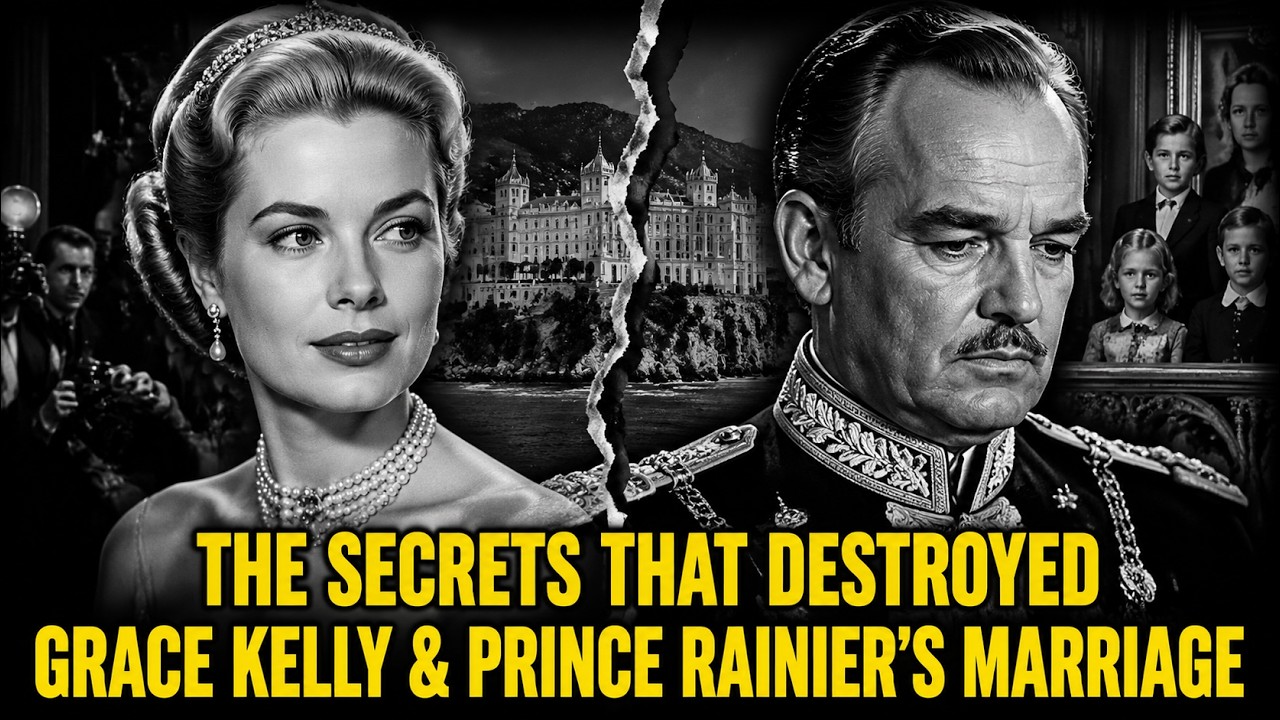
The marriage of Grace Kelly and Prince Rainier III of Monaco has been told for decades as a fairy tale. The Oscar-winning actress married a sovereign prince, moved into a palace above the Mediterranean, and lived a life of glamour and duty until her sudden death in 1982. The reality, as documented across multiple serious biographies and primary sources, is considerably more complicated.
The marriage ran from April 1956 to September 1982. It produced three children, a documented pattern of control over Grace’s professional and personal life, and a career ending that she did not recognize as permanent until it was too late to change it. It also produced a depression she carried for years, a body of philanthropic work that still operates today, and a gradual separation of two people into parallel lives inside the same palace.
The story begins in Philadelphia. Grace Patricia Kelly was born on November 12, 1929, the third of four children in a family built around athletic achievement and exacting standards. Her father, Jack Kelly, was a construction magnate and three-time Olympic gold medalist in rowing. He ran the household on the understanding that achievement was the baseline. He also held a fixed opinion that acting was not a serious profession. That view did not adjust as evidence accumulated against it.
Grace moved to New York at 18 to attend the American Academy of Dramatic Arts. She paid her tuition through modeling work and began landing roles in early live television drama. By the time she reached Hollywood, she had more live performance experience than most of her contemporaries.
Her first significant film was High Noon in 1952 opposite Gary Cooper. She was 22. Cooper was 51. The production drew attention for the chemistry between the leads. Hitchcock saw it and took note.
The Africa production for Mogambo in 1953 was a different experience. John Ford brought Grace, Clark Gable, and Ava Gardner to locations in Uganda and the Belgian Congo. Grace was 23. Gable was 52. What developed between them on location has been addressed by biographers with varying levels of specificity. The consistent element across accounts is that the attraction was mutual. Gable later said she was the most fascinating woman he had ever known.
Then came Hitchcock. Dial M for Murder was shot in early 1954. Rear Window followed the same year. Both films revealed what Grace could do in front of a camera. She had access to a register of intelligence and contained emotion that Hitchcock understood how to use.
To Catch a Thief was shot in the summer of 1954 on the French Riviera near Cannes and Monaco. Cary Grant played the lead. Grace played an American heiress. She and Grant became genuine friends during the production. He would be at the wedding and would remain one of the people she called when the palace became too much.
The Country Girl was the role that won the Oscar. It required Grace to play someone unglamorous and exhausted. The studio had reservations about asking their most photographed asset to appear on screen in a frumpy housecoat with dark circles under her eyes. She did it anyway. She won the Academy Award on March 30, 1955, at age 25.
By the spring of 1955, the pace of her professional life had taken something from her. She was working inside a studio system that was extracting everything it could from her as a commodity. The MGM contract worked the way studio contracts of that era worked. It was designed to benefit the institution rather than the individual it was extracting from.
In May 1955, the French magazine Paris Match asked her to pose for a photograph with the reigning prince of Monaco during the Cannes Film Festival. Grace agreed. It would fill an afternoon before a dinner engagement. She borrowed a floral dress because her own clothing was at the laundry.
The Monaco she was being brought to meet bore almost no relationship to the Monaco of current imagination. The principality of 1955 was in genuine financial difficulty. It is approximately 2.1 square kilometers, smaller than Central Park. Its economy ran almost entirely on the Société des Bains de Mer, the SBM, a company that owned the casino, most of the major hotels, the opera house, and most commercial property of any size in the principality.
The international gambling market had changed since the 1920s. Cheaper casinos had opened along the French and Italian coasts. The SBM’s quarterly reports told the same story each quarter. The man reading those reports with the most acute concern was Aristotle Onassis. He had acquired roughly a third of the SBM’s shares in the early 1950s.
Onassis was not interested in Monaco as a cultural institution. He was interested in it as an investment, and his investment was underperforming. His analysis was that the American tourist market was not coming to Monaco in sufficient numbers because Monaco had nothing that gave American tourists a reason to put it at the top of their European itinerary. The American market ran on faces. If a face sufficiently recognizable to the American public was associated with Monaco, the American market would respond.
The face needed to be American, Catholic, and recognizable enough across enough magazine covers that the association would stick. Rainier had a private chaplain and spiritual adviser named Father Francis Tucker, an American Dominican priest. Tucker had arrived at much the same analysis as Onassis from a different direction. The prince needed an American Catholic woman of public profile.
The Paris Match correspondent who arranged the Cannes meeting later went on record that the afternoon of May 6, 1955 did not come together through coincidence. It was staged. The photographer, the setting, the specific participants had been arranged in advance by people with practical reasons for wanting the photograph to exist.
Grace had not been given full information about what she was walking into. She found Rainier courteous and unexpectedly shy. The photograph that resulted ran in Paris Match, then in Life magazine, and in papers across Europe and the United States. It ran in 40 countries.
After Cannes, Grace wrote to Rainier. He wrote back. The correspondence ran through the summer and fall of 1955. In October, Grace accepted an invitation to visit Monaco for four days in December. She brought her parents.
She also underwent a medical examination administered by palace physicians. The reason was the Franco-Monégasque Treaty of 1918. It established that if the reigning prince of Monaco died without producing a legitimate Grimaldi heir, the principality would revert to French sovereignty. No heir meant no Monaco.
The palace had run the same examination with a previous relationship and had terminated it based on the results. Grace Kelly was presented with the same requirement. She passed. The palace moved forward.
On January 5, 1956, Grace Kelly announced her engagement to Prince Rainier III of Monaco. She had known him for eight months. She had spent approximately ten days in his physical company across two meetings. She had agreed to leave the United States, surrender her professional identity, give up her citizenship, and produce the children that a treaty required her to produce.
She had also agreed to a financial transaction. The dowry was $2 million in 1956 currency, approximately $23 million today. Her film earnings covered half. Her father covered the remainder. He was not quiet about it. He thought the arrangement was humiliating. He paid it anyway.
Grace spent the months between the announcement and the wedding completing the two films she owed MGM. The Swan was a period romantic comedy about a princess being presented to a crown prince. High Society was her final American film. She was on screens playing a socialite while being measured for a wedding dress that would be seen by 30 million people.
She thought she was pausing. She would resume. She said this to friends. She believed it.
The wedding took place over two days, April 18 and 19, 1956. The civil ceremony first, then the religious ceremony at the Cathedral of Our Lady Immaculate. The television audience was estimated at between 30 and 45 million. It was one of the most watched television events in history to that point.
Grace’s dress was designed by Helen Rose, MGM’s chief costume designer, and built from 25 yards of silk taffeta, antique rose point Brussels lace, and pearl beading. Rose and a team of seamstresses worked on it for six weeks. Among the guests were Cary Grant and Frank Sinatra.
After the ceremony, the couple embarked on a Mediterranean honeymoon cruise aboard Rainier’s yacht. They were extensively photographed at ports. When they returned to Monaco and Grace moved into the Palais de Monaco, the practical dimensions of what she had agreed to became concrete.
The palace was not a comfortable domestic environment. It was a working government building organized around governmental function rather than domestic warmth. The rooms available to Grace were formal and cold. She worked on them over the following years with a seriousness that people who observed the results consistently noted.
The Monégasque aristocratic circle was small, historically self-referential, and protective of its codes. Grace was assessed immediately as a Hollywood actress. She was not rejected. She was maintained at a social temperature that indicated she was on probation. People were gracious in the formal sense. People were not warm in the personal sense.
Her French was functional but insufficient for the precision that court-level social occasions required. She worked at it consistently. The palace staff were another layer of the same problem. They were professional, courteous, and completely opaque about their actual assessments. Their institutional loyalty ran to Rainier.
She could not casually telephone a friend in Philadelphia without that call passing through palace channels. She could not take a walk without security. Judith Balaban Quine, one of Grace’s six closest American friends, describes letters from the first years after the wedding that capture this isolation in terms that are very clear about what it felt like.
Princess Caroline arrived on January 23, 1957, nine months and ten days after the wedding. Albert followed in March 1958. The succession was secured. The Grimaldi line would continue. France would not inherit Monaco.
Then the palace had no plan. The institutional machinery that had engineered the marriage and produced two heirs had not extended its planning to the question of what an Oscar-winning actress in her late twenties was supposed to do with the next four decades of her existence. This was not a small oversight. It was the structural problem of the entire marriage.
Rainier had assumed the throne in 1949 at age 26. He had spent his entire adult life as the absolute authority of a sovereign state. He was also, by accounts of people who knew him, a man of genuine warmth and considerable intellectual curiosity in private. He kept a private zoo on the palace grounds with personal involvement. He was an accomplished driver who had raced in the Monte Carlo Rally.
He also had a temper. Jeffrey Robinson’s authorized biography, written with Rainier’s cooperation, describes incidents of explosive anger that palace staff had developed institutional strategies for managing. Rainier himself acknowledges the substance of this description without denying it. He contextualizes it. He does not repudiate it.
The marriage’s structural asymmetry showed itself within the first years. Rainier had needed an American face to solve Monaco’s marketing problem, and the American face was doing exactly what it was supposed to do. Tourist revenues from American visitors began recovering within two years of the wedding.
The man who had to live alongside the strategy was the husband of the person the strategy centered on. He was smaller than her in the only measurement that mattered in the international press, which was recognizability. Robert Lacy cites an account of a state visit to Paris in 1959. During a public walkway, the crowd’s response became so completely directed at the princess that Rainier looked like a man who had ended up at someone else’s event.
Rainier managed Grace’s schedule more tightly than her official responsibilities required. He placed limits on how frequently she could travel to the United States. He controlled through channels that were his channels her access to communications and her movements outside the palace. None of this was stated as explicit prohibition. It operated as the management of logistics.
The Onassis situation ran separately through the early years of the marriage. Rainier had been furious about the SBM acquisition from the moment it happened. As tourist revenues recovered and the SBM returned to profitability, Rainier began the slow and expensive project of buying back enough shares to remove Onassis from significant influence. The process took most of the 1960s. By 1967, Rainier had succeeded.
The tabloid tradition has settled on a narrative about Rainier as a habitual philanderer who made his wife’s life a sustained misery. The narrative is durable. It is not supported by the primary documentary record. Robert Lacy concludes that no documented primary source evidence exists for chronic infidelity by Rainier during the marriage. Judith Balaban Quine does not support the account. Jeffrey Robinson, who worked directly with Rainier, does not support it.
The honest picture is neither the fairy tale version nor the tabloid version. Rainier was authoritarian at home in ways the authorized sources confirm. He exercised control over Grace’s professional and social movements. He was resentful of the fame asymmetry. He could be cold. He could also be warm genuinely and without performance. He was a man raised to treat absolute authority as the natural condition of his existence, who then married a woman the world was more interested in than him.
The year 1962 is where the marriage showed its real structure most clearly. Alfred Hitchcock had been in pre-production on an adaptation of Winston Graham’s novel about a woman who compulsively steals from her employers. He called it Marnie. He had directed Grace in three films and believed this was the role that would finally reach the quality of damage held in check by will that he saw just underneath the surface of her performances.
Grace was interested in a way that went beyond professional interest. The roles she had done had been shaped by what the studio era permitted. Marnie did not stay within that frame. She wanted to do it.
In March 1962, the palace formally announced that Princess Grace would return to films in Hitchcock’s production. The Monégasque public reacted with open hostility. Their princess intended to fly to America to play a thief. Clergy made their views known. The local press amplified the dissatisfaction.
The geopolitical pressure arrived simultaneously. Charles de Gaulle had decided that Monaco’s status as a tax haven operating inside French geography had become an intolerable drain on French state revenues. He demanded that Monaco align its income tax structure with France’s. Rainier refused. The confrontation escalated. In October, de Gaulle announced that France would establish customs barriers around Monaco, effectively a blockade.
Grace’s announcement of her withdrawal from Marnie came in June 1962, several months before the blockade announcement. The public statement cited the concerns of the Monégasque public and the delicacy of the diplomatic situation. It was accurate as far as it went.
Donald Spoto’s research establishes that it did not go far enough. Rainier’s opposition to the project predated the de Gaulle announcement by several months. He had concerns about the role itself, about what it required Grace to do on screen, about Hitchcock’s reputation. The de Gaulle crisis provided the political cover for a veto he had already decided to exercise.
The role went to Tippi Hedren. Grace Kelly withdrew in June 1962 and never appeared in another film ever. The withdrawal ended her screen career without either party explicitly framing it as an ending. Framing it as permanent would have required both of them to acknowledge what neither was ready to acknowledge. There was no version of Grace Kelly’s professional ambitions that was compatible with Rainier’s household.
What followed in the months after the withdrawal is documented in the correspondence that Quine describes. Grace fell into a depression. Not publicly. The public face was the same precisely calibrated figure the palace had been presenting for six years. What the private letters showed was a woman carrying a weight she could not name. She had told herself the sacrifice was temporary. The Marnie situation clarified that it was not.
She was 32. She had an Oscar. She had just watched the last professional exit close permanently.

The version of Grace Kelly’s post-Marnie life that circulates most widely has her in a state of elegant decline through the 1960s and 1970s. This account has been fairly comprehensively rejected by historians who worked with the primary material, because the primary record does not support it.
Grace had been president of the Monégasque Red Cross since 1958. When she assumed the role, it was a ceremonial appointment. By the time of her death in 1982, the organization looked substantively different. The budget had grown. The staff had grown. The international programs had expanded. People who worked within the organization consistently describe her involvement as executive rather than ceremonial.
In 1963 she founded AMADE, the World Association of Children’s Friends. It began small. By the time of Grace’s death, AMADE had active operations in dozens of countries and held consultative status with the United Nations Economic and Social Council. It continues to function today.
During the decade when the decline narrative requires her to have been collapsing into elegant uselessness, she took on the cultural development of Monaco. The Monte Carlo Ballet developed its contemporary footing under her patronage. She established a foundation that distributed grants to emerging artists. The Monte Carlo cultural season acquired a level of seriousness it had not had when she arrived.
Around 1976, she began giving public poetry readings in collaboration with John Westbrook, a British actor. They developed programs of English poetry and prose, rehearsed them with professional care, and performed at venues that treated the readings as events. Critics who reviewed the readings at the Edinburgh Festival wrote about them in the same terms they would have applied to any professional literary performance.
She also produced a substantial body of pressed flower botanical art. She assembled the work carefully and exhibited it at galleries in Paris, New York, and Tokyo. Critics who encountered it without knowing who had made it responded with specific and honest engagement with the work on its own terms.
This is not the output of a woman who has given up on having an artistic life. It is the output of someone who has found the narrowest possible opening within a severe set of constraints and is using it with full professional commitment.
Her Paris apartment on the Avenue Foch has been misread by the tabloid tradition as evidence of a separation in progress. Every serious biographer who has examined the marital correspondence pushes back against this interpretation. Grace Kelly was a practicing Catholic with three children whose institutional futures were tied to a European throne. She was not constructing an exit. She was constructing a workspace. A private room in a city she had always loved, for the artistic and organizational work that the palace could not characterize as threatening without looking absurd.
In the last two years of her life, Grace was running more simultaneous activities than at any point since the early 1960s. The Red Cross required daily administrative attention. AMADE demanded international travel. The poetry reading programs needed preparation. The flower art was in active production with gallery deadlines. Stephanie required daily management. Caroline was rebuilding from a failed marriage. Albert was managing the pressures of being the heir.
Grace Kelly in the fall of 1982 was not declining. She was fully engaged in more things simultaneously than most 52-year-olds in any profession manage.
The children are among the clearest lenses through which the household’s dynamics are visible. Caroline grew up in a palace with two parents whose ideas about parenting were organized around principles that operated in direct opposition. Rainier parented from the old European monarchical tradition. Authority communicated through volume. Discipline as the primary grammar of instruction.
Grace ran the opposite playbook. She sat on the floor with her children. She let them be loud in ways the palace did not conventionally accommodate. She read to them in English in a palace where the official language was French. She brought to motherhood the warmth that had been conspicuously absent from the household she had grown up in.
Albert developed a stutter as a child. The accounts of people with knowledge of the household connect the stutter consistently and explicitly to the particular pressure of being Rainier’s son. He worked through it over years with speech therapy. Grace and Albert developed a relationship that multiple accounts describe as genuinely close. He attended Amherst College in Massachusetts, which gave him several years of American experience that his mother had specifically encouraged.
Stephanie, born February 1, 1965, spent her teenage years declining to perform any of the roles her circumstances required. She wanted to model. She wanted to record music. She wanted to drive racing cars. She communicated these preferences openly. Grace’s management of Stephanie’s teenage years took what amounted to daily operational attention.
Caroline’s marriage to Philippe Junot in June 1978 was the episode that tested Grace’s composure most publicly. Junot was 38. Caroline was 21. His social reputation in Paris was the kind that reads clearly to anyone who has spent time in those circles. Grace and Rainier opposed the marriage with a directness that eventually became semi-public. The opposition did not prevent it. The marriage collapsed in 1980. The divorce finalized in 1981.
The letters Quine describes from Grace in the period of 1980 and 1981 are letters from a woman who is tired in a particular way. Not broken. Not despairing. Tired in the way that accumulates when you have held many things together for many years and watched the one you most wanted to hold together come apart in precisely the way you had feared it would.
By the fall of 1982, the aggregate management load Grace was carrying was Stephanie at 17, Caroline at 25 rebuilding from a failed marriage, Albert at 24 navigating his preparation for the throne, the Red Cross presidency, AMADE, the poetry reading program, the flower art production, the Paris apartment, and the marriage itself, which had settled into the parallel lives configuration that long marriages often settle into.
That is the woman who put Stephanie in the passenger seat of a car on the morning of September 13, 1982, and started driving down a mountain.
The morning began at Rocagel, the Grimaldi family’s private country property in the hills above Monaco near La Turbie. Grace took the wheel of the family’s Rover 3500. Stephanie settled into the passenger seat.
The route was the Moyenne Corniche. The middle road runs along the cliff face with a series of switchbacks and blind curves built into the rock in the early 19th century. The morning was clear. The road surface was dry. The conditions were not the cause of what happened.
A French truck driver named Yves Bio was traveling behind the Rover. His truck was large enough that he had a higher vantage point than an ordinary car driver. He watched the car ahead of him begin to drift on a curve. He watched the brake lights activate briefly and then stop responding. He watched the car strike the low retaining wall, tip, and go over.
He was the only person from a moving vehicle who witnessed the full sequence. He gave his testimony to police on the afternoon of September 13, 1982. He gave the same testimony in every material detail in every interview he granted for the remainder of his life, a consistency spanning four decades.
His account is that a woman matching Grace Kelly’s description was in the driver’s seat, and the car’s behavior was consistent with a driver who had suddenly and completely lost control of her right hand.
What had happened to Grace’s right hand was a cerebrovascular event. A small stroke. It produced a loss of motor control on her right side. It lasted a matter of seconds. At the speed the Rover was traveling, a matter of seconds was enough to put the car off the road.
The Rover broke through the retaining wall and fell approximately 120 feet down the mountainside. Stephanie sustained a hairline fracture in a vertebra and bruising. She was conscious when she climbed out of the passenger side.

Grace suffered a second and much larger stroke during the fall and impact. The cerebral hemorrhaging produced by the second stroke was beyond what the available interventions could reverse. She was alive when the ambulance reached the crash site. She was unconscious when she arrived at the hospital. She did not regain consciousness.
Rainier was reached by telephone and arrived at the hospital. He stayed at her bedside through the night and into the following afternoon. The medical team communicated to him what the prognosis indicated. The damage was irreversible. The decision about when to cease life support fell to Rainier. He made the decision on September 14, 1982. He signed the paperwork himself.
Grace Kelly died that afternoon.
On the afternoon of September 13, after Grace had entered the hospital, the Palace of Monaco issued a press statement. The statement said Princess Grace had suffered a broken leg and broken ribs. It described a serious accident with recoverable injuries. It made no mention of the stroke. It made no mention of the brain hemorrhage. It was not accurate.
The world read the statement and drew the obvious conclusion. She would recover. The follow-up communication was that she had died.
24 hours separated the palace’s statement that she had broken ribs from the palace’s announcement that she was dead. Within that 24 hours, every conspiracy theory about Grace Kelly’s death was born. They were born not because anything about the accident was genuinely uncertain or suspicious, but because the palace had told the world a false thing and then told the world a true thing the following day with no explanation for the gap.
The most credible reading of why the false statement was issued is that Rainier could not yet say the true words. He had been told what the doctors were telling him. He had not accepted it. The press office issued the statement that reflected the version of reality he was capable of managing at that moment.
This is a recognizable human response to unbearable news. It is also, in the communication of public information, catastrophic. The conspiracy theories it generated are the direct and lasting consequence.
The most widely circulated claim is that Stephanie was driving the car. This claim rests on no physical evidence. The forensic examination placed Stephanie’s injuries as consistent with the passenger seat. It placed Grace’s injuries as consistent with the driver’s seat. Yves Bio’s testimony, consistent across 40 years, identifies the driver as a woman matching Grace Kelly’s description. No competing eyewitness testimony exists. No physical evidence contradicts the official account.
Stephanie Grimaldi has spent four decades being publicly accused of having caused her mother’s death. She was 17 years old on September 13, 1982. She was in the passenger seat. She survived a crash that killed the person next to her. The accusation rests on nothing.
The brake tampering and mafia involvement narratives are in the same evidential condition. The forensic examination of the Rover found no evidence of mechanical interference. The medical documentation of Grace’s cerebrovascular event is consistent with the car’s behavior as Bio described it. The specific claims about organized crime involvement have never produced any verifiable documentary basis whatsoever.
The funeral was September 18, 1982. The Cathedral of Our Lady Immaculate, the same cathedral where Grace and Rainier had been married 26 years earlier, was filled with delegations, cameras, dignitaries, and the world’s press.
The footage of the ceremony has been reproduced in every documentary about Grace Kelly made in the four decades since. In the front pew in full official dress, Rainier cannot hold his face together. He wept the way grief actually operates when nothing is left to perform. His face came apart on camera in full view of the world’s press.
Robert Lacy makes a specific analytical argument that uses the funeral footage as its centerpiece. The man visible in the footage is not producing calibrated grief for the cameras. He is not managing the expression his role requires. He is doing the complete opposite of all of those things. Whatever resources he would normally deploy to manage his public presentation have been entirely spent.
A head of state at a state funeral in the European monarchical tradition performs composure. Rainier at Grace Kelly’s state funeral did not perform anything.
In the weeks after the funeral, Monaco’s governance reasserted its practical demands. Rainier returned to the work of running the principality. He did not remarry. People in his social and professional circle attempted to introduce him to women over the years that followed. He declined all of it. Eventually the effort ceased because the pattern was clear enough that continuing to push against it was futile.
Her rooms in the palace stayed as she had left them. Her personal spaces were not repurposed. The photographs she had chosen remained where she had placed them. Rainier visited her grave at the Cathedral of Monaco regularly. When journalists asked him about Grace in interviews, he either redirected the conversation or responded in sentences short enough to foreclose follow-up questions.
He died on April 6, 2005. He was 81. He had ruled Monaco for 56 years, the longest reign in the principality’s modern history. He had been a widower for 23 of those years. His children arranged for him to be buried in the cathedral crypt beside Grace. Their names are on the tomb together.
There is a summary of this marriage that would be satisfying and would require ignoring most of the evidence to produce it. Two photogenic people, a film festival, a fairy tale, a palace, a crash on a mountain road, resolved and romantic in the way that early death always is.
There is a counter summary that would also be satisfying and would also require ignoring most of the evidence. A scheming prince, a trapped princess, 26 years of control and jealousy and lost ambition. A career murdered by institutional jealousy.
What the documented record produces is less satisfying than either of those summaries and considerably more real.
A 26-year-old woman who was exhausted by a studio system, who had recently lost a relationship she had wanted to continue, and who had a father who had spent her entire adult life refusing to take her most serious work seriously, agreed to a marriage that had been arranged by a priest, a shipping magnate, and a set of SBM quarterly revenue reports. The terms included a fertility examination administered before the engagement was formalized and a $2 million financial transaction.
She agreed to leave her country, her language, her professional career, and her ability to walk to the corner without security. She could not resume acting. A tax dispute between France and Monaco combined with her husband’s veto of the one project that would have given her professional life a real second chapter closed that possibility in 1962 and left it closed for the remaining 20 years of her life.
Within those 20 years, she built organizations that still do operational work in the world. She performed poetry at the Edinburgh Festival and was reviewed as a professional performer. She produced botanical art that was exhibited in three countries and reviewed as art. She raised three children who each developed into complicated adults.
Her husband was difficult in documented ways. Controlling in documented ways. Resentful of the fame asymmetry that had been built into the marriage’s structure from the beginning. He was also not the monster the tabloid tradition requires him to be. The primary sources do not support the narrative that he was a systematic abuser who made Grace’s life a sustained misery for 26 years.
He was a complicated man in an impossible structural position who managed the impossibility imperfectly and sometimes badly, and whose failures had real consequences for the person he was married to. He was also the man in the front pew who could not hold his face together at her funeral, and the man who declined every subsequent invitation to replace her, and the man who arranged to be buried next to her when his own time came.
Grace Kelly was not the woman the fairy tale describes. She was more complicated, more frustrated, more artistically serious, more politically constrained, and more determined than the fairy tale can contain. She was also not the suffering prisoner the tabloid version requires. She built things inside constrained circumstances. The organizations she left in Monaco are still doing work in the world.