On Christmas night, 1776, George Washington loaded 2,400 starving soldiers into wooden boats and crossed the Delaware River through a blizzard of ice and sleet. On the other side, over a thousand Hessian mercenaries were sleeping off their holiday celebrations in the town of Trenton, New Jersey. They had no idea what was coming. Within 90 minutes of Washington’s attack, the battle was over.
More than 900 prisoners were taken, and the Americans suffered zero combat deaths. It was one of the most lopsided victories of the entire revolution. But this was not some lucky break by a desperate general rolling the dice. It was the opening move in a war strategy so unconventional, so deliberately deceptive, that the British Empire—the most dominant military force on the planet—never figured out how to counter it until it was far too late.
In Philadelphia in 1775, the Second Continental Congress handed George Washington a job nobody in their right mind would want: commander-in-chief of the Continental Army. It sounded impressive until you realized what the Continental Army actually was. It was a loose collection of local militias with no unified training, no standard equipment, and no reliable source of funding. Washington had some experience from the French and Indian War twenty years earlier, but nothing that prepared him for what he was about to face.
The numbers alone were staggering. Britain had the largest navy in the world, with over 270 warships patrolling the Atlantic. They had professional soldiers who had been drilling since childhood, trained officers from Europe’s finest military academies, and a war chest deep enough to hire 30,000 German mercenaries—mostly from the region of Hesse—on top of their own regular forces. Washington had farmers, shopkeepers, and teenagers who had never fired a musket at another human being.
His soldiers signed up for short enlistments, sometimes as little as 90 days, and when their time was up, they walked home regardless of what was happening on the battlefield. Imagine trying to win a war when your entire army evaporates every three months and you have to recruit a new one from scratch. In the early going, every fear was confirmed. The Battle of Long Island in August 1776 was a catastrophe.
British General William Howe outflanked Washington’s forces on multiple fronts and nearly trapped the entire Continental Army against the East River on Brooklyn Heights. Washington had around 10,000 men defending the position, and Howe’s forces overwhelmed them so thoroughly that the war almost ended that single afternoon. If Howe had pressed his advantage that evening, he could probably have destroyed the rebel army entirely. But then something happened that Washington’s critics never give him enough credit for.
A dense fog rolled in over the East River overnight. Washington organized a silent evacuation. Using every boat he could find, he ferried 9,000 soldiers, their horses, their artillery, and their supplies across the river to Manhattan. The entire operation took about nine hours.
The British sentries, positioned less than 600 yards from the embarkation point, never heard a thing. By the time the fog lifted and Howe realized what had happened, the American army was gone. That retreat saved the revolution. But more importantly, it taught Washington the lesson that would define his entire approach to the war.
He could not beat the British in a straight fight. Not on an open field with formed ranks and bayonet charges. Not with these numbers, this training, these supplies. So he stopped trying.
And that decision changed everything. Military historians sometimes call what Washington did next the Fabian strategy, named after the Roman general Fabius Maximus, who defeated Hannibal’s Carthaginian army not by fighting it, but by refusing to fight it. Fabius understood that Hannibal was dangerous precisely because his army was so good at pitched battles. So Fabius just never gave him one.
He shadowed Hannibal’s forces, cut off his supply lines, harassed his foragers, and waited for time and distance to do the real damage. Washington applied the same logic to the British. The Continental Army did not need to win battles. It needed to survive.
As long as Washington kept his army intact and in the field, the revolution continued. Every day the war dragged on cost Britain millions of pounds sterling. Every month the British failed to deliver a knockout blow, political support for the war back in Parliament eroded a little more. Washington understood something that the British commanders, with all their military training and aristocratic confidence, completely missed.
Time was on his side. The British had to win quickly and decisively. Washington just had to not lose. So, instead of charging into glorious battle, Washington retreated.
He retreated across New Jersey. He retreated through Pennsylvania. He retreated so many times that his own officers started questioning whether he had any intention of fighting at all. British generals mocked him in their dispatches back to London.
Loyalist newspapers in New York called him a coward and predicted the rebellion would collapse within weeks. His own army was hemorrhaging soldiers because men who signed up to fight for freedom did not sign up to spend months walking away from the enemy. But Washington was not running scared. He was watching the British make the exact mistake he needed them to make.
After taking New York City, the British spread their forces across New Jersey in a chain of isolated outposts. They were so confident the war was winding down that General Howe returned to New York for the winter social season. His officers threw elaborate parties. The Hessian garrison at Trenton felt so secure that their commander, Colonel Johann Rall, reportedly dismissed warnings about a possible American attack.
Local loyalists tried to hand him a note warning that Washington was on the move. Rall supposedly shoved the note in his pocket unread and went back to his card game. That unread note cost him his life and 900 of his men. Washington planned the Delaware crossing for Christmas night because he knew the Hessians would be celebrating.
The operation was supposed to involve three separate crossings at different points along the river, with each column converging on Trenton simultaneously. But two of the three forces could not get across because the river was choked with ice. Only Washington’s column made it. For nine hours, 2,400 men fought the current while massive chunks of ice smashed against the hulls of their flat-bottomed boats.
Horses panicked in the darkness. Artillery pieces had to be hauled across on reinforced ferries. Several boats nearly capsized. They finally reached the New Jersey side around three in the morning, already hours behind schedule.
The plan called for a pre-dawn attack under cover of darkness. That window was gone. Washington pushed forward anyway. His men marched nine miles through a driving snowstorm.
Some of them were barefoot because their shoes had worn through weeks ago. Bloody footprints marked the frozen road behind them. Two soldiers actually died from exposure during the march itself, collapsing on the road and never getting up again. When they reached the outskirts of Trenton just after eight in the morning, the Hessians were caught completely off guard.
Washington split his force into two columns that hit the town from different directions simultaneously. Colonel Rall stumbled out of his quarters trying to organize a defense, but his men were scattered and confused. Rall was shot from his horse and mortally wounded in the streets. Within 90 minutes, the fighting was over.
More than 900 Hessians surrendered. Washington suffered zero combat deaths. Future president James Monroe was among the wounded, having taken a musket ball to the shoulder during the assault. And then, just one week later, Washington pulled off a deception so audacious that it made the British look foolish for the second time in seven days.
British General Charles Cornwallis marched south with over 5,000 troops to crush Washington’s small force, which had reoccupied Trenton after the battle. Cornwallis arrived on the evening of January 2nd, 1777, found Washington camped behind a sunken creek, and decided to wait until morning to finish the job. According to multiple accounts, Cornwallis told his officers he would bag the old fox in the morning. Washington kept his campfires burning all night long.
He ordered a small detachment to stay behind, feeding the fires, banging shovels into the frozen ground as if digging fortifications, making enough noise to convince Cornwallis that the entire American army was still in position. Meanwhile, the actual army wrapped the wheels of their cannons in rags to muffle the sound and slipped away on back roads in the frozen darkness. By dawn, Cornwallis attacked an empty camp. Washington had already marched twelve miles north and slammed into the British garrison at Princeton, winning another quick, sharp victory.
Cornwallis had been completely outsmarted by a man he had dismissed as a beaten fox hiding behind a creek. The victories at Trenton and Princeton were critical for morale. Enlistments surged. Congress stopped panicking.
The revolution had a pulse again. But Washington knew these wins did not change the fundamental math of the war. The British were still stronger, still better equipped, and still controlled every major port city along the coast. So he went back to his Fabian approach, picking fights only when conditions favored him and melting away whenever the British tried to force a major engagement.
The winter of 1777 to 1778 brought the revolution’s darkest chapter. Washington’s army, roughly 12,000 men, set up camp at Valley Forge, Pennsylvania, about twenty miles northwest of British-occupied Philadelphia. What followed was six months of misery that tested the limits of human endurance. Soldiers lived in crude log huts they built themselves, packed twelve men to a structure barely 14 feet by 16 feet.
Food was so scarce that men survived on fire cakes, which were basically flour mixed with water and cooked on hot rocks. Disease swept through the camp relentlessly: typhus, dysentery, smallpox. Around 2,000 soldiers died at Valley Forge, not from British bullets, but from starvation and sickness. Clothing was so short that hundreds of men could not leave their huts because they had nothing to wear.
But something remarkable happened in that frozen camp that the British never saw coming. A Prussian military officer named Friedrich Wilhelm von Steuben arrived and began drilling Washington’s ragged troops with proper European battlefield discipline. Von Steuben could barely speak English and had to give instructions through translators, but he was relentless. He personally demonstrated every maneuver, standing in the mud with the enlisted men and showing them exactly how to hold a bayonet, how to march in tight formation, how to reload and fire in coordinated volleys.
The army that limped into Valley Forge was a collection of desperate amateurs. The army that marched out in the spring of 1778 was something the British had never faced before: a professional fighting force with the discipline of European regulars and the motivation of men fighting for their own soil. Meanwhile, Washington’s other secret weapon had been operating in the shadows for years: espionage. Washington was obsessed with intelligence gathering.
He ran one of the most effective spy networks of the 18th century with almost no budget and a team of civilian amateurs who had no formal training in tradecraft. The most famous operation was the Culper Ring, a network of ordinary people operating deep behind British lines in occupied New York City. They used coded names, numbered substitution ciphers, and invisible ink developed by a patriot physician named James Jay, brother of founding father John Jay. Secret messages were written between the visible lines of innocent-looking letters.
Only a specific chemical reagent could reveal the hidden text underneath. One of the ring’s key operatives, known by his code name Samuel Culper Jr. , was actually a merchant named Robert Townsend who ran a dry goods shop in Manhattan. He picked up intelligence simply by socializing with British officers who openly discussed military plans over drinks, never suspecting that the quiet shopkeeper was memorizing every detail.
His reports traveled through a chain of couriers, including a woman named Anna Strong, who reportedly used her clothesline on the shore of Long Island Sound as a signal system. A black petticoat hanging on the line meant a new message was waiting at one of several dead drop locations. The number of handkerchiefs indicated which specific location to check. But Washington did not just collect intelligence.
He weaponized disinformation with a skill that would impress modern military strategists. He had his officers write fake dispatches describing troop movements and reinforcements that did not exist, then arranged for those papers to fall into British hands through captured couriers who were actually double agents. He planted forged letters discussing phantom armies arriving from France. He created entire fake encampments with decoy tents and manufactured supply orders for forces that were completely fictional.
The British spent enormous resources chasing threats that existed only on paper. The most spectacular example of this deception came in 1781, and it was the single maneuver that won the entire war. By the summer of that year, British General Cornwallis had marched his army of roughly 7,500 troops to Yorktown, Virginia, a small tobacco port sitting on a peninsula where the York River meets the Chesapeake Bay. He was fortifying the position and waiting for reinforcements and resupply from the British fleet in New York.
Washington saw an opportunity that might never come again. The problem was distance. Cornwallis was roughly 350 miles south of Washington’s position outside New York City. If Washington simply marched his army south in the open, British commander General Henry Clinton in New York would immediately realize what was happening and either reinforce Cornwallis by sea or attack Washington’s weakened northern positions.
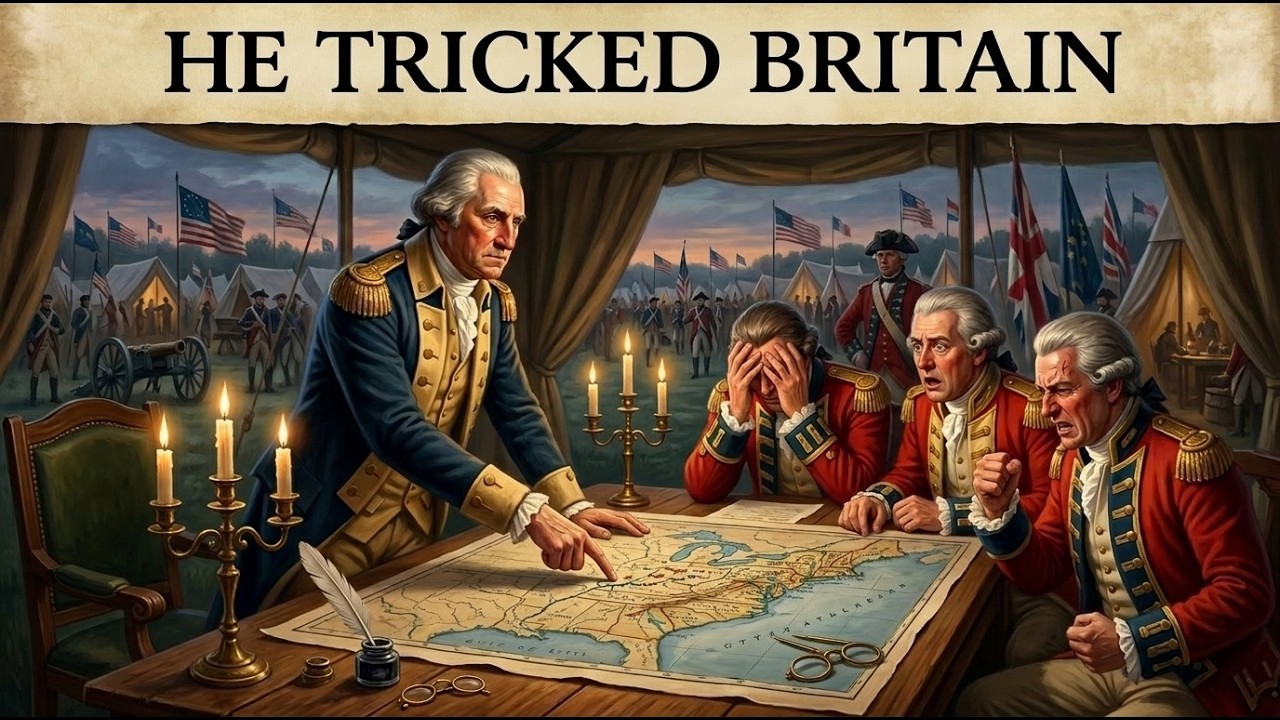
Washington needed Clinton to believe with total conviction that New York City was the real target. So Washington launched what might be the greatest military deception of the entire 18th century. He ordered the construction of a massive fake camp in northern New Jersey, complete with brick bread ovens large enough to feed an army of thousands. He had his troops build boats along the New Jersey shore, arranged as if preparing for an amphibious crossing to Manhattan.
He wrote detailed attack plans for a full assault on New York and made sure British spies intercepted them. He even marched French troops in conspicuous formations toward New York’s outer defenses where British scouts could observe and report them. Clinton swallowed the deception completely. He pulled every available soldier tight around New York and prepared to defend against a major amphibious assault.
Meanwhile, Washington’s real army, combined with roughly 4,000 French regulars under General Rochambeau, was racing south toward Virginia at a speed that seemed impossible for the era. They covered the full distance in just a few weeks, passing through New Jersey, Pennsylvania, Delaware, and Maryland before swinging into Virginia. By the time Clinton finally realized New York was never the target, Cornwallis was already surrounded. And there was one more piece of the trap.
French Admiral Francois Joseph Paul de Grasse had sailed 28 warships from the Caribbean into the Chesapeake Bay, sealing off Yorktown from any hope of British naval rescue. When a British relief fleet of 19 ships under Admiral Thomas Graves finally arrived from New York, de Grasse sailed out and engaged them in the Battle of the Virginia Capes on September 5th, 1781. The French battered the British squadron badly enough that Graves retreated to New York for repairs. Cornwallis was now completely sealed on the Yorktown peninsula with no escape by land or by sea.
The siege lasted about three weeks, and it was methodical, relentless, and brutal. Washington’s combined force of over 17,000 American and French troops set up a semicircle of heavy artillery around the British fortifications and began bombarding them around the clock. The noise was constant, day and night. Cannon fire tore into the British earthworks, smashing fortifications that had taken weeks to build.
French siege engineers, the best in Europe, directed the construction of parallel trenches that crept closer and closer to the British lines. Each new trench brought the American and French guns within more devastating range. The British fired back, but they were outgunned and they knew it. Inside the Yorktown defenses, conditions deteriorated rapidly.
Cornwallis ordered hundreds of horses slaughtered and thrown into the York River because he could not spare the feed. His soldiers were running low on ammunition and food. Disease was spreading through the cramped fortifications. Desertion became a daily occurrence as men slipped away under cover of darkness, preferring the risk of capture to the certainty of continued bombardment.
On the night of October 14th, the Allied forces launched their most critical assault. Two columns charged key British defensive positions, called redoubts, in fierce hand-to-hand combat. French soldiers attacked redoubt nine, fighting through sharpened wooden stakes called abatis before overwhelming the garrison. The second column, led by a young colonel named Alexander Hamilton, who had been practically begging Washington for a field command for years, stormed redoubt 10.
Washington ordered the attack carried out with unloaded muskets to maintain silence and speed. Hamilton’s men climbed the earthen walls and took the position in under ten minutes using only bayonets. The capture of those two redoubts allowed Washington to extend his trenches even closer and bring his artillery to point-blank range. Two days later, Cornwallis attempted one final desperate gamble.
He tried to evacuate his remaining forces across the York River at night, hoping to break out to the north and link up with other British units. The first boats made it across successfully, but then, as if the weather itself had chosen a side, a sudden violent storm swept across the river. Wind and rain scattered the remaining boats and drove his half-evacuated army back to the Virginia shore. Whatever slim hope Cornwallis had left disappeared with that storm.
On October 17th, 1781, a single British drummer boy appeared on the ramparts of the battered Yorktown fortifications and began beating for a parley. The guns fell silent. Two days later, on October 19th, over 7,000 British soldiers marched out of their ruined positions and laid down their weapons in a field between the American and French lines. According to tradition, the British band played a tune called The World Turned Upside Down during the surrender ceremony.
Some historians debate whether that specific detail is accurate, but the symbolism could not be more fitting. When news of Yorktown reached London, British Prime Minister Lord Frederick North reportedly paced the room, repeating the words: “It is all over. ” He was right. The total humiliation of the British Empire at the hands of underfunded, under-equipped colonial rebels was the direct result of Washington’s strategy from the very first day he took command.
He did not win by being a superior battlefield tactician. He lost more battles than he won. He lost New York. He lost Philadelphia.
He lost nearly every major city the British wanted. But he understood that the war was never about holding ground. It was about endurance, deception, and making the British pay so dearly for every mile that their own people eventually refused to keep paying. Washington turned weakness into doctrine.
He turned retreat into a weapon. He turned a freezing river on Christmas night into the moment that saved a revolution from dying. He turned a network of shopkeepers and farmers into one of the most effective intelligence operations of the century. And he turned a small tobacco port in Virginia into the trap that shattered an empire’s hold on the American colonies forever.
The British came to fight a conventional war. Washington gave them a ghost who would not stand still, who struck when they slept, who fed them lies they believed completely, and who vanished every time they tried to corner him. By the time they finally understood what he was doing, Cornwallis was already handing over his sword at Yorktown.